The Command Structure Behind Federal Control of Lawful Medicine
Most Americans know the Drug Enforcement Administration through its public image: raids, seizures, cartels, counterfeit pills, street narcotics, and international trafficking organizations.
That is only one side of the agency.
Inside the DEA is a regulatory and investigative structure devoted to substances that begin inside the law. These medicines are manufactured by licensed companies, shipped by registered distributors, stocked by pharmacies, prescribed by physicians, administered in hospitals, studied by researchers, and ultimately received by patients.
The federal machinery governing that lawful channel is the Diversion Control Division.
The DEA describes the division’s mission as preventing, detecting, and investigating the diversion of controlled pharmaceuticals and listed chemicals while also ensuring an adequate and uninterrupted supply for legitimate medical, scientific, and commercial needs. That dual responsibility places the division between two competing obligations: preventing controlled substances from leaving lawful channels while preserving the standard of care through the lawful supply upon which medicine depends.
This page identifies the publicly visible command structure surrounding that responsibility. Each named official is linked to an individual page examining the person’s official role, public statements, institutional authority, connection to Diversion Control, and importance to patients dependent upon lawful medicine.
The Direct Chain of Command
The Diversion Control Division does not operate outside the DEA. It sits within the agency’s national command structure.
The clearest publicly documented line of authority is:
Terrance C. “Terry” Cole
Administrator
↓
Daniel Salter
Principal Deputy Administrator
↓
Cheri Oz
Assistant Administrator
Diversion Control Division
That is the central spine of the hierarchy.
Other senior officials lead the administrative, operational, intelligence, and inspection components that surround the division. Their offices influence how Diversion Control is supported, informed, coordinated, evaluated, and investigated, but the direct public chain begins with Cole, passes through Salter, and reaches Oz.
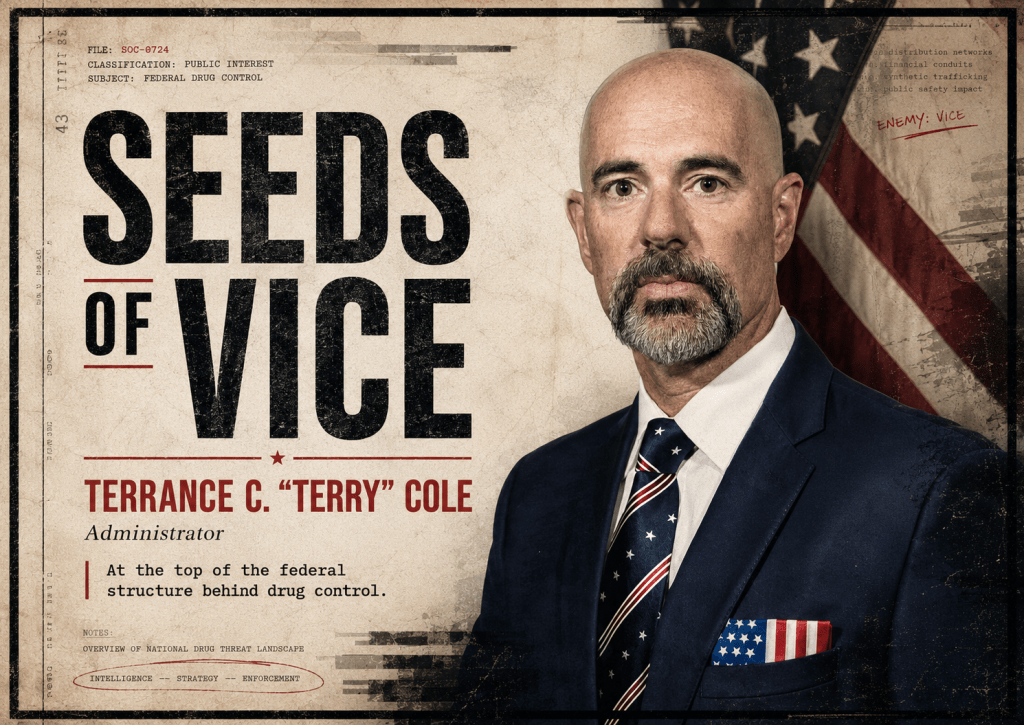
Terrance C. “Terry” Cole
Administrator
Terrance C. “Terry” Cole is the Administrator of the Drug Enforcement Administration. He was sworn into office on July 23, 2025, after confirmation by the United States Senate. As Administrator, Cole stands at the top of the agency and carries ultimate executive responsibility for the DEA’s divisions, personnel, priorities, enforcement posture, and use of delegated federal authority.
For Diversion Control, his importance is not merely ceremonial.
The division acts through authority delegated within the DEA. Its registration systems, production quotas, investigations, regulatory actions, administrative proceedings, and supply chain policies all exist beneath the Administrator’s command. Cole may not personally review every registration, inspection, quota decision, or administrative case, but the system acts under the agency he leads.
His place in this project is therefore straightforward: he is the highest publicly accountable official in the command structure.
Daniel Salter

Principal Deputy Administrator
Daniel Salter serves as the DEA’s Principal Deputy Administrator and second in command.
The DEA expressly states that Salter oversees several of its most consequential components, including the Forensic Sciences Division, Operations Division, Intelligence Division, Inspection Division, and Diversion Control Division. The agency describes these portfolios as touching every part of its enforcement mission, including efforts to prevent diversion and protect the pharmaceutical supply chain.
That makes Salter the most important official between the Administrator and the Diversion Control Division.
Cole leads the agency. Oz leads the division. Salter occupies the position connecting them.
When Diversion Control priorities compete with other institutional priorities, when headquarters resources are allocated, when enforcement and regulatory operations must be coordinated, or when the division’s conduct becomes an agency level concern, the Principal Deputy Administrator is positioned directly within that chain.
He should not be treated as a distant administrative name. According to DEA’s own description, Diversion Control is part of his assigned portfolio.
Cheri Oz

Assistant Administrator, Diversion Control Division
Cheri Oz is the Assistant Administrator of the Diversion Control Division. She was appointed to that position in November 2025.
DEA identifies Oz as the principal adviser to the Administrator on the regulation and coordination of programs safeguarding the controlled prescription drug and listed chemical supply chain. Her publicly described responsibilities include authorizing controlled substance handling for approximately 2.2 million registrants, coordinating major pharmaceutical and chemical diversion investigations, developing regulations, establishing production quotas, and conducting liaison with industry, governments, and law enforcement partners.
Oz is therefore the center of this structure.
The Administrator possesses the highest authority. The Principal Deputy provides agency level oversight. But the Assistant Administrator directs the specialized division through which federal control reaches the lawful medicine system.
Registration passes through this structure… As do quotas, regulatory interpretation, diversion investigations, and the controlled substance supply chain.
For us, Oz is not important because she should be reduced to a symbol or portrayed as a cartoon antagonist. She is important because her office has identifiable authority over decisions and programs that can reach from a federal headquarters building into a factory, distribution center, pharmacy, medical office, hospital room, and patient’s life.
The Senior Leadership Surrounding Diversion Control
The following officials are not all direct supervisors of the Assistant Administrator. They lead parallel components of the DEA whose work can surround, support, inform, inspect, or intersect with the Diversion Control Division.
The DEA’s public leadership roster currently identifies Gary Owen, Timothy S. Flaherty, Matthew W. Allen, Cheri Oz, and James L. Collins as the heads of major agency components.
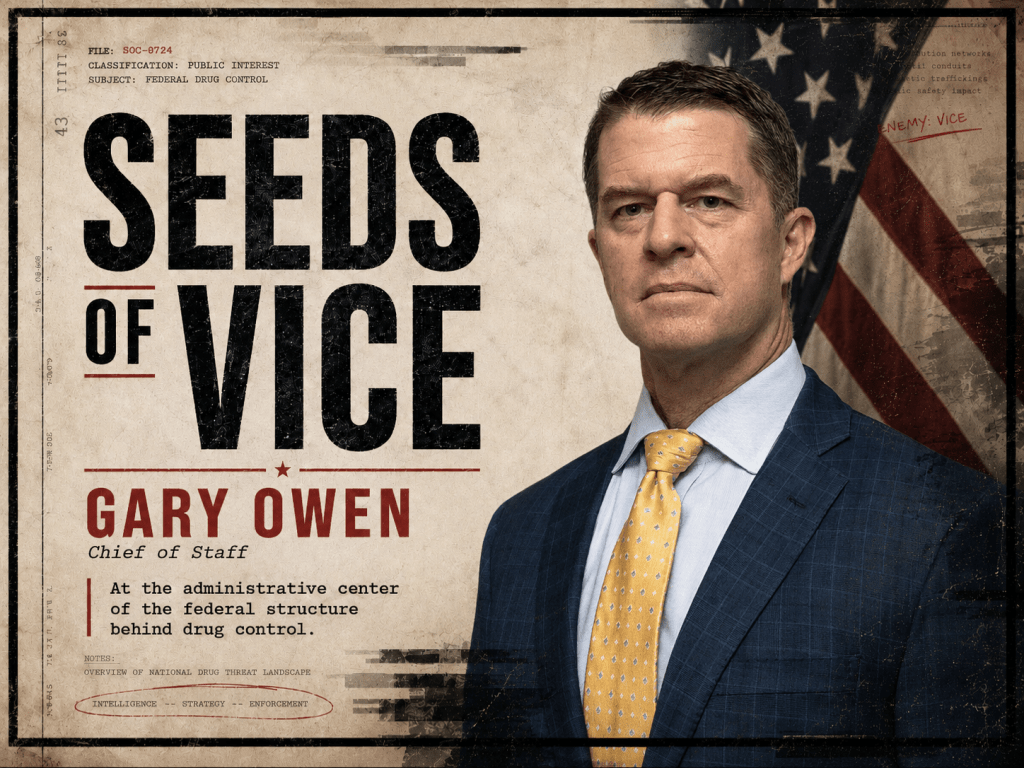
Gary Owen
Associate Administrator
Gary Owen serves as Associate Administrator and leads the DEA’s administration component.
Administration is the institutional machinery behind the operational machinery. Personnel, resources, internal support, organizational capacity, technology, and agency management determine what a division can actually do. An office may possess broad legal authority, but that authority becomes usable through staffing, budgets, systems, training, and administrative infrastructure.
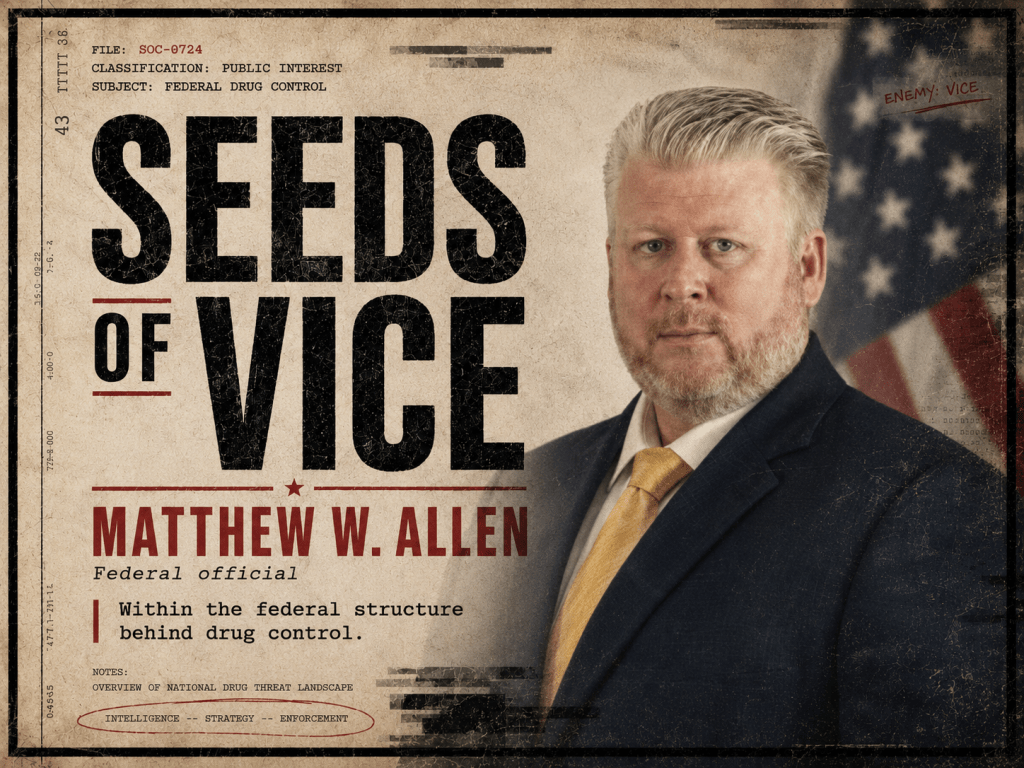
Matthew W. Allen
Chief of Operations
Matthew W. Allen serves as the DEA’s Chief of Operations.
The Operations Division represents the broader operational posture of the DEA. Diversion investigations may involve lawful registrants, nonregistrant criminal enterprises, pharmaceutical trafficking, coordinated enforcement operations, task forces, and matters crossing between the regulated and illicit markets.
Allen’s importance lies in the intersection between Diversion Control and the DEA’s larger enforcement apparatus. When a regulatory matter becomes a criminal investigation, or when a diversion case requires broader operational coordination, the boundary between the two components can narrow quickly.
James L. Collins

Chief of Intelligence
James L. Collins serves as Chief of Intelligence.
Drug control depends upon information: prescribing data, shipment records, suspicious orders, production figures, registration histories, investigative reports, regional trends, intelligence assessments, and referrals from other institutions.
Intelligence helps determine what the agency sees, what it treats as a threat, where it directs attention, and which patterns become the basis for greater scrutiny. Although the Intelligence Division and Diversion Control Division remain separate components, their functions can intersect whenever data and institutional analysis are used to direct investigations or identify suspected diversion.
Timothy S. Flaherty

Chief Inspector
Timothy S. Flaherty serves as Chief Inspector and leads the DEA’s Inspection Division.
The Inspection Division provides an internal accountability function. It exists on the agency side of the structure rather than the registrant side. Its significance is therefore different from that of Diversion Investigators inspecting pharmacies, clinics, distributors, or manufacturers.
Flaherty’s office matters because any powerful regulatory and investigative system must itself be examined. When questions arise about compliance with agency policy, internal conduct, program administration, or institutional performance, the Chief Inspector occupies a central accountability position.
Inside the Diversion Control Division
The public facing mission of Diversion Control can be divided into several major functions:
Registration determines who may lawfully manufacture, distribute, prescribe, dispense, research, import, export, or otherwise handle controlled substances.
Compliance evaluates whether registrants continue to satisfy federal requirements.
Quotas govern how much of certain controlled substances may be produced for medical, scientific, research, industrial, export, and reserve-stock needs.
Inspections examine records, security, inventories, dispensing practices, and other regulated activities.
Investigations examine suspected violations by registrants and nonregistrants involved in pharmaceutical or chemical diversion.
Rulemaking and scheduling support help transform statutes and executive policy into regulations, classifications, procedures, and binding administrative systems.
Administrative actions can affect whether a registrant may obtain, retain, surrender, restrict, or lose the federal registration necessary to handle controlled substances.
These are not merely clerical functions. Together, they determine who may participate in the lawful controlled substance system, under what conditions participation is allowed, how much medicine enters the system, and what happens when the DEA concludes that a registrant no longer serves the public’s best interest.
From Headquarters to the Field
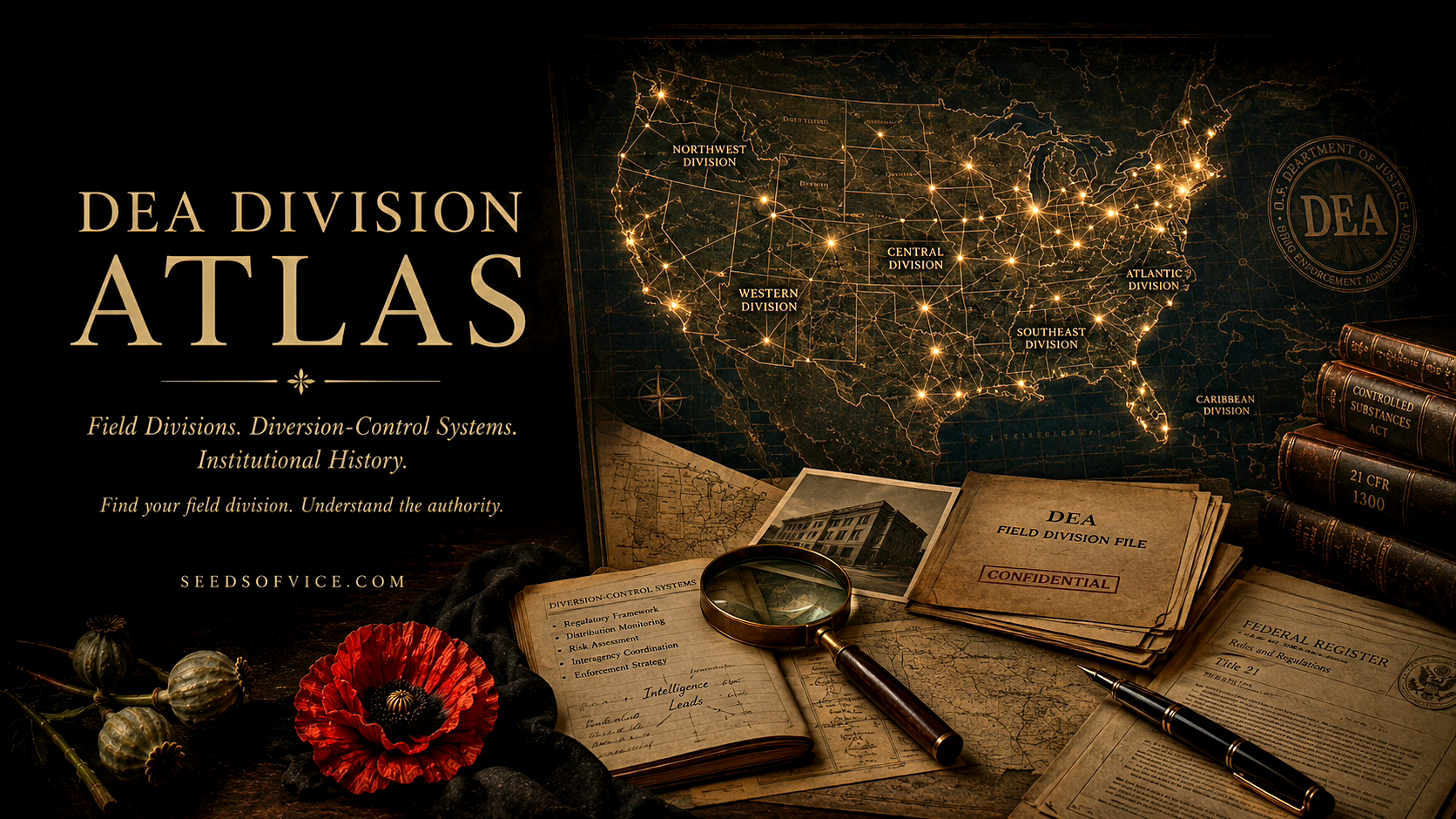
Headquarters establishes national policy and work plans, but the system reaches the country through DEA field divisions.
The DEA currently reports 241 domestic offices organized within 23 domestic divisions. Within those divisions, local Diversion Control work may involve:
Special Agents in Charge, who oversee the larger field division;
Diversion Program Managers, who lead regional diversion programs;
Diversion Group Supervisors, who direct individual groups;
Diversion Investigators, who conduct regulatory and investigative work;
Tactical Diversion Squads, which combine diversion expertise with criminal enforcement capabilities;
Task Force Officers, who bring state and local personnel into coordinated operations; and
Registration Program Specialists, who process and review applications.
A July 2026 Justice Department Inspector General audit reported that, as of July 2025, 81 Registration Program Specialists were distributed among the 23 field divisions. The audit described those specialists as checking applications, state licenses, addresses, liability responses, background information, and other registration requirements. Matters containing derogatory information may be referred to Diversion Investigators for further review.
The same audit reported that DEA headquarters develops annual work plans for scheduled investigations performed by Diversion Investigators in the field. It also stated that the division had fewer than 700 Diversion Investigators responsible for oversight involving more than 1.9 million medical practitioners as of April 2025.
The names of these lower level officials are not maintained by the DEA in one complete, stable public national roster. Individual Diversion Program Managers, supervisors, investigators, specialists, and task force personnel sometimes appear in press releases or public events, but personnel change and many names are never published.
The Regulated Chain
Federal registration requirements extend across the controlled substance supply chain. Businesses that import, export, manufacture, or distribute controlled substances must register. So must health professionals authorized to prescribe, administer, or dispense them, along with pharmacies authorized to fill controlled substance prescriptions.
The regulated field therefore includes:
Manufacturers
Distributors
Pharmacies
Hospitals
Clinics
Physicians
Dentists
Veterinarians
Nurse practitioners
Physician assistants
Researchers
Teaching institutions
Analytical laboratories
Importers
Exporters
Narcotic treatment programs
Other registered handlers of controlled substances
Patients generally are not DEA registrants. They occupy the final position downstream.
They do not establish production quotas, write federal regulations, design annual investigation plans, determine registration policy… They do not decide whether a physician, clinic, pharmacy, distributor, or manufacturer will face greater scrutiny.
Yet patients experience the final consequences of decisions made throughout the structure.
A restriction imposed at the manufacturing level can become a shortage.
Pressure applied to distributors can become reduced pharmacy inventory.
Pressure applied to pharmacies can become an unfilled prescription.
Pressure applied to physicians can become undertreatment, refusal, forced tapering, or the disappearance of willing prescribers… All of which are daily lived realities for millions.
Why This Hierarchy Matters
Street enforcement is only one face of federal drug control.
Diversion Control governs permission within the lawful system: permission to manufacture, permission to distribute, permission to prescribe, permission to dispense, permission to research, permission to import, and permission to remain registered… permission to fill a prescription.
Its officials do not need to enter a patient’s home to affect that patient’s medicine. They can act farther upstream, where rules, quotas, registrations, investigations, institutional warnings, and administrative pressures shape what will be available by the time the patient reaches the pharmacy counter. They can and they do.
That is the structure I intend to document.
Not through cheap accusations.
Not through invented motives.
Not by calling public servants criminals merely because they exercise power.
The DEA Diversion Divisions
Atlanta Division

Caribbean Division

Chicago Division

Dallas Division

Detroit Division

El Paso Division

Houston Division

Los Angeles Division

Louisville Division

Miami Division

New England Division

New Jersey Division

New Orleans Division

New York Division

Omaha Division

Philadelphia Division

Phoenix Division

Rocky Mountain Division

San Antonio Division

San Diego Division

San Francisco Division

Seattle Division

St. Louis Division

Tampa Division

Washington, DC Division


