The Chicago Division
DEA Chicago Division
Last fully verified: July 24, 2026
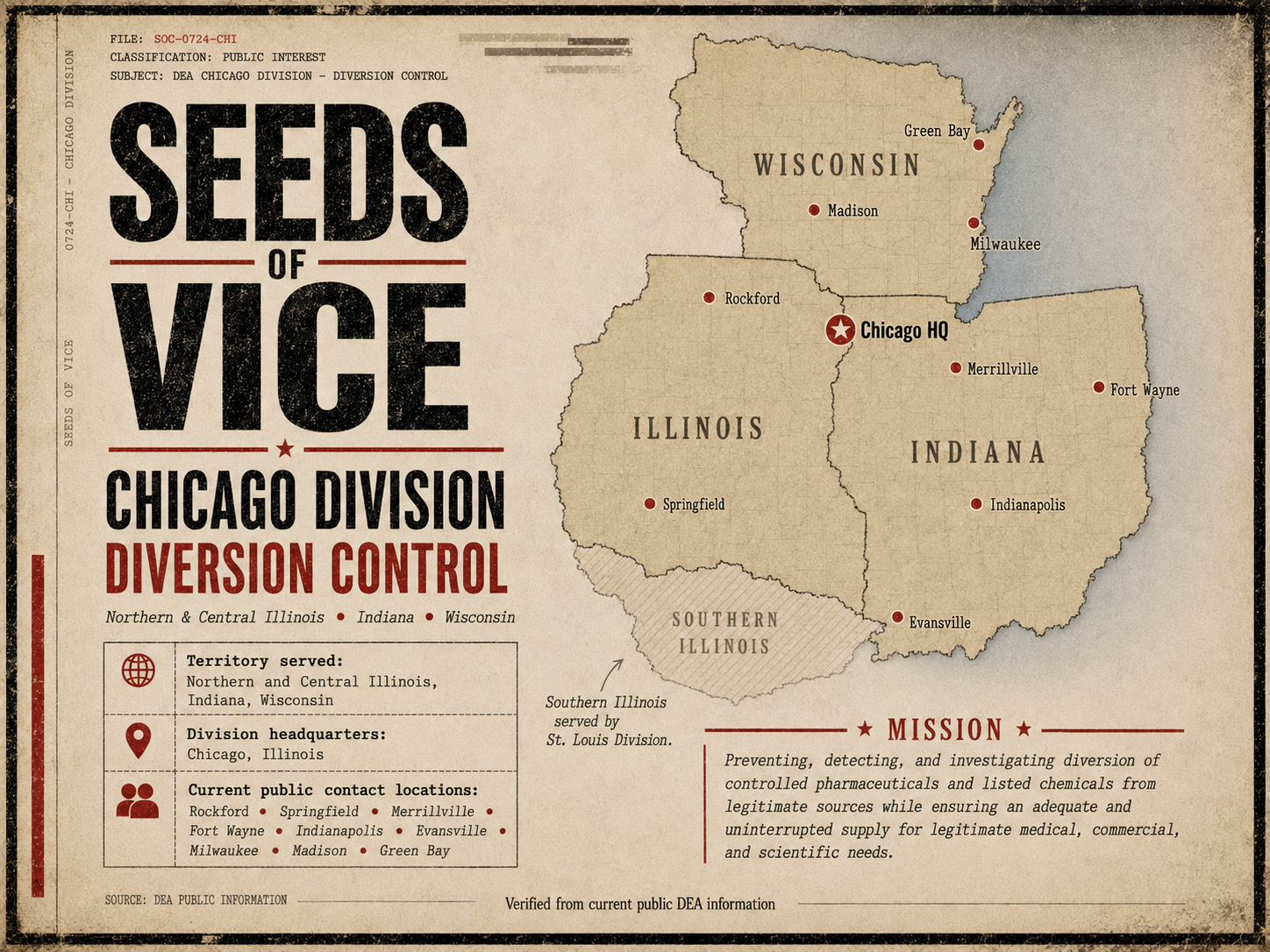
The Drug Enforcement Administration’s Chicago Division serves Illinois, Indiana, and Wisconsin.
Its jurisdiction contains one of the country’s largest metropolitan centers, extensive rural territory, major interstate transportation corridors, international airports, pharmaceutical distribution networks, hospitals, medical schools, pharmacies, manufacturers, and thousands of practitioners authorized to handle controlled substances.
The division’s responsibilities extend far beyond Chicago itself. DEA publicly lists contact locations in Rockford and Springfield, Illinois; Evansville, Fort Wayne, Indianapolis, and Merrillville, Indiana; and Green Bay, Madison, and Milwaukee, Wisconsin. Its headquarters is located in downtown Chicago.
The Chicago Division investigates illegal drug trafficking, money laundering, violent organizations, and transnational criminal networks. It also administers and enforces the federal controlled-substance system governing lawful manufacturers, distributors, pharmacies, hospitals, prescribers, researchers, and other DEA registrants.
This page concerns that lawful system.
It explains who presently leads the division, which personnel and offices are publicly identified, how diversion control is organized in the region, what authority belongs to DEA, how federal and state systems overlap, what enforcement looks like in practice, and what the available prescribing data can—and cannot—prove about lawful medicine in Illinois, Indiana, and Wisconsin.
The Name Matters
The official regional organization is the DEA Chicago Division.
It is not formally named the “Chicago Diversion Division.”
The Chicago Division is one of DEA’s regional field divisions. It carries out multiple enforcement missions, including but not limited to pharmaceutical diversion control.
The national Diversion Control Division, by contrast, is an operational component within DEA headquarters. It administers national programs involving controlled-substance registration, regulation, production quotas, imports and exports, distribution monitoring, listed chemicals, regulatory policy, and major diversion investigations.
The two organizations are connected, but they are not interchangeable.
National DEA components establish many of the rules and priorities under which the controlled-substance system operates. Chicago Division personnel implement and enforce portions of that system within Illinois, Indiana, and Wisconsin.
The Chicago Division does not independently establish national production quotas, write the Controlled Substances Act, create CDC clinical recommendations, or determine the medical standard of care throughout the United States.
Its personnel can, however, inspect registrants, examine records, investigate suspected diversion, work with state licensing and law-enforcement agencies, execute warrants, support administrative proceedings, and refer cases for civil or criminal prosecution.
Responsibility must therefore be assigned with precision. National policies should not be attributed solely to one field division, but a field division should not be treated as irrelevant when it exercises federal authority over the lawful medical channel.
Who This Division Serves
The Chicago Division serves the people and federally registered controlled-substance handlers of three states.
Illinois
Illinois contains the division headquarters and publicly listed DEA contact locations in Chicago, Rockford, and Springfield.
Chicago is the largest population center within the division and an important transportation, healthcare, pharmaceutical, and commercial hub. The city also contains the Chicago High Intensity Drug Trafficking Area program and numerous federal, state, county, and municipal law-enforcement partners.
Indiana
DEA publicly lists contact locations in Evansville, Fort Wayne, Indianapolis, and Merrillville.
Official DEA releases identify the Indianapolis and Merrillville locations as district offices. Merrillville serves northwestern Indiana near the Chicago metropolitan region, while Indianapolis represents a central operational location for the state.
Wisconsin
DEA publicly lists contact locations in Green Bay, Madison, and Milwaukee.
Official DEA records identify Milwaukee as a district office. The office network places federal personnel within southeastern Wisconsin while maintaining public contact points in the state capital and northeastern Wisconsin.
The division’s territory is not medically uniform. Chicago, Indianapolis, Milwaukee, rural Illinois, northern Wisconsin, and southern Indiana differ considerably in hospital density, transportation, prescriber availability, pharmacy access, population health, insurance coverage, and local medical infrastructure.
A single regional enforcement command therefore operates across numerous distinct healthcare environments.
Headquarters
The Chicago Division headquarters is publicly listed at:
DEA Chicago Division
230 South Dearborn Street
Suite 1200
Chicago, Illinois 60604-1745
Main telephone: (312) 353-7875
The headquarters coordinates division-wide operations and serves as the primary public contact for the Chicago Division.
Current Leadership
Todd C. Smith
Special Agent in Charge
As of July 24, 2026, Todd C. Smith is the publicly identified Special Agent in Charge of the DEA Chicago Division.
Smith began his federal law-enforcement career with United States Customs and Border Protection in 2002. He entered DEA’s academy in 2004 and was assigned to a Chicago High Intensity Drug Trafficking Area group, where he worked with Chicago Police Department personnel on gang and drug-trafficking investigations.
DEA states that Smith later investigated international drug-trafficking and money-laundering organizations connected to Mexican cartels. In 2012, he became a group supervisor of a financial investigative team that used court-authorized wiretaps and other investigative methods against organizations associated with the Sinaloa Cartel. Those investigations resulted in seizures, indictments, and extraditions.
In 2018, Smith transferred to DEA headquarters and worked within the Operations Division on matters involving Mexico, Central America, and Canada. He also served as DEA’s liaison to the Department of Defense Narcotics and Transnational Crime Support Center.
In 2019, he became executive assistant to DEA’s Chief of Operations.
Smith returned to the Chicago Division in June 2020 as an Assistant Special Agent in Charge. In November 2021, he assumed responsibility for enforcement groups targeting transnational criminal organizations. DEA Administrator Terrance Cole appointed him Deputy Special Agent in Charge in August 2025 and Special Agent in Charge in January 2026.
Smith holds a bachelor’s degree in criminal justice from Michigan State University and has received multiple DEA and interagency awards.
His published biography is primarily an illicit-trafficking and organizational-leadership biography. It does not present him as a physician, pharmacist, epidemiologist, or specialist in pain medicine.
That distinction does not diminish his legal authority. It defines the perspective from which that authority is exercised.
An Important Official-Record Discrepancy
DEA’s current English-language Chicago Division page identifies Todd C. Smith as Special Agent in Charge. His official biography also documents his January 2026 appointment.
DEA’s Spanish-language Chicago Division page, however, still states that the division is led by Robert J. Bell. It repeats that outdated leadership information while displaying several current office contacts.
The stronger and more recent official record establishes Smith as the current leader.
The contradictory page should nevertheless be documented rather than silently disregarded.
When a federal agency publishes conflicting leadership information, the responsible method is to compare appointment records, current biographies, dated releases, and repeated contemporary references. An official website is evidence, but the word “official” does not guarantee that every page was updated at the same time.
That discrepancy also matters institutionally. DEA requires controlled-substance registrants to maintain accurate records. The public is entitled to expect similar care in DEA’s own public-facing information.
Publicly Identified Personnel
DEA does not publish a complete roster of Chicago Division special agents, diversion investigators, intelligence analysts, task-force officers, supervisors, attorneys, or administrative personnel.
Seeds of Vice will not manufacture such a roster from old releases, social-media profiles, commercial people-search databases, or assumptions based on previous assignments.
The following individuals are included because DEA currently identifies them in official public records.
John McGarry
Assistant Special Agent in Charge — Milwaukee District Office
Recent official DEA records identify John McGarry as the Assistant Special Agent in Charge of the Milwaukee District Office. His position places him among the senior publicly identified officials responsible for DEA operations in Wisconsin.
Alfred “Chip” Cooke
Assistant Special Agent in Charge — Merrillville District Office
DEA has publicly identified Alfred “Chip” Cooke as the Assistant Special Agent in Charge of the Merrillville District Office in northwestern Indiana.
Gerald C. Dooley
Assistant Special Agent in Charge — Indianapolis District Office
DEA has publicly identified Gerald C. Dooley as the Assistant Special Agent in Charge of the Indianapolis District Office.
These three names document publicly identified district-office leadership. They do not constitute the complete command structure of the Chicago Division.
Luis Agostini
Media Inquiries
DEA lists Luis Agostini as the Chicago Division’s media contact.
Telephone: (312) 353-7875
Jonathan Woods
Special Agent Recruitment
DEA identifies Special Agent Jonathan Woods as the Chicago Division recruitment contact.
Email: chicagospecialagentrecruiter@dea.gov
Fidel Arroyo Jr.
Community Outreach
DEA identifies Fidel Arroyo Jr. as the Chicago Division’s community-outreach contact.
Telephone: (872) 222-0430
Email: Fidel.ArroyoJr@dea.gov
Community outreach is distinct from diversion investigation. Outreach personnel generally work with schools, organizations, prevention programs, community groups, and other public stakeholders. Their public role should not be confused with command of diversion groups or authority over individual prescribing investigations.
Public Contact Locations
DEA currently publishes the following regional contacts.
Illinois
Chicago Headquarters
(312) 353-7875
Rockford
(815) 987-4494
Springfield
(217) 585-2750
Indiana
Evansville
(812) 465-6457
Fort Wayne
(260) 420-4018
Indianapolis
(571) 362-4707
Merrillville
(219) 681-7000
Wisconsin
Green Bay
(920) 492-4907
Madison
(608) 210-4300
Milwaukee
(414) 336-7300
DEA’s public page does not clearly classify every listed location as a district office, resident office, post of duty, satellite office, or other organizational unit.
Accordingly, this page calls them publicly listed contact locations except where a separate official record explicitly identifies the office classification.
A telephone listing establishes a public point of contact. It does not by itself establish the location’s staffing level, precise organizational rank, geographic boundaries, or internal chain of command.
Diversion-Control Infrastructure
Diversion control inside the Chicago Division is not confined to one office or one investigative group.
DEA publicly identifies Tactical Diversion Squads in:
- Chicago, Illinois
- Springfield, Illinois
- Indianapolis, Indiana
- Milwaukee, Wisconsin
A Tactical Diversion Squad is an enforcement-oriented unit combining DEA personnel with participating federal, state, and local agencies.
DEA describes these squads as designed to investigate, disrupt, and dismantle organizations or individuals suspected of violating the Controlled Substances Act or other laws related to pharmaceutical diversion. They bring together different agencies’ intelligence, legal authorities, investigative programs, and local knowledge.
Tactical Diversion Squads can also provide capabilities that a traditional regulatory group may not routinely possess. DEA specifically identifies activities such as:
- Physical surveillance
- Controlled purchases of evidence
- Recruitment and management of confidential sources
- Payment of informants
- Arrest operations
- Search-warrant execution
- Evidence seizures
- Coordination across federal judicial districts
This structure is important.
Diversion control may begin with records, inventories, prescriptions, suspicious orders, registration issues, or professional conduct. Once investigators believe the evidence supports criminal activity, the investigation can move beyond regulatory review into the methods commonly associated with narcotics enforcement.
That does not mean every inspection becomes a criminal case.
It means the system has the capacity to move from administrative scrutiny to coercive criminal enforcement.
Traditional Diversion Groups and Tactical Squads
Traditional diversion investigators and Tactical Diversion Squads perform overlapping but distinguishable functions.
Diversion investigators are regulatory specialists. Their work can involve:
- DEA registration
- Compliance inspections
- Controlled-substance inventories
- Ordering and distribution records
- Theft and loss reports
- Suspicious-order systems
- Prescription records
- Security requirements
- Administrative cases
- Interviews with registrants
- Coordination with licensing authorities
Tactical squads add law-enforcement personnel and criminal-investigative capabilities.
The existence of both models reflects the unusual nature of diversion control. It governs a lawful commercial and medical system, but suspected violations can result in administrative sanctions, civil penalties, professional consequences, or criminal prosecution.
A hospital, pharmacy, practitioner, distributor, or employee may therefore encounter diversion control through very different pathways depending upon the suspected conduct and available evidence.
The Federal and State Layers
The Chicago Division does not operate alone.
Controlled-substance practice in Illinois, Indiana, and Wisconsin is governed through overlapping federal and state systems.
A practitioner may need:
- A professional license
- State controlled-substance authority
- DEA registration
- Compliance with state prescribing laws
- Compliance with federal prescribing rules
- Participation in or consultation of a prescription-monitoring system
- Hospital or health-system credentials
- Pharmacy acceptance
- Insurance approval
- Compliance with professional-board expectations
These requirements come from different institutions.
They should not all be attributed to DEA.
They should also not be treated as unrelated when their combined effect determines whether a patient can obtain medicine.
Illinois Prescription Monitoring Program
The Illinois Prescription Monitoring Program collects information concerning controlled-substance prescriptions in Schedules II through V. Illinois requires retail pharmacies to report dispensing information daily.
Illinois law also generally requires prescribers to document an attempt to check the monitoring program when issuing an initial prescription for a Schedule II narcotic, subject to statutory exceptions.
The Illinois monitoring program is a state system.
DEA may use lawfully available prescription and investigative information in appropriate cases, but the state program should not be mislabeled as a DEA database.
The distinction matters because a practitioner may be influenced simultaneously by Illinois law, professional-board expectations, institutional policies, and federal controlled-substance authority.
Indiana INSPECT
Indiana’s prescription-monitoring system is known as INSPECT.
The system produces reports showing controlled-substance prescriptions, the prescribers involved, and the pharmacies that dispensed them. Indiana describes INSPECT as both a clinical information resource and an investigative tool for authorized law-enforcement use. Reporting was expanded to cover Schedules II through V and generally operates on a rapid reporting schedule.
Indiana also maintains a state controlled-substance registration structure that interacts with eligibility for federal DEA registration.
This illustrates the layered nature of permission.
A federal registration does not replace state authority. State authority does not replace federal registration. The practitioner must remain acceptable to multiple institutions.
Wisconsin Enhanced Prescription Drug Monitoring Program
Wisconsin operates an enhanced Prescription Drug Monitoring Program commonly referred to as the ePDMP.
Wisconsin describes the system as a source of monitored prescription-drug information intended to support safer prescribing and dispensing decisions and to facilitate appropriate collaboration among healthcare professionals, pharmacies, public-health authorities, and law enforcement.
As in Illinois and Indiana, the Wisconsin program is administered at the state level.
The existence of state databases does not remove DEA from the system. It means federal registration and enforcement operate alongside state monitoring, state licensing, professional discipline, healthcare institutions, and pharmacy practice.
The Official Mission
DEA’s Diversion Control Division states that its mission is to prevent, detect, and investigate the diversion of controlled pharmaceuticals and listed chemicals from legitimate sources while ensuring an adequate and uninterrupted supply for legitimate medical, commercial, and scientific needs.
That mission has two parts.
Prevent Diversion
DEA is responsible for protecting the lawful controlled-substance channel from:
- Theft
- Fraud
- Prescription forgery
- Record falsification
- Illicit prescribing
- Unlawful dispensing
- Employee diversion
- Improper distribution
- Suspicious ordering
- Security failures
- Other unlawful transfers
Preserve Legitimate Supply
DEA is also responsible for ensuring that controlled substances remain available for legitimate purposes.
Those purposes include:
- Medical care
- Surgery
- Emergency medicine
- Cancer treatment
- Palliative care
- Veterinary medicine
- Scientific research
- Pharmaceutical manufacturing
- Other lawful commercial uses
The mission is not written as “prevent diversion regardless of the medical consequences.”
It is a balancing obligation.
Neither half should be omitted when evaluating the institution.
The Closed System of Distribution
Federal controlled-substance law operates through what DEA calls a closed system of distribution.
Businesses that import, export, manufacture, or distribute controlled substances generally must register with DEA. Healthcare professionals who prescribe, administer, or dispense controlled substances, together with pharmacies and other lawful handlers, also operate within the federal registration system. Registrants must comply with applicable security, inventory, ordering, reporting, and recordkeeping requirements.
The system is “closed” because lawful controlled substances are intended to move only among authorized participants until they reach an ultimate user or another legally permitted destination.
DEA registration is therefore not a ceremonial document.
It is the federal permission that allows many practitioners and businesses to participate in the controlled-substance channel.
A physician may possess a state medical license but still require DEA registration to prescribe federally controlled substances.
A pharmacy may be licensed by a state but still require DEA authority to handle controlled drugs.
A distributor’s continued operation depends on federal registration, security, records, and monitoring.
A hospital depends on registered suppliers, registered pharmacies, authorized practitioners, and functioning distribution networks.
The closed system reaches the patient indirectly through every authorized participant standing between manufacturing and medical use.
What the Chicago Division Can Do
Within its jurisdiction, Chicago Division personnel can investigate suspected violations of federal controlled-substance law.
Depending on the facts and the type of case, DEA can:
- Conduct regulatory inspections
- Review controlled-substance records
- Audit inventories
- Examine ordering patterns
- Investigate thefts and losses
- Interview registrants and employees
- Use subpoenas and other lawful process
- Work with state licensing boards
- Coordinate with police and prosecutors
- Use confidential sources
- Conduct surveillance
- Execute search and arrest warrants
- Seize evidence
- Seek administrative action against a registration
- Refer civil or criminal matters for prosecution
The precise authority and procedure depend upon the investigation, legal process, and personnel involved.
What the Chicago Division Does Not Do
The Chicago Division does not independently practice medicine.
Its agents and diversion investigators do not ordinarily examine a patient, diagnose the cause of pain, perform surgery, monitor functional improvement, determine the patient’s tolerance, or assume the clinician’s ongoing duty of care.
DEA does not issue medical licenses. State licensing boards decide who is professionally licensed. Health systems decide who receives credentials. Insurers decide what they will pay for. Pharmacies make dispensing decisions. Practitioners retain responsibilities under medical ethics and state law.
The Chicago Division also does not bear sole responsibility for every medication reduction, refused prescription, pharmacy denial, involuntary taper, or untreated patient in Illinois, Indiana, and Wisconsin.
Many institutions can contribute to those outcomes.
DEA nevertheless holds a distinct federal responsibility because it controls access to the federal registration system and possesses enforcement authority capable of affecting the behavior of practitioners, pharmacies, distributors, and institutions.
That influence should not be exaggerated into sole causation.
It should not be minimized into irrelevance.
How Diversion Control Works in Practice
The best way to understand diversion control is through actual cases.
Allcare Discount Pharmacy
In September 2025, the United States Attorney’s Office announced a civil settlement involving Allcare Discount Pharmacy in Illinois.
The government alleged that a DEA inspection and audit identified inadequate records involving hydrocodone-acetaminophen and alprazolam and inadequate controls against diversion.
The investigation was connected to a separate criminal scheme in which two pharmacy technicians stole more than 56,000 hydrocodone tablets between 2015 and 2017. One technician falsified inventory information to conceal the theft. Both technicians pleaded guilty and were sentenced in 2019—one to five years in federal prison and the other to one year.
Allcare agreed to pay $250,000 and complete obligations under a memorandum of agreement. The pharmacy’s civil settlement was not an admission of liability.
This record must be described carefully.
The technicians’ criminal convictions are established facts.
The civil allegations against the pharmacy were resolved through settlement without an admission of liability.
The case demonstrates a legitimate purpose of diversion control. Tens of thousands of controlled tablets were removed from a pharmacy’s inventory, records were falsified, and the lawful distribution system failed to account for the loss.
Preventing that conduct protects both the public and lawful patients.
Jessica Friday
In December 2025, a federal court sentenced Appleton, Wisconsin, advanced-practice nurse practitioner Jessica Friday to 16 months in prison.
Friday had pleaded guilty in August 2025 to distributing controlled substances outside the usual course of professional practice and without a legitimate medical purpose.
According to the Justice Department, she issued opioid prescriptions, including oxycodone prescriptions, between 2020 and 2024 without demonstrated medical necessity. Patients filled the prescriptions and returned half or more of the pills to her. The government also stated that she knew some retained pills were being resold and that some of the patients involved were vulnerable.
Because Friday pleaded guilty, the central criminal conduct is not merely an unresolved allegation.
The case represents actual corruption of the medical channel. Prescriptions were used as a mechanism to obtain drugs for the prescriber rather than to provide legitimate treatment to the named patients.
That is diversion.
It should be investigated.
It should also not be used to presume that every practitioner providing sustained or high-dose pain treatment is engaged in comparable conduct.
A system based on evidence must distinguish the Friday case from a physician who documents a diagnosis, monitors a patient, observes benefit, evaluates risk, and prescribes for a legitimate medical purpose.
The Necessary Distinction
Diversion control is strongest when it distinguishes among fundamentally different situations.
These are not equivalent:
- A pharmacy employee stealing inventory
- A prescriber using patients to obtain drugs
- A forged prescription
- A doctor treating severe chronic pain
- A surgeon treating acute postoperative pain
- A palliative-care physician treating a dying patient
- A pharmacist resolving an unusual but lawful prescription
- A patient physically dependent after years of authorized treatment
- A person selling medication illegally
The Controlled Substances Act exists in part to separate lawful medical use from unlawful distribution.
When that distinction is carefully maintained, diversion control protects the lawful channel.
When suspicion becomes generalized, the lawful channel itself can become inaccessible.
How Enforcement Pressure Travels
Not every effect of enforcement appears in an indictment or administrative order.
Federal authority can affect behavior through anticipation.
A practitioner may know that DEA registration is essential to practice.
A pharmacy may know that controlled-substance records and dispensing decisions can be reviewed.
A hospital may know that abnormal inventory patterns can trigger investigation.
A distributor may know that suspicious orders must be identified and reported.
Those realities can produce necessary safeguards.
They can also produce defensive institutional behavior.
A healthcare organization may impose rules stricter than federal law. A pharmacy may refuse a lawful prescription because it appears burdensome or risky. A physician may decline to treat chronic pain because the practice area seems professionally dangerous. An insurer may transform a recommendation into an inflexible limit. A clinic may use contracts, testing, pill counts, mandatory procedures, or discharge policies to transfer risk from the institution to the patient.
The existence of DEA authority does not prove that DEA directly ordered each decision.
It does establish part of the regulatory environment in which those decisions occur.
A serious analysis must distinguish:
- Direct DEA action
- Anticipatory compliance
- State legal requirements
- Corporate policy
- Professional-board pressure
- Insurance restrictions
- Individual clinical judgment
- Personal fear or prejudice
Without that separation, every outcome is blamed on one institution and no institution is held precisely responsible.
How This Affects Pain Patients and Lawful Medicine
Diversion control can protect patients.
It protects them when stolen medication is recovered, tampered vials are discovered, forged prescriptions are stopped, fraudulent clinics are dismantled, corrupt employees are removed, and medications remain traceable through the lawful channel.
Control can also affect patients when institutions respond by reducing access.
The patient may experience that response as:
- Difficulty finding a prescriber
- Difficulty finding a pharmacy
- Refusal to continue longstanding treatment
- Mandatory tapering
- Abrupt discontinuation
- Delayed postoperative medication
- Restrictive pain contracts
- Repeated drug testing
- Required pill counts
- Refusal to accept a patient using cannabis
- Denial after an insurance or pharmacy policy
- Treatment based on a numerical threshold rather than individual circumstances
No single one of those outcomes proves DEA misconduct.
They are nevertheless relevant to DEA’s stated duty to preserve an adequate and uninterrupted supply for legitimate medical needs.
An institution cannot fairly claim success based only on what it prevented.
It must also examine what legitimate care remained possible.
CDC’s Current Clinical Position
CDC’s 2022 opioid-prescribing guideline provides voluntary clinical recommendations. CDC states that the guideline is not a replacement for individualized, patient-centered clinical judgment and is not intended to become an inflexible standard imposed by health systems, pharmacies, insurers, or governments.
CDC also warns against policies that cause abrupt discontinuation or rapid involuntary tapering in patients already receiving opioid therapy, except when an immediate life-threatening danger requires urgent action.
The guideline does not apply to pain treatment related to sickle-cell disease, cancer, palliative care, or end-of-life care.
These limitations matter because recommendations can change character when translated through institutions.
A recommendation intended to support judgment can become a ceiling.
A discussion point can become a mandatory policy.
A population-level risk observation can become an individual presumption.
A dosage threshold can become a line beyond which a patient is treated as improper.
When that occurs, the resulting policy should not continue to be defended merely by naming the original guideline.
Prescribing and Dose-Decline Context
Why There Is No Single 1984-to-Present Line
No single official dataset measures opioid prescribing in Illinois, Indiana, and Wisconsin continuously from 1984 through 2026 using one stable definition.
The historical record changes over time.
Different sources measure:
- Drug mentions during office visits
- Number of prescriptions
- Prescriptions per 100 residents
- Morphine milligram equivalents
- Average daily dosage
- Days supplied
- High-dose prescriptions
- Medicare claims
- Medicaid claims
- Particular drug classes
- Particular patient populations
Those measures cannot be placed into one uninterrupted graph as though they describe the same thing.
The correct approach is to preserve each dataset’s original definition and disclose the gaps.
1984: Historical Analgesic Utilization
On March 14, 1984, the National Center for Health Statistics published Utilization of Analgesic Drugs in Office-Based Ambulatory Care.
The report relied on National Ambulatory Medical Care Survey data collected during 1980 and 1981. It described analgesic drug mentions in office-based physician encounters.
It was not a Chicago Division report.
It did not provide a continuous Illinois, Indiana, and Wisconsin retail-opioid-dispensing series.
It did not use the modern measure of prescriptions per 100 persons.
It nevertheless establishes a defensible historical point: federal health researchers were measuring analgesic use in medical practice during the period in which Kenneth Vice was born.
That historical measure belongs in the record.
It should not be mathematically merged with modern pharmacy data.
State Opioid Dispensing Rates
The table below reports retail opioid prescriptions dispensed per 100 persons.
The 2006–2018 figures come from CDC’s historical state maps. The 2023 figures come from a preserved copy of CDC’s November 2024 table. No values were interpolated for missing years.
| Year | Illinois | Indiana | Wisconsin |
|---|---|---|---|
| 2006 | 55.6 | 94.3 | 64.7 |
| 2007 | 59.2 | 99.7 | 69.2 |
| 2008 | 60.2 | 103.3 | 70.6 |
| 2009 | 61.0 | 105.6 | 71.9 |
| 2010 | 63.1 | 107.1 | 74.4 |
| 2011 | 64.3 | 106.7 | 75.2 |
| 2012 | 66.1 | 110.5 | 76.8 |
| 2013 | 63.7 | 106.3 | 73.8 |
| 2014 | 62.3 | 96.7 | 71.9 |
| 2015 | 59.1 | 89.1 | 67.5 |
| 2016 | 56.8 | 83.9 | 62.2 |
| 2017 | 51.4 | 75.7 | 52.7 |
| 2018 | 45.2 | 65.8 | 45.8 |
| 2023 | 35.2 | 49.4 | 32.8 |
The 2006–2009 values are taken from CDC’s individual state dispensing tables.
The 2010–2013 values show that all three states reached or approached their series peaks during that period.
The 2014–2018 values document sustained declines in all three states.
The preserved 2023 CDC table reports Illinois at 35.2, Indiana at 49.4, Wisconsin at 32.8, and the national rate at 37.5 prescriptions per 100 persons.
What the State Series Shows
Illinois
Illinois rose from 55.6 prescriptions per 100 persons in 2006 to a series high of 66.1 in 2012.
By 2018, the rate had fallen to 45.2.
By 2023, it had fallen to 35.2.
That represents an approximate 47 percent decline from the 2012 peak.
Illinois was slightly below the national 2023 rate of 37.5.
Indiana
Indiana had the highest dispensing rate among the three Chicago Division states during every year shown.
Its rate rose from 94.3 in 2006 to 110.5 in 2012.
By 2018, it had declined to 65.8.
By 2023, it had declined to 49.4.
That represents an approximate 55 percent decline from the 2012 peak.
Indiana remained above the national rate in 2023.
Wisconsin
Wisconsin rose from 64.7 in 2006 to 76.8 in 2012.
By 2018, it had declined to 45.8.
By 2023, it had declined to 32.8.
That represents an approximate 57 percent decline from the 2012 peak.
Wisconsin was below the national rate in 2023.
What Those Comparisons Do Not Mean
Indiana’s higher rate does not by itself prove poorer medicine, weaker enforcement, irresponsible prescribing, or excessive treatment.
Wisconsin’s lower rate does not by itself prove safer medicine, better enforcement, adequate pain care, or superior patient outcomes.
Illinois being near the national rate does not establish that its system is balanced.
A dispensing rate is a measure of prescriptions dispensed relative to population.
It does not directly measure:
- Number of people experiencing serious pain
- Dosage per prescription
- Duration of therapy
- Medical diagnosis
- Functional improvement
- Treatment adequacy
- Prescriptions refused
- Patients unable to find a pharmacy
- Patients involuntarily tapered
- Access to specialists
- Surgical or cancer treatment
- Suicide
- Quality of life
- Illicit fentanyl exposure
- Whether a particular prescription was medically appropriate
The rate can describe the scale and direction of dispensing.
It cannot independently judge the quality of medicine.
The 2017 Dosage Record
A separate CDC surveillance product provides additional detail for 2017.
That source reports slightly different overall state rates from CDC’s historical map series because the products were produced through somewhat different versions or analytical treatments of the underlying data.
The 2017 surveillance report gives all-opioid rates of approximately:
- Illinois: 51.1 prescriptions per 100 persons
- Indiana: 74.2
- Wisconsin: 52.6
- United States: 58.5
The corresponding historical map values were 51.4, 75.7, and 52.7.
The small differences demonstrate why a publication should use one version consistently rather than selecting whichever figure best supports a desired conclusion.
The 2017 surveillance report also divided prescriptions by daily dosage.
Below 50 MME Per Day
- Illinois: 41.5 prescriptions per 100 persons
- Indiana: 57.9
- Wisconsin: 37.6
50 to Below 90 MME Per Day
- Illinois: 6.8
- Indiana: 10.9
- Wisconsin: 10.4
90 MME Per Day or Greater
- Illinois: 2.8
- Indiana: 5.4
- Wisconsin: 4.6
The corresponding national high-dose rate was 5.0 prescriptions per 100 persons.
These figures add information that a simple prescription count cannot provide.
They still do not establish whether an individual high-dose prescription was medically justified.
MME is a standardized analytical measure. It is not a diagnosis, examination, functional assessment, or substitute for clinical judgment.
2019 Through 2024
CDC’s current retail-pharmacy series covers 2019 through 2024.
Nationally, the dispensing rate declined from 46.8 prescriptions per 100 persons in 2019 to 35.4 in 2024.
CDC states that the underlying IQVIA Xponent data are based on a sample of approximately 54,600 non-hospital retail pharmacies representing nearly 94 percent of retail prescriptions in the United States.
The data include new and refilled retail prescriptions paid through commercial insurance, Medicare, Medicaid, cash, and other coverage.
They do not include mail-order prescriptions.
Geographic assignment is based on the location of the prescriber rather than necessarily the patient or dispensing pharmacy.
Methadone dispensed through opioid-treatment programs is excluded.
The state and national numerators are projected totals rather than simple unadjusted counts from the participating pharmacies.
CDC’s current interactive table contains 2024 state-level values. The static citable version available during this review did not expose the individual 2024 rows for Illinois, Indiana, and Wisconsin.
For that reason, this page does not guess the three state values.
It reports the fully recoverable state series through 2023 and the verified national series through 2024.
That is a limitation in presentation—not permission to invent numbers.
The Central Statistical Finding
Across all three Chicago Division states, opioid dispensing rose during the first portion of the CDC series and then fell substantially.
The decline was not minor.
From their 2012 peaks to 2023:
- Illinois declined approximately 47 percent.
- Indiana declined approximately 55 percent.
- Wisconsin declined approximately 57 percent.
The change represents one of the largest transformations in modern American medical practice.
It affected prescribing culture, pharmacy practice, hospital policy, professional risk, insurer behavior, and the expectations of patients.
The dispensing data establish the decline.
They do not identify how much of it resulted from DEA enforcement, state laws, CDC guidance, insurers, pharmacy chains, professional boards, litigation, changing clinical practice, illicit-market substitution, voluntary medical judgment, or patient demand.
Those causal questions require different evidence.
What the Statistics Prove
The official record proves that:
- Opioid dispensing increased in Illinois, Indiana, and Wisconsin during the early years of the CDC series.
- All three states reached their highest reported rates around 2012.
- Dispensing then declined substantially in each state.
- Indiana consistently had the highest rate among the three states.
- By 2023, Illinois and Wisconsin were below the national rate while Indiana remained above it.
- High-dose prescribing represented only part of total prescribing.
- National dispensing continued to decline through 2024.
- Different CDC products can produce small differences even when describing the same general year and measure.
- No honest analysis can combine every historical measure into one seamless 1984-to-present line.
What the Statistics Cannot Prove
The statistics cannot prove that every prescription reduced from the system was unnecessary.
They cannot prove that every prescription remaining in the system was appropriate.
They cannot tell us whether a particular patient could walk, sleep, work, recover from surgery, care for family, or remain alive with or without medication.
They do not count patients who were refused care before a prescription was written.
They do not show the number of physicians who stopped treating pain because of legal fear.
They do not reveal every pharmacy refusal, insurance denial, shortage, abandonment, involuntary taper, or untreated night.
They do not isolate the Chicago Division’s individual contribution to the trend.
Most importantly, the statistics measure medicine distributed.
They do not directly measure suffering left untreated.
Seeds of Vice Analysis
What the Official Record Proves
The Chicago Division is a large regional field command with offices and contact points distributed across Illinois, Indiana, and Wisconsin.
Todd C. Smith is its current Special Agent in Charge.
Recent official records publicly identify district-office leadership in Milwaukee, Merrillville, and Indianapolis.
The division maintains Tactical Diversion Squads in Chicago, Springfield, Indianapolis, and Milwaukee.
Those squads possess the ability to move beyond regulatory review into surveillance, controlled evidence purchases, confidential-source activity, arrests, and search-warrant execution.
The official record also proves that diversion from the lawful medical channel is real.
Pharmacy employees have stolen tens of thousands of tablets and falsified inventory records.
A Wisconsin practitioner used prescriptions and patients to obtain controlled substances for herself.
These are not philosophical abstractions. They are concrete violations that can harm patients, corrupt institutions, and move medicine into unlawful markets.
The record further proves that DEA’s mission is not limited to stopping diversion. The agency accepts an affirmative responsibility to preserve an adequate and uninterrupted supply for legitimate medical, commercial, and scientific needs.
Finally, the record proves that DEA’s public information is not perfectly maintained. Its English and Spanish Chicago pages conflict over the identity of the division’s leader.
What the Record Suggests
The Chicago Division’s diversion structure suggests that healthcare-related controlled-substance investigations receive meaningful regional resources.
Four Tactical Diversion Squads spread across three states provide a permanent infrastructure capable of conducting both regulatory and criminal investigations.
That does not prove that ordinary lawful practitioners are routinely targeted without cause.
It does mean that controlled-substance practice occurs within sight of a substantial enforcement apparatus.
The three-state prescribing record also suggests a profound change in institutional risk tolerance.
All three states reduced dispensing far below their early-2010s peaks. The decline was broad enough that no single doctor, hospital, pharmacy, insurer, or enforcement case can explain it.
The available evidence supports an inference of systemic change.
The sources reviewed here do not permit that change to be assigned entirely to DEA. State monitoring programs, licensing authorities, professional organizations, litigation, insurers, corporate pharmacies, CDC recommendations, public-health campaigns, and changing illicit markets all formed part of the environment.
The practical patient experience is produced by their combined operation.
The record also suggests that regional averages conceal local differences.
A patient in Chicago, rural southern Illinois, northwestern Indiana, Indianapolis, Milwaukee, or northern Wisconsin may face very different numbers of prescribers, pharmacies, specialists, hospitals, transportation options, and alternative treatments.
A three-state rate cannot describe those individual environments.
What Seeds of Vice Concludes
Diversion control has a legitimate purpose.
A pharmacy technician who steals tens of thousands of hydrocodone tablets is not a pain patient exercising lawful medical liberty.
A practitioner who uses patients to obtain oxycodone for herself is not engaged in legitimate prescribing.
A forged prescription is not medical judgment.
Investigating those acts protects the lawful channel.
The same legal system must remain capable of recognizing legitimate pain treatment.
The patient who lawfully needs a controlled medicine is not a defect in diversion control.
That patient is one of the reasons the controlled medical channel exists.
The Chicago Division should therefore be judged by both parts of its official mission.
Does it detect and stop actual diversion?
Does it preserve adequate and uninterrupted access for legitimate medical needs?
Does it distinguish a documented crime from an unusual but lawful course of treatment?
Does it measure the downstream effect of enforcement on practitioners who have committed no crime?
Does it recognize when institutions move beyond federal requirements and impose defensive restrictions of their own?
Does it protect patients from theft and fraud without treating every patient as a potential source of theft and fraud?
Does it understand that a falling prescription rate is a trend—not a complete measure of success?
Control alone is not enough.
Availability alone is not enough.
A system with uncontrolled theft, fraud, falsification, and unlawful distribution is unsafe.
A system in which lawful medicine exists on paper but cannot be obtained by legitimate patients is also unsafe.
The standard must be lawful control and lawful availability.
Illinois, Indiana, and Wisconsin have all experienced extraordinary reductions in opioid dispensing.
The burden is not merely to point at the descending line and call it progress.
The burden is to prove what improved, who was protected, who was harmed, and whether the patients left behind still had a lawful place to go.
Contact Information
Headquarters
DEA Chicago Division
230 South Dearborn Street
Suite 1200
Chicago, Illinois 60604-1745
Main telephone: (312) 353-7875
Media
Luis Agostini
(312) 353-7875
Community Outreach
Fidel Arroyo Jr.
(872) 222-0430
Fidel.ArroyoJr@dea.gov
Special Agent Recruitment
Jonathan Woods
chicagospecialagentrecruiter@dea.gov
Illinois
Rockford: (815) 987-4494
Springfield: (217) 585-2750
Indiana
Evansville: (812) 465-6457
Fort Wayne: (260) 420-4018
Indianapolis: (571) 362-4707
Merrillville: (219) 681-7000
Wisconsin
Green Bay: (920) 492-4907
Madison: (608) 210-4300
Milwaukee: (414) 336-7300
Sources and Methodology
This page was assembled primarily from current official records published by:
- The Drug Enforcement Administration
- DEA’s Diversion Control Division
- The United States Department of Justice
- The Centers for Disease Control and Prevention
- The Illinois Prescription Monitoring Program
- Indiana INSPECT
- The Wisconsin Enhanced Prescription Drug Monitoring Program
Official DEA sources were compared with one another rather than presumed to be internally consistent.
Where DEA’s English and Spanish pages conflicted over the current Special Agent in Charge, the current English division page, Todd C. Smith’s official biography, and the dated appointment history were given greater weight. The conflict remains disclosed.
Personnel were included only when a current or recent official record publicly identified them. No complete roster was inferred from social-media profiles, commercial databases, stale biographies, or unsupported assumptions.
Office classifications were used only where DEA explicitly identified them. Other locations are described as public contact locations.
Criminal convictions and guilty pleas were distinguished from allegations. Civil settlements were not described as admissions of liability when the official record said otherwise.
Historical prescribing measures were kept separate according to their definitions.
No interpolation was performed across missing years.
Drug mentions during office visits were not treated as prescriptions.
Prescriptions per 100 persons were not treated as dosage.
MME categories were not treated as individual medical judgments.
State monitoring-program data were not mislabeled as DEA data.
Dispensing rates were not treated as proof of adequate or inadequate treatment.
The latest verified national retail-pharmacy rate is presented through 2024. The state series is presented through the latest individual values recoverable and citable during this review: 2023.
An absent number is reported as absent.
It is not replaced with an estimate selected for narrative convenience.
Verification date: July 24, 2026


Bestsellers
-

A gift of Luck
-

Proof of Progress: Mr. DEA’s Diversion Autographed Hardcover & Seed Pack
$39.99 -

Seeds of Vice ™
$24.99 -

Seeds of Vice Book Set
$119.00 -
Seeds of Vice: On Poppy Tea Autographed Hardcover & Seed Pack
Original price was: $39.99.$29.99Current price is: $29.99. -

Seeds of Vice: On The Poppy Plant Autographed Hardcover & Seed Pack
$55.00
