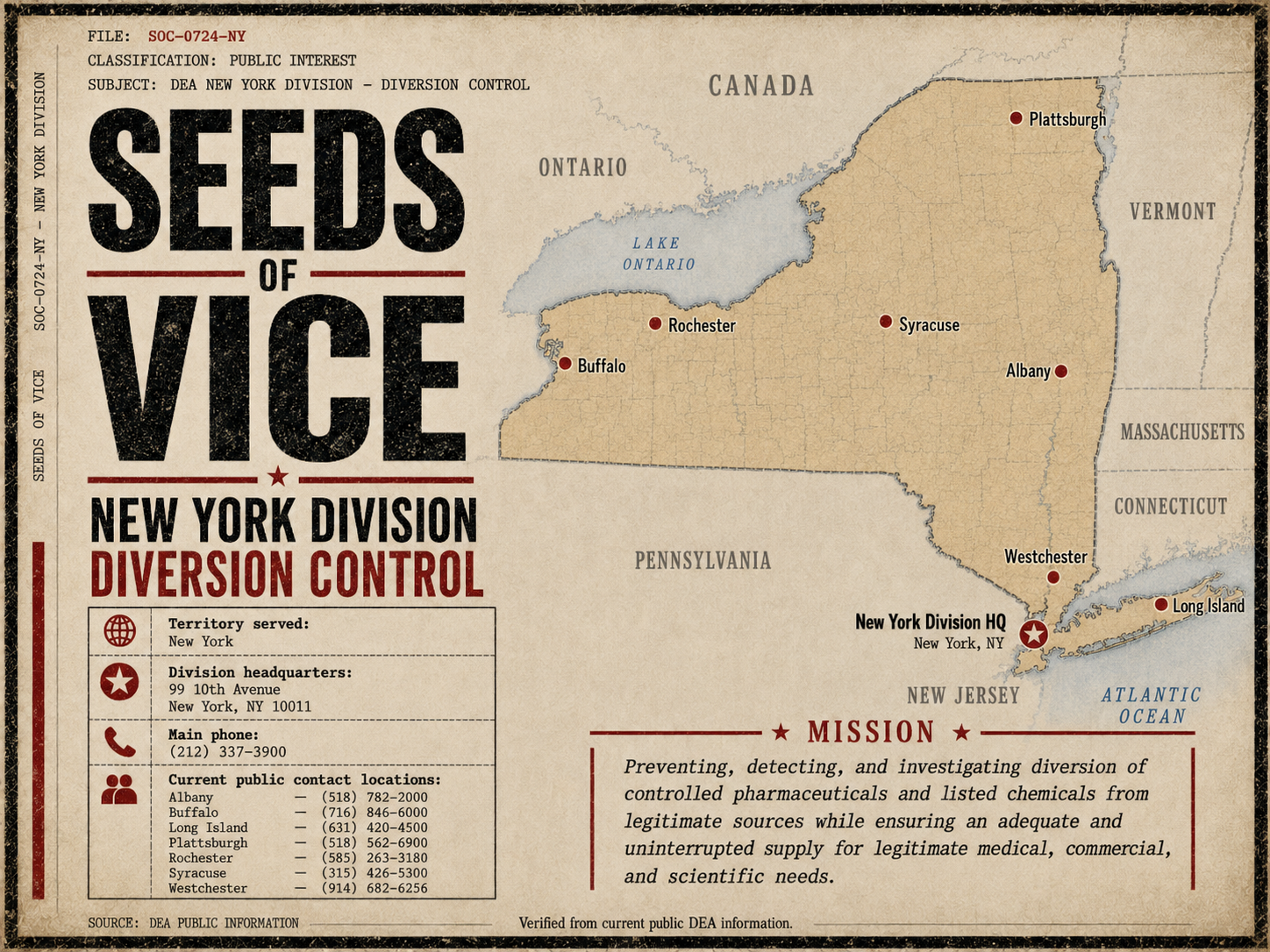
The New York Division
DEA New York and Its Diversion-Control System
Last fully verified: July 25, 2026
The Drug Enforcement Administration’s public record no longer supports describing New York as a single, conventionally organized field division without qualification.
DEA’s live New York Division webpage continues to state that one division serves the entire State of New York. It lists one statewide headquarters, seven subordinate regional contacts, and Frank A. Tarentino III as the Special Agent in Charge.
Current 2026 enforcement records, however, identify two distinct commands:
- The New York Enforcement Division, led by Special Agent in Charge Farhana Islam.
- The New York Task Force Division, led by Special Agent in Charge Christopher Roberts.
DEA also currently identifies Frank Tarentino as its Northeast Associate Chief of Operations, not as the operational head of a single statewide New York Division.
The operational split was publicly visible no later than January 2026. A January 8 announcement identified Christopher Roberts as Special Agent in Charge of the New York Task Force Division. A January 14 announcement identified Farhana Islam as Special Agent in Charge of the New York Enforcement Division.
DEA has not adequately reconciled this reorganization across its public website.
The resulting record contains:
- One legacy statewide division page.
- Two current operational division names.
- Two current Special Agents in Charge.
- One former statewide Special Agent in Charge now holding a regional Northeast position.
- One unrevised office directory.
- No public explanation of the new reporting structure.
- No published territorial or functional order allocating offices, personnel, investigations, or Diversion authority between the two commands.
The most defensible conclusion is:
DEA reorganized its New York operations into separate Enforcement and Task Force divisions by January 2026, but it has not published a complete explanation of how those divisions relate to the legacy New York Division, its statewide offices, or its Diversion-Control system.
Executive Finding
What is official
DEA’s live New York page states that the New York Division serves the entire state through offices or published contacts in:
- New York City
- Albany
- Buffalo
- Long Island
- Plattsburgh
- Rochester
- Syracuse
- Westchester County
The stated headquarters is:
99 10th Avenue
New York, New York 10011
Main telephone: 212-337-3900
The public page identifies Kenneth M. Heino as the media contact, Special Agent Romona Sy as the recruitment contact, and Ciara A. Gregovich as the community-outreach contact.
DEA’s current enforcement announcements separately and repeatedly identify:
- Farhana Islam as Special Agent in Charge of the New York Enforcement Division.
- Christopher Roberts as Special Agent in Charge of the New York Task Force Division.
- Frank A. Tarentino III as Northeast Associate Chief of Operations.
DEA’s March 2026 Fentanyl Free America release reported enforcement statistics separately for the New York Enforcement Division and the New York Task Force Division. That separate accounting is strong evidence that the distinction is operational rather than merely stylistic.
Where the official record conflicts
DEA’s live division page still identifies Frank Tarentino as the statewide Special Agent in Charge, even though July 2026 records identify him as Northeast Associate Chief of Operations. The same page does not identify Farhana Islam or Christopher Roberts and does not mention either of the two current operational divisions.
DEA’s national domestic-divisions directory continues to state that the agency operates through 23 domestic divisions. It does not explain whether New York’s two new organizations are:
- Independent domestic divisions.
- Two commands within one domestic division.
- Functionally separate subdivisions.
- Temporary operational structures.
- Components supervised through a Northeast regional command.
The use of the word division in current enforcement releases does not, by itself, establish that DEA formally increased its national domestic-division count.
The public office directory also continues to treat Albany, Buffalo, Long Island, Plattsburgh, Rochester, Syracuse, and Westchester as components of one undifferentiated New York Division. It does not identify which current command supervises each office.
What can be concluded
DEA has created a functional separation between an Enforcement Division and a Task Force Division in New York.
Current records indicate that the Enforcement Division conducts operations both upstate and in New York City. Farhana Islam has been identified in connection with matters in Albany, Saratoga, Broome County, Brooklyn, Queens, Long Island, and Manhattan.
The Task Force Division operates through joint groups involving DEA, the New York City Police Department, the New York State Police, prosecutors, and other partner agencies. Current Task Force Division matters include New York City fentanyl mills, cocaine-distribution organizations, overdose-death investigations, firearms cases, Long Island investigations, and at least one major New Jersey seizure.
The reorganization was in operation no later than January 8, 2026, when DEA publicly identified Christopher Roberts as Task Force Division Special Agent in Charge. Farhana Islam was publicly identified as Enforcement Division Special Agent in Charge by January 14.
What cannot presently be concluded
The current public record does not establish:
- The formal effective date of the reorganization.
- The written authority creating the two commands.
- Whether both commands constitute independent domestic field divisions.
- Whether either command has exclusive geographic territory.
- Whether the division of responsibility is geographic, functional, personnel-based, task-force-based, or some combination.
- Which command supervises Albany, Buffalo, Long Island, Plattsburgh, Rochester, Syracuse, and Westchester.
- Which command controls the headquarters at 99 10th Avenue.
- Whether Frank Tarentino directly supervises both Special Agents in Charge.
- Whether New York’s Diversion personnel report to the Enforcement Division, Task Force Division, Northeast Associate Chief, or another DEA component.
- The current New York Diversion Program Manager.
- The complete Assistant Special Agent in Charge roster for either command.
- Whether the New York Drug Enforcement Task Force and the New York Task Force Division are institutionally identical.
- Whether DEA’s national domestic-division count should now be 24 or 25 rather than 23.
Seeds of Vice will not invent those answers.
Who DEA New York Serves
The combined New York structure serves the entire State of New York, including:
- New York City.
- Long Island.
- The Hudson Valley.
- The Capital Region.
- Central New York.
- Western New York.
- The North Country.
- The Canadian border.
- Major ports, airports, highways, rail corridors, and postal routes.
- Interstate connections to New Jersey, Pennsylvania, Connecticut, Massachusetts, Vermont, and Canada.
New York’s position makes it both a destination market and a regional command center for investigations extending beyond the state.
Its environment includes:
- International trafficking organizations.
- Cartel-linked wholesale suppliers.
- Maritime and air-cargo movement.
- Drugs transported from Mexico, the Caribbean, South America, and other regions.
- Interstate narcotics and firearms networks.
- Fentanyl-packaging operations.
- Counterfeit pharmaceutical production.
- Illicit pill presses.
- Internet and telehealth distribution.
- Pharmacy and practitioner investigations.
- Controlled-substance manufacturers, distributors, hospitals, pharmacies, researchers, and prescribers.
- Patients receiving lawful controlled medication.
The New York system therefore governs two fundamentally different channels.
The illicit channel
The illicit channel includes:
- Unlawful importation.
- Manufacturing outside the regulated system.
- Fentanyl and heroin packaging.
- Counterfeit tablets.
- Cocaine and methamphetamine distribution.
- Firearms trafficking.
- Money laundering.
- Drug-related violence.
- Theft and forgery.
- Internet sales without valid prescriptions.
The lawful channel
The lawful channel includes:
- Registered manufacturers.
- Distributors.
- Pharmacies.
- Hospitals.
- Physicians and other practitioners.
- Researchers.
- Treatment programs.
- Veterinary practices.
- Patients using controlled substances for legitimate purposes.
The two channels may intersect when genuine pharmaceuticals are stolen or intentionally diverted, when prescriptions are forged, when a registrant acts outside lawful professional practice, or when counterfeit tablets imitate legitimate medicine.
They are not otherwise interchangeable.
Territory and Office Structure
Legacy New York Headquarters
99 10th Avenue
New York, New York 10011
Telephone: 212-337-3900
DEA continues to identify this address as the headquarters of the statewide New York Division. The public page does not identify whether the building now houses the Enforcement Division, Task Force Division, Northeast regional leadership, or all three.
Published Regional Contacts
| Location | Published telephone |
|---|---|
| Albany | 518-782-2000 |
| Buffalo | 716-846-6000 |
| Long Island | 631-420-4500 |
| Plattsburgh | 518-562-6900 |
| Rochester | 585-263-3180 |
| Syracuse | 315-426-5300 |
| Westchester | 914-682-6256 |
These are current published contact points. DEA’s public page provides an office-type legend but does not apply a visible classification to the individual locations.
Historical office classifications
When Frank Tarentino assumed command in 2022, DEA described the former statewide structure as including:
- New York Division Office.
- New York Strike Force.
- New York Drug Enforcement Task Force.
- Long Island District Office.
- Albany District Office.
- Buffalo District Office.
- Westchester Resident Office.
- Syracuse Resident Office.
- Rochester Resident Office.
- Plattsburgh Resident Office.
That historical record is useful, but it does not establish the current reporting relationships following the 2026 reorganization.
A district or resident office that existed within the former statewide command may now report to the Enforcement Division, Task Force Division, or another regional authority.
Current operational evidence
Current records associate the Enforcement Division with upstate operations, including Albany, Saratoga, Warren, Washington, Broome, and St. Lawrence counties. They also associate it with New York City and Long Island matters.
Current records associate the Task Force Division with joint New York City investigative groups, including numbered task-force groups composed of DEA, NYPD, and New York State Police personnel. Task Force Division matters have also extended into Long Island and New Jersey.
This evidence demonstrates overlapping geographic activity.
It does not reveal the formal division of authority.
Tactical Diversion Squads and Diversion Geography
DEA’s national Tactical Diversion Squad directory lists New York squads or contacts in:
- Albany
- Buffalo
- Long Island
- New York
- New York2
- Westchester County
The public directory does not explain:
- The difference between “New York” and “New York2.”
- Which command supervises either New York City squad.
- Whether the listed locations represent separate physical offices.
- The territory assigned to each squad.
- Whether Rochester, Syracuse, or Plattsburgh are served through Albany or Buffalo.
- Whether a squad’s jurisdiction follows federal judicial districts, DEA office boundaries, or investigative needs.
- Whether the list has been reconciled with the 2026 restructuring.
DEA states that Tactical Diversion Squads unify federal, state, and local information and authorities, coordinate investigations and prosecutions, and support traditional Diversion Groups when law-enforcement powers such as surveillance, evidence purchases, arrests, and search warrants are required.
A Tactical Diversion Squad is therefore not simply a compliance office.
It is an enforcement structure capable of investigating criminal diversion, counterfeit pharmaceuticals, forged prescriptions, unlawful distribution, pill presses, pharmacy theft, and related conduct.
Historical regional Diversion contacts
DEA guidance dated February 2024 divided New York Diversion contacts into three broad areas:
- New York City and surrounding territory.
- Long Island.
- Upstate New York.
That guidance provides evidence that DEA’s New York Diversion system was regionally divided even before the 2026 enforcement reorganization.
It does not establish who currently occupies those positions or where the three regional components now report.
Current Leadership and Publicly Identified Personnel
Frank A. Tarentino III
Northeast Associate Chief of Operations
Frank Tarentino led the former statewide New York Division beginning in April 2022.
DEA’s unrevised leadership page continues to identify him as New York’s Special Agent in Charge. Current July 2026 records instead identify him as Northeast Associate Chief of Operations.
Tarentino’s DEA career has included:
- Service with the New York Drug Enforcement Task Force.
- Foreign-deployed operations in Afghanistan.
- Supervisory assignments in New Jersey.
- Leadership of DEA’s Seattle Division.
- Command of the former statewide New York Division.
- Current Northeast regional operational responsibility.
The current public record supports describing Tarentino as a regional Northeast executive.
It does not clearly define his chain of command over Farhana Islam, Christopher Roberts, or the two New York operational divisions.
Farhana Islam
Special Agent in Charge, New York Enforcement Division
Farhana Islam was publicly identified as Special Agent in Charge of the New York Enforcement Division by January 14, 2026.
Current official announcements associate her command with:
- Albany and Capital Region investigations.
- Saratoga, Warren, and Washington County operations.
- Broome County.
- New York City.
- Long Island.
- Pharmaceutical-diversion and healthcare-fraud matters.
- Unlicensed cannabis investigations.
- Interstate and international enforcement.
DEA’s live leadership directory does not provide a current biography for Islam or explain the Enforcement Division’s precise organization.
Her present title and operational role are nevertheless established by repeated current official records.
Christopher Roberts
Special Agent in Charge, New York Task Force Division
Christopher Roberts was publicly identified as Special Agent in Charge of the New York Task Force Division by January 8, 2026.
Current official announcements associate his command with:
- The New York Drug Enforcement Task Force.
- Joint DEA–NYPD–New York State Police groups.
- Fentanyl-packaging mills.
- Counterfeit-pill manufacturing.
- Cocaine-delivery organizations.
- Drug-related overdose-death investigations.
- Firearms trafficking.
- Long Island and interstate cases.
- Major operations extending into New Jersey.
DEA does not currently publish a full Roberts biography or explain whether every New York Drug Enforcement Task Force group reports to the Task Force Division.
Kenneth M. Heino
Media Contact
Telephone: 862-373-3557
Email: Kenneth.M.Heino@dea.gov
DEA’s current New York page identifies Kenneth M. Heino as the media contact. Current releases from both operational divisions also use his contact information, suggesting that public affairs remains shared or centrally coordinated.
Special Agent Romona Sy
Recruitment Contact
Telephone: 571-776-1634
Email: NewYorkSpecialAgentRecruiter@dea.gov
Ciara A. Gregovich
Community Outreach and Red Ribbon Contact
Telephone: 720-431-8836
Email: Ciara.A.Gregovich@dea.gov
Current Diversion leadership
A current New York Diversion Program Manager could not be verified through a current official public personnel record.
DEA’s public materials identify regional Diversion contacts and Tactical Diversion Squad locations, but they do not name a current statewide or division-level Diversion Program Manager.
No historical official should be represented as the current officeholder without further confirmation.
National Diversion leadership
New York’s regional Diversion personnel are distinct from DEA’s national Diversion Control Division.
The national division establishes and administers federal registration systems, regulatory programs, policy functions, and nationwide Diversion structures. New York personnel perform regional work within that broader national system.
Neither Farhana Islam nor Christopher Roberts should be represented as the national head of Diversion Control.
Official Role and Mission
The New York Enforcement and Task Force structures enforce the federal Controlled Substances Act and related federal law within New York and in connected interstate and international investigations.
Their activities may include:
- Drug-trafficking investigations.
- Joint task-force operations.
- Intelligence collection.
- Cartel and transnational investigations.
- Fentanyl and counterfeit-pill cases.
- Overdose-death investigations.
- Firearms and money-laundering cases.
- Controlled-substance theft and forgery.
- Registration investigations.
- Administrative inspections.
- Civil Controlled Substances Act matters.
- Healthcare-fraud investigations.
- Practitioner and pharmacy cases.
- Manufacturer and distributor oversight.
- Community outreach and prevention.
DEA defines the national Diversion Control mission as preventing, detecting, and investigating the diversion of controlled pharmaceuticals and listed chemicals from legitimate sources while ensuring an adequate and uninterrupted supply for legitimate medical, commercial, and scientific needs.
Those are concurrent obligations.
The official mission is not merely to restrict controlled substances.
It is to protect the integrity of the lawful channel while preserving legitimate availability.
How the New York System Works in Practice
Two operational commands with overlapping geography
DEA’s March 2026 enforcement report separately attributed seizures, arrests, currency, and assets to the Enforcement Division and Task Force Division.
For the reported enforcement period, DEA attributed to the Enforcement Division:
- 5,000 fentanyl pills.
- 19 pounds of fentanyl powder.
- 177 pounds of methamphetamine.
- 1,185 pounds of cocaine.
- 100 pounds of marijuana.
- 13 firearms.
- 41 arrests.
DEA attributed to the Task Force Division:
- 515,060 fentanyl pills.
- 147 pounds of fentanyl powder.
- 165 pounds of methamphetamine.
- 234 pounds of cocaine.
- 150 pounds of marijuana.
- Eight firearms.
- 52 arrests.
DEA’s published currency figure for the Enforcement Division appears malformed as written. Seeds of Vice will not silently correct or reinterpret it.
The separate results demonstrate two operating commands.
They do not reveal why particular seizures or groups were assigned to one division rather than the other.
Upstate statewide enforcement
Operation Fast Track resulted in charges against 83 defendants and seizures that authorities reported included counterfeit pills, fentanyl, heroin, cocaine, psychedelic mushrooms, marijuana, diverted Suboxone, bromazolam tablets, and firearms.
Eighteen defendants were assigned to federal prosecution, while the remaining cases were being handled by local district attorneys. Charging instruments are accusations, and the defendants remain presumed innocent unless convicted.
The operation was attributed to the New York Enforcement Division and involved Saratoga, Warren, and Washington counties.
This establishes that the Enforcement Division has substantial upstate responsibility.
New York City fentanyl and pill-press operations
In January 2026, authorities charged three defendants following searches that allegedly uncovered pill presses and more than 16 pounds of suspected fentanyl, methamphetamine, cocaine, and oxycodone.
The investigation was conducted by a New York Drug Enforcement Task Force group composed of DEA, NYPD, and New York State Police personnel and was attributed to the New York Task Force Division. The substances had not all completed laboratory analysis at the time of the announcement, and the charges remained allegations.
In April 2026, the Task Force Division participated in the dismantling of three unrelated fentanyl-packaging mills in the Bronx and Manhattan. Other current matters involve fentanyl-manufacturing or packaging operations in residential buildings.
These cases involve illicit manufacturing and packaging outside the lawful pharmaceutical channel.
Cocaine-distribution networks
A May 2026 investigation attributed to the Task Force Division resulted in arrests connected to an alleged cocaine-delivery organization operating from a Bronx luxury apartment building. Authorities reported recovering more than 10 kilograms of cocaine, firearms, and more than $200,000. The charges were allegations at the time of publication.
In July 2026, federal authorities announced charges against a defendant accused of directing the movement of thousands of kilograms of cocaine from Puerto Rico into Long Island. Authorities reported seizing more than 465 kilograms and alleged that the organization distributed more than $100 million in cocaine. The case was announced by Northeast Associate Chief Frank Tarentino rather than either New York Special Agent in Charge. The charges remain allegations unless proved.
That announcement illustrates a further unresolved organizational issue: some major New York investigations are publicly attributed to the Northeast regional executive rather than one of the two current New York divisions.
Overdose-death investigations
Current Task Force Division cases include allegations that particular fentanyl suppliers caused fatal overdoses.
In June 2026, federal prosecutors charged one Bronx defendant with drug crimes allegedly resulting in three deaths. Another superseding indictment alleged that a different defendant’s conduct caused three fatal overdoses, including the death of a 12-year-old child. These remain allegations unless established through guilty pleas or convictions.
A fatal-overdose charge requires more than evidence that a defendant sold drugs.
The government must establish the applicable statutory elements, including identity of the substance, distribution, causation, and the defendant’s legal responsibility.
The press release is not the adjudication.
Diversion Control and Lawful Medicine
New York Diversion personnel may regulate or investigate:
- Physicians.
- Dentists.
- Nurse practitioners.
- Physician assistants.
- Pharmacists.
- Hospitals.
- Clinics.
- Veterinary practices.
- Manufacturers.
- Distributors.
- Researchers.
- Narcotic-treatment programs.
- Importers and exporters.
- Telehealth companies.
- Other DEA registrants.
Their work may include:
- Registration applications and renewals.
- Inspections.
- Controlled-substance inventories.
- Recordkeeping reviews.
- Security evaluations.
- Theft and loss investigations.
- Suspicious-order investigations.
- Prescription review.
- Administrative subpoenas.
- Immediate Suspension Orders.
- Orders to Show Cause.
- Voluntary registration surrender.
- Civil referrals.
- Administrative proceedings.
- Criminal investigations.
These processes occupy different legal postures.
Warren County physician and nurse practitioner
Civil settlement, admissions, and registration exclusion
In June 2026, physician Douglas Cline and nurse practitioner Laurie McKenna agreed to pay $500,000 to resolve civil actions involving controlled-substance prescribing and a fraudulent-conveyance claim.
The settlement barred both providers for 20 years from applying for or holding DEA controlled-substance registrations. The official record states that they admitted and accepted responsibility for specified conduct involving a cash-pay practice, high-dose opioid prescribing, controlled-substance combinations, recurring payments, and circumstances in which patients were not regularly examined.
Cline had surrendered his registration in August 2025, and McKenna’s registration expired in January 2026. The case was investigated by the Albany District Office SPEAR Group and partner agencies.
This matter was a civil resolution containing admissions and long-term registration consequences.
It was not described as a criminal conviction or prison sentence.
Done Health telehealth prosecution
Convictions and sentences
In July 2026, Done Global founder Ruthia He received a six-year prison sentence and a $1 million fine. Former clinical president David Brody received a two-year sentence and a $1 million fine.
Federal authorities stated that the scheme unlawfully distributed more than 37 million Adderall pills, defrauded insurers, and obstructed the investigation. The case involved DEA’s San Francisco Division, New York Enforcement Division, Northeast regional leadership, HHS-OIG, IRS Criminal Investigation, and federal prosecutors.
This was an adjudicated criminal matter.
It should not be described merely as an investigation, allegation, or civil compliance dispute.
Manhattan pharmacist
Civil settlement with factual admissions
In September 2025, a Manhattan pharmacist agreed to pay $100,000 and accepted restrictions on supervising, owning, or operating a pharmacy dispensing controlled substances.
The settlement resolved a civil Controlled Substances Act lawsuit involving oxycodone prescriptions containing asserted red flags. The pharmacist made factual admissions, but the resolution was civil rather than a criminal conviction.
Operation Meltdown
Criminal, administrative, and domain-seizure actions
In February 2026, DEA announced the seizure of more than 200 internet domains associated with alleged illegal online pharmacies. DEA also reported arrests, five Immediate Suspension Orders, and one Order to Show Cause.
DEA expressly described Immediate Suspension Orders and Orders to Show Cause as administrative actions against registrants. The online-pharmacy operators were accused of distributing diverted or counterfeit products without valid prescriptions.
Operation Meltdown demonstrates why outcomes must be separated:
- A domain seizure is not a conviction.
- An Immediate Suspension Order is an emergency administrative action.
- An Order to Show Cause initiates an administrative process.
- An arrest or criminal charge is an allegation.
- A conviction requires adjudication.
The word enforcement cannot replace the legal posture.
New York’s State-Control Layer
DEA’s federal registration and enforcement system operates alongside New York law, the New York State Department of Health, the Bureau of Narcotic Enforcement, professional licensing boards, insurers, hospitals, pharmacies, and institutional policies.
Prescription Monitoring Program and I-STOP
New York’s Prescription Monitoring Program Registry gives authorized practitioners access to patients’ controlled-substance dispensing histories.
The state’s I-STOP framework generally requires practitioners to consult the registry before prescribing or dispensing covered Schedule II, III, or IV controlled substances, subject to statutory and regulatory exceptions.
The registry is intended to assist with identifying:
- Multiple prescribers.
- Multiple pharmacies.
- Potential forgery.
- Dangerous combinations.
- Repeated early fills.
- Possible diversion.
- Prior controlled-substance dispensing.
A database result is information.
It is not, by itself, proof that a patient committed a crime, has a substance-use disorder, deceived a practitioner, or received inappropriate medical care.
Initial opioid prescribing for acute pain
New York generally limits an initial opioid prescription for acute pain to a seven-day supply.
The limitation applies to initial treatment of acute pain. It should not be represented as a universal seven-day limit governing every subsequent prescription, chronic-pain patient, cancer patient, palliative-care situation, or other excluded clinical circumstance.
The distinction matters.
An initial acute-pain rule is not a complete standard of care for long-term pain treatment.
Separate state and federal authority
New York’s Prescription Monitoring Program, state prescribing limits, and professional-discipline systems do not originate solely from DEA.
A practitioner may simultaneously face:
- Federal Controlled Substances Act requirements.
- DEA registration requirements.
- Federal Diversion investigations.
- New York Public Health Law.
- State medical or nursing-board requirements.
- I-STOP consultation.
- Pharmacy policies.
- Insurer restrictions.
- Hospital or clinic protocols.
- Civil-liability concerns.
- Professional guidance.
- Individual clinical judgment.
No single institution creates the entire treatment environment.
How the System Affects Pain Patients and Lawful Medicine
Legitimate protective functions
A properly functioning Diversion system protects patients by:
- Detecting forged prescriptions.
- Removing counterfeit pills.
- Investigating illicit pill presses.
- Identifying unlawful internet pharmacies.
- Preventing pharmacy theft.
- Enforcing accurate controlled-substance inventories.
- Investigating practitioners who intentionally prescribe outside legitimate practice.
- Holding registrants accountable for intentional unlawful distribution.
- Preserving confidence in authentic medicine.
The danger of counterfeit pharmaceuticals is real.
A tablet manufactured in an apartment with an illicit pill press may resemble oxycodone, alprazolam, or amphetamine while containing fentanyl, methamphetamine, bromazolam, or another undisclosed substance.
Protecting the lawful channel is therefore not opposed to patient access.
It is one condition of safe patient access.
Risk of institutional overcorrection
The same enforcement environment can harm lawful patients when:
- Numerical thresholds become inflexible rules.
- Practitioners stop treating pain because they fear investigation.
- Pharmacies refuse lawful prescriptions based on internal policy.
- Patients are rapidly tapered.
- Medication is abruptly discontinued.
- Clinics dismiss patients rather than manage them.
- Monitoring requirements are used as probationary controls rather than clinical tools.
- Statistical risk is treated as proof of individual misconduct.
CDC’s 2022 opioid-prescribing guideline acknowledged that the 2016 guideline had been misapplied through rigid dosage thresholds, rapid tapers, abrupt discontinuation, inflexible duration rules, patient dismissal, and application to circumstances outside its intended scope.
CDC associated these practices with untreated or undertreated pain, withdrawal, worsening pain, psychological distress, overdose, and suicidal ideation or behavior.
That acknowledgment does not prove that DEA alone caused those outcomes.
The treatment environment is produced through the interaction of:
- Federal enforcement.
- State legislation.
- Prescription monitoring.
- Licensing boards.
- Insurers.
- Pharmacy corporations.
- Hospitals.
- Clinic owners.
- Professional organizations.
- Civil-liability systems.
- Individual practitioners.
- Patients.
- The illicit drug supply.
DEA should not be assigned sole responsibility for every medical decision.
It should not be removed from the analysis.
The possibility of inspection, registration action, civil penalties, administrative exclusion, criminal referral, or prosecution is part of the institutional environment in which controlled-substance decisions are made.
Prescribing and Dose-Decline Context
Evidentiary boundary
Seeds of Vice begins its historical inquiry in 1984.
No continuous, directly comparable New York annual retail opioid-dispensing series was identified for every year beginning in 1984.
The record must therefore be divided into distinct evidentiary periods.
1984–2005
Historical evidence may include:
- Federal drug-distribution records.
- Manufacturing and production data.
- Quota records.
- Medicaid or insurer utilization.
- Drug-specific studies.
- Medical literature.
- State regulatory history.
- National prescribing indicators.
Those sources cannot be silently merged with the later CDC retail-pharmacy series.
Missing years should not be interpolated.
Selected retail-dispensing benchmarks
The following figures represent retail opioid prescriptions per 100 residents:
| Year | New York rate |
|---|---|
| 2006 | 44.2 |
| 2010 | 51.0 |
| 2011 | 51.1 |
| 2012 | 51.8 |
| 2015 | 45.1 |
| 2016 | 42.7 |
| 2019 | 34.8 |
| 2024 | 24.1 |
The highest rate in the selected reviewed series was 51.8 prescriptions per 100 residents in 2012.
Calculated decline
From the reviewed 2012 high of 51.8 to the 2024 rate of 24.1, New York’s retail opioid-dispensing rate declined by approximately:
53.5 percent
From 2006 to 2024, the decline was approximately:
45.5 percent
From 2019 to 2024, the decline was approximately:
30.7 percent
These percentages are Seeds of Vice calculations based on the underlying CDC rates.
National comparison
New York’s 2024 rate of 24.1 prescriptions per 100 residents was among the four lowest state rates in the United States.
The national rate was 35.4.
The other states identified by CDC among the four lowest were Hawaii, California, and New Jersey.
This establishes that New York dispensed substantially fewer retail opioid prescriptions per resident than the national average in 2024.
It does not establish:
- Whether every reduction was appropriate.
- Whether patients received effective alternatives.
- Whether average dosage declined at the same rate.
- Whether prescription duration changed.
- Whether patients were voluntarily or involuntarily tapered.
- Whether patients lost access because of pharmacy refusal.
- Whether patients improved or deteriorated.
- Whether DEA caused the decline.
- Whether the decline caused a particular mortality outcome.
Methodological limitations
CDC’s 2019–2024 data are derived from IQVIA Xponent and represent projected dispensing through approximately 54,600 non-hospital retail pharmacies covering nearly 94 percent of retail prescriptions.
The dataset:
- Includes new and refilled retail prescriptions.
- Includes multiple payment sources.
- Excludes mail-order prescriptions.
- Excludes methadone dispensed through opioid-treatment programs.
- Uses the prescriber’s location for geographic attribution.
- Does not establish whether a patient consumed the medication.
- Does not establish whether the prescription was clinically appropriate.
- Does not measure pain severity, function, treatment success, or patient abandonment.
CDC changed its geographic attribution methodology beginning in 2019 from pharmacy location to prescriber location. That change must be considered when comparing older and newer values.
Prescriptions per 100 residents must not be mixed with:
- MME per capita.
- Average MME per prescription.
- Daily dosage.
- Days supplied.
- Number of tablets.
- Number of patients.
- Total controlled-substance prescriptions.
- Overdose deaths.
- Drug-seizure quantities.
Those measures answer different questions.
Overdose Context
New York’s Office of Addiction Services and Supports reports that the state had approximately 1,800 fewer drug-overdose deaths in 2024 than in 2023, representing a 30 percent decline.
The state reports that:
- Overdose deaths declined in 74 percent of New York counties.
- Opioid-involved and stimulant-involved deaths both declined.
- More than 4,000 New Yorkers still died of drug overdose in 2024.
- Fentanyl and other synthetic opioids remained the most common substances involved.
- The downward trend continued into 2025, producing a two-year decline exceeding 40 percent.
The decline is important.
It does not prove that:
- Every prescribing reduction was medically appropriate.
- Every patient retained adequate pain treatment.
- DEA enforcement alone caused the decline.
- I-STOP alone caused the decline.
- Naloxone alone caused the decline.
- Treatment expansion alone caused the decline.
- Changes in the illicit fentanyl supply alone caused the decline.
The New York record contains simultaneous findings:
Lawful retail opioid dispensing fell by more than half from its reviewed high.
New York became one of the country’s lowest-dispensing states.
Illicit fentanyl, counterfeit pills, cocaine, methamphetamine, firearms, and pill-press operations remained active.
Overdose deaths later declined substantially but remained above 4,000 in 2024.
One fact does not independently explain the others.
Representative New York Matters
Operation Fast Track
Federal and state charges
Authorities announced charges against 83 defendants following a coordinated upstate operation involving counterfeit pills, fentanyl, heroin, cocaine, diverted Suboxone, bromazolam, marijuana, and firearms.
The defendants remain presumed innocent unless convicted.
Schenectady trafficking and firearms conspiracy
Guilty plea and sentence
Jabree Jones received a total sentence of 330 months after pleading guilty to drug-trafficking and firearms offenses and violating supervised release.
This was an adjudicated disposition, not a pending allegation.
Queens pill-press operation
Pending charges
Three defendants were charged after authorities allegedly recovered pill presses and quantities of suspected fentanyl, methamphetamine, cocaine, and oxycodone.
Laboratory analysis remained pending for some substances when the matter was announced.
Bronx cocaine-delivery organization
Pending charges
Authorities charged defendants connected to an alleged cocaine-delivery organization operating from a residential luxury building.
The charges remain allegations unless established through plea or trial.
Bronx fatal-fentanyl cases
Complaints and indictments
Current federal matters allege that individual defendants distributed fentanyl resulting in multiple fatal overdoses.
The complaints and indictments are accusations, and causation must be established in court.
Long Island Puerto Rico cocaine organization
Indictment and extradition
A defendant was charged with directing a large-scale organization allegedly responsible for transporting thousands of kilograms of cocaine from Puerto Rico into New York.
The charges remain allegations.
Warren County pain practice
Civil settlement and registration exclusion
A physician and nurse practitioner agreed to pay $500,000, accepted responsibility for specified prescribing conduct, and agreed to 20-year DEA-registration exclusions.
The matter was civil rather than a criminal conviction.
Done Health
Convictions and sentences
Two telehealth executives received prison sentences and fines for a scheme involving the unlawful distribution of more than 37 million Adderall pills and healthcare fraud.
This was an adjudicated criminal matter.
Manhattan pharmacist
Civil settlement
A pharmacist agreed to pay $100,000, made factual admissions, and accepted restrictions involving controlled-substance pharmacy ownership and supervision.
The outcome was civil, not a criminal conviction.
Operation Meltdown
Mixed criminal and administrative postures
DEA reported domain seizures, arrests, Immediate Suspension Orders, and an Order to Show Cause involving alleged illegal online pharmacies.
Each action has a different legal meaning and should be reported separately.
Contact Information
Legacy New York Headquarters
Address:
99 10th Avenue
New York, New York 10011
Main telephone: 212-337-3900
DEA does not presently identify whether this number routes to the Enforcement Division, Task Force Division, legacy division administration, or a shared service.
Media
Kenneth M. Heino
Telephone: 862-373-3557
Email: Kenneth.M.Heino@dea.gov
Recruitment
Special Agent Romona Sy
Telephone: 571-776-1634
Email: NewYorkSpecialAgentRecruiter@dea.gov
Community Outreach and Red Ribbon
Ciara A. Gregovich
Telephone: 720-431-8836
Email: Ciara.A.Gregovich@dea.gov
Published Regional Offices
Albany: 518-782-2000
Buffalo: 716-846-6000
Long Island: 631-420-4500
Plattsburgh: 518-562-6900
Rochester: 585-263-3180
Syracuse: 315-426-5300
Westchester: 914-682-6256
National DEA Registration Contact
Registration Contact Center: 800-882-9539
Registration email: DEA.Registration.Help@dea.gov
DEA’s current New York page does not provide a named current regional registration or Diversion official.
Because DEA has not published the new command structure, callers should verify whether the relevant inquiry belongs to:
- The New York Enforcement Division.
- The New York Task Force Division.
- A geographic office.
- A Tactical Diversion Squad.
- A traditional Diversion Group.
- The national Diversion Control Division.
- The Northeast regional office.
Seeds of Vice Analysis
New York is presently one of the most important unresolved pages in DEA’s public national structure.
The territorial question is simple.
DEA serves the State of New York.
The command question is not.
DEA’s public record now presents:
- One legacy statewide New York Division.
- One New York Enforcement Division.
- One New York Task Force Division.
- Two current Special Agents in Charge.
- One Northeast Associate Chief of Operations.
- One unrevised statewide office directory.
- One unrevised leadership page.
- Six published Tactical Diversion Squad labels, including unexplained entries for “New York” and “New York2.”
- No public reorganization order.
- No current Diversion organization chart.
That is not a minor website defect.
It prevents the public from identifying the institution exercising authority.
The split may be functional rather than territorial
The current evidence does not support a clean geographic division between downstate and upstate New York.
The Enforcement Division appears in both upstate and New York City cases.
The Task Force Division appears primarily in joint New York City operations but has also participated in Long Island and New Jersey matters.
The more likely explanation is that the reorganization distinguishes:
- Direct DEA enforcement groups.
- Joint task-force groups.
- Regional or specialized commands.
- Different personnel and partnership structures.
That is an inference from current cases.
DEA has not publicly confirmed it.
The New York Drug Enforcement Task Force is institutionally significant
The New York Drug Enforcement Task Force is one of the oldest and most consequential joint drug-enforcement structures in the country.
Current Task Force Division cases repeatedly describe numbered groups composed of DEA agents, NYPD detectives, and New York State Police investigators.
The creation of a separate Task Force Division may represent recognition that this joint institution is large enough to require its own Special Agent in Charge.
That interpretation is plausible.
It is not yet an official published explanation.
Diversion authority is left structurally homeless in the public record
DEA’s public materials identify Tactical Diversion Squads in Albany, Buffalo, Long Island, New York, New York2, and Westchester.
Current Diversion-related cases are attributed to the Enforcement Division.
Historical guidance divided Diversion responsibility among New York City and surrounding areas, Long Island, and upstate New York.
DEA does not explain whether:
- All Diversion personnel report to Farhana Islam.
- Tactical Diversion Squads involving joint agencies report to Christopher Roberts.
- Traditional Diversion Groups and Tactical Diversion Squads report to different commands.
- Frank Tarentino exercises regional supervision.
- A separate Diversion Program Manager coordinates both divisions.
A federal institution regulating medicine should not leave its own chain of authority unclear.
New York’s prescribing transformation is profound
New York’s retail opioid-dispensing rate fell from 51.8 prescriptions per 100 residents in 2012 to 24.1 in 2024.
New York is now one of the country’s lowest-dispensing states.
The data do not prove that this transformation was entirely beneficial.
They do not prove that it was entirely harmful.
They prove that the lawful treatment environment changed substantially.
A complete institutional account should ask:
- Which prescriptions were medically unnecessary?
- Which patients benefited from safer treatment?
- Which patients received effective alternatives?
- Which patients were voluntarily tapered?
- Which patients were involuntarily tapered?
- Which patients lost a practitioner?
- Which patients lost a pharmacy?
- Which patients were dismissed from care?
- Which patients retained medicine but at an inadequate dose?
- Which patients recovered function?
- Which patients lost function?
- Which patients entered the illicit market?
- Which patients died by overdose, suicide, untreated disease, or unrelated causes?
- Which outcomes were measured?
- Which disappeared from institutional records when the prescription ended?
Dispensing counts cannot answer those questions.
The overdose decline does not close the inquiry
New York’s 30 percent reduction in overdose deaths during 2024 is substantial and welcome.
It does not establish that every lawful patient received adequate treatment.
Likewise, evidence of undertreated pain does not negate the benefit of dismantling fentanyl mills, counterfeit-pill operations, and violent trafficking organizations.
Both truths must remain visible:
- Illicit fentanyl kills.
- Counterfeit pills kill.
- Intentional unlawful prescribing can harm patients.
- Abrupt loss of legitimate treatment can also harm patients.
The presence of one harm does not erase the other.
Lawful medicine and counterfeit medicine are opposites
A counterfeit pill borrows the appearance of legitimate medicine while bypassing every safeguard that makes medicine legitimate.
That supports stronger protection of:
- Licensed manufacturing.
- Accurate labeling.
- Genuine prescriptions.
- Trusted pharmacies.
- Individualized medical judgment.
- Traceable supply.
- Honest patient–practitioner relationships.
It does not support treating every controlled medication as though it were counterfeit.
A pain patient receiving medication through a lawful prescription is not situated like a person operating an illicit pill press.
A physician making a documented good-faith decision is not situated like a provider selling access to prescriptions without adequate examination.
A pharmacist resolving a civil compliance case is not situated like a convicted trafficker.
A patient appearing in a monitoring database has not been convicted of anything.
The system must preserve those distinctions.
The dual mandate is the correct standard
DEA’s official Diversion mission requires the agency to prevent diversion while ensuring an adequate and uninterrupted supply for legitimate need.
Seeds of Vice accepts the first obligation.
It insists upon the second.
The government should measure:
- Counterfeit pills removed.
- Trafficking organizations dismantled.
- Forged prescriptions prevented.
- Registrants convicted of intentional crimes.
- Civil and administrative compliance outcomes.
It should also measure:
- Practitioner departures.
- Registration delays.
- Pharmacy refusals.
- Controlled-substance shortages.
- Geographic loss of treatment.
- Patient abandonment.
- Involuntary tapering.
- Access to effective alternatives.
- Patient function.
- Patient-reported harm.
- Continuity of legitimate treatment.
A system that measures only restriction can describe what it stopped.
It cannot establish what legitimate care remained.
The institutional finding
DEA’s New York reorganization may ultimately prove sensible.
One command may be designed for direct enforcement across the state while the other manages the enormous joint task-force system centered in New York City.
The problem is not necessarily the split.
The problem is that the split occurred without an adequate public institutional record.
Drug control governs crime.
Diversion control governs permission.
In New York, that permission is now administered through at least two operational DEA commands, a Northeast regional executive, multiple geographic offices, six published Tactical Diversion Squad labels, state prescription monitoring, state professional regulation, insurers, pharmacies, hospitals, clinics, and individual practitioners.
The authority is immense.
The public explanation is not.
Recommended Public Disclosures
DEA should publish:
- The formal effective date of the New York reorganization.
- The directive or order creating the New York Enforcement Division and New York Task Force Division.
- Whether each organization is an independent domestic division.
- A corrected national domestic-division count.
- The reporting relationship between Frank Tarentino, Farhana Islam, and Christopher Roberts.
- A functional description of each command.
- The office assignment of Albany, Buffalo, Long Island, Plattsburgh, Rochester, Syracuse, and Westchester.
- Identification of the command occupying 99 10th Avenue.
- A current organization chart.
- Complete Assistant Special Agent in Charge rosters.
- The current Diversion Program Manager.
- The reporting structure of traditional Diversion Groups.
- The reporting structure of Tactical Diversion Squads.
- An explanation of the “New York” and “New York2” TDS listings.
- Current registration and practitioner-compliance contacts.
- Separate public reporting for criminal, civil, and administrative Diversion outcomes.
- Outcomes distinguished by complaint, indictment, plea, conviction, acquittal, dismissal, settlement, surrender, Immediate Suspension Order, and final administrative order.
- Measures of legitimate medical access alongside enforcement statistics.
Publishing this information would not require the disclosure of confidential investigative methods.
It would establish ordinary institutional accountability.
Methodology and Evidentiary Limits
This page prioritizes current primary sources from:
- The Drug Enforcement Administration.
- The DEA Diversion Control Division.
- United States Attorney’s Offices.
- The New York State Department of Health.
- The New York State Office of Addiction Services and Supports.
- The Centers for Disease Control and Prevention.
The following evidentiary rules were applied:
- The 2026 New York reorganization was treated as a central finding.
- Current operational releases were given greater weight than unrevised leadership pages.
- The legacy statewide page was not discarded; its continued publication was documented.
- The two current New York Special Agents in Charge were identified from repeated official records.
- Frank Tarentino’s current Northeast title was preserved.
- The national division count was not silently increased.
- A formal organizational relationship was not invented.
- Historical office classifications were not automatically carried forward.
- Tactical Diversion Squad locations were reproduced as DEA publishes them.
- The unexplained “New York2” listing was not interpreted.
- Historical Diversion contacts were not represented as current personnel.
- Allegations were distinguished from guilty pleas, convictions, civil settlements, and administrative actions.
- Immediate Suspension Orders and Orders to Show Cause were not described as convictions.
- State law was separated from federal DEA authority.
- The acute-pain limit was not represented as a universal chronic-pain rule.
- Prescription-monitoring information was not treated as proof of wrongdoing.
- Prescriptions per 100 residents were not mixed with MME, patient counts, pill counts, days supplied, or mortality.
- Missing historical years were not interpolated.
- CDC’s geographic-methodology change was acknowledged.
- Prescription decline was not represented as proof of either benefit or harm.
- Overdose decline was not attributed to a single institution.
- DEA was analyzed as one institution within a larger medical-control system.
- Official mission statements were separated from Seeds of Vice analysis.
Last fully verified: July 25, 2026


Bestsellers
-

A gift of Luck
-

Proof of Progress: Mr. DEA’s Diversion Autographed Hardcover & Seed Pack
$39.99 -

Seeds of Vice ™
$24.99 -

Seeds of Vice Book Set
$119.00 -
Seeds of Vice: On Poppy Tea Autographed Hardcover & Seed Pack
Original price was: $39.99.$29.99Current price is: $29.99. -

Seeds of Vice: On The Poppy Plant Autographed Hardcover & Seed Pack
$55.00
