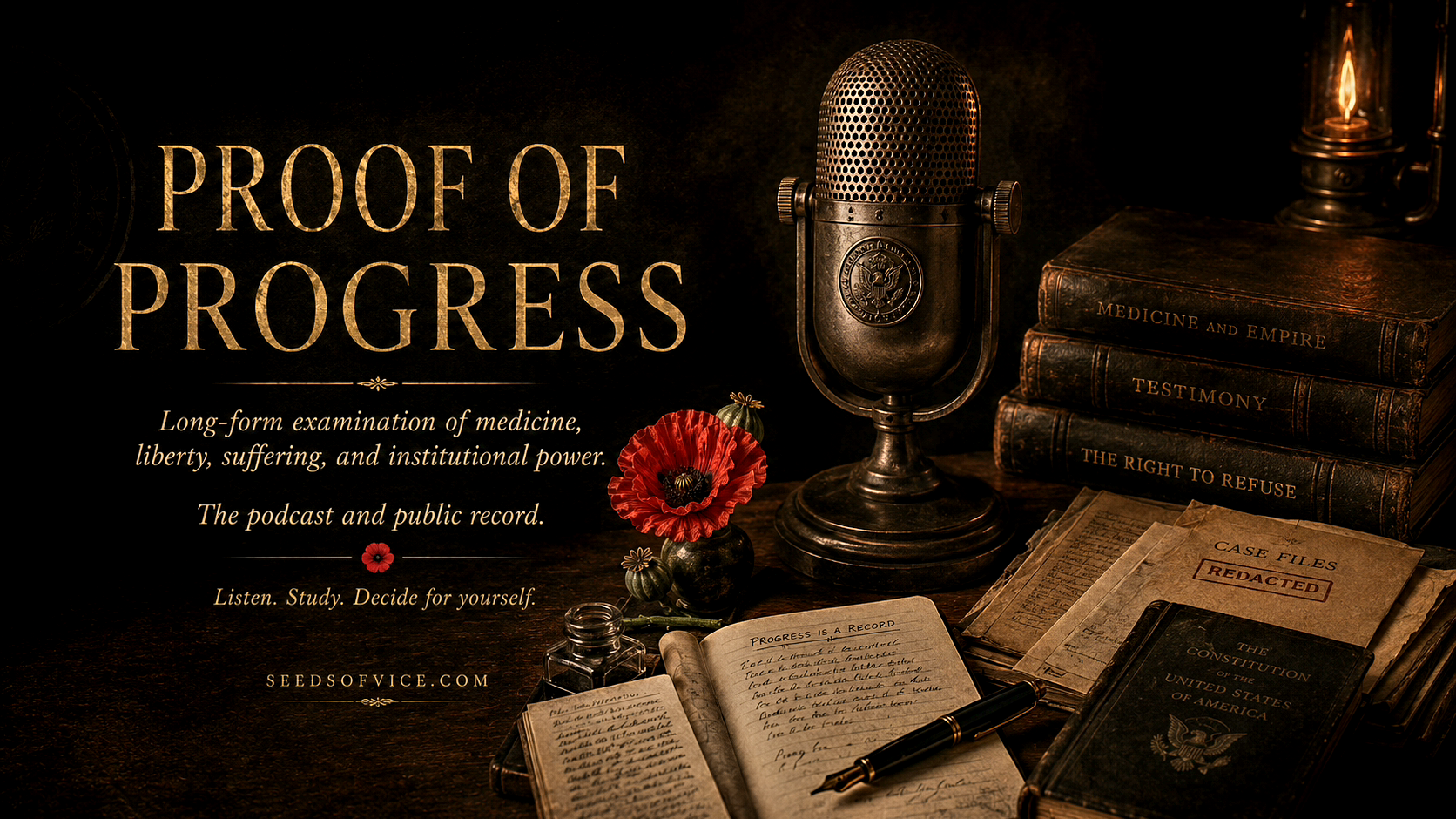
Proof of Progress Podcast
Januray 2027
There are two things I want to accomplish over the next ten years.
The first is an honest Article V effort.
The second is to teach people how to change the Standard of Care without waiting for the law to change first.
Those may sound like two different missions, but they are not. They are two sides of the same national problem. One deals with the highest structure of American authority. The other deals with the room where the suffering person actually sits needing medicine. One asks whether states still possess enough constitutional integrity to correct the federal machine when it outruns the people it is meant to empower and protect. The other insists a harmless citizen be able to walk into a doctor’s office and be treated as a human being instead of a liability, a compliance risk, a future criminal, or a future drug addict to be managed.
I do not believe this country can be repaired only by winning arguments online. I do not believe pain patients can meme themselves a prescription in hand. I do not believe a suffering person should spend the rest of their life begging the same institutions that injured them to stop because they found the right words. There has to be a higher road to take with lower fruit hanging. The higher line is constitutional. The low hanging fruit is practical. The higher line says the people and the states still retain authority over the federal structure that claims to manage them. The lower allows citizens to begin changing what is treated as reasonable care without legislating.
We will make them answer the under treatment and non treatment of pain in America.
Most people think laws control medicine directly. Sometimes it does. But often the more powerful force is not the statute. It is the accepted practice, the guideline, the hospital policy that no one voted on. It is the insurance rule that quietly became medical judgment. It is the board complaint no one wants. It is the prosecutor’s shadow in the exam room. It is the DEA press release that never says, “Do not treat pain,” while making every decent doctor understand exactly what danger comes with treating it. That is how a country can have medicine on the shelf and still create a non treatment epidemic. The law may allow treatment, while the Standard of Care punishes the doctor for providing access to it… shames the patient for needing it… and trains the public to accept it as what is best for everyone.
So no, I am not waiting ten years for permission to speak nor am I putting all my eggs in the basket reliant on an Article V convention of the States. Truth be told I have more faith in our ability to bring about a revision to our Standard of Care than I do our government’s willingness to bend to the will of any people. That being said our first duty is to each other and our second is to our nation so we will change the Standard of Care and we will attempt to change our Constitutions.
The Article V effort is the long constitutional attempt. It may fail. It may take more than ten years. It may expose how little appetite the states have left for their own authority. But an honest attempt matters because the attempt itself creates a record of our struggle history books will be forced to recognize. It forces people to say whether they believe the federal government still has boundaries, the states are still sovereign participants in the American design, and whether citizens have any peaceful instrument left when administrative government becomes permanent by habit rather than consent in practice. Article V is not a fantasy to me. It is a pressure test. It asks whether America still remembers how to correct itself lawfully from beneath the federal ceiling. Hail Mary or not.
But the Standard of Care is where lives are being lost now and the battle has to be focused.
Changing the Standard of Care does not begin nor end with the storming of a capitol or demanding that doctors become brave in isolation. It begins by changing what can be defended as reasonable. It begins by documenting the harm of non treatment as clearly as the system documents the harm of treatment. It begins by forcing the question that has been evaded for years… what happened to the people who were denied? The people who overdosed when pushed to the street in pain. The people who were harmless, injured, known, documented, stable, and still abandoned because fear has systemically become easier to defend than mercy.
That is the missing record we have to establish to force the change we want.
If the only harm counted is the harm caused by prescribing, then every Standard of Care will bend toward refusal. If the only death that matters is overdose, suicide rates disappear into the background. If the only public emergency that matters is addiction, untreated pain becomes an acceptable sacrifice. If the only doctor punished is the doctor who prescribed, then the doctor who withholds gets to wear caution like virtue, even when that caution destroys a life slowly enough that no one has to write it down honestly.
That is what has to change.
People can change the Standard of Care by creating a record the system cannot ignore. We must collect our histories better and establish denial patterns. We must document deterioration after forced tapering, untreated injury, functional collapse, lost work, lost marriages, isolation, suicide, and the quiet conversion of medical care into compliance handling. Then we must ask doctors direct questions and insist those questions be answered in the chart. On record. We must demand written treatment plans and ask what the goal is, what risk is being avoided, what harm is being accepted, and who is responsible if non treatment or under treatment produces a worse outcome than with treatment including the opioids we would choose.
The coast guard says the difference between them and the victim is how they enter the water. They take command of themselves even though the world is chaotic around them. They jump into the situation in command of themselves and fully aware of the realities of their situation. We must enter this water in such a manner to separate ourselves from the victims we would be.
That does not require a new law.
It requires discipline.
It requires people to understand that standards move. Doctors, Hospitals, Boards, Insurers, and Legislatures all respond to risk. For the last twenty years, the risk has been arranged almost entirely on one side. Prescribe and risk punishment. Treat aggressively and risk investigation. Trust the patient and risk being made an example. Meanwhile, abandon the patient and the system protects you, because abandonment is rarely named as an act. It is called prudence, policy, opioid stewardship… It is called everything except what it becomes in the life of the person left alone with a broken body.
So the work is to return consequence to non treatment.
That is the bridge between Mr. DEA’s Diversion and Seeds of Vice.
Mr. DEA’s Diversion explains the machine. Seeds of Vice speaks to the person inside it. The next ten years have to do both. We have to teach people how our medical system developed, how authority was redistributed upward, how medical discretion was limited without being openly outlawed, and how the suffering person became managed through fear. Then we have to teach each other how to act lawfully, patiently, intelligently, and relentlessly inside every room we enter.
The Article V effort says: the system must account.
The Standard of Care effort says: the people in the room are responsible to the patient.
I am interested in both avenues of change because I do not intend to spend the rest of my life asking permission to be. I do not intend to beg a bureaucrat for mercy or medicine and I do not intend to watch men and women in pain be pushed to suicide while every institution involved protects itself with language polished smooth by lawyers.
There is a lawful way to stand on this line. There is a peaceful way to make a record. There is a constitutional way to test the systems resolve and there is a practical way to change medicine before the law admits it was wrong.
An honest Article V attempt, because the federal structure must be confronted through the tools the Constitution already provides.
A Standard of Care campaign, because doctors and institutions must be made to understand that untreated pain is not neutral, abandonment is not the safe option, and non treatment has consequences that belong in the record.
The country does not have to agree with me today but it will answer the call for a record to be established within the next decade.

Bestsellers
-

A gift of Luck
-

Proof of Progress: Mr. DEA’s Diversion Autographed Hardcover & Seed Pack
$39.99 -

Seeds of Vice ™
$24.99 -

Seeds of Vice Book Set
$119.00 -
Seeds of Vice: On Poppy Tea Autographed Hardcover & Seed Pack
Original price was: $39.99.$29.99Current price is: $29.99. -

Seeds of Vice: On The Poppy Plant Autographed Hardcover & Seed Pack
$55.00
