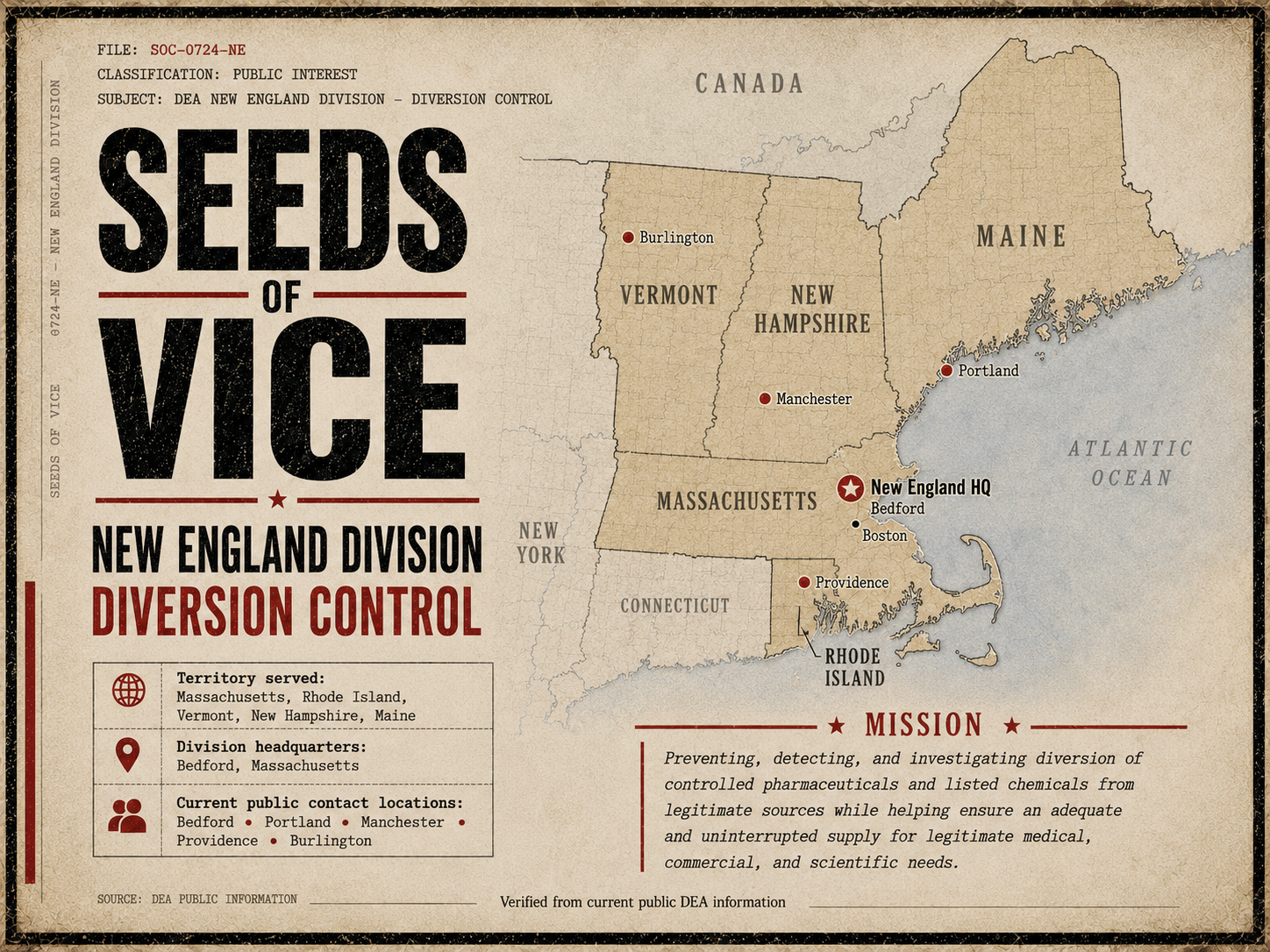
The New England Division
DEA New England Field Division
Last fully verified: July 25, 2026
The Drug Enforcement Administration’s New England Division serves all six New England states:
- Connecticut
- Maine
- Massachusetts
- New Hampshire
- Rhode Island
- Vermont
Unlike DEA’s presently conflicted Florida structure, the New England Division’s territorial jurisdiction is stated consistently in current official records. The principal public-record problems are instead organizational transparency, office classification, leadership disclosure, and the quality of DEA’s public contact directory.
DEA’s live page lists offices and telephone numbers across the region, but it duplicates the complete Connecticut, Maine, and Rhode Island contact block; assigns the same telephone number to Cape Cod and New Bedford; and provides a legend for division, district, resident, and post-of-duty offices without visibly identifying which classification applies to each location.
The division headquarters is separately identified in Bedford, Massachusetts, but the public directory does not present a complete, clearly classified regional command chart.
The jurisdiction is clear.
The internal office structure is not.
Executive Finding
What is official
DEA states that the New England Division serves Connecticut, Maine, Massachusetts, New Hampshire, Rhode Island, and Vermont.
The headquarters is located at:
40 Middlesex Turnpike
Bedford, Massachusetts 01730
DEA identifies Jarod Forget as the current Special Agent in Charge. He assumed command in July 2025 and oversees more than 600 employees throughout the six-state division.
Current federal cases show New England personnel operating through offices, task forces, and investigative groups in:
- Bridgeport
- Burlington
- Cape Cod
- Hartford
- Manchester
- New Bedford
- New Haven
- Portland
- Providence
- Springfield
DEA also conducts investigations through regional tactical-diversion squads, drug task forces, state and local partnerships, and interstate operations that do not fit neatly within a single office’s municipal location.
Where the official record is deficient
DEA’s current New England webpage:
- Repeats the Connecticut, Maine, and Rhode Island office entries.
- Lists Cape Cod and New Bedford with the same telephone number without explaining whether they are separate offices, shared facilities, or two labels for the same contact point.
- Provides an office-type legend without applying those classifications clearly to individual locations.
- Does not publish a complete current roster of Assistant Special Agents in Charge.
- Does not identify a current Diversion Program Manager.
- Does not explain which offices contain Tactical Diversion Squads or other specialized groups.
- Does not provide a current organizational diagram.
- Does not state whether the permanent New England Laboratory scheduled to open in April 2026 is now operational.
An older official record identified George J. Lutz Jr. as an acting Diversion Program Manager in 2024. That historical identification does not establish who presently holds the position.
What can be concluded
The New England Division is a stable six-state regional command.
Its operating environment includes:
- Dense metropolitan markets in Greater Boston, Connecticut, and Rhode Island.
- Interstate trafficking corridors linking New York, Massachusetts, northern New England, and Canada.
- Maritime and coastal access.
- Mail and parcel distribution.
- Cross-border and transnational investigations.
- Counterfeit pharmaceutical production and distribution.
- Illicit fentanyl, cocaine, methamphetamine, and other synthetic-drug markets.
- Oversight of lawful controlled-substance registrants.
- Coordination with six different state governments, medical systems, prescription-monitoring programs, and professional-licensing structures.
Recent cases establish that Massachusetts frequently functions as a regional supply or transit point for drugs moving into Maine, Vermont, New Hampshire, and other parts of New England. That is an inference from current case patterns—not a declaration that every regional investigation originates in Massachusetts.
What cannot presently be concluded
The current public record does not establish:
- The exact number of active DEA offices in the division.
- The classification of every listed location.
- Whether Cape Cod and New Bedford are administratively distinct offices.
- The complete chain of command beneath the Special Agent in Charge.
- The current Assistant Special Agent in Charge roster.
- The current Diversion Program Manager.
- The number and locations of Diversion Groups and Tactical Diversion Squads.
- Whether the permanent Londonderry laboratory opened as scheduled.
- The number of employees assigned specifically to enforcement, intelligence, administration, laboratories, or Diversion Control.
- How DEA allocates Diversion resources among the six states.
Seeds of Vice will not fill those gaps through assumption.
Who the New England Division Serves
The New England Division serves approximately the entire northeastern corner of the United States outside New York: six states with different laws, medical systems, political institutions, population densities, and controlled-substance environments.
Its responsibilities extend beyond conventional street-drug enforcement.
The division serves and regulates a region containing:
- Patients who receive controlled medications.
- Physicians and other authorized prescribers.
- Pharmacies and pharmacists.
- Hospitals and health systems.
- Manufacturers and distributors.
- Researchers and universities.
- Veterinary practices.
- Narcotic-treatment programs.
- Importers and exporters.
- State and local law-enforcement agencies.
- Tribal, federal, and international partners.
- Families and communities affected by counterfeit pills, illicit fentanyl, addiction, violence, and inadequate medical treatment.
DEA’s activities therefore affect both sides of the controlled-substance system:
- The illicit channel, in which drugs are manufactured, transported, possessed, or sold unlawfully.
- The lawful channel, in which controlled substances are manufactured, prescribed, dispensed, studied, and administered for legitimate purposes.
Those channels sometimes intersect, but they are not interchangeable.
Territory and Office Structure
Division Headquarters
40 Middlesex Turnpike
Bedford, Massachusetts 01730
Main telephone: 617-557-2100
DEA identifies this location as the New England Division headquarters. Although the division is often institutionally associated with Boston, the current published headquarters address is in Bedford.
Published Regional Contacts
| State | Published location | Telephone |
|---|---|---|
| Connecticut | Bridgeport | 203-579-5591 |
| Connecticut | Hartford | 860-257-2600 |
| Connecticut | New Haven | 203-497-5200 |
| Maine | Portland | 207-780-3331 |
| Massachusetts | Cape Cod | 508-996-4805 |
| Massachusetts | New Bedford | 508-996-4805 |
| Massachusetts | Springfield | 413-306-6920 |
| New Hampshire | Manchester | 603-628-7411 |
| Rhode Island | Providence | 401-732-2550 |
| Vermont | Burlington | 802-951-2900 |
DEA’s live page repeats the Bridgeport, Hartford, New Haven, Portland, and Providence entries a second time. The table above removes the duplicate presentation but does not alter the underlying official contact information.
Office classifications
DEA’s page displays a legend for:
- Division offices
- District offices
- Resident offices
- Post-of-duty offices
The visible public directory does not reliably associate those labels with each listed New England location.
A city’s appearance in the directory therefore establishes that DEA publishes a contact there. It does not, by itself, establish whether that location is a district office, resident office, post of duty, specialized task-force facility, or another organizational unit.
Missing headquarters-level clarity
The division’s headquarters is published separately from the state office list. DEA does not provide a single consolidated chart showing:
- Headquarters command.
- State-level supervision.
- Enforcement groups.
- Diversion groups.
- Tactical Diversion Squads.
- Intelligence personnel.
- Laboratory support.
- Task-force relationships.
- Public-affairs and community-outreach functions.
That information may exist internally. It is not adequately presented to the public.
Current Leadership and Publicly Identified Personnel
Jarod Forget
Special Agent in Charge
Jarod Forget became Special Agent in Charge of the New England Division in July 2025.
DEA states that he oversees more than 600 employees throughout Connecticut, Maine, Massachusetts, New Hampshire, Rhode Island, and Vermont.
Forget joined DEA in 2004 and began his career in the New York Division. His subsequent assignments included supervisory work in Miami, the Office of Professional Responsibility, and the Washington Division. He served in both Assistant Special Agent in Charge and Special Agent in Charge capacities involving operations in Washington, D.C., Maryland, and Virginia.
In January 2025, Forget became acting chief of operations at DEA headquarters. In that role, he helped oversee operations involving 241 domestic offices within 23 domestic divisions and 93 foreign offices in 69 countries.
He also served in DEA’s Guadalajara office and worked on investigations involving the Sinaloa and Jalisco New Generation cartels.
Forget is a Massachusetts native and holds bachelor’s and master’s degrees from Northeastern University. DEA describes him as fluent in Spanish.
His background is relevant to New England because the division’s cases frequently involve organizations whose operations extend far beyond the six-state region.
Kristen Govostes
Media Contact
DEA identifies Kristen Govostes as the New England Division’s media contact.
Telephone: 617-557-2100
Garth Hamelin
Special-Agent Recruitment Contact
Email: bostonspecialagentrecruiter@dea.gov
The continued use of a Boston recruitment address does not change the current headquarters location published in Bedford.
Brian O’Keefe
Community-Outreach Contact
Telephone: 508-509-1844
Email: Brian.OKeefe@dea.gov
Diversion and Medical-Practitioner Contact
Telephone: 571-362-9171
This is the public contact DEA provides for Diversion and medical-practitioner matters. The published number uses a Northern Virginia area code and does not identify a named New England official.
Personnel not presently verified
The following current information could not be established through current official public sources:
- Assistant Special Agents in Charge.
- Diversion Program Manager.
- Diversion Group Supervisors.
- Tactical Diversion Squad supervisors.
- State-office supervisors.
- Intelligence leadership.
- Laboratory director.
- Registration-program leadership.
Historical names should not be carried forward as though they remain current.
The New England Laboratory
In August 2024, DEA announced construction of a permanent New England regional laboratory in Londonderry, New Hampshire.
DEA stated that the facility would become its eighth regional laboratory and would provide:
- Drug-chemistry analysis.
- Latent-fingerprint examination.
- Support for New England investigations.
- Support for parts of upstate New York.
- Space for more than 50 personnel.
- Capacity to process more than 5,000 exhibits annually.
At the time, DEA was operating a temporary laboratory supporting the Manchester office. The permanent facility was expected to open in April 2026.
As of July 25, 2026, Seeds of Vice did not locate a current official announcement confirming that the permanent laboratory opened, became fully staffed, or began accepting evidence as scheduled.
The defensible statement is therefore:
DEA planned to open the permanent New England Laboratory in April 2026, but its present operational status has not been verified through a current official public record.
That distinction matters. A construction announcement is not proof of completed commissioning.
Official Role and Mission
The New England Division is a regional DEA field division.
It is not the national Diversion Control Division.
The regional division conducts and supports criminal, civil, administrative, intelligence, community-outreach, and regulatory activities within its territory. National policies, registration systems, quotas, regulations, and Diversion programs may originate elsewhere within DEA or the Department of Justice.
DEA describes the Diversion Control mission as preventing, detecting, and investigating the diversion of controlled pharmaceuticals and listed chemicals from legitimate channels while ensuring an adequate and uninterrupted supply for legitimate medical, commercial, and scientific needs.
Those are not opposing missions.
They are simultaneous obligations.
The official responsibility is not merely to reduce the availability of controlled substances. It is to distinguish unlawful diversion from legitimate access while preserving the lawful supply required by patients, medicine, research, and commerce.
How the New England System Works in Practice
A regional rather than purely state-based command
Criminal organizations do not necessarily observe state boundaries.
A trafficking organization may:
- Obtain drugs outside New England.
- Store them in Massachusetts or Connecticut.
- Transport them into Maine, Vermont, or New Hampshire.
- Use Rhode Island or Massachusetts financial accounts.
- Mail packages through several jurisdictions.
- Manufacture counterfeit pills in one state.
- Distribute them through another.
- Maintain suppliers or leadership outside the United States.
The division’s six-state structure allows DEA to coordinate investigations that would otherwise cross several state and federal districts.
Massachusetts as a regional operating center
In April 2026, federal prosecutors announced charges against 13 defendants in an alleged Worcester-area drug-trafficking organization. Authorities alleged that the organization distributed cocaine, methamphetamine, fentanyl, and marijuana and received more than 10 kilograms of cocaine through mailed packages connected to Puerto Rico.
Investigators also reported firearm seizures.
The defendants were charged, not convicted by the announcement. They remain presumed innocent unless proven guilty.
In a separate February 2026 case, two Massachusetts men were charged following seizures that authorities said included tens of thousands of counterfeit pills, approximately 30 pounds of crystal methamphetamine, two pill presses, and five firearms.
Those allegations illustrate the industrial character of some counterfeit-tablet operations. They do not establish guilt unless proved through a plea or trial.
Massachusetts-to-Maine distribution
In May 2026, federal authorities announced the extradition and indictment of a Dominican national accused of helping lead a trafficking organization operating in Massachusetts, Maine, and the Dominican Republic.
Prosecutors alleged that fentanyl, cocaine, and methamphetamine were transported from Massachusetts into Maine.
An indictment is an accusation. The defendant remains presumed innocent unless convicted.
The case demonstrates why the division cannot be evaluated as six separate state enforcement programs. A supply chain may involve several New England offices and federal districts at once.
New Hampshire’s Seacoast investigations
In July 2026, Michael Michaud pleaded guilty in New Hampshire to conspiracy and possession with intent to distribute methamphetamine and fentanyl. The investigation arose from a DEA-led inquiry into drug distribution in the Seacoast region that began in 2022.
In January 2026, Eddy Mendez Carmona received a 28-month federal sentence after pleading guilty to distributing methamphetamine and fentanyl in the same broader region.
These are adjudicated dispositions, not merely pending allegations.
Connecticut counterfeit-pill enforcement
In January 2026, federal authorities charged 11 people in an alleged Bristol-area organization accused of distributing fentanyl, cocaine, crack cocaine, counterfeit fentanyl pills, and other purported pharmaceuticals. Prosecutors connected the investigation to suspected overdose deaths.
Those charges remain allegations unless established through guilty pleas or convictions.
In July 2026, a West Haven man received an eight-year federal sentence after previously pleading guilty in a counterfeit-pill case investigated by DEA’s New Haven Tactical Diversion Squad.
The Tactical Diversion Squad’s involvement is instructive. Diversion personnel and task-force officers may investigate counterfeit pharmaceuticals and illicit controlled-substance distribution—not only administrative compliance by lawful registrants.
Rhode Island financial investigations
In February 2026, Carolina Correa received a 42-month federal sentence, a $150,000 fine, and a $350,000 forfeiture judgment after pleading guilty to laundering proceeds connected to fentanyl trafficking through a marijuana dispensary.
The case shows that regional controlled-substance investigations may include financial systems, licensed businesses, asset forfeiture, and money laundering in addition to physical drug seizures.
In March 2026, a Massachusetts man received a 121-month sentence in Rhode Island for trafficking approximately 3.4 pounds of crystal methamphetamine. The investigation involved both Rhode Island and Boston DEA task-force personnel.
Vermont and cross-state supply routes
In May 2026, Theodore Bland pleaded guilty in Vermont to federal firearm and controlled-substance charges, including conduct related to the deaths of two men during drug trafficking involving cocaine base and fentanyl in Lamoille County.
Other current Vermont prosecutions describe suspected cocaine base and fentanyl entering the state through interstate distribution arrangements. These cases demonstrate the operational connection between northern New England and supply centers elsewhere in the Northeast. Pending charges remain allegations unless proved.
Operation Engage
DEA’s current New England Operation Engage initiative identifies Middlesex County, Massachusetts, as its geographic focus.
Earlier New England Operation Engage campaigns focused on Lowell, Massachusetts, and Manchester, New Hampshire. The changing focus indicates that Operation Engage is a targeted community and enforcement initiative, not a permanent territorial boundary or independent field office.
Operation Engage combines elements such as:
- Enforcement.
- Community outreach.
- Prevention.
- Education.
- Drug-related intelligence.
- Partnerships with local organizations.
Such programs should be evaluated separately from the division’s permanent investigative and Diversion responsibilities.
Diversion Control and Lawful Medicine
The New England Division’s Diversion personnel regulate and investigate activity within the lawful controlled-substance channel.
Potential subjects include:
- Registration eligibility.
- Prescription and dispensing records.
- Controlled-substance inventories.
- Security requirements.
- Loss and theft reporting.
- Suspicious orders.
- Transfers between registrants.
- Prescribing outside the usual course of professional practice.
- Unlawful distribution by registered entities.
- Counterfeit pharmaceuticals.
- Illicit pill presses.
- Internet and telemedicine activity.
- Civil and administrative compliance.
- Criminal conduct involving controlled-substance registration.
The presence of a DEA registration does not immunize a person or business from investigation.
It also does not make every recordkeeping failure a criminal offense.
The legal posture of each matter must be stated precisely.
Maine mental-health practice settlement
In January 2026, Riverbird LLC and two Maine medical providers agreed to pay $20,000 and enter a memorandum of understanding to resolve federal allegations arising from a November 2024 DEA audit.
The government alleged controlled-substance reporting and recordkeeping failures.
The settlement did not constitute a judicial finding of criminal guilt. The government acknowledged the providers’ cooperation, and the matter was resolved through a civil agreement.
New Hampshire veterinary settlement
In January 2025, Tilton Veterinary Hospital and its owner agreed to pay $53,500 to resolve federal allegations involving controlled-substance inventory, recordkeeping, and security practices.
The resolution was a civil settlement, not a criminal conviction.
These matters illustrate that Diversion enforcement operates along a continuum:
- Education and voluntary correction.
- Inspection.
- Memoranda of understanding.
- Civil settlement.
- Registration restriction or surrender.
- Administrative proceedings.
- Civil litigation.
- Criminal investigation.
- Prosecution and conviction.
Those outcomes should never be collapsed into the single word “enforcement.”
The Six-State Prescription-Control Layer
The New England Division operates over six separate state prescription-monitoring and professional-regulation systems.
The states share broad objectives, but they do not impose one uniform regional rule.
| State | Monitoring system | Verified general feature |
|---|---|---|
| Connecticut | Connecticut Prescription Monitoring and Reporting System | Receives reported Schedule II–V dispensing transactions; controlled-substance prescribers must register for access under applicable state requirements |
| Maine | Prescription Monitoring Program | Monitors Schedule II–V dispensing and is incorporated into the state’s controlled-substance and opioid strategy |
| Massachusetts | MassPAT | State rules require consultation in covered circumstances, including whenever an opioid prescription is issued |
| New Hampshire | Prescription Drug Monitoring Program | Collects Schedule II–IV information and is intended to promote appropriate use for legitimate medical purposes |
| Rhode Island | Prescription Drug Monitoring Program | Collects Schedule II–V information and opioid-antagonist data; requires or recommends review in specified prescribing circumstances |
| Vermont | Vermont Prescription Monitoring System | Serves as both a clinical and surveillance tool for Schedule II–IV controlled substances |
Sources: Connecticut ; Maine ; Massachusetts ; New Hampshire ; Rhode Island ; Vermont .
This table is an institutional overview, not legal advice. Consultation requirements, exceptions, reporting deadlines, emergency provisions, veterinary rules, age thresholds, and enforcement mechanisms vary by state and may change.
DEA’s federal registration system exists alongside—not in place of—these state systems.
A practitioner may therefore be affected simultaneously by:
- Federal controlled-substance law.
- DEA registration requirements.
- State prescribing statutes.
- State medical-board rules.
- Prescription-monitoring requirements.
- Pharmacy policies.
- Insurer restrictions.
- Hospital or clinic protocols.
- Professional guidelines.
- Civil-liability concerns.
- Employment rules.
- Individual clinical judgment.
No single institution controls the entire treatment environment.
How the System Affects Pain Patients and Lawful Medicine
Protective functions
A properly functioning system protects patients by:
- Removing counterfeit tablets that imitate legitimate medications.
- Detecting fentanyl, methamphetamine, nitazenes, and other undisclosed substances in purported pharmaceuticals.
- Preventing theft from pharmacies, hospitals, and veterinary practices.
- Requiring accurate inventories and transaction records.
- Identifying intentional unlawful distribution by registrants.
- Preserving traceability within the lawful supply chain.
- Investigating violent trafficking organizations.
- Separating authentic medicine from products made with illicit pill presses.
The counterfeit-tablet cases investigated in Massachusetts and Connecticut demonstrate why the lawful pharmaceutical channel requires protection. A tablet may visually resemble oxycodone, alprazolam, or another medication while containing fentanyl, methamphetamine, or a different substance entirely.
Risks of institutional overcorrection
Controlled-substance oversight can also produce harmful secondary effects when enforcement fear or administrative policy replaces individualized clinical judgment.
The Centers for Disease Control and Prevention has acknowledged that its 2016 opioid-prescribing guideline was misapplied through:
- Rigid dosage thresholds.
- Rapid tapering.
- Abrupt discontinuation.
- Inflexible duration limits.
- Patient dismissal.
- Abandonment.
- Application to patients and circumstances outside the guideline’s intended scope.
CDC associated those misapplications with untreated or undertreated pain, withdrawal, worsening pain, psychological distress, overdose, and suicidal ideation or behavior. Its 2022 guideline emphasized individualized, patient-centered decision-making and warned against treating recommendations as inflexible law or policy.
That acknowledgment does not establish that DEA alone caused those harms.
It establishes that the broader control system can injure patients when recommendations, enforcement signals, payer rules, or institutional risk controls are applied without clinical judgment.
Shared institutional responsibility
The treatment environment is produced by the interaction of:
- Congress and federal law.
- DEA and the Department of Justice.
- State legislatures.
- State professional boards.
- Public-health agencies.
- Insurers.
- Pharmacy corporations.
- Hospital systems.
- Clinic owners.
- Professional associations.
- Civil-liability systems.
- Prescribers.
- Patients.
- The illicit market.
DEA should neither be assigned sole responsibility for every prescribing decision nor removed from the analysis entirely.
The possibility of investigation, registration action, civil settlement, or criminal referral is one component of the institutional environment in which controlled-substance decisions are made.
Prescribing and Dose-Decline Context
Evidentiary boundary
Seeds of Vice begins its historical inquiry in 1984.
A directly comparable annual state-level retail opioid-dispensing series was not identified for all six New England states from 1984 forward.
The record must therefore be divided into defensible periods.
1984–2005
No continuous, directly comparable six-state annual series of retail opioid prescriptions per 100 residents was located for this period.
Historical analysis may use:
- Federal drug-distribution records.
- Manufacturing and quota data.
- Medical-literature trends.
- State regulatory history.
- National utilization evidence.
- Drug-specific or payer-specific datasets.
Those sources cannot be silently merged into the later CDC retail-prescription-rate series.
No missing year should be interpolated.
2006–2023
CDC’s archived state dispensing data permit comparison using the metric retail opioid prescriptions per 100 residents.
The table below provides selected benchmark years and the highest rate located within the reviewed 2006–2023 series.
| State | 2006 | Peak in reviewed series | 2013 | 2016 | 2019 | 2023 | Peak-to-2023 decline |
|---|---|---|---|---|---|---|---|
| Connecticut | 64.7 | 69.3 in 2012 | 67.4 | 55.9 | 40.5 | 32.4 | 53.2% |
| Maine | 83.6 | 93.1 in 2011 | 85.9 | 66.9 | 44.1 | 33.8 | 63.7% |
| Massachusetts | 66.0 | 69.2 in 2008 | 63.0 | 47.1 | 35.4 | 28.6 | 58.7% |
| New Hampshire | 75.0 | 83.7 in 2012 | 82.0 | 64.3 | 38.1 | 30.9 | 63.1% |
| Rhode Island | 78.7 | 83.2 in 2012 | 76.9 | 60.3 | 40.3 | 30.5 | 63.3% |
| Vermont | 56.9 | 60.1 in 2015 | 52.2 | 58.6 | 36.9 | 27.9 | 53.6% |
The percentage changes are Seeds of Vice calculations based on the reported peak and 2023 rates.
Historical rate sources: 2006 ; peak years ; 2013 ; 2016 ; 2019 ; 2023 .
What the table establishes
The table establishes that retail opioid-dispensing rates declined substantially in every New England state from the highest rate located in the reviewed series through 2023.
The decline exceeded 50 percent in all six states.
It exceeded 63 percent in:
- Maine
- New Hampshire
- Rhode Island
The table does not establish:
- How many individual patients lost treatment.
- Whether reductions occurred among new or established patients.
- Whether the discontinued prescriptions were medically appropriate or inappropriate.
- Whether average prescription duration changed.
- Whether average dosage declined at the same rate.
- Whether nonopioid treatment became available.
- Whether patient pain or function improved.
- Whether illicit opioid use increased or decreased as a result.
- Whether DEA caused the changes.
- Whether the changes caused a particular mortality outcome.
A prescription count is a utilization measure—not a complete measure of care quality.
Methodological limits
The CDC/IQVIA retail-dispensing data cover most retail pharmacy prescriptions but exclude some distribution channels, including mail-order dispensing and methadone administered through opioid-treatment programs.
Geographic methodology also requires care. Beginning with more recent portions of the series, rates were generally assigned using the prescriber’s location rather than necessarily the patient’s residence or dispensing pharmacy.
Prescriptions per 100 residents must not be mixed with:
- Morphine milligram equivalents per capita.
- Average MME per prescription.
- Daily dosage.
- Days supplied.
- Patient counts.
- Total controlled-substance prescriptions.
- Overdose deaths.
- Drug-seizure quantities.
Those measures answer different questions.
2024 national context
CDC reported that the national retail opioid-dispensing rate declined from 46.8 prescriptions per 100 residents in 2019 to 35.4 in 2024.
Exact 2024 values for all six New England states were not reproduced in the accessible static CDC material reviewed for this page. They should not be estimated from the 2023 values or replaced with the national figure.
The latest fully transcribed and cross-checked six-state comparison presented here therefore ends in 2023.
Overdose Context
Prescribing decline and overdose mortality are related public-policy subjects, but they are not the same dataset.
CDC has stated that prescription opioids continue to contribute to overdose deaths but are not the principal driver of the current illicit overdose crisis.
National provisional data indicated that overdose deaths fell sharply in 2024, including a major reduction in opioid-involved mortality. New Hampshire was among the states reporting particularly large year-over-year declines.
Those results are important.
They do not prove that:
- Every prescribing reduction was medically appropriate.
- Every patient retained adequate treatment.
- DEA enforcement alone caused the decline.
- Prescription monitoring alone caused the decline.
- Naloxone alone caused the decline.
- Changes in the illicit fentanyl supply alone caused the decline.
- A single policy can account for the regional outcome.
Current New England cases continued to involve illicit fentanyl, counterfeit pills, methamphetamine, cocaine, firearms, and interstate trafficking even after lawful retail opioid dispensing had fallen by more than half from its earlier regional peaks.
The two records must therefore be presented together:
Lawful opioid dispensing declined profoundly. Illicit controlled-substance markets remained active and dangerous.
One fact does not erase the other.
Representative New England Division Matters
Worcester-area trafficking organization
Indictments and pending charges
Thirteen defendants were charged in April 2026 in an alleged organization involving cocaine, methamphetamine, fentanyl, marijuana, mailed packages, and firearms.
The charges are allegations. The defendants remain presumed innocent unless convicted.
Massachusetts counterfeit-pill operation
Pending charges
Two men were charged in February 2026 after authorities reported seizing tens of thousands of suspected counterfeit tablets, approximately 30 pounds of crystal methamphetamine, two pill presses, and five firearms.
The charges remain allegations.
Massachusetts–Maine–Dominican Republic organization
Indictment and extradition
A Dominican national was extradited and indicted in an alleged organization accused of transporting fentanyl, cocaine, and methamphetamine from Massachusetts into Maine.
An indictment does not establish guilt.
New Hampshire Seacoast investigation
Guilty plea
Michael Michaud pleaded guilty in July 2026 to methamphetamine- and fentanyl-related offenses arising from a DEA-led investigation.
Bristol-area Connecticut organization
Pending charges
Eleven people were charged in January 2026 in an alleged organization involving fentanyl, cocaine, crack cocaine, counterfeit pills, and purported pharmaceuticals.
The charges remain allegations.
West Haven counterfeit-pill case
Guilty plea and sentence
A West Haven defendant received an eight-year sentence in July 2026 after pleading guilty in a counterfeit-pill case investigated by the New Haven Tactical Diversion Squad.
Rhode Island proceeds-laundering case
Guilty plea and sentence
Carolina Correa received a 42-month sentence, a $150,000 fine, and a $350,000 forfeiture judgment after pleading guilty to laundering fentanyl-trafficking proceeds.
Vermont firearm and drug case
Guilty plea
Theodore Bland pleaded guilty in May 2026 to federal firearm and controlled-substance charges connected to trafficking activity and two deaths.
Riverbird LLC and Maine providers
Civil settlement
The clinic and two providers paid $20,000 and entered a memorandum of understanding to resolve alleged controlled-substance reporting and recordkeeping violations.
The resolution was civil and did not constitute a criminal conviction.
Tilton Veterinary Hospital
Civil settlement
The hospital and its owner paid $53,500 to resolve allegations involving controlled-substance inventory, security, and recordkeeping.
The resolution was civil, not a criminal conviction.
Contact Information
New England Division Headquarters
Address:
40 Middlesex Turnpike
Bedford, Massachusetts 01730
Main telephone: 617-557-2100
Media
Contact: Kristen Govostes
Telephone: 617-557-2100
Special-Agent Recruitment
Contact: Garth Hamelin
Email: bostonspecialagentrecruiter@dea.gov
Community Outreach
Contact: Brian O’Keefe
Telephone: 508-509-1844
Email: Brian.OKeefe@dea.gov
Diversion and Medical-Practitioner Matters
Telephone: 571-362-9171
Published State Contacts
Bridgeport, Connecticut: 203-579-5591
Hartford, Connecticut: 860-257-2600
New Haven, Connecticut: 203-497-5200
Portland, Maine: 207-780-3331
Cape Cod, Massachusetts: 508-996-4805
New Bedford, Massachusetts: 508-996-4805
Springfield, Massachusetts: 413-306-6920
Manchester, New Hampshire: 603-628-7411
Providence, Rhode Island: 401-732-2550
Burlington, Vermont: 802-951-2900
Because DEA does not clearly classify each published location, callers should verify which office, group, or division component has responsibility for the relevant investigation, registration, compliance matter, or county.
Seeds of Vice Analysis
The New England Division is not suffering from a territorial identity crisis.
Its jurisdiction is clear.
Its transparency is not.
DEA publicly identifies one six-state field division with more than 600 employees, yet the public receives:
- A duplicated office directory.
- Unclassified office entries.
- Two Massachusetts locations sharing one unexplained telephone number.
- No complete current command roster.
- No named current Diversion Program Manager.
- No public Diversion organization chart.
- No confirmed update on a laboratory scheduled to open months ago.
- A regional medical-practitioner contact that does not identify a regional official.
These are not findings of misconduct.
They are findings of inadequate public administration.
The distinction matters.
The New England Division exercises consequential authority over both criminal organizations and lawful institutions. Its personnel may help dismantle organizations distributing fentanyl and counterfeit pills. They may also inspect a clinic, veterinary hospital, pharmacy, or medical practice and initiate a process that affects a professional license, DEA registration, business, or patient population.
The public should be able to identify who exercises that authority.
A six-state institution requires six-state accountability
New England is not a uniform medical jurisdiction.
Connecticut, Maine, Massachusetts, New Hampshire, Rhode Island, and Vermont each maintain separate:
- Legislatures.
- Medical boards.
- Pharmacy boards.
- Prescription-monitoring programs.
- Health departments.
- Professional standards.
- Enforcement mechanisms.
- Medical cultures.
- Rural-access conditions.
- Treatment infrastructures.
DEA operates above and across those systems.
That makes regional coordination necessary, but it also makes transparency more important.
A practitioner in rural Maine does not operate within the same healthcare environment as a major Boston hospital. A Vermont patient may face different pharmacy access, specialist availability, transportation barriers, and state rules from a patient in Connecticut.
Federal enforcement must recognize those differences even when the Controlled Substances Act is national.
The counterfeit-pill distinction
Current New England cases demonstrate a genuine public danger from pills manufactured to resemble lawful medicine.
That danger supports stronger protection of the lawful channel.
It does not support treating the lawful channel as though it were itself counterfeit.
A pain patient receiving medication from a licensed practitioner and pharmacy is not situated like a person manufacturing fentanyl tablets with an illicit pill press.
A physician documenting good-faith treatment is not situated like an organization mailing kilograms of cocaine or distributing methamphetamine across state lines.
A veterinary hospital accused of inventory failures is not situated like an armed trafficking organization.
The legal system must preserve those distinctions.
Prescribing decline is no longer a marginal change
Every New England state experienced a decline of more than 50 percent from the highest retail opioid-dispensing rate found in the reviewed 2006–2023 series.
That is not a minor correction.
It is a regional transformation in the availability and use of lawful opioid medicine.
The data do not prove whether the entire decline was beneficial or harmful. They do prove that the treatment environment changed substantially.
Any serious institutional account must therefore ask:
- Which patients stopped receiving medication?
- Which patients improved?
- Which patients were tapered voluntarily?
- Which were tapered involuntarily?
- Which lost their prescriber?
- Which retained medication but at a lower dosage?
- Which received effective alternatives?
- Which were left untreated?
- Which entered the illicit market?
- Which withdrew from medical care?
- Which died from unrelated disease, suicide, overdose, or progressive disability?
- Which consequences were measured?
- Which were never recorded?
Prescription counts alone cannot answer those questions.
The dual mandate must remain visible
DEA’s official Diversion mission includes both preventing diversion and ensuring an adequate and uninterrupted lawful supply.
Seeds of Vice accepts the first obligation.
It insists upon the second.
The lawful system should be strong enough to investigate counterfeit fentanyl without treating a pain patient as counterfeit.
It should be precise enough to prosecute intentional diversion without making ordinary medical care administratively impossible.
It should be transparent enough that the public can identify the officials responsible for regional Diversion policy.
It should be honest enough to measure not only what enforcement prevented, but what institutional overcorrection may have denied.
Drug control governs crime.
Diversion control governs permission.
In New England, that permission is administered across six states, more than 600 division personnel, multiple task forces, an extensive registrant population, and six separate medical-regulatory systems.
The institutional scale demands a public record equal to the authority being exercised.
At present, DEA’s New England public directory does not meet that standard.
Recommended Public Disclosures
DEA should publish:
- A current regional organization chart.
- The classification of every listed office.
- A corrected office directory without duplicated entries.
- An explanation of the Cape Cod and New Bedford contact arrangement.
- A complete current Assistant Special Agent in Charge roster.
- The current Diversion Program Manager.
- The locations and general jurisdiction of regional Diversion Groups.
- The locations of Tactical Diversion Squads.
- A current registration and compliance contact for each state.
- Confirmation of the Londonderry laboratory’s operational status.
- A clear description of how the laboratory supports New England and upstate New York.
- Public reporting that distinguishes criminal, civil, and administrative Diversion outcomes.
- Regional measures of legitimate medical access alongside enforcement statistics.
- Clear instructions for patients, practitioners, pharmacies, and attorneys seeking the responsible office.
The publication of these facts would not compromise active investigations.
It would establish ordinary institutional accountability.
Methodology and Evidentiary Limits
This page prioritizes current primary sources from:
- The Drug Enforcement Administration.
- United States Attorney’s Offices.
- State prescription-monitoring programs.
- State health and regulatory agencies.
- The Centers for Disease Control and Prevention.
The following evidentiary rules were applied:
- Current official sources were favored over archived personnel pages.
- Historical personnel were not presented as current.
- Office locations were not assigned classifications that DEA did not clearly publish.
- The laboratory’s announced completion date was not treated as proof of opening.
- Indictments and complaints were described as allegations.
- Guilty pleas were distinguished from convictions following trial.
- Sentences were identified as adjudicated dispositions.
- Civil settlements were not described as criminal convictions.
- Regional case patterns were identified as patterns or inferences rather than formal jurisdictional rules.
- State prescription-monitoring systems were described separately.
- No six-state legal system was invented.
- Prescriptions per 100 residents were not mixed with MME, patient counts, dosage, days supplied, or mortality.
- Missing annual data were not interpolated.
- The 2024 national rate was not substituted for unavailable state values.
- Prescribing decline was not represented as proof of causation.
- DEA was analyzed as one institution within a broader medical-control system.
- Official mission statements were separated from Seeds of Vice analysis.
Last fully verified: July 25, 2026


Bestsellers
-

A gift of Luck
-

Proof of Progress: Mr. DEA’s Diversion Autographed Hardcover & Seed Pack
$39.99 -

Seeds of Vice ™
$24.99 -

Seeds of Vice Book Set
$119.00 -
Seeds of Vice: On Poppy Tea Autographed Hardcover & Seed Pack
Original price was: $39.99.$29.99Current price is: $29.99. -

Seeds of Vice: On The Poppy Plant Autographed Hardcover & Seed Pack
$55.00
