The Houston Division
DEA Houston Division
Last fully verified: July 24, 2026
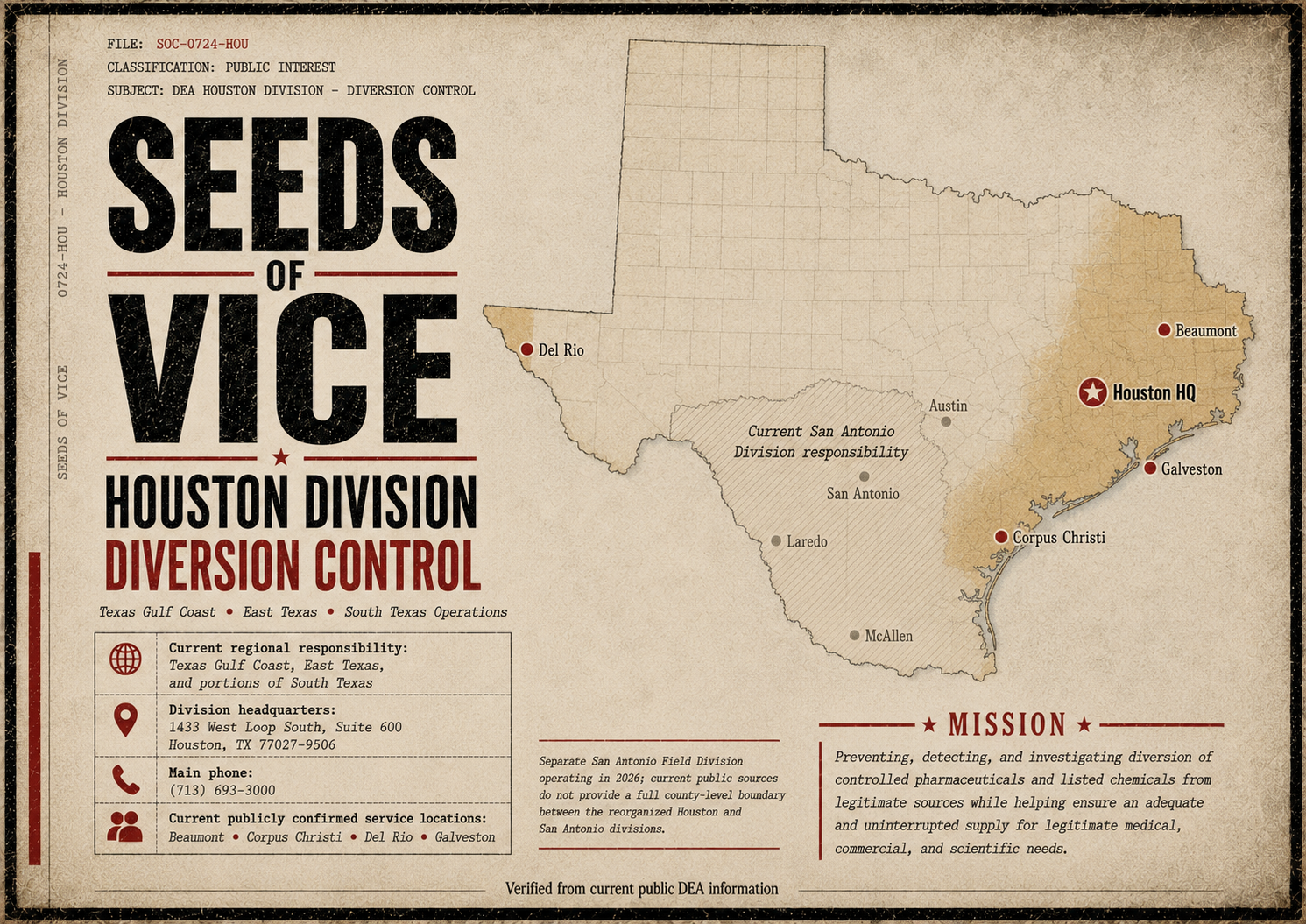
The Drug Enforcement Administration’s Houston Division serves part of Texas, not the entire state.
Its present jurisdiction is difficult to describe precisely because DEA established a separate San Antonio Field Division in January 2026, but the Houston Division’s public contact table still displays several offices that DEA now lists under San Antonio.
DEA’s live Houston Division page identifies the division as serving Beaumont, Corpus Christi, Del Rio, and Galveston, with Houston serving as the headquarters. Special Agent in Charge Brian C. Leardo’s official biography describes the division’s broader operational area as the Texas Gulf Coast, East Texas, and South Texas. His biography also specifically identifies the Houston Division Office and the Galveston and Beaumont Resident Offices.
The same Houston page continues to display contact information for:
- Austin
- Brownsville
- Eagle Pass
- Laredo
- McAllen
- San Antonio
- Waco
DEA’s separate San Antonio Division page now identifies those seven locations as the San Antonio Division’s service area. Miguel A. Madrigal’s official biography states that he became Special Agent in Charge of the newly established San Antonio Field Division in January 2026.
The most defensible reading of the current record is therefore:
DEA’s Houston contact table has not been fully reconciled with the January 2026 creation of the San Antonio Division.
That conclusion should be stated as an interpretation of conflicting official pages—not as proof of an internal administrative fact that DEA has expressly explained.
The precise county-by-county boundary of the reorganized Houston Division is not published in the current public sources reviewed for this page. Seeds of Vice will not construct that boundary from assumptions about geography, federal judicial districts, old office assignments, or the location of individual investigations.
The Houston Division investigates illicit drug trafficking, transnational criminal organizations, money laundering, violent criminal networks, and other violations of federal law. It also administers and enforces portions of the federal controlled-substance system governing lawful manufacturers, importers, distributors, pharmacies, hospitals, practitioners, treatment programs, researchers, and other DEA registrants.
This page concerns that lawful system.
It explains who leads the division, which offices and personnel are publicly identified, how the 2026 Texas reorganization affected the public record, how diversion control operates, what actual Houston-area diversion cases look like, and what prescribing statistics can—and cannot—prove about lawful medicine.
The Name Matters
The official regional organization is the DEA Houston Division.
It is not formally called the “Houston Diversion Division.”
The Houston Division is a domestic field division responsible for numerous enforcement and administrative missions. Pharmaceutical diversion control is one part of that broader command.
The national Diversion Control Division is a separate operational component within DEA headquarters.
Its responsibilities include administering federal controlled-substance registration and regulatory programs, coordinating major diversion investigations, overseeing regulated imports and exports, monitoring portions of the controlled-substance distribution system, and participating in national regulatory and policy work.
The two organizations are connected, but they are not interchangeable.
National DEA components establish and administer much of the federal framework. Houston Division personnel implement and enforce portions of that framework within the division’s regional jurisdiction.
The Houston Division does not independently:
- Enact the Controlled Substances Act;
- Establish national pharmaceutical-production quotas;
- Write all national DEA regulations;
- Create CDC clinical recommendations;
- Issue Texas medical, pharmacy, or other professional licenses;
- Establish every insurer, hospital, clinic, or corporate-pharmacy policy;
- Determine the national medical standard of care.
Its personnel can, however:
- Inspect DEA registrants;
- Review controlled-substance records;
- Audit inventories;
- Investigate thefts and significant losses;
- Examine ordering, distribution, prescribing, and dispensing;
- Coordinate with state licensing authorities and law-enforcement agencies;
- Support administrative action against DEA registrations;
- Use warrants and compulsory process when legally authorized;
- Refer civil and criminal matters for prosecution.
National policy should not be attributed solely to one field division.
A field division should also not be treated as irrelevant when its personnel possess federal authority over the lawful controlled-substance channel.
A Division Redrawn in 2026
The present Houston Division cannot be understood without the establishment of the San Antonio Division.
Before January 2026
Historically, the Houston Division operated through a larger office network extending across central and southern Texas.
Official cases from before the 2026 reorganization may therefore identify Houston Division personnel working through Austin, San Antonio, Laredo, McAllen, Brownsville, Eagle Pass, or Waco.
That historical attribution was not necessarily inaccurate when the case was investigated.
Present-day jurisdiction should not be projected backward onto an earlier organizational structure.
January 2026
DEA appointed Miguel A. Madrigal to lead the newly established San Antonio Field Division in January 2026.
Madrigal had served as Deputy Special Agent in Charge of the Houston Division beginning in May 2022. DEA states that the new San Antonio Division oversees offices in central Texas and along the southern border.
The live San Antonio Division page identifies:
- Austin
- Brownsville
- Eagle Pass
- Laredo
- McAllen
- San Antonio
- Waco
The Publicly Identified Houston Area
The live Houston page identifies:
- Beaumont
- Corpus Christi
- Del Rio
- Galveston
The division headquarters remains in Houston.
The Del Rio Question
Del Rio appears in the Houston Division’s live jurisdiction heading and contact table.
It does not appear on the San Antonio Division page, even though San Antonio now administers several other offices along the southern border.
The public sources reviewed for this page do not explain:
- Why Del Rio remained under Houston;
- Whether the assignment is permanent;
- Which surrounding counties belong to Houston;
- How the Houston–San Antonio boundary is drawn near Del Rio.
This page preserves DEA’s current public listing without inventing an explanation.
The Duplicate Contact Problem
The Houston page continues to display the seven locations now listed by the San Antonio Division.
That duplication creates a real public-record problem.
A reader consulting only the Houston page could reasonably believe those offices remain under Houston. A reader consulting only the San Antonio page would conclude that they belong to San Antonio.
The San Antonio page and Madrigal’s appointment record are the stronger evidence of the current organizational assignment. The duplicated Houston entries should therefore be treated as apparently unreconciled legacy information unless DEA publishes a different explanation.
DEA requires controlled-substance registrants to maintain accurate and current records.
The public is entitled to expect the agency to maintain an intelligible record of its own organizational structure.
Who This Division Serves
Houston
Houston is the division headquarters and its principal administrative center.
Brian Leardo’s biography states that he oversees the division’s enforcement, intelligence, regulatory, and administrative operations. He also oversees DEA participation in the Houston High Intensity Drug Trafficking Areas grant program and the Homeland Security Task Force.
Those broader programs should not be confused with diversion control.
Illicit-trafficking investigations, intelligence work, national-security coordination, pharmaceutical investigations, registration administration, community outreach, and regulatory inspections may operate under the same divisional command, but they involve different personnel, evidence, authorities, and purposes.
Galveston
DEA identifies Galveston as part of the current Houston service area.
Leardo’s official biography specifically calls it a Resident Office.
Galveston connects the division to Gulf Coast transportation, healthcare, institutional pharmacy, pharmaceutical-distribution, and maritime systems outside the headquarters.
Beaumont
DEA identifies Beaumont as part of the current Houston service area.
Leardo’s biography identifies it as a Resident Office. DEA’s national Tactical Diversion Squad directory also lists Beaumont as a Texas TDS location.
That means Beaumont has a publicly documented pharmaceutical-diversion enforcement presence, not merely a general DEA contact number.
Corpus Christi
Corpus Christi appears in the live Houston jurisdiction heading and contact table.
The accessible page text does not clearly identify the office as a district office, resident office, post of duty, or another organizational unit.
This page therefore calls it a publicly listed contact location rather than assigning an unsupported classification.
Del Rio
Del Rio also appears in the live Houston jurisdiction heading and contact table.
Because DEA does not publish a current county boundary or an explanation of the post-reorganization arrangement, this page does not infer how far the Del Rio responsibility extends beyond the city.
East Texas, the Gulf Coast, and South Texas
Leardo’s official biography describes his operational territory as the Texas Gulf Coast, East Texas, and South Texas.
Those descriptions establish broad regional responsibilities.
They do not supply a precise county list.
The most responsible current description is therefore:
The Houston Division serves Houston and a publicly identified network centered on Beaumont, Corpus Christi, Del Rio, and Galveston, within broader Gulf Coast, East Texas, and South Texas responsibilities whose exact post-2026 county boundary is not publicly defined.
Headquarters
DEA Houston Division
1433 West Loop South
Suite 600
Houston, Texas 77027-9506
Main telephone: (713) 693-3000
The headquarters is the most reliable published contact for questions involving uncertain boundaries or the 2026 reorganization.
Current Leadership
Brian C. Leardo
Special Agent in Charge
As of July 24, 2026, Brian C. Leardo is the publicly identified Special Agent in Charge of the DEA Houston Division.
He assumed the position in January 2026.
DEA states that Leardo provides executive oversight of the division’s enforcement, intelligence, regulatory, and administrative operations. He also oversees DEA participation in the Houston HIDTA grant program and the Homeland Security Task Force.
Before receiving the permanent appointment, Leardo served as Deputy Special Agent in Charge of the Houston Division. DEA states that he directed day-to-day operations and coordinated activity involving:
- The Houston Division Office;
- The Galveston Resident Office;
- The Beaumont Resident Office.
Leardo became a member of the Senior Executive Service in March 2024. DEA credits him with more than 21 years of agency service and more than 27 years of federal law-enforcement experience.
At DEA headquarters, he served as Section Chief of the Counter Threat Team and held leadership assignments within the Special Operations Division.
His earlier field assignments included the New York Field Division and DEA’s Nassau Country Office. DEA states that his work included investigations of transnational criminal organizations and maritime-interdiction operations.
Leardo began his federal law-enforcement career with the United States Capitol Police in 1998. He later served with the Federal Air Marshal Service before entering DEA.
He holds a bachelor’s degree in criminal justice from Saint Anselm College.
His published biography documents experience in:
- Federal law enforcement;
- Transnational-organized-crime investigations;
- Intelligence coordination;
- Maritime interdiction;
- National-security programs;
- Interagency operations;
- Executive management.
It does not identify him as a physician, pharmacist, pain specialist, epidemiologist, or clinical researcher.
That distinction does not diminish his statutory authority.
It identifies the professional perspective from which the division is led.
Publicly Identified Personnel
DEA does not publish a complete roster of Houston Division:
- Special agents;
- Diversion investigators;
- Intelligence analysts;
- Tactical Diversion Squad personnel;
- Registration specialists;
- Task-force officers;
- Supervisors;
- Attorneys;
- Administrative employees.
Seeds of Vice will not manufacture one from social-media profiles, commercial databases, stale press releases, or unsupported directories.
The following individuals are included because DEA currently identifies them in official public-facing roles.
Sally M. Sparks
Media Inquiries
DEA lists Sally M. Sparks as the Houston Division’s media contact.
Email: sally.m.sparks@dea.gov
Sparks is also listed as the San Antonio Division’s media contact. DEA’s public pages do not explain whether this represents a shared public-affairs arrangement, a transitional assignment, or another internal structure.
This page will not speculate.
Kimball L. Hardeman
Special Agent Recruitment
Telephone: (571) 324-8227
Email: SpecialAgentRecruiter.Houston@dea.gov
Kareem Vaughn
Community Outreach
Telephone: (571) 324-6193
Email: Kareem.R.Vaughn@dea.gov
Community outreach is distinct from diversion investigation.
A prevention or public-engagement role should not be confused with authority over registration inspections, administrative proceedings, or criminal pharmaceutical cases.
No Current Public Diversion Roster
The live Houston page does not presently identify a named:
- Diversion Program Manager;
- Diversion Outreach Coordinator;
- Tactical Diversion Squad supervisor;
- Diversion Group supervisor;
- Registration Program Specialist.
The absence of a published name does not establish that the position is vacant.
It means the current public record does not support identifying the employee.
Current Public Contact Locations
Houston Headquarters
Houston: (713) 693-3000
Beaumont
Beaumont: (409) 981-7400
Corpus Christi
Corpus Christi: (361) 887-1200
Del Rio
Del Rio: (830) 778-7886
Galveston
Galveston: (281) 335-2900
Locations Now Listed Under San Antonio
DEA’s separate San Antonio Division page assigns the following locations to that division:
- Austin — (512) 344-4900
- Brownsville — (956) 504-7000
- Eagle Pass — (830) 752-4000
- Laredo — (956) 523-6000
- McAllen — (956) 992-8400
- San Antonio — (210) 442-5600
- Waco — (254) 297-0300
The same locations remain duplicated on Houston’s live contact table.
For present organizational purposes, inquiries involving those seven locations should be directed to the San Antonio Division unless DEA later publishes a contrary clarification.
Diversion-Control Infrastructure
DEA’s national Tactical Diversion Squad directory lists Texas squads in:
- Austin
- Beaumont
- Dallas
- El Paso
- Fort Worth
- Houston
- San Antonio
For the current Houston Division, the publicly listed TDS locations are most clearly:
- Houston
- Beaumont
Austin and San Antonio are now associated with the separate San Antonio Division.
The national TDS directory lists cities by state but does not itself show the field-division reporting structure. The 2026 field-division pages provide the more current organizational context.
No separately named Tactical Diversion Squad is publicly listed in:
- Corpus Christi;
- Del Rio;
- Galveston.
That does not prove that diversion investigators never work in those locations.
It means DEA’s national directory does not publish a separate TDS entry for them.
What a Tactical Diversion Squad Is
DEA describes Tactical Diversion Squads as multiagency units combining federal, state, and local resources to investigate suspected violations involving the diversion of lawful pharmaceutical controlled substances or listed chemicals.
DEA states that TDS units can:
- Combine information and authorities held by separate agencies;
- Coordinate investigations across judicial districts;
- Support traditional Diversion Groups when law-enforcement authority is required;
- Make arrests;
- Purchase evidence;
- Compensate confidential sources;
- Conduct surveillance;
- Execute search warrants.
That is significant.
Diversion control is sometimes described as though it consisted only of licensing, paperwork, and pharmacy education.
Tactical Diversion Squads possess conventional criminal-investigative capabilities.
A matter may begin with:
- A registration inspection;
- An inventory discrepancy;
- A suspicious-order report;
- A theft or significant-loss report;
- A questionable prescription;
- A dispensing complaint;
- Information from a patient;
- Information from an employee;
- Information from a professional board;
- Information from another law-enforcement agency.
If investigators believe the evidence supports criminal conduct, the matter can develop into surveillance, confidential-source activity, warrants, arrests, and prosecution.
That does not mean every inspection becomes a criminal case.
It means the system possesses both regulatory and criminal enforcement capacity.
Traditional Diversion Work
Traditional diversion investigators are regulatory specialists.
Their work can involve:
- DEA registration;
- Compliance inspections;
- Controlled-substance inventories;
- Ordering records;
- Distribution records;
- Prescription records;
- Pharmacy-dispensing records;
- Theft and loss reporting;
- Security requirements;
- Suspicious-order systems;
- Administrative registration proceedings;
- Interviews with registrants and employees;
- Coordination with professional licensing authorities.
Tactical Diversion Squads add law-enforcement personnel and criminal-investigative methods to that regulatory structure.
A registrant may therefore encounter DEA through very different legal pathways.
A matter may remain administrative.
It may result in corrective action or a civil settlement.
It may lead to professional discipline.
It may become a criminal prosecution.
Those outcomes are not legally interchangeable.
Broader Enforcement Programs Are Not Diversion Control
Brian Leardo’s responsibilities also include DEA participation in the Houston HIDTA grant program and the Homeland Security Task Force.
Those programs concern broader public-safety and national-security threats.
Their existence should not be used to imply that:
- Every controlled-substance patient belongs to a trafficking investigation;
- Every practitioner is being evaluated through a cartel-enforcement framework;
- Every drug sold illegally originated in a lawful medical channel;
- Illicitly manufactured fentanyl is equivalent to pharmaceutical fentanyl used in legitimate medicine.
The Houston Division operates against illicit trafficking and within the lawful pharmaceutical system.
Those missions can intersect.
They are not identical.
The Official Diversion-Control Mission
DEA’s Diversion Control Division states that its mission is to prevent, detect, and investigate the diversion of controlled pharmaceuticals and listed chemicals while ensuring an adequate and uninterrupted supply for legitimate medical, commercial, and scientific needs.
That is a dual obligation.
Prevent Diversion
DEA is responsible for protecting the lawful channel against conduct such as:
- Theft;
- Fraud;
- Forgery;
- Record falsification;
- Employee diversion;
- Unlawful prescribing;
- Unlawful dispensing;
- Improper distribution;
- Security failures;
- Suspicious ordering;
- Transfer into illicit markets.
Preserve Legitimate Supply
DEA also accepts responsibility for maintaining lawful supply for legitimate purposes, including:
- Surgery;
- Emergency medicine;
- Cancer treatment;
- Palliative care;
- End-of-life care;
- Acute and chronic pain treatment;
- Treatment of substance-use disorders;
- Veterinary medicine;
- Scientific research;
- Pharmaceutical manufacturing;
- Other lawful commercial purposes.
The legitimate-supply obligation is not decorative language.
It is part of the stated mission.
A complete evaluation of the Houston Division’s diversion work must therefore ask two questions:
What unlawful diversion did the division prevent?
What legitimate access remained available?
Counting arrests, surrendered registrations, closed pharmacies, seized medication, civil penalties, and criminal convictions answers only the first question.
The Closed System of Distribution
Federal controlled-substance law operates through what DEA calls a closed system of distribution.
Manufacturers, importers, exporters, distributors, pharmacies, hospitals, practitioners, researchers, and other lawful handlers generally must be registered or otherwise authorized.
They must comply with requirements involving:
- Security;
- Inventories;
- Ordering;
- Records;
- Prescribing;
- Dispensing;
- Theft and loss reporting;
- Suspicious orders;
- Transfers;
- Disposal;
- Import and export activity.
DEA registration is not ceremonial.
For many practitioners and businesses, it is the federal permission required to participate in the controlled-substance channel.
A physician may hold a Texas medical license but still require DEA registration to prescribe federally controlled substances.
A pharmacy may possess Texas authority but still require DEA registration to handle them.
A hospital depends upon registered suppliers, pharmacies, and practitioners.
The patient experiences the closed system through every authorized participant standing between pharmaceutical manufacture and medical use.
The Texas Prescription Monitoring Program
The Texas Prescription Monitoring Program is administered by the Texas State Board of Pharmacy, not DEA.
The Texas PMP collects outpatient prescription information involving Schedule II, III, IV, and V controlled substances dispensed by Texas pharmacies or to Texas residents by participating out-of-state pharmacies.
Texas-licensed pharmacies generally must report covered controlled-substance dispensing no later than the next business day.
Since March 1, 2020, Texas generally requires prescribers and pharmacists—other than veterinarians—to review a patient’s PMP history before prescribing or dispensing:
- Opioids;
- Benzodiazepines;
- Barbiturates;
- Carisoprodol.
Texas describes the PMP as a patient-care tool that can also help address misuse and diversion.
Law-enforcement and prosecutorial access is subject to the applicable Texas process. The state has maintained a Law Enforcement Access Portal through which approved users submit warrants, subpoenas, or court orders for PMP information.
The PMP is not a DEA database.
DEA may obtain relevant information through lawful investigative process, but state monitoring and federal enforcement remain institutionally distinct.
The Federal and State Layers
A Texas practitioner handling controlled substances may need:
- A professional license;
- Authority under Texas law;
- DEA registration;
- Compliance with state prescribing requirements;
- Compliance with federal prescribing requirements;
- PMP registration and consultation;
- Hospital or health-system credentials;
- Pharmacy acceptance;
- Insurance authorization;
- Compliance with professional-board standards.
These requirements come from different institutions.
They should not all be attributed to DEA.
They also should not be treated as unrelated when their combined effect determines whether a lawful patient receives medicine.
A patient may be denied because of:
- A federal-registration issue;
- State law;
- Professional-board policy;
- Corporate-pharmacy policy;
- An insurer;
- A hospital;
- A distributor;
- Medication availability;
- A prescriber’s clinical judgment;
- A prescriber’s fear of regulatory consequences.
Accurate responsibility requires identifying which institution made which decision.
What the Houston Division Can Do
Depending upon the evidence and applicable legal process, Houston Division personnel can:
- Conduct regulatory inspections;
- Review controlled-substance records;
- Audit inventories;
- Examine ordering and distribution patterns;
- Investigate thefts and significant losses;
- Interview registrants and employees;
- Investigate prescribing and dispensing;
- Coordinate with professional boards;
- Work with federal, state, and local law enforcement;
- Use subpoenas and other compulsory process;
- Conduct surveillance;
- Use confidential sources;
- Execute warrants;
- Seize evidence;
- Make arrests;
- Seek administrative action against DEA registrations;
- Refer civil or criminal matters to prosecutors.
The precise authority and procedure depend upon the investigation and the legal process being used.
What the Houston Division Does Not Do
The Houston Division does not ordinarily:
- Examine an individual pain patient;
- Diagnose the cause of that person’s pain;
- Perform surgery;
- Observe the patient’s daily function;
- Evaluate every available treatment;
- Assume the treating clinician’s ethical duty;
- Issue Texas professional licenses;
- Make every pharmacy-dispensing decision;
- Decide every insurance authorization;
- Write every hospital or pain-clinic policy.
The Houston Division therefore does not bear sole responsibility for every:
- Refused prescription;
- Involuntary taper;
- Pharmacy denial;
- Delayed postoperative dose;
- Insurance refusal;
- Patient unable to locate pain treatment.
Prescribers, pharmacists, insurers, health systems, professional boards, legislatures, corporate pharmacies, manufacturers, distributors, federal agencies, and individual clinical decisions can all affect access.
DEA nevertheless bears a distinct federal responsibility.
It controls access to the federal registration system and possesses enforcement authority capable of influencing institutional conduct beyond the registrant directly investigated.
That influence should not be exaggerated into sole causation.
It should not be minimized into irrelevance.
How Diversion Control Works in Practice
The clearest way to understand diversion control is to examine actual Houston-area cases.
The matters below involve different parts of the pharmaceutical supply chain:
- Manufacturing and importation;
- Wholesale distribution;
- Retail pharmacies;
- Institutional pharmacy services;
- Individual pharmacists and corporate officers.
They also involve different legal outcomes.
A civil settlement is not a criminal conviction.
A deferred prosecution agreement is not an acquittal.
An Immediate Suspension Order is not a jury verdict.
A guilty plea is not an unresolved allegation.
Responsible publication must preserve those distinctions.
Woodfield Distribution and Woodfield Pharmaceutical
The Woodfield matter involved pharmaceutical manufacturing, wholesale distribution, importation, security, recordkeeping, and counterfeit cough syrup.
In August 2021, DEA issued three Immediate Suspension Orders involving Woodfield’s Texas distributor, importer, and manufacturing registrations.
A later civil resolution identified violations or alleged failures involving:
- More than 120 million unaccounted-for controlled-substance dosage units;
- Failure to operate an adequate suspicious-order monitoring system;
- Failure to notify DEA of more than 200,000 stolen dosage units;
- Falsified importation documents;
- Illegal importation of more than 200 million controlled-substance dosage units;
- Inadequate storage and security;
- Incomplete records;
- Failure to report controlled-substance transactions and sales.
In August 2023, Adam Runsdorf, Woodfield Distribution, and associated operations surrendered seven DEA registrations and agreed to pay $2.475 million in civil fines.
The record also included a separate criminal case.
Runsdorf and Woodfield Pharmaceutical pleaded guilty to conspiracy, trafficking in counterfeit drugs, and money-laundering conspiracy.
Prosecutors said Woodfield’s Houston manufacturing facility was used to produce more than 500,000 pints of counterfeit cough syrup for a Houston trafficking organization.
Runsdorf received a 72-month prison sentence and was ordered to forfeit $5 million and a McLaren sports car. Woodfield Pharmaceutical was separately ordered to forfeit $1 million and pay a $50,000 fine.
The case demonstrates why diversion and controlled-substance enforcement can legitimately reach major corporate registrants.
The official record concerned:
- Unaccounted inventory;
- Illegal imports;
- False records;
- Security failures;
- Counterfeit pharmaceutical production;
- Knowing cooperation with drug traffickers.
That conduct is fundamentally different from an authorized practitioner prescribing an approved medication to a documented patient for a legitimate medical purpose.
Health Fit Pharmacy
In September 2025, a pharmacy owner and three Houston pharmacists received prison sentences for their roles in Health Fit Pharmacy.
The Justice Department described Health Fit as a cash-only pill-mill pharmacy that dispensed controlled substances to people sent by drug traffickers to pose as patients. The prescriptions were often fraudulent and issued in the names of physicians whose identities had been stolen.
Arthur Billings
Arthur Billings, the owner, operator, and pharmacist-in-charge, pleaded guilty to a four-year conspiracy involving the unlawful distribution and dispensing of hydrocodone and oxycodone.
He was sentenced to 12 years in prison and received a $2.6 million forfeiture order.
Deanna Winfield-Gates
Deanna Winfield-Gates was convicted by a federal jury of conspiracy to distribute and dispense hydrocodone and oxycodone unlawfully.
She was sentenced to six years in prison and received a $60,000 forfeiture order.
Jeremy Branch
Jeremy Branch pleaded guilty to conspiracy and was sentenced to 22 months in prison. He also received a forfeiture order of $68,931.44.
Frank Cooper
Frank Cooper pleaded guilty to conspiracy and was sentenced to 20 months in prison. He received a $5,000 forfeiture order.
The Health Fit case was not a dispute about a difficult or unconventional pain-treatment decision.
The established record involved:
- Fraudulent prescriptions;
- Stolen physician identities;
- People paid to pose as patients;
- Black-market resale;
- Continued operation despite repeated regulatory warnings.
Investigating that conduct protects the lawful pharmaceutical channel.
It should not become a basis for presuming that every cash-paying patient, independent pharmacy, or long-term pain patient is engaged in comparable activity.
CC Pharmacy
A federal jury convicted Houston-area pharmacy owner Clint Carr in March 2022 of controlled-substance distribution and money laundering.
Evidence presented at trial showed that CC Pharmacy in Houston and two related Austin-area pharmacies unlawfully distributed more than 1.5 million controlled-substance dosage units in approximately 18 months. That total included more than 1.1 million oxycodone and hydrocodone tablets.
Prosecutors presented evidence that drug couriers used mostly forged or stolen prescriptions while pretending to represent long-term-care facilities. The pharmacies generated more than $5.5 million from the unlawful sales.
Carr was later sentenced to 20 years in prison and ordered to forfeit more than $700,000.
The case was investigated by DEA Houston, including the Austin Resident Office, before Austin became part of the separate San Antonio Division.
That historical fact illustrates why current jurisdiction should not be projected backward onto older cases.
PharMerica
In October 2025, Houston-based institutional pharmacy provider PharMerica and its parent company agreed to pay $778,000 to resolve Controlled Substances Act allegations.
A June 2024 DEA inspection of PharMerica’s Post Oak Road location allegedly identified recordkeeping failures involving every controlled substance included in an eight-drug audit. The government also alleged that dispensing records were not readily retrievable for seven of the eight audited substances and that records of transfers involving collected controlled substances were incomplete.
The settlement resolved allegations only.
PharMerica did not admit liability.
This matter must therefore be described differently from Health Fit or CC Pharmacy, where guilty pleas or jury convictions established criminal responsibility.
The PharMerica case demonstrates the regulatory importance of records.
A recordkeeping failure does not by itself prove that medication entered the black market.
It can prevent investigators, institutions, and the registrant itself from establishing where controlled substances went.
Accurate records protect the public.
They also protect legitimate registrants from suspicions that cannot be resolved because the documentation is incomplete.
Atlantic Biologicals Corporation
In January 2026, pharmaceutical wholesaler Atlantic Biologicals Corporation entered a two-year deferred prosecution agreement concerning sales to Houston-area pill-mill pharmacies.
The company admitted that its National Apothecary Solutions business unit sold opioid tablets and other controlled substances to certain Houston-area pharmacies while knowing and intending that the pharmacies would dispense them outside the usual course of professional practice and without a legitimate medical purpose.
The admitted conduct involved more than 14 million doses of opioids and other commonly misused controlled substances.
Atlantic Biologicals admitted that it received at least $2,508,735.85 in gross proceeds from sales to specifically identified Houston-area pill-mill pharmacies. It agreed to pay a $450,000 criminal penalty.
The official record identified warning signs and practices including:
- Pharmacies ordering unusually narrow groups of controlled drugs;
- Orders concentrated in the strongest immediate-release formulations;
- Purchases at above-market prices;
- Purported compliance systems that were circumvented;
- Requirements that pharmacies purchase noncontrolled products to maintain controlled-to-noncontrolled ordering ratios.
This case demonstrates that diversion responsibility does not stop at the prescribing or pharmacy counter.
A distributor can become responsible when it knowingly supplies customers operating outside the lawful channel.
The supply chain carries obligations at every level.
What These Cases Establish
The official record establishes that actual diversion can involve:
- Counterfeit pharmaceutical production;
- Illegal importation;
- Unreported theft;
- Missing inventory;
- False records;
- Stolen prescriber identities;
- People paid to pose as patients;
- Black-market resale;
- Knowing wholesale distribution to pill mills;
- Failure to maintain required pharmacy records.
Those are legitimate subjects of investigation.
The cases do not establish that:
- Every opioid prescription is suspicious;
- Every high-dose prescription is unlawful;
- Every independent pharmacy is a pill mill;
- Every cash-paying patient is participating in diversion;
- Every long-term patient lacks a legitimate medical need;
- Physical dependence is equivalent to addiction or crime;
- Unusual treatment is automatically outside professional practice.
Each case must turn on its own evidence.
Administrative, Civil, and Criminal Paths
Diversion cases can result in:
- Education or corrective action;
- A memorandum of agreement;
- A compliance plan;
- Civil monetary penalties;
- A consent decree;
- A deferred prosecution agreement;
- Immediate suspension of registration;
- Voluntary surrender of registration;
- An administrative order to show cause;
- Registration suspension or revocation;
- State professional discipline;
- Criminal charges;
- A guilty plea;
- A jury conviction;
- No action if the evidence is insufficient.
These outcomes have different legal meanings.
An Immediate Suspension Order is an emergency administrative action.
It is not itself a criminal conviction.
A civil settlement may resolve allegations without an admission of liability.
A deferred prosecution agreement can contain formal admissions and obligations while postponing prosecution subject to compliance with the agreement.
A guilty plea or jury verdict establishes criminal responsibility for the admitted or proven offenses.
Responsible publication must preserve those distinctions.
The Necessary Distinction
The following circumstances are not equivalent:
- A wholesaler knowingly supplying pill mills;
- A pharmacist filling forged prescriptions for traffickers;
- A manufacturer falsifying import records;
- A pharmacy with incomplete inventory records;
- A physician treating severe chronic pain;
- A surgeon treating acute postoperative pain;
- An oncologist treating cancer pain;
- A palliative-care physician treating a dying patient;
- A pharmacist resolving a lawful but unusual prescription;
- A patient physically dependent after years of authorized treatment;
- A person selling medication illegally.
The controlled-substance system exists in part to distinguish lawful medical activity from unlawful distribution.
When diversion control preserves that distinction, it protects the lawful channel.
When suspicion becomes generalized, the lawful channel itself can become inaccessible.
How Enforcement Pressure Travels
Formal cases are only the most visible part of federal authority.
A practitioner knows that DEA registration may be essential to practice.
A pharmacy knows that its records, orders, and dispensing decisions may be examined.
A hospital knows that missing medication can trigger investigation.
A distributor knows that suspicious orders and customer warning signs can create liability.
Those facts produce necessary safeguards.
They can also produce defensive conduct broader than federal law requires.
A hospital may establish an inflexible dosage policy.
A pharmacy may decline lawful prescriptions considered difficult or risky.
A practitioner may stop treating pain because controlled-substance medicine appears professionally dangerous.
A clinic may impose:
- Repeated drug testing;
- Mandatory pill counts;
- One-pharmacy rules;
- Treatment contracts;
- Mandatory procedures;
- Immediate-discharge provisions.
An insurer may transform a clinical recommendation into a rigid payment rule.
DEA does not necessarily order each of those actions.
The institutions nevertheless operate within an environment partly shaped by federal registration and enforcement authority.
A rigorous analysis must distinguish among:
- Direct DEA action;
- Texas law;
- Professional-board requirements;
- Corporate-pharmacy policy;
- Hospital risk management;
- Insurance restrictions;
- Clinical judgment;
- Anticipatory compliance;
- Individual prejudice or fear.
Without that separation, one institution is blamed for everything while every other institution avoids responsibility for its own decisions.
How This Affects Pain Patients and Lawful Medicine
Diversion control protects patients when:
- Stolen medication is recovered;
- Counterfeit pharmaceuticals are removed;
- Forged prescriptions are stopped;
- False records are uncovered;
- Corrupt employees are identified;
- Institutional inventories become accurate;
- Registrants knowingly serving illicit markets are removed.
Control can also affect patients through the reactions of lawful institutions.
Patients may encounter:
- Difficulty finding a willing practitioner;
- Difficulty locating a pharmacy;
- Involuntary dosage reductions;
- Abrupt discontinuation;
- Delayed postoperative medication;
- Restrictive treatment contracts;
- Repeated drug testing;
- Mandatory pill counts;
- Refusal because of cannabis use;
- Mandatory procedures as a condition of medication;
- Insurance denials;
- Pharmacy-stock restrictions;
- Treatment based on a numerical threshold rather than individual circumstances.
No single outcome proves misconduct by the Houston Division.
They remain relevant to DEA’s mission because the agency has accepted responsibility for preserving legitimate supply.
A control system cannot evaluate itself solely by counting what it prevented.
It must also examine what lawful treatment remained possible.
CDC’s Current Clinical Position
CDC states that its 2022 opioid-prescribing guideline is intended to support individualized, person-centered clinical decision-making.
It is not intended to replace clinical judgment or become an inflexible standard imposed without regard to the patient.
CDC advises against abrupt discontinuation and rapid involuntary tapering except when an immediate, life-threatening danger requires urgent action.
The guideline does not apply to pain treatment related to:
- Sickle-cell disease;
- Cancer;
- Palliative care;
- End-of-life care.
Those limitations matter because guidance can change character as it moves through institutions.
A clinical consideration can become a corporate ceiling.
A population-level risk association can become an individual presumption.
A recommendation to proceed carefully can become an order to end treatment.
When that occurs, the resulting policy should be judged on its own terms rather than defended solely by invoking CDC.
Prescribing and Dose-Decline Context
Why There Is No Honest Houston Division Rate
The Houston Division does not serve all of Texas.
DEA has not published a current county-by-county jurisdiction list.
The division’s public geography also changed in January 2026 when DEA established the San Antonio Division.
Those facts create three methodological barriers.
First, statewide Texas statistics include numerous regions outside the Houston Division.
Second, county-level aggregation cannot be performed responsibly without an authoritative current county boundary.
Third, a historically accurate Houston aggregation would not necessarily describe the post-2026 division.
Therefore:
Texas statewide prescribing statistics may be used as background.
They must not be labeled a Houston Division prescribing rate.
Why There Is No Single 1984-to-Present Line
No single official dataset measures opioid prescribing continuously from 1984 through the present using one stable definition.
Historical records change:
- Geography;
- Population;
- Data source;
- Sampling method;
- Drug category;
- Prescriber setting;
- Pharmacy setting;
- Unit of measurement.
Different sources measure:
- Drug mentions during physician visits;
- Numbers of prescriptions;
- Prescriptions per 100 residents;
- Morphine milligram equivalents;
- Daily dosage;
- High-dose prescriptions;
- Days supplied;
- Medicare claims;
- Medicaid claims;
- Particular patient populations.
Those measures cannot be fused into one smooth line without misleading the reader.
1984: Historical Analgesic Utilization
In March 1984, the National Center for Health Statistics published Utilization of Analgesic Drugs in Office-Based Ambulatory Care: National Ambulatory Medical Care Survey, 1980–81.
The report studied analgesic drugs ordered or provided during office-based physician visits.
It did not measure Houston Division dispensing.
It did not produce a Texas retail-pharmacy rate.
It estimated approximately 116.6 million analgesic drug mentions nationally during the combined 1980–1981 period, with approximately 27 percent categorized as opioids.
That report provides historical context.
It cannot be treated as directly comparable to modern retail prescriptions per 100 residents.
Texas Statewide Retail-Dispensing Context
The following figures describe Texas statewide.
They do not measure the Houston Division specifically.
| Year | Texas opioid prescriptions per 100 persons |
|---|---|
| 2006 | 66.8 |
| 2010 | 73.0 |
| 2012 | 73.4 |
| 2014 | 67.0 |
| 2017 | 52.2 |
| 2018 | 47.2 |
| 2019 | 42.1 |
These values come from CDC’s archived annual state dispensing tables.
What the Texas Series Shows
Texas’s statewide rate rose from 66.8 prescriptions per 100 persons in 2006 to 73.4 in 2012.
By 2018, it had declined to 47.2.
By 2019, it had declined to 42.1.
That represents an approximate 43 percent decline from 2012 through 2019.
The change was substantial.
It does not reveal why each prescription entered or left the system.
The decline may include:
- Patients who no longer needed medication;
- Safer prescribing decisions;
- Shorter treatment durations;
- Voluntary dosage changes;
- Involuntary tapers;
- Practitioners leaving pain medicine;
- Pharmacy refusals;
- Insurance restrictions;
- Patients unable to locate care;
- Population changes;
- Changes in data methods.
The rate describes dispensing.
It does not independently judge the quality of treatment.
2019 Through 2024
CDC reports that the national opioid-dispensing rate declined from 46.8 prescriptions per 100 persons in 2019 to 35.4 in 2024.
CDC’s IQVIA Xponent data are based on approximately 54,600 non-hospital retail pharmacies representing nearly 94 percent of United States retail prescriptions.
The dataset:
- Includes new and refilled retail prescriptions;
- Includes commercial insurance, Medicaid, Medicare, cash, and other payment sources;
- Excludes mail-order prescriptions;
- Assigns geography based on the prescriber’s location;
- Excludes methadone dispensed through opioid-treatment programs;
- Uses projected prescription totals and Census population estimates.
CDC’s public page states that state and county tables cover 2019 through 2024, but the static page text reviewed for this publication did not expose a stable, directly citable Texas row for those later years.
This page therefore does not guess the missing Texas values.
What the Statistics Prove
The available record proves that:
- Texas statewide opioid dispensing increased during the early portion of the historical CDC series;
- The selected statewide series reached its highest shown value in 2012;
- Statewide dispensing declined substantially afterward;
- The 2019 statewide rate was approximately 43 percent below the 2012 value;
- National retail dispensing continued to decline through 2024;
- Texas statewide data do not equal a Houston Division rate;
- The 2026 Houston–San Antonio reorganization prevents an assumption of one stable divisional boundary;
- Office-visit drug mentions, prescriptions, dosage, MME, and claims are different measures;
- No honest analysis can merge every historical source into one seamless 1984-to-present line.
What the Statistics Cannot Prove
The statistics cannot prove that every prescription removed from the system was unnecessary.
They cannot prove that every prescription remaining in the system was appropriate.
They cannot determine whether an individual patient:
- Could walk;
- Could sleep;
- Could work;
- Could recover from surgery;
- Could care for family;
- Could remain independent;
- Received enough medicine;
- Received too much medicine;
- Was abandoned;
- Was involuntarily tapered;
- Could locate a pharmacy;
- Could find a willing practitioner.
The figures do not count prescriptions never written because a practitioner refused to accept the patient.
They do not count lawful prescriptions a pharmacy declined to fill.
They do not identify every shortage.
They do not directly measure:
- Pain severity;
- Functional ability;
- Quality of life;
- Suicide;
- Untreated suffering;
- Adequacy of postoperative care;
- The medical justification for an individual decision.
The numbers measure portions of medicine distributed.
They do not fully measure the human consequences of what was withheld.
Seeds of Vice Analysis
What the Official Record Proves
The Houston Division underwent a major public organizational change in January 2026.
DEA created a separate San Antonio Field Division.
The San Antonio page now assigns Austin, Brownsville, Eagle Pass, Laredo, McAllen, San Antonio, and Waco to that division.
Houston’s live page nevertheless continues to display those seven locations in its contact table.
Houston’s current jurisdiction heading identifies Beaumont, Corpus Christi, Del Rio, and Galveston, in addition to the Houston headquarters.
Brian C. Leardo is the current Special Agent in Charge.
His professional history is rooted in federal law enforcement, transnational-organized-crime investigations, intelligence coordination, maritime interdiction, national-security work, and executive management.
The division has publicly identified Tactical Diversion Squad locations in Houston and Beaumont.
Those squads possess access to surveillance, confidential sources, evidence purchases, arrests, and search-warrant execution.
The official record also proves that diversion from Houston’s lawful pharmaceutical channel has been real and substantial.
Manufacturers and distributors have failed to account for enormous quantities of controlled substances.
Companies have produced counterfeit pharmaceuticals.
Wholesalers have admitted knowingly supplying pill-mill pharmacies.
Pharmacists have filled forged prescriptions for traffickers using people who posed as patients.
Those are legitimate subjects of investigation.
The same official record establishes that diversion control includes a responsibility to preserve legitimate supply.
That obligation must remain part of the evaluation.
What the Record Suggests
The creation of a separate San Antonio Division suggests that DEA considered central and southern Texas operations sufficiently large, complex, or strategically important to require a separate field command.
That is an inference from the formal reorganization. DEA’s public pages reviewed here do not provide a detailed policy explanation.
The restructuring also reveals a public-accountability problem.
Citizens, journalists, registrants, patients, and attorneys should be able to determine which field division administers a location.
At present, DEA’s Houston and San Antonio pages provide conflicting answers unless the reader independently compares both pages and the leadership record.
The enforcement cases also suggest that Houston has been a major center of pharmaceutical-diversion activity.
The matters reviewed here involve:
- Retail pharmacies;
- Institutional pharmacy services;
- Pharmaceutical wholesalers;
- Manufacturers;
- Importers;
- Corporate officers;
- Individual pharmacists.
That represents a deep enforcement footprint across the supply chain.
The existence of proven diversion does not answer whether legitimate patients retained adequate access.
DEA does not publicly report a Houston Division measure showing:
- How many legitimate patients lost treatment;
- How many pharmacies stopped carrying particular medications;
- How many practitioners left pain care;
- How many lawful prescriptions went unfilled;
- How many patients were rapidly tapered;
- Whether alternative care existed after a registrant closed;
- How hurricanes, transportation disruptions, or distribution interruptions affected controlled-medicine access along the Gulf Coast.
The lack of measurement does not prove that every enforcement action harmed legitimate access.
It means one half of the dual mission is far less visible in the public performance record.
What Seeds of Vice Concludes
Diversion control has a legitimate purpose.
A forged prescription is not medical judgment.
A wholesaler knowingly supplying pill mills is not an innocent commercial transaction.
Counterfeit cough syrup is not lawful pharmaceutical care.
A pharmacist dispensing to traffickers through people posing as patients is not treating pain.
Investigating those acts protects patients and preserves the lawful channel.
The person who legitimately needs controlled medicine is also part of that lawful channel.
That patient is not an accidental exception to the system.
The patient is one of the reasons the system exists.
The Houston Division should therefore be judged by both parts of DEA’s diversion-control mission.
Does it detect and stop actual diversion?
Does it preserve adequate access for legitimate medical needs?
Does it distinguish documented fraud from an unusual but lawful treatment plan?
Does it recognize the difference between physical dependence and criminal conduct?
Does it measure the effects of enforcement on practitioners who have committed no crime?
Does it identify when hospitals, insurers, clinics, distributors, or pharmacies impose restrictions federal law never required?
Does it determine whether patients retain access after a pharmacy, practitioner, manufacturer, or distributor leaves the lawful channel?
Does it protect patients from counterfeit and stolen drugs without treating every patient as a likely source of diversion?
Does it regard a descending prescription line as evidence requiring interpretation—or as proof of success by itself?
Control alone is not enough.
Availability alone is not enough.
A system permitting uncontrolled theft, fraud, falsification, counterfeit manufacturing, and unlawful distribution is unsafe.
A system in which lawful medicine exists in statutes and warehouses but cannot be obtained by legitimate patients is also unsafe.
The proper standard is lawful control and lawful availability.
Texas experienced a substantial decline in opioid dispensing.
The burden is not merely to display the descending line and call it progress.
The burden is to establish:
- What improved;
- Who was protected;
- Which harms were prevented;
- Which harms were created;
- Whether legitimate medical supply remained adequate;
- Whether the harmless patient left without medicine still had a lawful place to go.
Contact Information
Headquarters
DEA Houston Division
1433 West Loop South
Suite 600
Houston, Texas 77027-9506
Main telephone: (713) 693-3000
Media Inquiries
Sally M. Sparks
sally.m.sparks@dea.gov
Special Agent Recruitment
Kimball L. Hardeman
(571) 324-8227
SpecialAgentRecruiter.Houston@dea.gov
Community Outreach
Kareem Vaughn
(571) 324-6193
Kareem.R.Vaughn@dea.gov
Current Houston Service Locations
Beaumont: (409) 981-7400
Corpus Christi: (361) 887-1200
Del Rio: (830) 778-7886
Galveston: (281) 335-2900
Locations Listed Under the San Antonio Division
Questions involving Austin, Brownsville, Eagle Pass, Laredo, McAllen, San Antonio, or Waco should be directed to the San Antonio Division unless DEA publishes a later clarification.
Sources and Methodology
This page was assembled primarily from current official records published by:
- The Drug Enforcement Administration;
- DEA’s Diversion Control Division;
- The United States Department of Justice;
- The Centers for Disease Control and Prevention;
- The Texas State Board of Pharmacy.
Official DEA pages were compared rather than presumed to be synchronized.
The current public jurisdiction was evaluated using:
- The Houston Division page;
- Brian C. Leardo’s biography;
- The San Antonio Division page;
- Miguel A. Madrigal’s biography.
Where Houston’s page continued to display locations now assigned to San Antonio’s live page, the discrepancy was disclosed.
The conclusion that the Houston entries appear to be legacy information is identified as an interpretation of conflicting public records, not as a quoted DEA explanation.
No county-by-county Houston Division boundary was invented.
No statewide Texas figure was labeled a Houston Division rate.
Office classifications were used only when an official source explicitly supplied them. Galveston and Beaumont were described as Resident Offices because Leardo’s biography uses that designation.
Other locations were described as public contact locations rather than assigned unsupported classifications.
Personnel were included only when current official records identified them publicly.
No complete employee roster was constructed from social-media profiles, commercial databases, old assignments, or unsupported directories.
Enforcement matters were described according to their legal posture:
- Allegations remained allegations;
- Civil settlements were not described as convictions;
- Deferred prosecution agreements were described according to their admissions and conditions;
- Guilty pleas and jury verdicts were identified as established criminal outcomes;
- Immediate Suspension Orders were identified as administrative actions;
- Historical office assignments were not automatically treated as current assignments after the 2026 reorganization.
The Texas Prescription Monitoring Program was identified as a state-administered system rather than a DEA database.
Historical prescribing measures were kept separate according to their definitions.
No interpolation was performed across missing years.
Office-visit drug mentions were not treated as retail prescriptions.
Prescription counts were not treated as dosage.
Population rates were not treated as individual medical judgments.
The national retail-pharmacy trend is presented through 2024.
Texas figures are presented only where a stable historical value was available and are expressly labeled as statewide context.
An unavailable number is reported as unavailable.
It is not replaced with a convenient estimate.
Verification date: July 24, 2026


Bestsellers
-

A gift of Luck
-

Proof of Progress: Mr. DEA’s Diversion Autographed Hardcover & Seed Pack
$39.99 -

Seeds of Vice ™
$24.99 -

Seeds of Vice Book Set
$119.00 -
Seeds of Vice: On Poppy Tea Autographed Hardcover & Seed Pack
Original price was: $39.99.$29.99Current price is: $29.99. -

Seeds of Vice: On The Poppy Plant Autographed Hardcover & Seed Pack
$55.00
