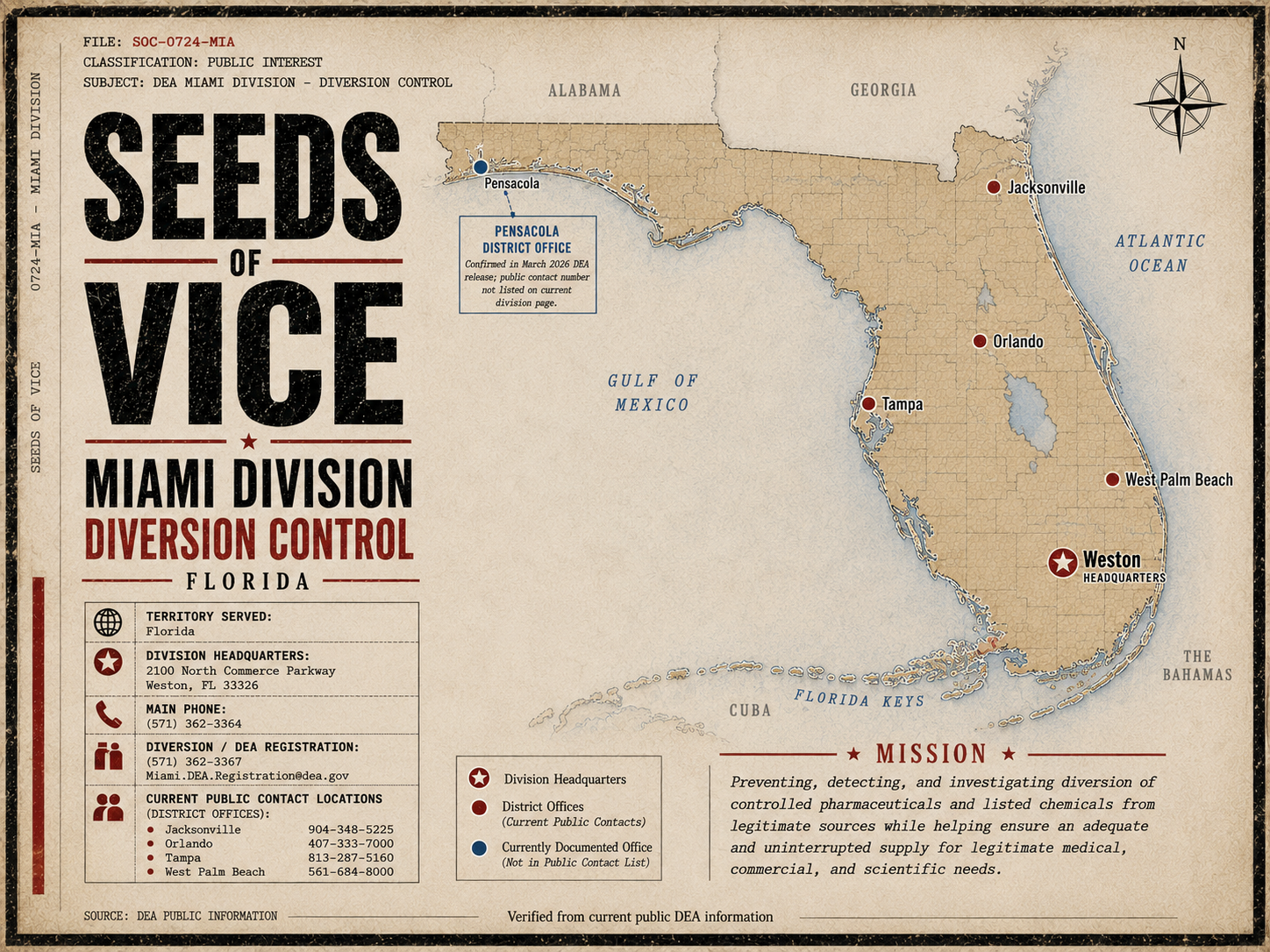
The Miami Division
DEA Miami Field Division
Last fully verified: July 25, 2026
The Drug Enforcement Administration’s Miami Division remains one of DEA’s principal domestic field commands, but its current territorial jurisdiction cannot be described accurately by relying on DEA’s division webpage alone.
DEA’s live Miami Division page continues to state that the division is “Serving Florida.” It also continues to list Jacksonville, Orlando, Tampa, and West Palm Beach as Miami contacts. Current federal enforcement records, however, repeatedly identify a separate Tampa Field Division, led by Special Agent in Charge Daniel Escobar, as responsible for matters in North Florida, Central Florida, the Florida Panhandle, and the Middle District of Florida. DEA has also created a separate Tampa Division webpage, although that page remains substantially incomplete.
The resulting public record is internally inconsistent.
The most defensible present conclusion is that DEA has operationally divided Florida between the Miami and Tampa field divisions, while several of its public-facing directories and contact pages still reflect the former statewide Miami structure.
DEA has not published a sufficiently detailed territorial map, county list, reorganization order, or fully reconciled office directory from which the exact boundary can be established.
Executive Finding
What is official
DEA’s current Miami Division page states that it serves Florida. It identifies the division headquarters at 2100 North Commerce Parkway and lists Jacksonville, Orlando, Tampa, and West Palm Beach as Miami contacts. The page names Miles D. Aley as the division’s Special Agent in Charge.
DEA has also published a separate Tampa Division page. Federal enforcement announcements issued during 2026 repeatedly identify the DEA Tampa Field Division as an operating field division under Special Agent in Charge Daniel Escobar. These announcements associate Tampa with cases in Gainesville, Tallahassee, Pensacola, the Panhandle, Orlando, and other parts of North and Central Florida.
Where the official record conflicts
DEA’s Miami webpage still claims statewide service and continues to display Tampa, Orlando, and Jacksonville as Miami offices.
DEA’s national field-division directory states that DEA operates through 23 domestic divisions and lists Miami, but it does not list Tampa among those divisions. Meanwhile, DEA and the Department of Justice are publicly describing Tampa as a field division in current criminal and civil matters.
The headquarters address is also presented inconsistently. One Miami page labels the location as Miami even though the street address and ZIP code are in Weston. DEA’s separate contacts page identifies Weston but displays an apparently malformed ZIP-code extension.
What can be concluded
DEA Miami remains operationally responsible for a substantial South Florida territory. Current cases demonstrate activity in Miami-Dade County, Broward County, Palm Beach County, the Treasure Coast, the Southern District of Florida, the waters approaching Miami, and trafficking routes connecting South Florida with the Caribbean and Latin America.
Current federal records also establish that Tampa is no longer merely a Miami district office. It is being represented publicly as a separate field division with its own Special Agent in Charge and its own operational responsibility.
The transition occurred no later than February 2026, when DEA publicly attributed North Florida investigations to the Tampa Field Division. A January 2026 record had still attributed a North Florida matter to Miami, indicating that the public transition occurred during the opening weeks of 2026 or that official records remained inconsistent during that period.
What cannot presently be concluded
The public record does not establish:
- The exact effective date of the Florida reorganization.
- The complete county-by-county boundary between Miami and Tampa.
- Whether West Palm Beach is the northernmost permanent Miami office.
- Whether any counties are served jointly during the transition.
- Whether DEA formally increased its national division count from 23 to 24.
- Whether Jacksonville, Orlando, and Tampa have been administratively removed from Miami even though they remain on Miami’s public pages.
- The complete present Miami Diversion personnel roster.
Seeds of Vice will not invent those answers.
Who the Miami Division Serves
The best-supported description is that the Miami Division serves South Florida and the southeastern portion of the Florida peninsula, including the Southern District of Florida and the Atlantic and Caribbean approaches to Miami.
Its operational environment includes:
- Miami-Dade, Broward, and Palm Beach counties.
- The Treasure Coast and Port St. Lucie area.
- South Florida ports, airports, postal facilities, highways, and coastal waters.
- Maritime trafficking routes entering through the Florida Straits, the Bahamas, Turks and Caicos, and the wider Caribbean.
- International investigations involving Latin America and the Caribbean.
- Controlled-substance registrants and pharmaceutical operations within its assigned territory.
This is an evidence-based operational description, not a substitute for the territorial map DEA has not yet published.
DEA’s current records support West Palm Beach as an active Miami component. A May 2026 fentanyl case specifically states that the investigation was conducted by the DEA Miami Field Division’s West Palm Beach District Office.
By contrast, current records associate Orlando and the Middle District of Florida with the Tampa Field Division, while North Florida matters are also being attributed to Tampa.
Territory and Office Structure
Miami Division Headquarters
Official street address:
2100 North Commerce Parkway
Weston, Florida 33326
DEA’s main Miami page identifies this address as Miami, while its separate contact page identifies it as Weston. The physical address is in Weston, Broward County.
West Palm Beach District Office
DEA continues to list West Palm Beach as a Miami contact, and current enforcement records confirm that the West Palm Beach District Office was operating under the Miami Field Division in 2026.
Public telephone: 561-684-8000
Legacy offices still displayed under Miami
DEA’s public Miami pages continue to display:
| Office | Published telephone | Current public-record status |
|---|---|---|
| Jacksonville | 904-348-5225 | Still listed by Miami, but current North Florida cases are attributed to Tampa |
| Orlando | 407-333-7000 | Still listed by Miami, but current Middle District matters are attributed to Tampa |
| Tampa | 813-287-5160 | Still listed by Miami despite the creation of a separate Tampa Field Division |
| West Palm Beach | 561-684-8000 | Current records continue to associate it with Miami |
The telephone numbers may remain functional, but DEA’s current pages do not reliably communicate the administrative division to which each office now reports.
This is more than a cosmetic website problem. Registrants, patients, practitioners, attorneys, journalists, and members of the public should be able to determine which field command is responsible for a particular location without reconstructing the answer from scattered prosecution announcements.
Current Leadership and Publicly Identified Personnel
Miles D. Aley
Special Agent in Charge
Miles D. Aley was appointed Special Agent in Charge of the Miami Field Division in February 2026.
Before assuming command, Aley served as a deputy chief of operations in DEA’s Office of Foreign Operations. His prior assignments included responsibility for DEA operations in Mexico and other parts of North and Central America, service as an Assistant Special Agent in Charge in Kansas City, work within the Special Operations Division, command experience in Las Vegas, and service as the Guatemala Country Attaché. He entered DEA in 2003 after working as a police officer in Auburn, Alabama.
His background is particularly relevant to Miami because the division’s work is inseparable from international trafficking, Caribbean routes, transnational criminal organizations, maritime interdiction, and cooperation with foreign counterparts.
Gretchen Rovira
Community Outreach Contact
DEA publicly identifies Gretchen Rovira as the Miami Division’s community-outreach contact.
Telephone: 954-612-3285
Email: Gretchen.M.Rovira@dea.gov
Public Information Office
DEA does not currently identify an individual Miami public-information officer on the main division page.
Media telephone: 571-362-3364, option 5
Email: Miami.FD.PIO@dea.gov
Diversion personnel
The current Miami Diversion Program Manager and the division’s complete Diversion personnel roster could not be verified from current official public sources.
Susan Langston was publicly identified as the Miami Division’s Diversion Program Manager in a 2019 pharmacy settlement announcement. That is a historical identification and should not be interpreted as evidence that she currently holds the position.
The absence of current publicly named Diversion leadership is significant because registrants and patients are directly affected by Diversion policy and enforcement, yet the officials exercising that authority are often less visible than the agents leading conventional drug-trafficking investigations.
Official Role and Mission
The Miami Division is a regional DEA field command. It is not the national Diversion Control Division.
Its responsibilities include enforcing the federal Controlled Substances Act, investigating drug-trafficking organizations, conducting international and maritime investigations, supporting task forces, pursuing controlled-substance violations, and carrying out Diversion functions affecting lawful manufacturers, distributors, pharmacies, practitioners, researchers, and other DEA registrants.
DEA states that its Diversion Control mission is to:
- Prevent, detect, and investigate the diversion of controlled pharmaceuticals and listed chemicals from legitimate channels.
- Ensure an adequate and uninterrupted supply of controlled substances for legitimate medical, commercial, and scientific needs.
Those are concurrent obligations.
Diversion Control is not officially defined solely as restricting medicine. DEA is also charged with protecting the legitimate channel and preserving an adequate supply.
That second obligation must remain visible whenever enforcement activity is discussed.
How the Miami System Works in Practice
International and maritime enforcement
Miami’s geography makes the division a gateway command.
In May 2026, three Dominican nationals pleaded guilty after authorities intercepted a vessel approximately six nautical miles from Government Cut carrying approximately 1,694 kilograms of cocaine. The investigation involved DEA Miami, Homeland Security Investigations, the Coast Guard, Customs and Border Protection, and the FBI. The documented route involved the Turks and Caicos Islands and an intended return toward Miami.
The case demonstrates that Miami’s jurisdiction cannot be understood only by drawing lines across Florida counties. Its practical operating territory extends through maritime corridors and international investigative relationships.
Caribbean coordination
In May 2026, DEA’s Caribbean Division and the Dominican Republic’s National Directorate for Drug Control held a strategic meeting at the Miami Field Division headquarters. Miles Aley participated in discussions involving intelligence sharing, operational coordination, and trafficking activity across the Caribbean.
Miami therefore functions both as a domestic field division and as an important coordination point between domestic enforcement and foreign or territorial operations.
Counterfeit pills and synthetic opioids
A May 2026 federal indictment alleged that a China-based source supplied protonitazene for a counterfeit-pill operation connected to Miami-Dade County. Prosecutors alleged that pill presses were used to manufacture tablets distributed across the United States, including from South Florida to Nevada.
An indictment is an allegation. The defendants remain presumed innocent unless and until proven guilty.
Protonitazene and counterfeit tablets illustrate the distinction between the lawful pharmaceutical channel and the illicit market. A pill manufactured to resemble legitimate oxycodone may contain a substance that was never prescribed, dispensed, or produced through a regulated pharmacy.
Violent drug organizations
Operation Hurricane, announced in July 2026, involved an ATF-led investigation supported by DEA Miami and numerous federal, state, and local agencies. Authorities announced charges against 38 federal and eight state defendants and reported the seizure of 94 firearms, more than 600 rounds of ammunition, and approximately 9.4 kilograms of controlled substances.
The announced charges remain allegations, and the defendants are presumed innocent unless convicted.
Postal and regional distribution networks
In May 2026, a Port St. Lucie defendant was sentenced to 15 years in federal prison after pleading guilty in a case involving at least 15,000 counterfeit fentanyl pills, approximately 2,000 grams of fentanyl, and a firearm. The tablets had been pressed to resemble oxycodone. The investigation was conducted by the DEA Miami Field Division’s West Palm Beach District Office.
Drug-related homicide
In April 2026, two defendants received federal sentences of 230 months and 330 months following guilty pleas connected to a 2022 Miami murder arising from a methamphetamine transaction. DEA Miami participated in the investigation.
These cases show a division confronting maritime importation, international suppliers, counterfeit pharmaceuticals, street distribution, firearms, postal shipments, and drug-related violence at the same time.
Diversion Control and Lawful Medicine
The Miami Division’s Diversion personnel operate within a very different legal environment from agents investigating maritime cocaine shipments or armed trafficking organizations.
Diversion investigators interact with lawful registrants, including:
- Physicians and other prescribers.
- Pharmacies and pharmacists.
- Hospitals and clinics.
- Manufacturers and distributors.
- Researchers.
- Importers and exporters.
- Narcotic-treatment programs.
- Other entities authorized to possess or handle controlled substances.
Their work may include registration matters, inspections, recordkeeping reviews, suspicious-order investigations, administrative proceedings, civil referrals, and criminal investigations where intentional diversion is alleged.
A historical Orlando pharmacy matter illustrates the distinction between a civil regulatory resolution and a criminal conviction. In 2019, Taylor’s Pharmacy and Florida Discount Drugs paid $107,500 to resolve federal Controlled Substances Act allegations involving distributions to unregistered individuals and recordkeeping violations.
The payment resolved allegations. It was not described as a criminal conviction, and the pharmacies’ location and administrative alignment predated the current Tampa reorganization.
Legal posture matters. A settlement is not a guilty plea. An indictment is not a conviction. An administrative action is not automatically a criminal prosecution.
Florida’s State-Control Layer
DEA enforcement operates alongside Florida law, the state prescription-drug-monitoring program, medical-board expectations, insurer rules, pharmacy policies, and institutional risk-management systems.
Acute-pain prescription limits
Florida law generally limits a Schedule II opioid prescription for acute pain to a three-day supply.
A prescriber may issue up to a seven-day supply when the prescriber determines that it is medically necessary, documents the justification, and marks the prescription “ACUTE PAIN EXCEPTION.”
Prescriptions for pain that does not meet the statutory definition of acute pain must be marked “NONACUTE PAIN.” Florida law also requires discussion and documentation of nonopioid alternatives in covered circumstances.
E-FORCSE and mandatory consultation
Florida’s prescription-drug-monitoring program, E-FORCSE, receives dispensing information for Schedule II through Schedule V controlled substances.
Prescribers and dispensers, or their authorized designees, generally must consult the system before prescribing or dispensing a controlled substance to a patient aged 16 or older, subject to statutory exceptions. When the system cannot be consulted, the reason must be documented and the prescription is generally restricted to a three-day supply.
Florida’s statute also states that the system must not infringe upon the legitimate prescribing or dispensing of controlled substances by a practitioner acting in good faith and in the course of professional practice.
The legal system therefore contains the same tension expressed in DEA’s mission: prevent diversion while preserving legitimate medical access.
How the System Affects Pain Patients and Lawful Medicine
The Miami Division does not independently create Florida prescribing statutes, insurance rules, pharmacy corporate policies, medical-board standards, or individual clinical decisions.
It nevertheless operates within an enforcement environment that influences how controlled-substance risk is perceived by institutions and practitioners.
Legitimate protective effects
Effective enforcement can protect patients by:
- Removing counterfeit tablets represented as legitimate medicine.
- Identifying illicit fentanyl and synthetic opioids.
- Preventing theft or intentional diversion from pharmacies.
- Requiring accurate controlled-substance inventories and records.
- Investigating practitioners or registrants who knowingly operate outside professional practice.
- Disrupting violent organizations using pharmaceutical imagery to disguise illicit products.
The Port St. Lucie and protonitazene cases demonstrate why a protected lawful channel matters. Counterfeit pills are dangerous in part because they imitate the appearance of regulated medicine while bypassing its manufacturing, prescribing, dispensing, and labeling safeguards.
Chilling effects and overcorrection
The same enforcement environment can contribute to institutional overcorrection when numerical thresholds, enforcement fears, pharmacy rules, or administrative policies are treated as substitutes for individualized medical judgment.
The Centers for Disease Control and Prevention has acknowledged that the 2016 opioid-prescribing guideline was misapplied through rigid dosage thresholds, rapid tapers, abrupt discontinuation, inflexible duration limits, patient dismissal, and abandonment.
CDC identified consequences including untreated or undertreated pain, withdrawal, worsening pain, psychological distress, overdose, and suicidal ideation or behavior.
That finding does not establish that DEA alone caused these harms.
The practical treatment environment is produced by the interaction of:
- Federal enforcement.
- State legislation.
- Medical licensing authorities.
- Prescription monitoring.
- Insurers.
- Pharmacy chains.
- Hospital and clinic policies.
- Civil-liability concerns.
- Professional guidelines.
- Individual clinical judgment.
- Illicit-market conditions.
A defensible analysis must recognize the combined system rather than assigning every consequence to one institution.
At the same time, DEA should not be treated as irrelevant merely because it is not the only institution involved. The possibility of investigation, registration action, civil penalties, or criminal referral is part of the environment in which controlled-substance decisions are made.
Prescribing and Dose-Decline Context
The evidentiary boundary
Seeds of Vice begins its historical inquiry in 1984, but no directly comparable annual Florida retail opioid-dispensing series was located for every year beginning in 1984.
The available evidence must therefore be presented in separate historical layers.
1984–1998
No comparable annual Florida prescription-rate series was identified for this period.
Seeds of Vice will not interpolate missing years or represent later data as though it extends continuously back to 1984.
1999–2005
National opioid-volume evidence exists for this broader era, but it is not directly interchangeable with Florida prescriptions per 100 residents.
CDC has reported that national opioid prescribing measured in morphine milligram equivalents per capita was still approximately three times its 1999 level in 2015, even after declining from its 2010 peak. That comparison uses a different metric from the Florida prescription-rate series presented below.
2006–2020 Florida dispensing rates
The following figures represent retail opioid prescriptions per 100 Florida residents:
| Year | Prescriptions per 100 residents |
|---|---|
| 2006 | 79.7 |
| 2007 | 82.2 |
| 2008 | 84.3 |
| 2009 | 86.3 |
| 2010 | 87.6 |
| 2011 | 83.5 |
| 2012 | 75.9 |
| 2013 | 73.5 |
| 2014 | 71.4 |
| 2015 | 67.1 |
| 2016 | 66.6 |
| 2017 | 61.5 |
| 2018 | 53.7 |
| 2019 | 45.4 |
| 2020 | 43.4 |
These figures were reported through Florida and CDC-derived annual surveillance materials. CDC’s dispensing methodology uses IQVIA retail-pharmacy data, covering approximately 94 percent of retail prescriptions, and generally assigns geography according to the prescriber’s location. It excludes certain channels, including mail-order dispensing and methadone dispensed through opioid-treatment programs.
2021–2022
CDC datasets extend into these years, but exact Florida annual figures were not reproduced here because the currently accessible official text reviewed for this page did not expose the state values with sufficient clarity.
The missing figures should be added only after direct dataset verification. They should not be estimated from surrounding years.
2023
Florida’s reported opioid-dispensing rate was 37.4 prescriptions per 100 residents in 2023.
Compared with the 2010 Florida peak of 87.6, the 2023 rate represents a decline of approximately 57.3 percent.
Compared with 2012, when Florida’s rate was 75.9, the 2023 rate represents a decline of approximately 50.7 percent.
These percentages are Seeds of Vice calculations based on the underlying reported rates.
July 2023 through June 2024
Florida’s 2023–2024 prescription-monitoring report recorded:
- 11,699,632 opioid prescriptions.
- 3,024,162 adult Florida patients receiving those prescriptions.
- A 2.3 percent decline in opioid prescriptions from approximately 12.0 million to 11.7 million.
- A decline in average daily MME per opioid prescription from 49.9 to 46.5.
- Approximately 230.2 million total PDMP queries.
- Approximately 172.7 million queries through integrated electronic systems.
- 3,298 electronic-health-record and pharmacy integrations.
The same report stated that total Schedule II through Schedule V prescriptions increased by 4.7 percent to 30,205,430, demonstrating that opioid decline and total controlled-substance activity are not identical measures.
2024 national benchmark
The national retail opioid-dispensing rate declined from 46.8 prescriptions per 100 residents in 2019 to 35.4 in 2024. CDC continued to report the highest state rates primarily in portions of the South.
An exact Florida 2024 state rate was not stated in the accessible current CDC text reviewed for this page. The national figure should not be substituted for Florida’s figure.
Overdose Context
Florida reported that total drug-related deaths declined by approximately 14 percent in 2024 compared with 2023, while opioid-related deaths declined by approximately 26 percent.
Those declines are important, but they do not by themselves prove that any particular DEA policy, prescribing reduction, public-health intervention, naloxone program, illicit-market change, or law-enforcement operation caused the result.
Overdose mortality and medical access must also be measured separately.
A reduction in illicit deaths does not establish that every lawful patient received adequate care. Likewise, evidence of undertreated pain does not negate the public benefit of removing counterfeit fentanyl or protonitazene tablets.
Both realities can exist at the same time.
Representative Miami Division Matters
Maritime cocaine interdiction — guilty pleas
Three Dominican nationals pleaded guilty in May 2026 following the seizure of approximately 1,694 kilograms of cocaine from a vessel intercepted near Government Cut.
Port St. Lucie counterfeit-pill case — guilty plea and sentence
A defendant received a 15-year sentence following a guilty plea in a case involving fentanyl tablets pressed to resemble oxycodone, bulk fentanyl, and a firearm.
Miami drug-related murder — guilty pleas and sentences
Two defendants were sentenced to 230 and 330 months after pleading guilty in connection with a methamphetamine-related murder.
Protonitazene counterfeit-pill case — indictment
Federal prosecutors alleged that protonitazene obtained through a China-based source was used in a Miami-Dade counterfeit-pill operation. The charges are allegations, and the defendants remain presumed innocent.
Operation Hurricane — pending charges
Federal and state authorities announced charges against dozens of defendants following a multiagency investigation involving firearms and controlled substances. The defendants are presumed innocent unless convicted.
Taylor’s Pharmacy — civil settlement
Two Orlando-area pharmacies paid $107,500 in 2019 to resolve Controlled Substances Act allegations involving distributions to unregistered individuals and recordkeeping. The matter was resolved as a civil settlement and predates the current Florida field-division reorganization.
Contact Information
Miami Field Division
Main telephone: 571-362-3364
Media: 571-362-3364, option 5
Media email: Miami.FD.PIO@dea.gov
Recruitment: 571-362-3106
Recruitment email: Miami.Recruiting@dea.gov
Diversion and DEA registration: 571-362-3367
Registration email: Miami.DEA.Registration@dea.gov
Training: 571-362-2942
Training email: Miami.Training@dea.gov
Community outreach: Gretchen Rovira
Telephone: 954-612-3285
Email: Gretchen.M.Rovira@dea.gov
Headquarters:
2100 North Commerce Parkway
Weston, Florida 33326
Published district-office numbers
Jacksonville: 904-348-5225
Orlando: 407-333-7000
Tampa: 813-287-5160
West Palm Beach: 561-684-8000
Because DEA’s Florida reorganization remains unreconciled across its public pages, callers should verify which division currently controls the relevant county, registration matter, or investigation.
Seeds of Vice Analysis
The Miami Division’s present identity is no longer that of a single field command transparently serving every part of Florida.
It is increasingly identifiable as a South Florida gateway division: maritime interdiction, international coordination, Caribbean and Latin American trafficking routes, counterfeit-pill networks, violent drug organizations, postal distribution, and Diversion oversight within one of the country’s most strategically significant controlled-substance environments.
The strongest evidence of current jurisdiction comes from recent operational attribution—not from DEA’s outdated contact lists.
When DEA states in current court-related announcements that Tampa handled a Gainesville, Tallahassee, Pensacola, Orlando, or Middle District matter, that is stronger evidence of present command responsibility than a legacy Miami webpage that still lists every former Florida office.
That does not authorize Seeds of Vice to draw an exact territorial line that DEA itself has not published.
The proper finding is narrower:
Florida has been operationally divided between the Miami and Tampa field divisions, but DEA has not adequately reconciled or explained that division to the public.
The inconsistency matters because geographic responsibility determines where registrants seek guidance, where attorneys direct inquiries, which leadership bears public accountability, which Diversion personnel supervise an area, and which institution should answer questions concerning enforcement practice.
DEA should publish:
- The formal effective date of the Tampa Field Division.
- A county-by-county territorial map.
- A corrected national division count.
- A reconciled Florida office directory.
- Accurate headquarters addresses.
- Current Special Agent in Charge and Assistant Special Agent in Charge rosters.
- Current Diversion Program Manager information.
- Clear registration and compliance contacts for each Florida territory.
Seeds of Vice also rejects two false choices.
It is not necessary to deny the danger of counterfeit fentanyl, protonitazene, violent trafficking, or intentional pharmaceutical diversion in order to defend lawful pain patients.
It is equally unnecessary to treat every prescribing decline or patient abandonment as an unavoidable price of enforcement.
DEA’s own mission recognizes both sides of the responsibility: prevent diversion and ensure an adequate, uninterrupted supply for legitimate need.
The question is not whether controlled substances should be regulated.
The question is whether the system can distinguish the dangerous from the harmless, the counterfeit from the prescribed, the criminal actor from the legitimate patient, and intentional diversion from good-faith medical care.
A system that cannot make those distinctions does not merely control drugs.
It controls permission without adequately accounting for the people who must live beneath it.
Methodology and Evidentiary Limits
This page prioritizes current primary sources from DEA, the United States Department of Justice, the Florida Legislature, the Florida Department of Health, and the Centers for Disease Control and Prevention.
The following rules were applied:
- Current operational records were given greater weight than unreconciled legacy directories.
- No territorial boundary was represented as formal unless DEA had formally documented it.
- Allegations were distinguished from guilty pleas, convictions, sentences, civil settlements, and administrative matters.
- Historical personnel were not represented as current personnel.
- Prescriptions per 100 residents were not mixed with MME per capita, average MME per prescription, patient counts, or total prescription counts.
- Missing annual figures were not interpolated.
- National figures were not substituted for Florida figures.
- Correlation was not represented as causation.
- DEA enforcement was analyzed as one component of a larger prescribing and institutional system.
- Official mission statements were separated from Seeds of Vice interpretation.
Last fully verified: July 25, 2026


Bestsellers
-

A gift of Luck
-

Proof of Progress: Mr. DEA’s Diversion Autographed Hardcover & Seed Pack
$39.99 -

Seeds of Vice ™
$24.99 -

Seeds of Vice Book Set
$119.00 -
Seeds of Vice: On Poppy Tea Autographed Hardcover & Seed Pack
Original price was: $39.99.$29.99Current price is: $29.99. -

Seeds of Vice: On The Poppy Plant Autographed Hardcover & Seed Pack
$55.00
