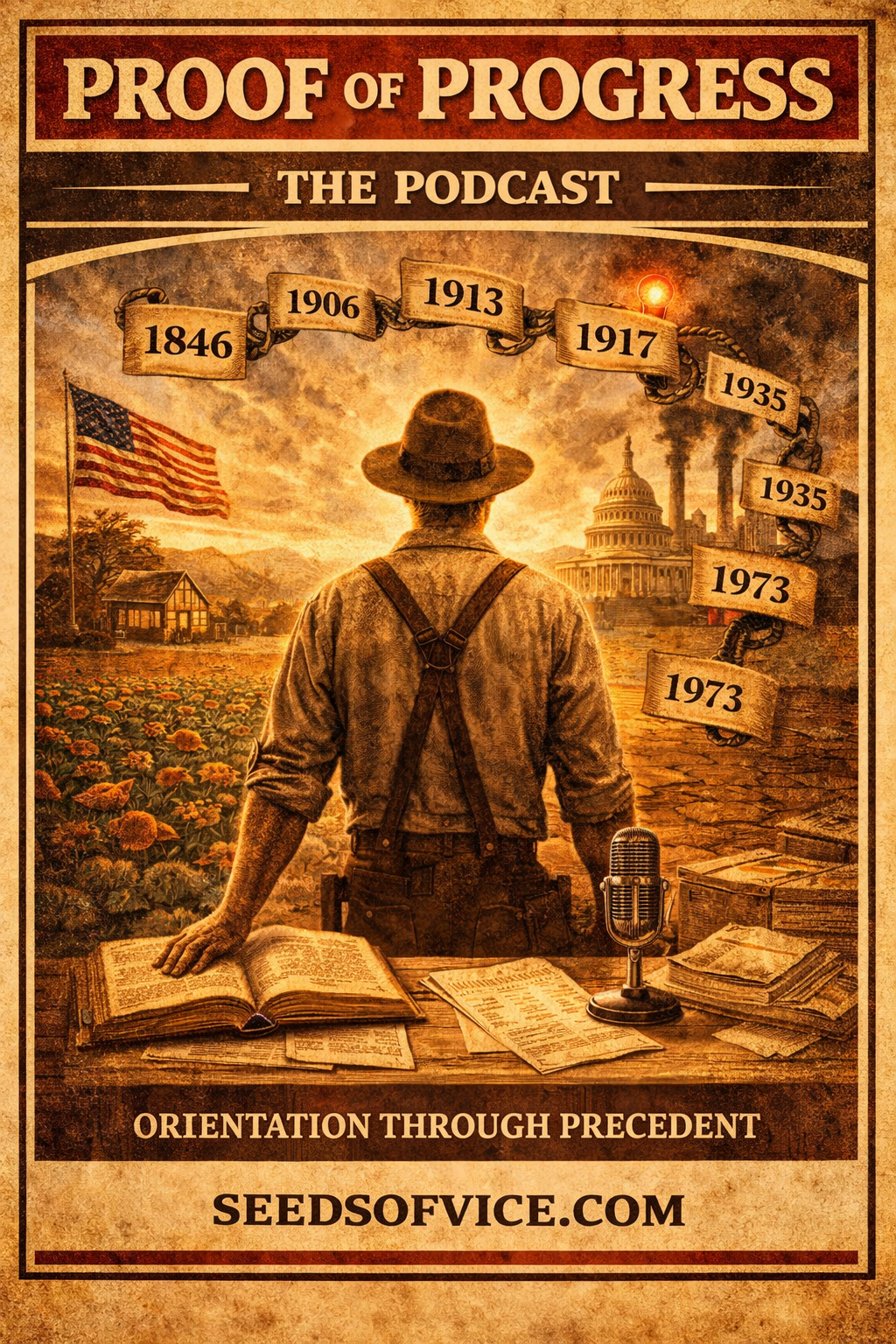
Proof of Progress
The Podcast
This project is not a podcast in the conventional sense. It is not commentary, persuasion, or debate. It is a system of orientation. Its purpose is to place the listener within a sequence of structural changes that occurred in the United States over time, without telling them what to think about those changes.
The series operates under a strict discipline: it does not argue, it does not conclude, and it does not instruct. It presents. It arranges. It allows.
The objective is not agreement. The objective is recognition.
The subject of the series is not politics in the contemporary sense, nor is it ideology, nor is it personality. The subject is the evolution of our governing structure… specifically, how systems were created, how they persisted, how they expanded, and what those expansions made possible.
Events are selected not for their emotional weight, cultural visibility, or controversy, but for their structural consequence. The question is always the same: did this create or expand a system that persisted beyond its origin?
If it did not, it does not belong.
The series proceeds chronologically. It does not rearrange history for narrative effect. It does not group by theme. It moves forward in time, stopping only when a structural change occurs.
The Episodes
Each episode centers on a single primary shift. It does not compress multiple unrelated events. It does not summarize eras. It isolates the moment where something changed and shows what that change allowed the government to do moving forward.
Causality is handled with restraint. Only direct, mechanical relationships are stated. If something made something else possible, it may be said. If it requires interpretation, it is not said.
The tone is restrained, precise, and consistent. It is not casual, and it is not performative. It reflects a controlled literary voice… clear, rhythmic, and disciplined. It does not rely on emotion, emphasis, or persuasion.
Language is chosen for clarity’s sake.
Controversy is acknowledged but not explored. It may be noted that disagreement existed, but no sides are presented, and no conflict is analyzed. The focus remains on what changed structurally, not who supported or opposed it. Although it most certainly is about the progress of progressives and their progressive movement from it’s beginning into our future.
Individuals are named only when necessary to understand the structure. They are not treated as central figures. They are actors within a system, not the subject of the story.
The episodes settle arguments rather than starting them. They interconnect and the later ones reframe earlier ones. The listener begins to see patterns over time, not because they were told, but because they were shown.
A secondary layer exists beneath the surface of each episode: the repetition of tactics. These are not stated as conclusions. They are presented as descriptions. The listener may observe that similar methods appear across time. This observation is never forced but it is history and what is happening has happened many times in our past. It’s important to me to point that out even if only as an undertone.
The series begins with public health not because it is controversial, but because it is clear. It provides a visible, understandable entry point into system creation. From there, the series progresses through temperance, suffrage, financial systems, regulatory frameworks, and administrative expansion, ultimately arriving at the present structure.
There is no final conclusion.
There is no resolution.
Each episode ends with a question, not an answer. The purpose of the question is not to guide the listener to a specific position, but to leave tension unresolved.
This project exists within a broader framework. It aligns with a larger body of work that emphasizes personal sovereignty, responsibility, and the boundary of harm. However, those ideas are not argued within this series. They exist outside it. This series provides the structural foundation upon which those ideas may later rest.