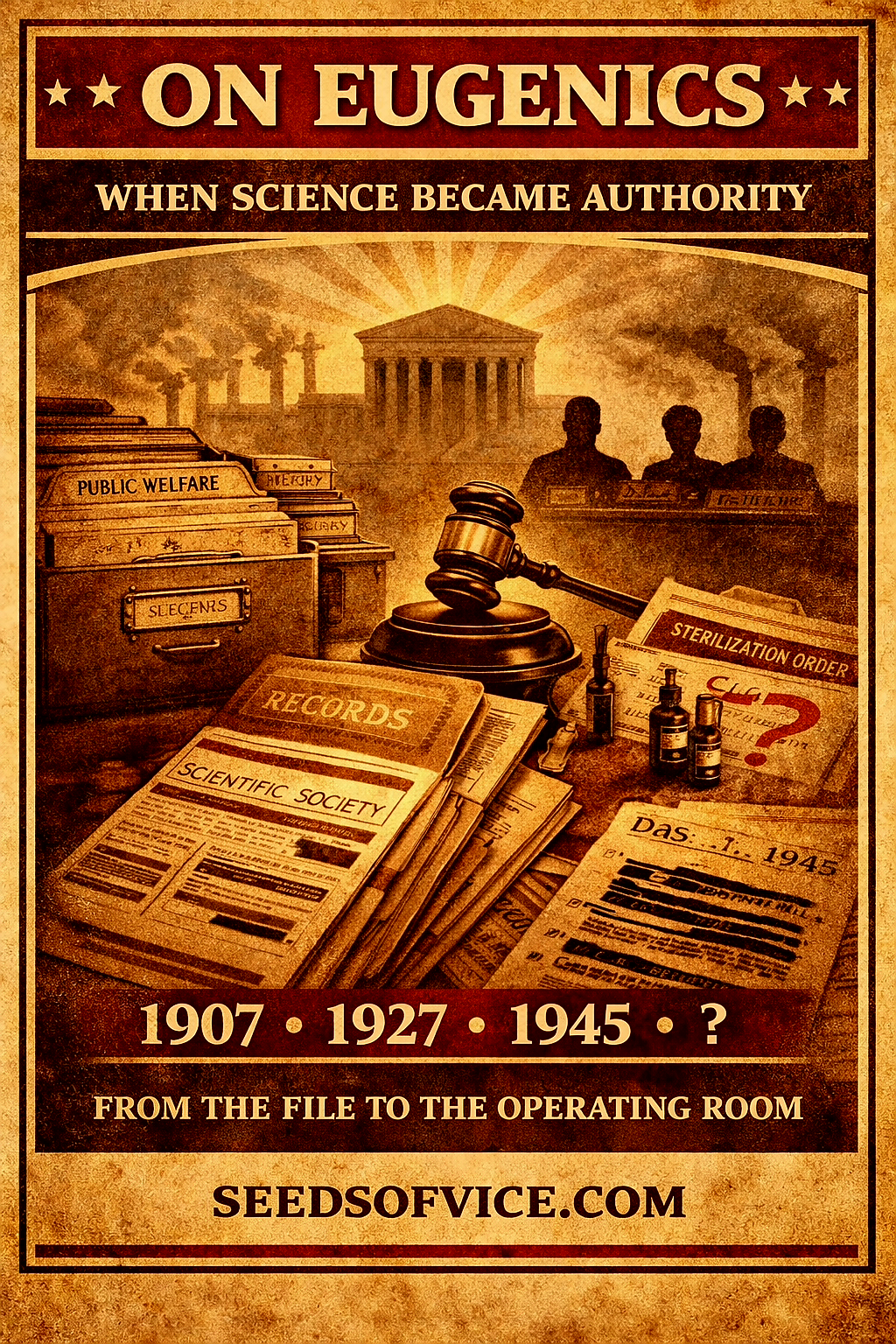
On Eugenics
Section I — American Eugenics Before World War I: Foundations
Introduction: Eugenics Before It Had an Enemy
Eugenics did not begin as a warning sign nor a stigma. It began as an answer.
At the turn of the twentieth century, the United States was facing rapid industrialization, mass immigration, mass urbanization, and visible poverty on a scale the nation had never experienced. Political leaders, academics, physicians, and social reformers confronted a shared question: How does a modern society manage human difference at scale?
Eugenics emerged as a proposed solution… scientific, progressive, and, above all, respectable.
Long before it became associated with atrocities abroad, eugenics in America was taught in universities, funded by major philanthropic institutions, endorsed by public health officials, and ultimately ratified by courts. It was not fringe ideology. It was institutional consensus.
Understanding this origin is essential, because it establishes a critical point that modern discussions often avoid: eugenics did not arise from hatred or tyranny, but from confidence… confidence that the state could improve society by managing biology, behavior, and reproduction.
This section traces how that confidence took shape in the United States before World War I, laying the intellectual and institutional groundwork that would later be studied, cited, and radicalized elsewhere.
The Intellectual Origins: From Heredity to Policy
The term eugenics was coined in the late nineteenth century to describe the idea that human traits such as intelligence, morality, criminality, poverty were largely inherited and could therefore be managed through selective reproduction. While the concept originated in Europe, it found unusually fertile ground in the United States.
This was not accidental.
America at the turn of the century viewed itself as a laboratory for progress. The same mindset that drove industrial efficiency, scientific management, and public sanitation also encouraged the belief that social problems could be engineered away through rational planning. Eugenics fit neatly into this worldview.
What distinguished American eugenics was not its originality, but its translation into governance.
Rather than remaining an abstract theory, it became a framework for law, medicine, education, and public administration. The question was no longer whether heredity influenced outcomes, but whether the state had a responsibility to intervene when heredity appeared to threaten society.
Institutional Legitimacy: Universities, Foundations, and Science
By the early 1900s, eugenics had become embedded within elite American institutions.
Universities incorporated eugenic principles into biology, sociology, and public health curricula. Courses on heredity and “social fitness” were taught not as ideology, but as applied science. Students who would later become judges, physicians, and policymakers encountered eugenics as a rational extension of Darwinian thought.
At the same time, major philanthropic organizations provided funding and legitimacy. Research institutions dedicated to studying heredity, population quality, and social outcomes received support from prominent foundations whose influence shaped American science and medicine broadly.
This funding did more than support research… it signaled respectability. When eugenics was backed by institutions associated with medical breakthroughs and public welfare, it appeared neither radical nor cruel. It appeared responsible.
The most influential of these efforts was the establishment of centralized record-keeping institutions designed to catalogue hereditary traits across generations. Family histories were collected, classified, and analyzed to identify patterns believed to predict social outcomes such as crime, poverty, disability, and dependency.
The language used was clinical, not punitive. Individuals were described as “unfit,” “defective,” or “burdens” not as insults, but as a matter of classification… terms that framed human beings as variables in a population model. This framing would prove decisive.
Progressivism and the Moral Case for Intervention
Eugenics aligned closely with the Progressive Era’s emphasis on reform, expertise, and government action. Progressives believed that trained professionals, armed with data and insulated from political pressures, could manage society more effectively than markets or tradition.
Within this framework, non-intervention came to be viewed not as restraint, but as negligence.
If disease could be prevented through sanitation, why not prevent social dysfunction through reproduction control? If public health could justify quarantines, why not justify sterilization? If children could be removed from abusive homes, why not prevent the birth of children deemed likely to suffer or impose costs on society?
These questions were not asked cynically. They were asked earnestly, in legislative hearings, academic journals, and courtrooms.
Eugenics promised efficiency. It promised compassion through prevention. It promised a future with fewer prisons, fewer asylums, and fewer dependents… achieved not through punishment, but through management…
Crucially, eugenics reframed suffering as a problem to be minimized at the population level, even if doing so required imposing hardship on individuals.
This shift from individual rights to aggregate outcomes would become the defining feature of modern administrative systems.
Public Health as the Vehicle Eugenics gained its greatest power by aligning itself with public health.
Public health had already demonstrated success in combating infectious disease through collective measures: vaccination, sanitation, quarantine. These interventions normalized the idea that individual autonomy could be limited in the name of communal well-being.
Eugenic thinkers extended this logic inward, from pathogens to people.
If certain individuals were believed to contribute disproportionately to social costs through illness, dependency, or criminality then restricting their reproductive capacity could be framed as preventive medicine. Sterilization was described not as punishment, but as treatment. Institutionalization was portrayed as care.
This medicalization mattered. It shifted authority away from legislatures and toward experts. Decisions about who should reproduce, who should be confined, and who should be restricted were increasingly framed as technical judgments rather than moral ones.
Once classified as health policy, these decisions became insulated from democratic scrutiny.
The Role of Law: Preparing the Ground
By the time the first compulsory sterilization laws were proposed, much of the intellectual work had already been done.
Courts had accepted the premise that the state could act in the interest of public welfare. Legislatures had accepted the premise that experts should guide social policy. The public had been conditioned to view intervention as humane rather than coercive.
Early eugenic statutes were often narrowly framed, targeting those confined in institutions such as prisons, mental hospitals, poorhouses. This incremental approach reduced resistance and normalized the practice.
Each law reinforced a key assumption: that some lives could be managed without consent for the benefit of society.
Once that assumption was established, expansion was not a leap, but a progress.
An Exportable Model
By the eve of World War I, the United States had accomplished something historically significant: it had transformed eugenics from a speculative theory into an operational system.
It had:
legitimized population management through science
embedded heredity into public policy
established legal precedent for bodily intervention
framed coercion as care
These developments did not go unnoticed abroad.
American journals, statutes, and court decisions were studied internationally. U.S. immigration law, sterilization policies, and racial classifications were translated, analyzed, and, in some cases, praised by foreign policymakers seeking models for their own societies.
What made the American example influential was not extremism, but normalization.
Eugenics in the United States did not appear as a warning. It appeared as governance.
Transition Forward
This foundation matters because it sets the stage for what follows.
When later regimes adopted eugenic policies, they did not do so in a vacuum. They drew upon an existing body of law, science, and administrative practice that had already answered the hardest question:
Can the state override individual autonomy in the name of collective improvement?
In the United States, the answer had already been given.
The next section examines how that answer was formalized… explicitly and unmistakably… by American law.
Legal Codification in the United States: When Eugenics Became Law
Section II
Introduction: From Expert Opinion to State Power
By the early twentieth century, eugenics no longer needed to be sold. It needed only to be implemented.
The intellectual groundwork had been laid. Universities had taught it. Foundations had funded it. Public health officials had normalized it. What remained was the most consequential step of all:
legal authorization.
This section examines how eugenics moved from advisory science to enforceable law in the United States, and why that transition mattered more than any particular statute. Once eugenics entered the legal system, it ceased to be a theory about heredity and became a doctrine about authority… specifically, the authority of the government over the bodies of its citizens.
The importance of this moment cannot be overstated. Law does not merely reflect values; it operationalizes them. When courts and legislatures endorse a principle, they convert it into precedent, repetition, and habit. Eugenics did not require universal agreement to succeed. It required only legal permission.
It received it.
The First Compulsory Sterilization Laws
The first compulsory sterilization law in the United States was enacted in Indiana in 1907. The statute authorized the involuntary sterilization of individuals deemed “confirmed criminals, idiots, imbeciles, and rapists” who were confined in state institutions.
This law did not emerge from panic or revolution. It was passed quietly, with support from medical professionals and reformers who framed sterilization as a humane alternative to lifelong confinement. The language emphasized prevention, not punishment.
Indiana’s statute set a precedent… not because it was especially harsh, but because it demonstrated that bodily autonomy could be overridden by legislative judgment without violating prevailing constitutional interpretations.
Other states followed.
Over the next three decades, more than thirty U.S. states enacted sterilization laws. While the specifics varied, the logic remained consistent: individuals classified as unfit could be permanently altered without consent if doing so served the public interest.
The targets expanded over time. Initially focused on institutionalized populations, sterilization statutes increasingly encompassed:
the disabled
the mentally ill
the poor
the socially dependent
the incarcerated
The unifying characteristic was not danger to others, but perceived burden to society.
Administrative Process and the Appearance of Due Process
One of the most important and least discussed features of American eugenic law was its bureaucratic structure.
Sterilization decisions were typically made through administrative boards composed of physicians, superintendents, and occasionally judges. Hearings were often perfunctory. Appeals were rare. Consent was frequently implied, coerced, or entirely absent.
Yet the presence of process mattered. It created the appearance of legality and care. Decisions were recorded, reviewed, and archived. This documentation insulated the system from moral scrutiny by framing sterilization as a regulated procedure rather than a moral transgression.
The law did not present itself as violent. It presented itself as orderly.
This administrative model… expert judgment insulated by procedural formalities… would later become a defining feature of modern governance across domains far beyond eugenics.
Buck v. Bell (1927): Judicial Endorsement
The most consequential moment in the legal history of American eugenics came in 1927, when the Supreme Court decided Buck v. Bell.
The case involved Carrie Buck, a young woman institutionalized in Virginia and labeled “feeble-minded.” The state sought to sterilize her under its eugenic statute. Buck challenged the law, arguing that compulsory sterilization violated her constitutional rights.
The Court disagreed.
In an 8–1 decision, the Supreme Court upheld Virginia’s sterilization law. Justice Oliver Wendell Holmes Jr., writing for the majority, framed the issue not as one of individual liberty, but of public welfare. His opinion compared sterilization to compulsory vaccination and military service… interventions long accepted as constitutional…
Holmes’s concluding sentence would become infamous:
“Three generations of imbeciles are enough.”
The significance of Buck v. Bell lies not in its rhetoric, but in its logic. The Court explicitly affirmed that:
the state may permanently alter a person’s body
without consent
based on predicted future burden
for the benefit of society
The ruling established that constitutional protections yield to population-level judgments when framed as public health.
This was not a lower-court anomaly. It was Supreme Court doctrine.
The Expansion of Authority
After Buck v. Bell, sterilization programs expanded rapidly. The decision removed constitutional uncertainty and signaled judicial approval of eugenic reasoning.
By the mid-1930s:
tens of thousands of Americans had been sterilized
many without meaningful consent
often without understanding the procedure
Importantly, these programs were not hidden. They were reported, debated, and defended in professional journals and legislative hearings. The moral controversy existed, but it was secondary to administrative momentum. This was all going on… that’s why I make such a big deal about 1913-1937.
The law had spoken. Once bodily autonomy was declared subordinate to the public good in one domain, the precedent did not remain isolated. Courts and legislatures increasingly accepted the idea that individual rights could be conditioned on social utility.
This principle would later reappear in contexts involving labor, welfare, housing, and medicine.
Immigration Law and Population Control
Eugenic logic did not confine itself to institutions. It shaped national policy.
The Immigration Act of 1924 imposed strict national origin quotas designed to preserve the perceived genetic and cultural composition of the United States. The law favored immigrants from Northern and Western Europe while severely restricting those from Southern and Eastern Europe, Asia, and Africa.
The justification was explicit: protecting the nation from “undesirable” traits.
Supporters of the law relied on the same assumptions that underpinned sterilization statutes:
heredity determines social outcomes
populations can be improved through selection
the state has authority to decide
These policies were widely admired by foreign observers, particularly those seeking legal mechanisms to regulate population quality.
The connection between immigration restriction and eugenics was not incidental. It was ideological continuity applied at a national scale.
The Legal Principle at Work
By the onset of World War II, American law had embedded several critical principles:
The state may intervene in reproduction
Expert judgment outweighs individual consent
Predicted burden justifies permanent intervention
Public welfare overrides bodily autonomy
These principles were not theoretical. They were operational.
They did not require hatred. They did not require totalitarianism. They required only confidence in expertise and trust in authority.
Once established, these principles became exportable.
Transition Forward
It is essential to understand this sequence clearly.
Germany did not look to America for inspiration because America was brutal. It looked because America had already answered the hardest legal questions. American courts had done what few others had: they had constitutionalized population control.
(The next section examines how German policymakers studied, cited, and adapted American eugenic lawand what happened when the same logic was enforced without restraint.)
Transmission to Nazi Germany: When American Eugenics Became a Model
Section III
Introduction: Influence Without Innocence
When the history of eugenics is discussed publicly, a familiar pattern emerges. American eugenics is treated as a tragic mistake. German eugenics is treated as a moral aberration. The two are separated by tone, outcome, and scale but rarely connected by lineage.
That separation is historically inaccurate.
German racial policy did not arise in isolation. It developed within an international intellectual environment in which American eugenics was already established, codified, and constitutionally validated. German policymakers, physicians, and jurists did not need to invent population control. They studied existing models.
The United States was the most prominent of those models.
This section documents how American eugenic law and theory were received, cited, and adapted by Nazi Germany and why the differences between the two systems mattered less than the shared assumptions that made both possible. If we are an example of as good as it can get through eugenics Germany showed us how bad it can get.
Germany’s Eugenics Problem After World War I
Following World War I, Germany faced economic collapse, political instability, and social upheaval. As in the United States decades earlier, reformers sought explanations for national decline that extended beyond politics and economics.
Eugenics offered a familiar answer: degeneration.
German racial hygienists argued that social disorder, illness, and dependency reflected biological weakness within the population. These ideas were not unique to Germany. What distinguished Germany’s situation was the urgency with which reformers sought legal and administrative solutions.
They looked abroad.
American Law as a Reference Point
By the early 1930s, American eugenic law was among the most developed in the world.
The United States had:
compulsory sterilization statutes in dozens of states
judicial approval at the highest level
administrative mechanisms for implementation
decades of published case studies and outcomes
German legal scholars and policymakers studied these materials carefully.
One figure was especially influential: Harry H. Laughlin, chief eugenicist of the Eugenics Record Office in the United States. Laughlin authored a Model Eugenical Sterilization Law, designed to be constitutionally defensible and administratively efficient.
Laughlin’s work was translated, distributed, and cited by German racial hygienists. In 1936, the University of Heidelberg awarded him an honorary doctorate in recognition of his contributions to racial science. A fact that underscores the perceived legitimacy of American eugenics abroad at the time.
This was not admiration for brutality. It was admiration for legal sophistication.
The 1933 German Sterilization Law
Shortly after Adolf Hitler’s rise to power, Germany enacted the Law for the Prevention of Hereditarily Diseased Offspring (1933).
The statute mandated compulsory sterilization for individuals diagnosed with conditions believed to be hereditary, including:
congenital intellectual disability
schizophrenia
manic-depressive illness
epilepsy
hereditary blindness or deafness
severe alcoholism
The structure of the law bore striking resemblance to American statutes:
decisions were made by medical tribunals
physicians served as gatekeepers
procedures were framed as public health measures
appeals were limited and procedural
German legal commentary at the time explicitly referenced American precedent. U.S. sterilization laws were cited as evidence that such policies were compatible with modern legal systems.
What Germany added was not conceptual innovation, but scope and enforcement.
Hitler’s Engagement With American Eugenics
Adolf Hitler’s engagement with American racial theory is well-documented. In Mein Kampf, Hitler praised American immigration restriction laws for preserving racial composition. He viewed the United States as a nation that had already recognized the importance of biological boundaries. At that point we had already had our socialist revolution.
Hitler did not cite American policy as moral authority. He cited it as proof of feasibility.
The United States demonstrated that a democratic society could enact racially and biologically selective policies through law, medicine, and bureaucracy without collapsing.
This lesson mattered.
Similarities and Differences: A Necessary Distinction
It is essential to draw a clear line here.
American eugenics and Nazi eugenics were not identical. The United States did not implement extermination camps but it could have and still technically has the authority to. It did not pursue total racial annihilation after the tiff with Native Americans. It did not suspend all legal process but could and still can.
But these underlying premises were shared:
heredity determines social value
populations can be improved through intervention
the state has authority over reproduction
individual consent is subordinate to collective outcome
The difference lay in limits, not logic.
Germany removed restraints that American systems chose not to. It expanded the definition of unfitness, centralized enforcement, and fused eugenics with totalitarian power.
But Germany did not invent the blueprint. It intensified it.
Why the Lineage Matters
The point of documenting this transmission is not to assign collective guilt. It is to clarify responsibility.
If eugenics had emerged solely from authoritarian impulse, it could be dismissed as a deviation. But eugenics emerged from respected institutions, legal systems, and medical authorities operating under the banner of progress. It did not start with Germany and it did not end with WW2.
German policymakers did not have to imagine a world in which the state could permanently alter human bodies in the name of public welfare. They could point to one. Ours.
The Collapse of Legitimacy
The atrocities of the Nazi regime shattered the moral credibility of eugenics. What had once been discussed in journals and courtrooms became synonymous with genocide.
After 1945, the word eugenics became unusable in polite society.
But a crucial distinction must be made:
The label collapsed.
The logic did not.
Understanding what happened next requires moving beyond the war itself, into the period of reconstruction, rebranding, and institutional continuity that followed.
Transition Forward
The defeat of Nazi Germany did not end population management. It ended public tolerance for explicit eugenic language.
(The next section examines how eugenic frameworks survived the war, stripped of their name, reframed through ethics, and embedded within administrative systems that continue to shape modern healthcare and governance.)
After the War: Rebranding, Not Rejection
Section IV
Introduction: The Disappearance of a Word
After 1945, eugenics did not end.
It became unspeakable.
The exposure of Nazi atrocities rendered the term eugenics morally radioactive. Governments, universities, and medical institutions moved swiftly to distance themselves from it. Journals stopped using the word. Departments changed names. Research programs were reframed.
This disappearance has often been mistaken for abolition…
It was not.
What vanished was the label, not the logic. Population management, biological optimization, and cost-based judgments about human life did not retreat from governance. They were reorganized… ethically laundered through new language, new institutions, and new justifications.
This section examines how that transition occurred, and why it mattered more than a formal reckoning ever could.
The Immediate Postwar Response: Ethics Without Authority Limits
In the aftermath of World War II, the international community focused on atrocity prevention, not authority restraint.
The Nuremberg Trials prosecuted crimes against humanity. The Nuremberg Code articulated principles of informed consent for human experimentation. These developments are often cited as evidence that medicine and science learned their lesson.
But the lesson learned was narrow.
The postwar ethical framework emphasized:
consent in experimentation
prohibition of overt coercion
professional responsibility
It did not address a deeper issue: whether the state itself possessed legitimate authority to manage human life at the population level.
As a result, the moral failure of eugenics was framed as excess, not premise. The problem was said to be brutality, not selection. Abuse, not authority.
This distinction would shape everything that followed.
Operation Paperclip and the Subordination of Ethics
Between 1945 and the late 1950s, the United States conducted Operation Paperclip, a program that recruited German scientists, physicians, and technical experts to work in American research institutions.
The rationale was strategic. Cold War competition justified the rapid absorption of expertise regardless of prior affiliation. Ethical scrutiny was secondary to national interest.
It is important to be precise here.
Operation Paperclip did not import Nazi eugenics as policy. It did, however, demonstrate a critical continuity: ethical boundaries could be relaxed when population-level outcomes were deemed important.
This was the same logic that had underwritten eugenics earlier that now applied in a different context.
The program normalized the idea that:
scientific expertise outranks moral discomfort
past abuses do not disqualify present utility
state necessity overrides ethical clarity
These principles would reappear repeatedly in postwar governance.
Eugenics Programs Did Not End in 1945
While eugenics disappeared from public rhetoric, coercive population control did not immediately cease in the United States.
Forced sterilizations continued well into the mid-20th century, particularly among:
institutionalized individuals
the disabled
racial minorities
women deemed socially unfit
In some states, sterilization programs persisted into the 1960s and 1970s. In others, informal coercion replaced explicit mandates.
These programs were increasingly framed as:
medical necessity
economic relief
welfare reform
family planning…
You know social service…
The continuity is documented. The change was semantic.
The Rise of “Population Health”
As explicit eugenics receded, a new vocabulary took its place.
“Population health” emerged as a guiding framework in medicine and public policy. The term emphasized outcomes, efficiency, and aggregate benefit rather than individual experience.
This shift was presented as humane and modern.
In practice, it preserved several core assumptions of eugenics:
individuals can be evaluated statistically
interventions are justified by group outcomes
some losses are acceptable if totals improve
Crucially, population health redefined care as optimization rather than obligation.
When healthcare is evaluated by metrics rather than persons, decisions about denial, substitution, and delay become technical questions not moral ones.
Risk, Cost, and Administrative Authority
Postwar governance increasingly relied on risk assessment and cost-benefit analysis to allocate resources. This approach appeared neutral, even compassionate. Scarcity required prioritization. Expertise promised fairness.
But this framework introduced a subtle transformation.
Instead of asking, Does the state have the authority to deny relief?
The system asked, Is denial efficient?
Instead of evaluating harm to individuals, it measured impact on systems.
This was not eugenics by declaration. It was eugenics by function.
Selection no longer occurred at birth or through sterilization alone. It occurred through:
access criteria
compliance requirements
coverage decisions
bureaucratic exhaustion Survival became conditional without being declared.
Medicine as an Administrative Tool
As healthcare systems expanded, medical authority became increasingly intertwined with regulation.
Physicians were placed in dual roles:
caregiver
gatekeeper
This duality blurred responsibility. Decisions once grounded in clinical judgment were mediated by policy, reimbursement, and compliance frameworks.
Doctors did not become eugenicists.
They became administrators of a system whose incentives were not designed around individual relief.
This distinction matters. It locates responsibility not in intent, but in structure.
The Critical Continuity
By the mid-20th century, several continuities were firmly established:
bodily autonomy remained conditional
relief was mediated by authority
suffering could be justified statistically
denial could be framed as care
What had changed was visibility.
Eugenics had once been explicit, debated, and legislated.
Now it was diffuse, technical, and insulated from challenge.
The state no longer declared who was unfit.
It no longer needed to.
Transition Forward
The disappearance of eugenics as a word created a dangerous illusion: that the problem had been solved rather than transformed. They did a good job convincing people they lived in the old deal nation after WW2. That is what their propaganda machine was turned to after the war.
(The next section examines how these postwar developments crystallized into administrative medicine… a system in which healthcare is no longer primarily a relationship between patient and healer, but a managed function of the government.)
Administrative Medicine and Population Health: When Care Became a System
Section V
Introduction: The Transfer of Authority
Modern healthcare did not become centralized overnight. It was not seized. It was handed over, piece by piece, in response to complexity, cost, and fear. No emergency since the early 1900s has been allowed to go to waste. Every emergency allows for the tightening of the belt.
What emerged after World War II was not a return to physician sovereignty or patient autonomy, but a new arrangement: administrative medicine. In this system, healthcare is no longer primarily a moral obligation between healer and patient. It is a managed process governed by policy, metrics, and compliance.
This transition did not require cruelty. It required delegation.
As states expanded their role in funding, regulating, and standardizing care, authority over medicine migrated away from individuals and toward institutions. This migration preserved the central premise inherited from eugenics-era thinking: that populations, not persons, are the proper unit of concern.
From Public Health to System Management
Public health successes in the early twentieth century regarding sanitation, vaccination, infectious disease control provided a powerful precedent. These interventions demonstrated that centralized planning could improve outcomes at scale. But they also normalized a critical assumption: that individual preference may be overridden when aggregate benefit is demonstrable.
(Do not argue that is redistributing suffering doesn’t improve more people’s lives than it harms. Our argument is for every one person. This is a universal right we are pursuing. If we allow for exceptions or try to argue truths we fail. Socialism does help more people than it harms. Including drug control. Don’t argue this.)
As medicine advanced, this assumption was applied to increasingly personal domains:
chronic illness
disability
pain management
long-term care
What began as emergency intervention became routine governance.
Administrative medicine framed these changes as inevitable responses to scarcity. Limited resources required prioritization. Prioritization required criteria. Criteria required enforcement.
Each step appeared reasonable in isolation. Together, they transformed medicine into a regulatory domain.
Metrics Replace Obligation
One of the defining features of administrative medicine is the replacement of moral obligation with measurement. Care is no longer evaluated primarily by whether a patient is relieved or healed. It is evaluated by:
cost efficiency
risk reduction
compliance with guidelines
population-level outcomes
These metrics are not inherently malicious. They are tools. But tools shape behavior.
When success is defined statistically, decisions that harm individuals can be justified if they improve aggregate numbers. Suffering becomes acceptable when it is distributed quietly.
This logic mirrors earlier eugenic reasoning, stripped of its biological vocabulary. The language has changed. The mechanism has not.
Risk Stratification as Selection
Modern healthcare relies heavily on risk stratification. That is the classification of patients based on predicted outcomes, costs, or compliance.
Risk assessment is presented as neutral, even compassionate. Resources should be directed where they do the most good… But risk categories do more than guide care. They determine:
who receives treatment
what kind of treatment is permitted
under what conditions relief may continue
Patients classified as high-risk, non-compliant, or low-benefit often encounter barriers that others do not. These barriers are rarely framed as denial. They are framed as protocol.
Selection occurs without announcement. Life is like a box of chocolates…
The Physician as Gatekeeper
In earlier medical traditions, physicians exercised judgment on behalf of patients. Their authority derived from expertise and ethical obligation.
Administrative medicine altered this role.
Physicians became intermediaries between patients and systems. Treatment decisions became contingent on:
regulatory compliance
reimbursement rules
institutional policy
This dual loyalty places physicians in an impossible position. They are expected to care for individuals while enforcing population-based rules.
The result is moral diffusion. When relief is denied, responsibility is unclear:
the doctor followed policy
the institution followed regulation
the regulator followed data
No single actor bears accountability.
This diffusion is not accidental. It is a defining feature of administrative systems.
Conditional Relief and Compliance
In administrative medicine, relief is increasingly conditional.
Access to treatment may depend on:
behavioral compliance
program participation
monitoring agreements
continued justification
These conditions are often defended as safeguards. They are said to protect patients, practitioners, and society. But the effect is unmistakable… relief becomes a privilege contingent on behavior, not a response to suffering. This marks a decisive departure from earlier medical ethics, which treated relief as an obligation owed to the patient unless harm to others could be demonstrated.
The burden of proof has shifted.
Cost Containment and Acceptable Loss
Modern healthcare systems openly acknowledge cost containment as a central objective. Budgets are finite. Tradeoffs are unavoidable.
What is rarely addressed is how cost containment implicitly defines acceptable loss.
When care is rationed, someone endures. When treatment is delayed, someone suffers. When access is denied, someone deteriorates.
Administrative medicine does not deny this. It expects it.
Loss is justified statistically. Harm is anonymized. Responsibility is dispersed.
This is not eugenics by ideology. It is eugenics by arithmetic.
Why Intent No Longer Matters
One of the most persistent defenses of modern healthcare systems is the absence of malicious intent. No one is trying to eliminate populations. No one advocates suffering.
This defense misunderstands the problem.
Eugenics did not endure because of intent. It endured because of structure.
When systems are designed to optimize populations rather than serve individuals, selection occurs regardless of motive. When relief is mediated by authority rather than obligation, suffering becomes negotiable.
The presence of compassion does not alter this dynamic. It softens its appearance.
The Structural Inheritance
By this point, the inheritance should be clear.
From early American eugenics, modern healthcare systems retained:
centralized authority
expert-driven decision-making
population-level optimization
conditional access to relief
what was removed was explicit language about fitness and heredity.
What replaced it was management.
Transition Forward
Administrative medicine did not emerge as a conspiracy. It emerged as an answer to complexity. But answers carry assumptions, and assumptions harden into systems.
The final section examines how this structure manifests today… not as policy failure, but as continuity and why the only meaningful response is not reform, but revision on principle.
Modern Healthcare as a Eugenic Structure Without the Name
Section VI
Introduction: When Selection No Longer Needs to Be Declared
Modern healthcare does not acknowledge exclusion.
It does not classify citizens as unfit.
It does not publish lists or issue verdicts.
It does not need to.
The mechanisms that once required explicit declaration now operate implicitly through access rules, compliance regimes, administrative thresholds, and statistical justification. Selection occurs without language. Eugenics survives without the vocabulary.
This section demonstrates how modern healthcare functions as a eugenic structure not because of ideology or malice, but because of inherited assumptions about authority, population management, and acceptable loss.
From Explicit Sorting to Functional Sorting
Early eugenics categorized individuals directly. Laws named conditions. Courts approved classifications. Outcomes were permanent and visible.
Modern systems no longer require overt sorting. They operate through functional equivalents.
Selection now occurs through:
eligibility criteria
diagnostic thresholds
treatment ceilings
prior authorization
surveillance and compliance requirements
These mechanisms do not ask who should reproduce or who should be confined. They ask who qualifies, who complies, and who persists.
The result is the same: differential survival, relief, and quality of life determined by administrative judgment rather than individual need alone.
The Illusion of Choice
A defining feature of modern healthcare systems is the appearance of choice.
Patients are told they may opt in or opt out. Providers emphasize shared decision-making. Consent forms proliferate.
But choice without access is not autonomy. Pain patients more often than not have to sign away rights before they will be seen.
When every available option leads to the same outcome… delay, denial, substitution… choice becomes procedural rather than substantive. The patient is free to choose, provided they choose within constraints they did not set.
This mirrors an earlier eugenic justification: that individuals were not being punished, merely guided toward socially desirable outcomes.
The mechanism has changed. The power relation has not.
Compliance as a Gatekeeping Tool
Compliance has become one of the most powerful selection mechanisms in modern healthcare.
Patients who follow protocols, attend appointments, submit to monitoring, and accept substitutions are classified as cooperative. Those who resist, question, or deviate are classified as difficult or high-risk.
This classification carries consequences.
Compliance determines:
continuity of care
access to relief
professional tolerance
The logic is subtle but decisive: relief is conditioned on behavior, not solely on suffering.
This marks a fundamental departure from the ethical principle that care is owed to the patient unless harm to others can be demonstrated. In administrative medicine, harm need not be shown. Risk is sufficient.
Risk as Moral Substitute
Risk assessment occupies the moral space once held by direct judgment.
Rather than declaring someone unfit, systems label them high-risk. Rather than denying care outright, systems impose safeguards that effectively limit access.
Risk justifies everything while condemning nothing.
It allows denial without accusation and selection without stigma. It transforms moral decisions into technical ones.
Once risk becomes the decisive factor, the question of authority disappears. Systems do not ask whether they may deny relief… only whether denial reduces risk.
This is the administrative perfection of eugenic logic.
Substitution as Managed Deprivation
Modern healthcare frequently substitutes one form of treatment for another… not because the substitute is equally effective, but because it is more manageable.
Substitution is framed as safety. It is justified through guidelines and protocols.
But substitution often functions as managed deprivation.
When relief is replaced with tolerable discomfort, when efficacy yields to policy, when suffering is prolonged rather than resolved, the system does not deny care… it redefines it.
This redefinition allows harm to persist while remaining invisible.
Statistical Justification and Acceptable Suffering
Administrative systems justify themselves through outcomes.
If aggregate measures improve, individual suffering is deemed acceptable. If adverse outcomes are statistically rare, they are treated as anomalies rather than evidence of systemic failure.
This is not indifference. It is arithmetic. This is their way.
Earlier eugenic systems justified intervention by predicting future burden. Modern systems justify deprivation by calculating present efficiency. In both cases, individuals are rendered interchangeable.
The Disappearance of the Harmless Person
Perhaps the most consequential shift in modern healthcare is the disappearance of the harmless person as a meaningful category.
In earlier legal frameworks, harm mattered. A person could be restrained or punished unless they threatened others.
In administrative medicine, harm is no longer required.
A harmless person may be denied relief because:
they increase risk
they complicate metrics
they strain resources
they challenge protocol
The burden of justification has reversed.
The individual must now prove entitlement. The system no longer proves authority.
Why Reform Fails
Calls to reform modern healthcare often focus on excess: over regulation, inefficiency, inequity.
These critiques miss the foundation.
Reform assumes legitimacy. It accepts the system’s authority and seeks to soften its outcomes.
But eugenic structures are not defined by cruelty. They are defined by who decides.
As long as healthcare operates as a population-management system rather than a moral obligation to the harmless individual, reforms will rearrange procedures without altering selection.
The Unavoidable Conclusion
Modern healthcare does not resemble historical eugenics because it intends to replicate it.
It resembles it because it inherits the same answer to the same question:
May the state decide which harmless individuals must endure suffering for the sake of collective outcomes?
Once that answer is yes, the form is irrelevant.
Transition Forward
(The final section does not propose policy, activism, or reform. It draws a line.)
If there is a principle capable of restraining systems without dismantling care, it must address authority itself not outcomes, not intentions, not metrics.
That principle is simple, ancient, and incompatible with population management.
The Right of the Harmless: Where Authority Ends
Section VII
Introduction: The Question That Was Never Answered
Throughout the twentieth century, governments refined their ability to manage populations. They learned how to collect data, allocate resources, predict outcomes, and justify trade offs. They learned how to reduce visible cruelty while preserving control. They learned how to replace force with procedure.
What they did not learn because they never asked was where authority must stop.
This article has traced a historical continuity: from early American eugenics, to Nazi implementation, to postwar rebranding, to modern administrative medicine. The purpose was not to accuse, but to clarify. Systems do not become dangerous when they intend harm. They become dangerous when they forget their limits or set aside their ethics.
The final question is therefore not historical. It is foundational.
What authority does the government possess over a harmless person?
The Forgotten Category
Modern governance struggles to account for the harmless individual.
Policy frameworks focus on:
risk
cost
efficiency
compliance
outcomes
None of these categories ask whether a person has violated anyone else’s right.
As a result, harmless people are treated as variables rather than moral agents. Their suffering is weighed, averaged, and absorbed. Their endurance becomes part of the model. (But did you die?)
This represents a decisive break from older legal and ethical traditions, which treated harmlessness as a boundary condition. Where no harm existed, restraint was presumed.
Administrative systems reverse that presumption.
Authority Without Transgression
A defining feature of modern healthcare governance is that deprivation no longer requires wrongdoing…
A person may be denied relief not because they have harmed another, but because they:
fall outside guidelines
exceed risk tolerance
fail to comply with protocol
complicate administrative metrics
None of these conditions constitute moral fault.
Yet each is sufficient to justify intervention, restriction, or denial.
This is the quiet inheritance of eugenic logic: not the elimination of the unfit, but the normalization of justified suffering among the harmless.
The Moral Error at the Core
The error that sustains these systems is not cruelty. It is misplaced burden.
Modern frameworks ask the individual to justify relief. They require proof, compliance, patience, and submission. The system’s authority is assumed rather than demonstrated.
But authority is not self-justifying.
In any legitimate moral order, the burden rests with power. If power interferes with a harmless person, it must explain itself… not in statistics, not in projections, but in moral terms.
That explanation is rarely attempted.
Why Outcomes Cannot Justify Authority
Why the Ends do not Justify the Means
Why Outcomes Cannot Justify Authority
Defenders of administrative systems often appeal to outcomes. They argue that systems must prioritize the many over the few, efficiency over exception, safety over autonomy.
This argument collapses under inspection.
Outcomes can justify means only after authority is established. They cannot establish authority themselves. To argue otherwise is to say that good results retroactively legitimize coercion. A claim history has repeatedly disproved.
Eugenics relied on outcomes. So did every system that followed it.
The Principle That Ends the Argument
The Right of the Harmless does not compete with policy. It precedes it.
It states simply: A harmless person violates no one’s conscience.
Authority must therefore justify itself before interfering.
This principle does not demand perfect systems. It does not deny scarcity or complexity. It does not prohibit collective action. It draws one line only.
Where no harm exists, power must stop.
Why This Line Cannot Be Reformed Around
Administrative systems cannot absorb this principle without changing fundamentally.
If the harmless person cannot be denied relief without justification, then:
risk alone is insufficient
efficiency alone is insufficient
compliance alone is insufficient
Authority must become answerable again.
This is why reform efforts fail. They negotiate outcomes without challenging jurisdiction.
The Right of the Harmless does not negotiate.
What History Teaches Quietly
The lesson of eugenics is not that science went too far, or that doctors became monsters, or that governments acted with malice.
The lesson is simpler and more disturbing:
When authority is granted without a stopping point, it will always find a justification.
The justifications change. The language softens. The intentions improve.
The structure remains.
Resolve Without Instruction
This article offers no solutions and demands no allegiance.
It exists to establish a record.
Eugenics did not end because it was wrong.
It didn’t end. It was re-branded and evolved under the care of retired Nazi scientist and that’s the truth.
It survived because it learned how not to be seen. That’s the history of your healthcare system. You just didn’t know and that’s how they have gotten away with the fundamental transformation of our nation and the world.
The only safeguard against repetition is not vigilance, but principle.
Where the harmless person stands, authority has no right to harm.