The Omaha Division
DEA Omaha Field Division and Its Diversion-Control System
Last fully verified: July 25, 2026
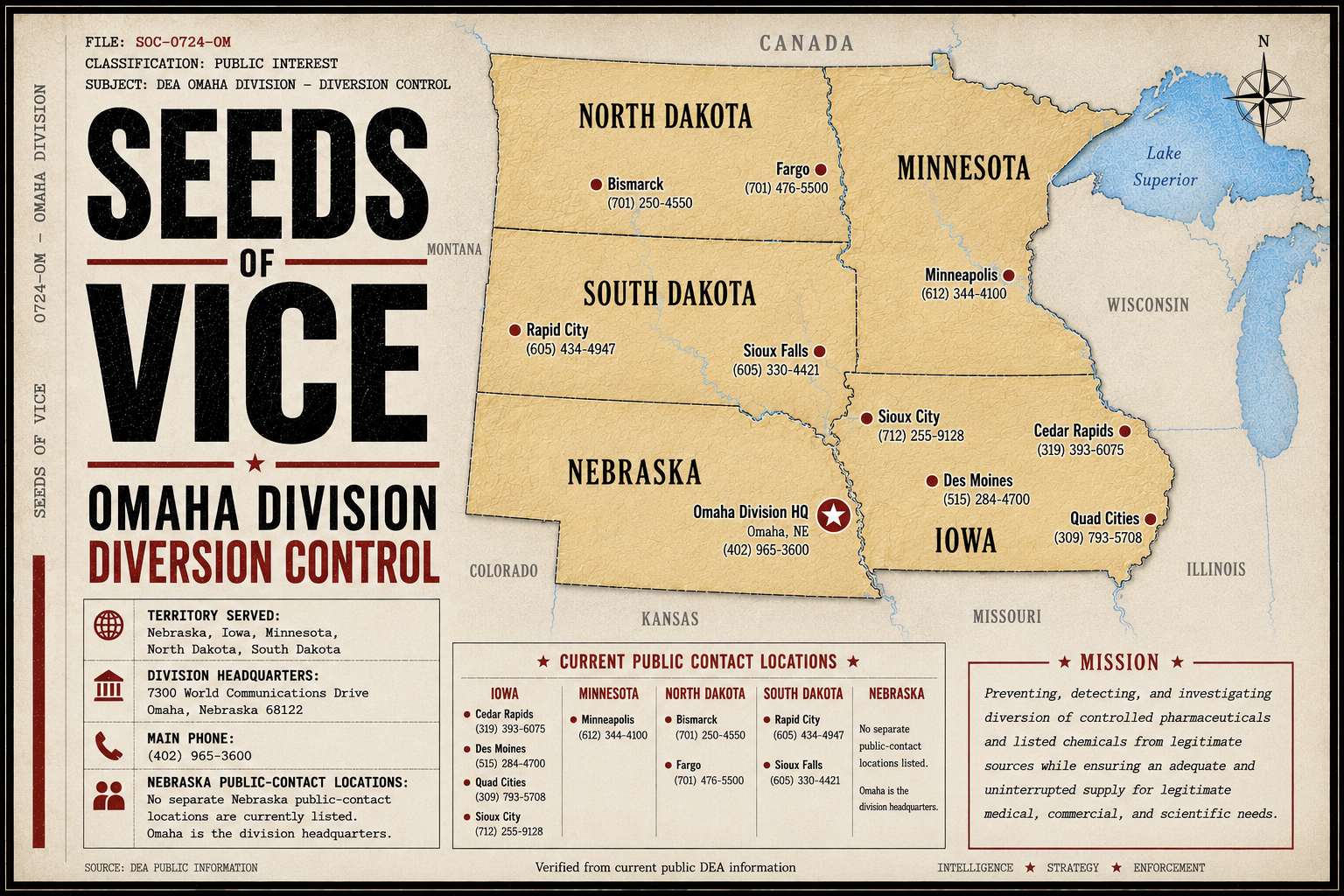
The Drug Enforcement Administration’s Omaha Field Division is officially presented as serving five states:
- Iowa
- Minnesota
- Nebraska
- North Dakota
- South Dakota
DEA’s current Special Agent in Charge biography, however, describes a larger jurisdiction. It states that the division operates through 11 offices across those five states and eight counties along the western borders of Illinois and Wisconsin. DEA does not identify those eight counties, show them on its Omaha Division page, or explain whether they are assigned to Omaha for all purposes or only for selected enforcement functions.
The regional command is officially the Omaha Field Division. There is no separate regional agency formally titled the “Omaha Diversion Division.” Diversion Control is one of the functions carried out within the field division under the broader law, registration systems, policies, and national leadership of DEA’s Diversion Control Division.
DEA’s current records support describing Omaha as a five-state field command with a documented but undefined cross-border extension into Illinois and Wisconsin.
They do not support inventing the eight counties.
Executive Finding
What is official
DEA’s live Omaha Division page states that the division serves Nebraska, Iowa, Minnesota, North Dakota, and South Dakota.
The headquarters is located at:
7300 World Communications Drive
Omaha, Nebraska 68122
Main telephone: 402-965-3600
DEA identifies Dustin R. Gillespie as the current Special Agent in Charge. He assumed command in September 2025 and is the fifth Special Agent in Charge since the Omaha Division was established in 2018.
DEA publishes subordinate contacts in:
Iowa
- Cedar Rapids
- Des Moines
- Quad Cities
- Sioux City
Minnesota
- Minneapolis
North Dakota
- Bismarck
- Fargo
South Dakota
- Rapid City
- Sioux Falls
Together with the Omaha headquarters, those contacts account for the 11 offices referenced in Gillespie’s official biography.
The Illinois–Wisconsin jurisdiction conflict
DEA’s main Omaha webpage lists only the five states.
Gillespie’s current biography adds eight counties along the western borders of Illinois and Wisconsin.
The main page:
- Does not identify the counties.
- Does not list an Illinois office.
- Does not list a Wisconsin office.
- Does not explain the legal or administrative basis for the additional territory.
- Does not state whether the counties are assigned to Omaha for criminal enforcement, Diversion Control, intelligence, registration, or all DEA functions.
- Does not explain how Omaha’s authority intersects with DEA’s Chicago Division.
The Omaha contact directory places the Quad Cities contact under Iowa. That regional label commonly describes communities on both sides of the Iowa–Illinois border, but DEA’s public page does not state whether this contact is responsible for any or all of the unnamed Illinois counties.
The reference to western-border counties in Wisconsin is even less transparent. The Omaha Division page contains no Wisconsin contact and no explanation of which Omaha office serves that territory.
The leadership-page conflict
DEA’s live Omaha page and Gillespie’s current biography identify Dustin R. Gillespie as Special Agent in Charge.
DEA also continues to publish a separate leadership biography stating that Steven T. Bell leads the Omaha Field Division. Bell was Gillespie’s predecessor. The continued publication of that biography without a historical or former-officeholder label creates a direct leadership inconsistency within DEA’s public record.
The current and better-supported conclusion is that Gillespie is the Special Agent in Charge.
The Bell page is obsolete.
What can be concluded
The Omaha Field Division is a comparatively new regional command established in 2018.
Its core jurisdiction consists of Iowa, Minnesota, Nebraska, North Dakota, and South Dakota. Current DEA leadership material also assigns it eight unnamed counties along the western borders of Illinois and Wisconsin.
Its work includes:
- Interstate and transnational drug-trafficking investigations.
- Methamphetamine distribution.
- Fentanyl and counterfeit-tablet investigations.
- Cocaine and other controlled-substance cases.
- Firearms connected to trafficking.
- Dark-web and cryptocurrency investigations.
- Overdose-death investigations.
- Pharmaceutical-diversion investigations.
- Controlled-substance registration and compliance.
- Prescription-drug collection and disposal.
- Coordination with federal, state, local, and tribal authorities.
Recent cases demonstrate that Omaha Division investigations frequently cross state lines, particularly through transportation routes connecting major metropolitan areas with rural communities and smaller regional markets.
What cannot presently be concluded
The public record does not establish:
- The names of the eight Illinois and Wisconsin counties.
- The exact effective date on which those counties were assigned to Omaha.
- Whether all DEA functions follow the same expanded boundary.
- Whether the assignment is permanent.
- Which Omaha Division offices supervise those counties.
- How authority is divided between the Omaha and Chicago divisions.
- The present classification of each listed office.
- A complete Assistant Special Agent in Charge roster.
- The current Diversion Program Manager.
- The number and locations of traditional Diversion Groups.
- Whether North Dakota has a dedicated Tactical Diversion Squad.
- The number of Diversion Investigators assigned to each state.
- County-level responsibility for registration and compliance matters.
- Whether every listed contact represents a permanently staffed physical office.
Seeds of Vice will not fill those gaps through assumption.
Who the Omaha Division Serves
The Omaha Division serves a large and geographically varied region containing major cities, extensive rural territory, agricultural communities, tribal lands, interstate transportation corridors, international-border activity, and medically underserved areas.
Its core five-state territory includes:
- The Omaha–Council Bluffs metropolitan region.
- The Minneapolis–Saint Paul metropolitan region.
- Des Moines, Cedar Rapids, Sioux City, and the Quad Cities.
- Fargo–Moorhead and the eastern North Dakota corridor.
- Bismarck and western North Dakota.
- Sioux Falls and southeastern South Dakota.
- Rapid City and western South Dakota.
- The Canadian border.
- Major interstate routes connecting Chicago, Minneapolis, Kansas City, Denver, and western markets.
- Rural communities located substantial distances from specialty medical care, pharmacies, and federal offices.
The division also serves or regulates:
- Patients receiving controlled medications.
- Physicians and other authorized prescribers.
- Pharmacies and pharmacists.
- Hospitals and clinics.
- Manufacturers and distributors.
- Researchers.
- Veterinary practices.
- Narcotic-treatment programs.
- Tribal and Indian Health Service facilities.
- Federal healthcare facilities.
- State and local law-enforcement agencies.
- Families affected by illicit fentanyl, methamphetamine, counterfeit pills, addiction, violence, and inadequate medical care.
The Omaha system therefore operates across two fundamentally different channels.
The illicit channel
The illicit channel includes:
- Unlawful importation.
- Cartel-linked distribution.
- Bulk methamphetamine transportation.
- Illicit fentanyl and counterfeit tablets.
- Dark-web sales.
- Cryptocurrency transactions.
- Drug-related firearms.
- Money laundering.
- Pharmacy theft.
- Forged prescriptions.
- Drug-distribution conduct connected to overdose deaths.
The lawful channel
The lawful channel includes:
- Registered manufacturers.
- Distributors.
- Pharmacies.
- Hospitals.
- Physicians and other practitioners.
- Researchers.
- Veterinary practices.
- Treatment programs.
- Patients using controlled substances for legitimate medical purposes.
The channels may intersect when a prescription is forged, a pharmacy is burglarized, genuine medicine is stolen, a registrant intentionally distributes outside legitimate practice, or an illicit manufacturer imitates an authentic pharmaceutical product.
They are not otherwise interchangeable.
Territory and Office Structure
Omaha Division Headquarters
7300 World Communications Drive
Omaha, Nebraska 68122
Main telephone: 402-965-3600
The headquarters is the division’s only published Nebraska office contact. DEA does not list a separate Lincoln, North Platte, or Scottsbluff office on its current public division page.
Iowa Contacts
| Published location | Telephone |
|---|---|
| Cedar Rapids | 319-393-6075 |
| Des Moines | 515-284-4700 |
| Quad Cities | 309-793-5708 |
| Sioux City | 712-255-9128 |
Minnesota Contact
| Published location | Telephone |
|---|---|
| Minneapolis | 612-344-4100 |
North Dakota Contacts
| Published location | Telephone |
|---|---|
| Bismarck | 701-250-4550 |
| Fargo | 701-476-5500 |
South Dakota Contacts
| Published location | Telephone |
|---|---|
| Rapid City | 605-434-4947 |
| Sioux Falls | 605-330-4421 |
These are DEA’s current published contacts. The division page includes a legend for division, district, resident, and post-of-duty offices but does not visibly apply those classifications to the individual Omaha locations.
The 11-office count
DEA states that Gillespie leads 11 offices.
The public directory contains:
- One Omaha headquarters.
- Four Iowa contacts.
- One Minnesota contact.
- Two North Dakota contacts.
- Two South Dakota contacts.
That produces 10 locations, not 11.
The apparent discrepancy is resolved only if DEA is treating the Omaha headquarters plus the 10 subordinate locations as 11 total offices. That is the most reasonable reading of the current official record, but DEA does not expressly provide a numbered office chart.
No published Illinois or Wisconsin contacts
The current leadership biography’s eight-county extension does not appear in the office directory.
DEA provides no Omaha-labeled contact under:
- Illinois.
- Wisconsin.
- Rock Island or another named Illinois location.
- A western Wisconsin location.
The absence of a separate contact does not disprove the jurisdictional assignment.
It demonstrates that DEA has not explained how the assignment is administered.
Current Leadership and Publicly Identified Personnel
Dustin R. Gillespie
Special Agent in Charge
Dustin R. Gillespie was appointed Special Agent in Charge of the Omaha Field Division effective September 8, 2025.
He succeeded Steven T. Bell and became the fifth Special Agent in Charge since DEA created the Omaha Division in 2018.
Gillespie joined DEA in 2006 and began his career in the Phoenix Field Division, where he worked on investigations involving transnational criminal organizations and the Southwest border.
His subsequent assignments included:
- Instructor service at DEA’s Office of Training in Quantico.
- Staff work in the Special Operations Division’s Gangs and Violent Crime Section.
- Supervision of a High Intensity Drug Trafficking Area enforcement group.
- Supervision of a strike-force group.
- Work at the El Paso Intelligence Center.
- Service as Assistant Special Agent in Charge of DEA operations in Utah through the Salt Lake City District Office.
DEA states that Gillespie is originally from Alaska, earned a bachelor’s degree from Middlebury College, served four years as an active-duty Army officer, and later earned an MBA from the University of Washington.
Steven T. Bell
Former Special Agent in Charge
Steven T. Bell preceded Gillespie.
DEA continues to maintain a live biography stating that Bell leads the Omaha Field Division. That statement conflicts with the current Omaha page, Gillespie’s appointment announcement, and Gillespie’s current biography.
Bell’s biography should be marked historical or updated.
Until then, it remains a public-record defect rather than a legitimate leadership ambiguity.
Emily Murray
Media Contact
Telephone: 571-387-3545
Scott Kunkel
Recruitment Contact
Telephone: 571-362-7282
Email: Omaha.Recruiter@dea.gov
Amanda Frazier
Community-Outreach Contact
Telephone: 502-780-7860
Email: Amanda.M.Frazier@dea.gov
Current Diversion leadership
A current Omaha Division Diversion Program Manager could not be verified through a current official public personnel page.
DEA does publish regional registration contacts divided into three administrative groupings:
- Iowa.
- Minnesota and North Dakota.
- Nebraska and South Dakota.
This establishes a public registration structure.
It does not establish:
- The name of the regional Diversion Program Manager.
- The internal reporting chain.
- The physical location of each Diversion Group.
- The number of investigators serving each group.
- Whether the unnamed Illinois and Wisconsin counties fall under one of those registration contacts.
Historical personnel should not be represented as current without confirmation.
Diversion Registration Structure
DEA publishes the following Omaha Division registration contacts.
Iowa
Telephone: 571-387-4638
Email: IA.Registration@dea.gov
Minnesota and North Dakota
Telephone: 800-251-1472
Email: MN-ND.Diversion.registration@dea.gov
Nebraska and South Dakota
Telephone: 571-387-4625
Email: NE-SD.Diversion.registration@dea.gov
The groupings reveal an administrative structure that differs from the criminal-enforcement office list.
For registration purposes:
- Iowa stands alone.
- Minnesota and North Dakota are paired.
- Nebraska and South Dakota are paired.
DEA does not explain:
- Why Iowa is administered separately.
- Whether the same pairings apply to inspections and investigations.
- Whether the groupings correspond to specific Diversion offices.
- Where registrants in the eight additional Illinois and Wisconsin counties should direct inquiries.
- Whether those registrants remain under Chicago Division registration contacts despite other Omaha authority.
A practitioner or pharmacy should not be required to infer that answer.
Tactical Diversion Squads
DEA’s national Tactical Diversion Squad directory lists the following information for Omaha’s core states:
| State | DEA’s published TDS entry |
|---|---|
| Iowa | Contact DEA Omaha |
| Minnesota | Minneapolis–Saint Paul |
| Nebraska | Omaha |
| North Dakota | No entry published |
| South Dakota | Sioux Falls |
DEA’s directory separately lists Chicago and Springfield for Illinois and Milwaukee for Wisconsin. It does not explain whether those squads or Omaha personnel serve the eight border counties identified in Gillespie’s biography.
What Tactical Diversion Squads do
DEA states that Tactical Diversion Squads combine DEA resources with federal, state, and local law-enforcement personnel to investigate suspected violations involving the diversion of lawfully produced pharmaceutical controlled substances and listed chemicals.
DEA states that the squads:
- Unify information and authority across agencies.
- Coordinate investigations and prosecutions across judicial districts.
- Support traditional Diversion Groups when arrest, surveillance, evidence purchases, confidential payments, or search warrants are required.
A Tactical Diversion Squad is therefore not simply a registration or compliance unit.
It is an enforcement structure capable of investigating:
- Counterfeit pharmaceuticals.
- Forged prescriptions.
- Illicit pill presses.
- Pharmacy theft.
- Unlawful distribution by registrants.
- Internet sales.
- Healthcare-related controlled-substance fraud.
- Other criminal diversion.
North Dakota’s omission
North Dakota has two published DEA office contacts—Bismarck and Fargo—but no North Dakota entry appears in DEA’s national Tactical Diversion Squad directory.
The omission may mean:
- North Dakota is served by a squad in another state.
- Traditional Diversion Groups handle its matters.
- A squad exists but is not separately listed.
- The directory is incomplete.
The public record does not establish which explanation is correct.
Official Role and Mission
The Omaha Field Division enforces the federal Controlled Substances Act and related federal law within its assigned territory.
Its work may include:
- Criminal investigations.
- Intelligence collection and analysis.
- Cartel and transnational-organization investigations.
- Methamphetamine and fentanyl cases.
- Counterfeit-tablet investigations.
- Dark-web and cryptocurrency cases.
- Firearms connected to drug trafficking.
- Controlled-substance registration.
- Administrative inspections.
- Civil referrals.
- Practitioner and pharmacy investigations.
- Manufacturer and distributor oversight.
- Theft and loss investigations.
- Community outreach.
- Drug collection and disposal.
DEA describes the Diversion Control mission as preventing, detecting, and investigating the diversion of controlled pharmaceuticals and listed chemicals from legitimate channels while ensuring an adequate and uninterrupted supply for legitimate medical, commercial, and scientific needs.
Both duties are official.
Diversion Control is not defined solely as reducing controlled-substance access.
It is also responsible for protecting the legitimate channel and maintaining adequate lawful supply.
The Omaha Field Division is a regional command.
It is not the national Diversion Control Division, even though regional personnel carry out Diversion functions within Omaha’s territory.
How the Omaha System Works in Practice
Methamphetamine remains a defining regional threat
DEA reported that Omaha Division personnel seized more than 3,000 pounds of methamphetamine during the first eight months of 2025.
During the same period, the division reported removing close to four million potentially lethal fentanyl doses.
During a 30-day enforcement period from January 12 through February 10, 2026, DEA reported that the Omaha Division seized:
- More than two million potentially lethal doses of fentanyl powder and pills.
- Approximately 715 pounds of methamphetamine.
- An additional 2,234 methamphetamine pills.
DEA’s “potentially lethal dose” calculation is an agency risk-communication measure.
It is not the same as:
- A confirmed number of intended users.
- A confirmed number of prevented deaths.
- A toxicological finding that every seized unit would have killed a person.
- A count of individual dosage units unless DEA states one.
The figures should be reported as DEA reports them, without converting them into stronger causal claims.
Large rural geography and long transportation corridors
The Omaha Division’s territory contains major interstate routes as well as rural regions located far from federal offices.
An organization may:
- Obtain methamphetamine or fentanyl outside the division.
- Transport it through Nebraska or Iowa.
- Store it in a metropolitan area.
- Redistribute it into Minnesota, the Dakotas, or rural counties.
- Use several federal judicial districts.
- Communicate through encrypted platforms.
- Move proceeds through cash, banking systems, or cryptocurrency.
A May 2026 Iowa prosecution involved methamphetamine transported from Des Moines to Pierre, South Dakota. The defendant pleaded guilty to federal drug and firearm offenses. That case illustrates how conduct in two Omaha Division states can form one distribution system.
Minnesota methamphetamine and fentanyl markets
In March 2026, a defendant pleaded guilty in a Minnesota conspiracy involving approximately 900 pounds of methamphetamine. The investigation involved DEA and several federal and state partners.
In July 2026, five defendants received sentences totaling 518 months in a Wadena County investigation involving methamphetamine, cocaine, and an overdose death that helped initiate the investigation. Authorities reported seizing more than 2.6 kilograms of methamphetamine and other evidence during the case.
In June 2026, Denzel Meeks received a 148-month sentence in a Minnesota fentanyl and firearms case. This was an adjudicated disposition following conviction or plea—not merely an announced allegation.
Iowa counterfeit-tablet cases
In March 2026, Devon Frazier received a 190-month sentence after pleading guilty in a case involving counterfeit Xanax tablets containing fentanyl. Federal authorities connected the pills to the death of a 19-year-old and reported that Frazier possessed 362 fentanyl-containing pills.
In July 2026, a federal jury convicted Jonathan Seff in a case involving dark-web sales, cryptocurrency, and more than 800 counterfeit oxycodone tablets containing fentanyl, along with methamphetamine, MDMA, and other drugs.
In a separate Iowa case, a Waterloo defendant received a 21-year sentence involving counterfeit M30 tablets associated with four nonfatal overdoses and one death.
These cases demonstrate the difference between:
- A tablet lawfully manufactured and dispensed through a pharmacy.
- A tablet illicitly manufactured to resemble legitimate medication.
The counterfeit product is dangerous partly because it borrows the appearance of lawful medicine while bypassing its safeguards.
South Dakota organizations
In June 2026, federal authorities announced the completion of prosecutions against four major South Dakota trafficking organizations.
The combined cases produced 54 convictions and involved more than 1,000 pounds of methamphetamine, multiple kilograms of fentanyl, and other controlled substances. Individual sentences varied, including a 33-year sentence imposed after a jury conviction and other substantial prison terms.
Because the defendants occupied different procedural positions, the cases should not be reduced to one undifferentiated enforcement event.
Some defendants pleaded guilty.
At least one was convicted by a jury.
Each sentence followed an adjudicated finding or admission.
Pharmaceutical Collection and Drug Disposal
The Omaha Division administers DEA’s National Prescription Drug Take Back Day throughout its territory.
For April 25, 2026, DEA initially announced approximately 130 planned collection sites across the five core states. After the event, DEA reported collecting more than 19,000 pounds of unwanted medication from 159 locations. DEA stated that cumulative collections within the division had reached 725,265 pounds.
Drug disposal is a Diversion-prevention activity.
It is intended to reduce:
- Accidental ingestion.
- Theft.
- Informal sharing.
- Retention of unused controlled medication.
- Entry of unused prescriptions into unlawful markets.
Take Back totals measure the weight of collected material.
They do not establish:
- How much of the material was opioid medication.
- How much was controlled rather than noncontrolled.
- How many individual patients participated.
- Whether medication had been medically unnecessary.
- Whether a patient’s treatment was adequate.
- Whether collection directly prevented a particular overdose or crime.
The program may still provide a legitimate public benefit without supporting claims beyond what its measurements establish.
Diversion Control and Lawful Medicine
Omaha Division Diversion personnel may regulate or investigate:
- Physicians.
- Dentists.
- Nurse practitioners.
- Physician assistants.
- Pharmacists.
- Hospitals.
- Clinics.
- Veterinary practices.
- Manufacturers.
- Distributors.
- Researchers.
- Narcotic-treatment programs.
- Federal and tribal medical facilities.
- Other DEA registrants.
Their work may include:
- Registration applications and renewals.
- Inspections.
- Controlled-substance inventories.
- Recordkeeping reviews.
- Security assessments.
- Theft and loss reporting.
- Suspicious-order investigations.
- Prescription investigations.
- Administrative subpoenas.
- Registration restrictions.
- Voluntary registration surrenders.
- Orders to Show Cause.
- Immediate Suspension Orders.
- Civil referrals.
- Criminal investigations when intentional unlawful conduct is suspected.
These actions occupy different legal positions.
Inspection
An inspection is a compliance or investigative process.
It is not itself proof that a registrant violated the law.
Corrective action or agreement
A registrant may agree to training, recordkeeping changes, monitoring, or other corrective conditions without being criminally convicted.
Civil settlement
A civil settlement resolves civil allegations or potential liability.
It is not automatically a guilty plea.
Administrative action
An administrative action concerns the authority to manufacture, distribute, prescribe, possess, or dispense controlled substances.
It may occur without a criminal prosecution.
Complaint or indictment
A criminal charge is an allegation.
The defendant remains presumed innocent unless convicted.
Guilty plea
A guilty plea is a formal admission to specified conduct in court.
Trial conviction
A trial conviction is an adjudicated finding of guilt.
Sentence
A sentence follows a guilty plea or conviction.
The word enforcement should never erase these distinctions.
The Five-State Prescription-Control Layer
The Omaha Field Division operates across five separate state prescription-monitoring, controlled-substance, and professional-regulation systems.
Those systems share broad purposes.
They are not one uniform regional law.
Iowa
Iowa’s Prescription Monitoring Program collects records of Schedule II through Schedule V controlled-substance prescriptions dispensed by Iowa-licensed pharmacies and dispensing prescribers.
The Iowa program states that its purpose includes supporting informed patient care while helping identify diversion, misuse, abuse, and unlawful use without impeding appropriate medical treatment.
Iowa also maintains a separate state Controlled Substances Act registration system. Certain practitioners must complete state registration and Prescription Monitoring Program requirements before their state controlled-substance registration becomes fully active.
Minnesota
Minnesota’s Prescription Monitoring Program contains information submitted by licensed pharmacies and dispensing prescribers for Schedule II through Schedule V controlled substances, as well as butalbital and gabapentin.
Minnesota describes the program as a patient-care tool intended to detect diversion, abuse, and misuse. State law requires covered controlled-substance prescribers and pharmacists to register and maintain program accounts.
Registration with a monitoring program does not establish that every prescription requires the same query procedure. Consultation duties depend on the applicable state statute, practice setting, drug, and clinical circumstance.
Nebraska
Nebraska’s statewide Prescription Drug Monitoring Program collects dispensed prescription information and is intended to support patient safety and help prevent misuse and diversion.
Nebraska’s program is integrated through the state’s health-information infrastructure rather than operating only as a conventional stand-alone controlled-substance database.
Nebraska guidance encourages clinicians to review the state monitoring program when beginning opioid treatment and emphasizes clinical evaluation, risk assessment, and individualized treatment. Guidance is not automatically identical to a statutory mandate or criminal rule.
North Dakota
North Dakota’s Prescription Drug Monitoring Program operates under the North Dakota Board of Pharmacy and receives controlled-substance dispensing reports under state law.
State regulations require covered dispensers to submit controlled-substance prescription information to the central repository. North Dakota also imposes profession-specific monitoring duties, including requirements applicable to advanced-practice registered nurses.
The state’s program should not be confused with DEA’s federal registration database.
South Dakota
South Dakota describes its Prescription Drug Monitoring Program as a state electronic database that tracks prescribing and dispensing of controlled substances.
The program is intended to assist healthcare professionals in identifying possible overprescribing, diversion, and misuse. South Dakota’s system receives information concerning specified controlled substances from covered in-state and out-of-state dispensers and includes prescription data associated with several federal healthcare systems.
South Dakota cautions that monitoring-program information may contain errors and should not be treated as the sole source for a clinical or enforcement conclusion.
What the state comparison establishes
A practitioner in the Omaha Division may simultaneously face:
- Federal Controlled Substances Act requirements.
- DEA registration rules.
- Regional DEA inspection or investigation.
- State controlled-substance registration.
- State prescribing statutes.
- State professional-board rules.
- State monitoring-program requirements.
- Pharmacy policies.
- Insurer restrictions.
- Hospital or clinic protocols.
- Civil-liability concerns.
- Professional guidelines.
- Individual clinical judgment.
No single institution creates the entire treatment environment.
A database entry is information.
It is not, by itself, proof that:
- A patient committed a crime.
- A patient has a substance-use disorder.
- A practitioner acted outside professional practice.
- A prescription lacked medical purpose.
- A pharmacist knowingly dispensed unlawfully.
Those conclusions require additional evidence and context.
How the System Affects Pain Patients and Lawful Medicine
Legitimate protective functions
A properly functioning Diversion system can protect patients by:
- Detecting forged prescriptions.
- Investigating pharmacy burglary and theft.
- Identifying counterfeit tablets.
- Enforcing accurate inventories.
- Identifying unlawful dispensing.
- Investigating intentional criminal prescribing.
- Preventing stolen medicine from entering illicit markets.
- Preserving traceability within the lawful supply chain.
- Removing products manufactured with illicit pill presses.
- Distinguishing authentic medication from tablets containing undisclosed fentanyl.
The Iowa counterfeit-pill cases demonstrate why protection of the lawful channel matters.
Patients and families may believe a pill is alprazolam or oxycodone because of its color, shape, or marking. An illicit producer may instead have manufactured it with fentanyl or another substance in a nonregulated setting.
The risk of institutional overcorrection
The same system can injure legitimate patients when:
- Numerical thresholds are converted into inflexible rules.
- Monitoring data are treated as verdicts.
- Practitioners stop treating pain because they fear investigation.
- Pharmacies refuse lawful prescriptions through undisclosed policies.
- Patients are rapidly tapered.
- Medication is abruptly discontinued.
- Patients are dismissed rather than clinically managed.
- Rural patients are required to travel unreasonable distances.
- Drug testing and contracts become punitive controls rather than clinical tools.
- Risk management replaces individualized judgment.
The CDC has acknowledged that its 2016 opioid guideline was misapplied through rigid dosage thresholds, rapid tapers, abrupt discontinuation, inflexible duration limits, patient dismissal, and application to patients outside its intended scope.
CDC associated those practices with untreated or undertreated pain, withdrawal, worsening pain, psychological distress, overdose, and suicidal ideation or behavior. Its 2022 guideline emphasizes individualized, patient-centered decision-making rather than inflexible rules.
That acknowledgment does not prove that DEA alone caused those outcomes.
The treatment environment is produced by the interaction of:
- Congress.
- DEA.
- Federal prosecutors.
- State legislatures.
- State licensing boards.
- Prescription-monitoring programs.
- Insurers.
- Pharmacy corporations.
- Hospitals.
- Clinic owners.
- Professional organizations.
- Civil-liability systems.
- Individual practitioners.
- Patients.
- The illicit market.
DEA should not be assigned sole responsibility for every treatment decision.
It should not be removed from the analysis either.
The possibility of inspection, administrative action, registration loss, civil penalties, criminal referral, or prosecution is part of the institutional risk environment in which controlled-substance decisions are made.
Rural and regional effects
Omaha’s territory presents particular access concerns because many communities are located far from:
- Pain specialists.
- Large medical systems.
- Independent pharmacies.
- Addiction-treatment programs.
- Physical therapy.
- Behavioral-health services.
- Nonopioid interventional treatment.
- DEA and state regulatory offices.
A policy that appears manageable in Minneapolis, Omaha, or Des Moines may impose a different burden in rural North Dakota, western South Dakota, northern Minnesota, or small Iowa and Nebraska communities.
Geographic variation does not prove that rural patients should receive more or less medication.
It means institutional policy must account for the actual availability of alternatives before representing them as practical substitutes.
Prescribing and Dose-Decline Context
Evidentiary boundary
Seeds of Vice begins its historical inquiry in 1984.
No continuous, directly comparable annual retail opioid-dispensing series was identified for all five Omaha Division states beginning in 1984.
The record must therefore be divided into distinct evidentiary periods.
1984–2005
Historical inquiry may use:
- Federal drug-distribution records.
- Manufacturer and production records.
- Controlled-substance quota information.
- Medicaid and insurer data.
- Drug-specific utilization studies.
- Medical literature.
- State regulatory history.
- National prescribing indicators.
Those measures cannot be silently merged into the later CDC retail-prescription-rate series.
Missing years should not be interpolated.
Selected retail-dispensing benchmarks
The following figures represent retail opioid prescriptions dispensed per 100 residents:
| State | 2006 | 2012 | 2016 | 2019 | 2023 | 2012–2023 decline |
|---|---|---|---|---|---|---|
| Iowa | 59.3 | 74.1 | 64.0 | 43.0 | 34.6 | 53.3% |
| Minnesota | 50.3 | 60.9 | 46.9 | 32.1 | 26.5 | 56.5% |
| Nebraska | 64.3 | 73.2 | 62.8 | 50.3 | 42.7 | 41.7% |
| North Dakota | 56.0 | 62.1 | 47.8 | 38.8 | 32.4 | 47.8% |
| South Dakota | 50.0 | 60.1 | 54.8 | 43.9 | 35.8 | 40.4% |
The percentage changes are Seeds of Vice calculations based on the reported 2012 and 2023 rates. The underlying state figures come from CDC’s archived and current dispensing tables.
What the table establishes
Every core Omaha Division state experienced a substantial decline from the 2012 benchmark through 2023.
The decline exceeded 50 percent in:
- Iowa.
- Minnesota.
It approached 48 percent in North Dakota and exceeded 40 percent in Nebraska and South Dakota.
The data establish a regional contraction in retail opioid dispensing.
They do not establish whether every discontinued, reduced, or avoided prescription was medically appropriate.
2024 national context
CDC reported that the national retail opioid-dispensing rate declined from 46.8 prescriptions per 100 residents in 2019 to 35.4 in 2024.
Exact 2024 rates for all five Omaha Division states were not reproduced in the accessible static CDC material reviewed for this page.
The latest fully transcribed and cross-checked five-state comparison presented here therefore ends in 2023.
The missing 2024 state values should be added only through direct extraction from the underlying CDC table.
They should not be estimated from a map or surrounding years.
Methodological limitations
CDC’s current estimates use IQVIA Xponent data projected from approximately 54,600 nonhospital retail pharmacies covering nearly 94 percent of retail prescriptions.
The dataset:
- Includes new and refilled retail prescriptions.
- Uses several payment sources.
- Excludes mail-order prescriptions.
- Excludes methadone administered through opioid-treatment programs.
- Uses the prescriber’s location for current geographic assignment.
- Does not establish whether the patient consumed the medication.
- Does not establish whether a prescription was appropriate.
- Does not measure pain severity.
- Does not measure patient function.
- Does not identify voluntary versus involuntary discontinuation.
CDC changed the geographic attribution methodology beginning in 2019, moving from the dispensing pharmacy’s location to the prescriber’s location. That change must be considered when comparing older and newer rates.
Prescriptions per 100 residents must not be mixed with:
- MME per capita.
- Average MME per prescription.
- Daily dosage.
- Days supplied.
- Number of patients.
- Number of tablets.
- Total controlled-substance prescriptions.
- Overdose deaths.
- Drug-seizure quantities.
Each measure answers a different question.
Overdose Context
DEA reported that more than 750 fentanyl-involved deaths occurred across its five core Omaha Division states during the 12 months ending in November 2025, citing CDC mortality information.
The figure demonstrates continuing regional harm from illicit fentanyl.
It does not independently establish:
- Whether every death involved illicit rather than pharmaceutical fentanyl.
- Which substance was the primary cause where several drugs were present.
- How the deaths were distributed among the five states.
- Whether the total was final or provisional.
- Whether one enforcement or public-health program caused a subsequent change.
- How many people were saved by naloxone.
- Whether lawful pain treatment was adequate.
Recent mortality figures may be revised as toxicology, death-certificate, and state reporting information becomes complete.
The regional record contains several simultaneous findings:
Retail opioid dispensing declined substantially.
Large methamphetamine markets remained active.
Counterfeit fentanyl tablets caused or were alleged to have caused deaths and nonfatal overdoses.
DEA continued to report hundreds of fentanyl-involved deaths across the five states.
One fact does not erase the others.
A decline in lawful prescribing does not prove that illicit markets disappeared.
The existence of illicit fentanyl does not prove that every lawful pain patient received adequate care.
Representative Omaha Division Matters
Divisionwide Fentanyl Free America enforcement
Seizures and arrests
During a 30-day period in early 2026, DEA reported removing more than two million potentially lethal fentanyl doses, approximately 715 pounds of methamphetamine, and more than 2,200 methamphetamine pills within the Omaha Division.
These are agency-reported enforcement results, not judicial findings against every person associated with the seizures.
Iowa counterfeit Xanax case
Guilty plea and sentence
Devon Frazier received a 190-month sentence after pleading guilty in a case involving counterfeit alprazolam tablets containing fentanyl and the death of a 19-year-old.
This was an adjudicated criminal disposition.
Iowa dark-web counterfeit-pill case
Trial conviction
A federal jury convicted Jonathan Seff in a case involving dark-web sales, cryptocurrency, counterfeit oxycodone tablets containing fentanyl, methamphetamine, MDMA, and other substances.
The conviction followed trial rather than a civil settlement or administrative action.
Waterloo counterfeit M30 case
Guilty plea or conviction and sentence
A Waterloo defendant received a 21-year federal sentence in a counterfeit-tablet case connected by prosecutors to four nonfatal overdoses and one death.
This was an adjudicated criminal matter.
Minnesota methamphetamine conspiracy
Guilty plea
A defendant pleaded guilty in March 2026 in a Minnesota conspiracy involving approximately 900 pounds of methamphetamine.
The plea constituted a formal admission to the charged conduct covered by the agreement.
Wadena County organization
Multiple sentences
Five defendants received combined sentences totaling 518 months in a Minnesota investigation involving methamphetamine, cocaine, and an overdose death.
The sentences followed adjudicated dispositions.
Minnesota fentanyl and firearms case
Sentence
Denzel Meeks received a 148-month sentence in a fentanyl-trafficking and firearms case.
This was not a pending allegation at the time of the sentencing announcement.
Iowa-to-South Dakota distribution
Guilty plea
A Mason City defendant pleaded guilty in a case involving methamphetamine transported from Des Moines to Pierre and possession of a firearm.
The matter demonstrates interstate distribution within a single DEA field division.
South Dakota trafficking organizations
Convictions and sentences
Four major investigations resulted in 54 convictions and involved more than 1,000 pounds of methamphetamine and multiple kilograms of fentanyl.
The individual defendants’ legal postures and sentences varied and should be reported separately where individual profiles are created.
Contact Information
Omaha Field Division Headquarters
Address:
7300 World Communications Drive
Omaha, Nebraska 68122
Main telephone: 402-965-3600
Media
Emily Murray
Telephone: 571-387-3545
Recruitment
Scott Kunkel
Telephone: 571-362-7282
Email: Omaha.Recruiter@dea.gov
Community Outreach
Amanda Frazier
Telephone: 502-780-7860
Email: Amanda.M.Frazier@dea.gov
Diversion Registration — Iowa
Telephone: 571-387-4638
Email: IA.Registration@dea.gov
Diversion Registration — Minnesota and North Dakota
Telephone: 800-251-1472
Email: MN-ND.Diversion.registration@dea.gov
Diversion Registration — Nebraska and South Dakota
Telephone: 571-387-4625
Email: NE-SD.Diversion.registration@dea.gov
Iowa Offices
Cedar Rapids: 319-393-6075
Des Moines: 515-284-4700
Quad Cities: 309-793-5708
Sioux City: 712-255-9128
Minnesota Office
Minneapolis: 612-344-4100
North Dakota Offices
Bismarck: 701-250-4550
Fargo: 701-476-5500
South Dakota Offices
Rapid City: 605-434-4947
Sioux Falls: 605-330-4421
National Registration Contact
DEA Registration Contact Center: 800-882-9539
DEA does not publish an Omaha-specific registration contact for the eight Illinois and Wisconsin counties identified in Gillespie’s biography.
Registrants in those counties should verify whether the responsible contact is:
- Omaha Division.
- Chicago Division.
- A named Tactical Diversion Squad.
- A traditional Diversion Group.
- The national Registration Contact Center.
That responsibility should be clear from DEA’s public directory without requiring individual investigation.
Seeds of Vice Analysis
The Omaha Division is institutionally unusual for two reasons.
First, it is one of DEA’s newest domestic field divisions.
Second, its current leadership biography gives it territory beyond the five states named on its division page without telling the public where that territory is.
The central finding is therefore not that Omaha lacks a defined core jurisdiction.
Its five-state core is clear.
The problem is that DEA has publicly added eight Illinois and Wisconsin counties without identifying them.
A federal boundary should not be implied
Territorial responsibility determines:
- Which Special Agent in Charge bears accountability.
- Which office receives tips.
- Which Diversion personnel inspect a registrant.
- Which regional contact handles registration.
- Which task force leads an investigation.
- Which public-information office responds.
- Which division’s statistics include an enforcement action.
- Which office a practitioner, pharmacy, attorney, or journalist should contact.
Those are ordinary administrative facts.
They should not require reconstruction from an individual official’s biography.
DEA should publish the eight counties.
Until it does, Seeds of Vice should not guess.
The office structure is only partially visible
DEA states that Gillespie leads 11 offices.
The public can reconstruct those 11 only by counting Omaha headquarters together with the 10 subordinate contacts.
The page provides a legend for four office types but does not identify the classification of each location.
The public therefore cannot determine from the directory whether a contact is:
- A district office.
- A resident office.
- A post of duty.
- A specialized group.
- A shared task-force location.
- A telephone contact without a separately identified public facility.
The directory gives locations and numbers.
It does not give an institutional map.
The Diversion system is fragmented in public view
DEA publishes three regional registration groupings:
- Iowa.
- Minnesota–North Dakota.
- Nebraska–South Dakota.
It separately publishes Tactical Diversion Squad entries for:
- Omaha.
- Minneapolis–Saint Paul.
- Sioux Falls.
- Iowa through a general “Contact DEA Omaha” instruction.
North Dakota is not listed.
The Illinois and Wisconsin counties are not explained.
No current Diversion Program Manager is named.
The result is a system whose authority is real but whose public chain of command is incomplete.
The stale Steven Bell page matters
An obsolete biography may appear minor.
It is not minor when the page identifies the person who supposedly commands federal enforcement and regulatory authority across several states.
DEA’s current main page identifies Gillespie.
The appointment announcement identifies Gillespie.
Gillespie’s biography identifies Gillespie.
Bell’s biography still says Bell leads the division.
That is an objectively contradictory public record.
The correct response is not to pretend the contradiction does not exist.
The correct response is to identify the current officeholder from the stronger evidence and preserve the obsolete page as a documented administrative failure.
Methamphetamine and counterfeit fentanyl require different analysis
The Omaha Division’s enforcement record is heavily shaped by methamphetamine.
It also includes counterfeit pills containing fentanyl.
Those markets are related through trafficking organizations and distribution systems, but they are not identical.
Bulk methamphetamine investigations often involve:
- Large transportation networks.
- Interstate or international suppliers.
- Rural and metropolitan distribution.
- Firearms and money movement.
- Extended conspiracies.
Counterfeit-pill investigations involve the additional danger of pharmaceutical imitation.
The consumer may believe the tablet is:
- Oxycodone.
- Alprazolam.
- Another recognizable prescription product.
The tablet may instead contain an undisclosed dose of illicit fentanyl.
That makes counterfeit medicine the opposite of legitimate medicine.
It should strengthen the institutional obligation to preserve a trusted lawful channel.
The lawful patient is not the counterfeit market
A pain patient receiving medication through a valid prescription is not situated like a dark-web seller of fentanyl tablets.
A physician making a documented, good-faith clinical decision is not situated like a trafficker distributing pills made with an illicit press.
A pharmacy maintaining an accountable inventory is not situated like an organization burglarizing pharmacies.
A patient appearing in five state monitoring programs has not been convicted of anything.
The system must preserve those distinctions.
The regional prescribing decline is substantial
From the 2012 benchmark through 2023, retail opioid dispensing fell:
- 53.3 percent in Iowa.
- 56.5 percent in Minnesota.
- 41.7 percent in Nebraska.
- 47.8 percent in North Dakota.
- 40.4 percent in South Dakota.
That is not a marginal adjustment.
It is a structural transformation in lawful medicine.
The statistics do not establish that the entire decline was harmful.
They do not establish that the entire decline was beneficial.
They establish that substantially less lawful opioid medication was dispensed per resident.
A complete institutional account should ask:
- Which prescriptions were unnecessary?
- Which patients benefited from safer treatment?
- Which patients received effective alternatives?
- Which patients were voluntarily tapered?
- Which were tapered against their wishes?
- Which lost a practitioner?
- Which lost a pharmacy?
- Which could not travel to specialty care?
- Which remained in severe pain?
- Which recovered function?
- Which lost function?
- Which turned to illicit substances?
- Which withdrew from medical care?
- Which died from overdose, suicide, disease, or unrelated causes?
- Which consequences were measured?
- Which disappeared from the record when the prescription ended?
Dispensing data cannot answer those questions by themselves.
Rural alternatives must be real
Institutions frequently describe nonopioid therapy as though its existence in principle establishes its availability in practice.
In parts of the Omaha Division, a patient may face:
- Long travel distances.
- Few specialists.
- Limited public transportation.
- Restricted insurance networks.
- Physical-therapy limits.
- Long appointment delays.
- A shortage of independent pharmacies.
- Clinic policies that refuse controlled-substance treatment.
- Telehealth limitations.
- Severe mobility restrictions.
An alternative is not functionally available merely because it appears in a guideline.
Institutional evaluation should measure whether the patient could actually obtain it, afford it, tolerate it, and benefit from it.
The dual mandate is the proper standard
DEA’s official Diversion mission requires the agency to prevent diversion while ensuring an adequate and uninterrupted supply for legitimate medical, commercial, and scientific needs.
Seeds of Vice accepts the first obligation.
It insists upon the second.
The Omaha system should be capable of:
- Interdicting hundreds of pounds of methamphetamine without treating ordinary medical practice as equivalent conduct.
- Prosecuting counterfeit-pill sellers without treating every controlled-substance patient as deceptive.
- Investigating forged prescriptions without presuming every early refill is criminal.
- Regulating pharmacies without creating avoidable access deserts.
- Using monitoring data without converting it into an automatic verdict.
- Identifying intentional unlawful prescribing without reducing clinical judgment to one dosage number.
- Protecting rural communities from illicit fentanyl while preserving authentic pain treatment.
Drug control governs crime.
Diversion control governs permission.
Across Iowa, Minnesota, Nebraska, North Dakota, South Dakota, and eight unnamed border counties, that permission is administered through one federal field division, several regional office contacts, multiple Tactical Diversion arrangements, five state monitoring systems, professional boards, insurers, pharmacies, hospitals, clinics, and individual practitioners.
The authority is substantial.
The public organizational record should be equally substantial.
At present, it is not.
Recommended Public Disclosures
DEA should publish:
- The names of the eight Illinois and Wisconsin counties assigned to Omaha.
- The effective date of that assignment.
- The authority or order establishing the expanded jurisdiction.
- Whether the assignment applies to enforcement, Diversion, intelligence, registration, or all functions.
- The reporting relationship between Omaha and Chicago for those counties.
- A current territorial map.
- A complete 11-office organization chart.
- The classification of every published location.
- The county responsibility of each office.
- A corrected historical label on Steven Bell’s biography.
- A complete current Assistant Special Agent in Charge roster.
- The current Diversion Program Manager.
- The location and responsibility of each traditional Diversion Group.
- The territory assigned to each Tactical Diversion Squad.
- An explanation of how North Dakota receives Tactical Diversion support.
- A specific registration contact for the Illinois and Wisconsin counties.
- Annual statistics separating criminal, civil, and administrative Diversion outcomes.
- Outcomes distinguished by inspection, warning, settlement, surrender, suspension, indictment, plea, conviction, dismissal, and acquittal.
- State-specific reporting rather than only divisionwide totals.
- Measures of legitimate medical access alongside enforcement statistics.
- Reporting on registration delays, pharmacy access, shortages, practitioner departures, and rural treatment availability.
Publishing these facts would not require disclosure of confidential investigative methods.
It would establish ordinary institutional accountability.
Methodology and Evidentiary Limits
This page prioritizes current primary sources from:
- The Drug Enforcement Administration.
- DEA’s Diversion Control Division.
- United States Attorney’s Offices.
- State prescription-monitoring programs.
- State regulatory agencies.
- The Centers for Disease Control and Prevention.
The following evidentiary rules were applied:
- The regional command was correctly identified as the Omaha Field Division.
- The field division was distinguished from the national Diversion Control Division.
- The five-state jurisdiction on DEA’s main page was preserved.
- The additional eight Illinois and Wisconsin counties in the current leadership biography were preserved.
- The unnamed counties were not invented.
- The 2018 formation date was taken from DEA’s current leadership announcement.
- Dustin R. Gillespie was identified as the current Special Agent in Charge.
- Steven Bell’s contradictory biography was treated as an obsolete public record.
- Office classifications were not assigned where DEA did not publish them.
- The 11-office count was reconstructed transparently.
- Tactical Diversion Squad locations were reproduced as DEA publishes them.
- North Dakota’s omission from the TDS directory was not silently resolved.
- A current Diversion Program Manager was not invented.
- State prescription-monitoring systems were described separately.
- Database information was not treated as proof of criminal or clinical wrongdoing.
- Allegations were distinguished from guilty pleas, convictions, and sentences.
- DEA seizure claims were not converted into independent casualty-prevention findings.
- Prescriptions per 100 residents were not mixed with MME, patient counts, dosage, days supplied, or mortality.
- Missing historical years were not interpolated.
- CDC’s 2019 geographic-methodology change was acknowledged.
- Exact 2024 state rates were not estimated from visual material.
- Prescribing decline was not represented as proof of either medical benefit or patient harm.
- Overdose data were not attributed to one institution or policy.
- DEA was analyzed as one institution within a broader medical-control system.
- Official mission statements were separated from Seeds of Vice analysis.
Last fully verified: July 25, 2026


Bestsellers
-

A gift of Luck
-

Proof of Progress: Mr. DEA’s Diversion Autographed Hardcover & Seed Pack
$39.99 -

Seeds of Vice ™
$24.99 -

Seeds of Vice Book Set
$119.00 -
Seeds of Vice: On Poppy Tea Autographed Hardcover & Seed Pack
Original price was: $39.99.$29.99Current price is: $29.99. -

Seeds of Vice: On The Poppy Plant Autographed Hardcover & Seed Pack
$55.00
