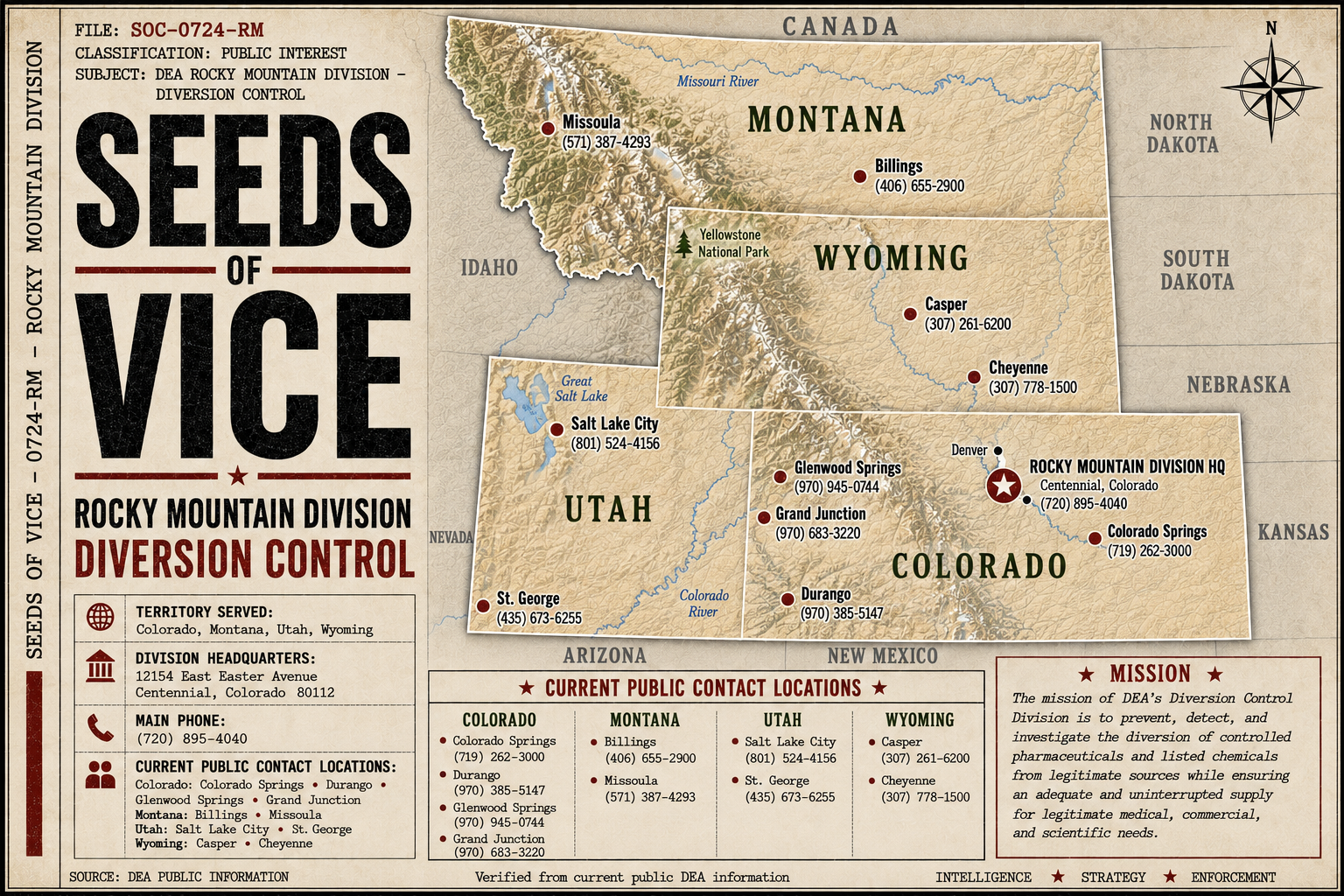
The Rocky Mountain Division
DEA Rocky Mountain Field Division and Its Diversion-Control System
Last fully verified: July 25, 2026
The Drug Enforcement Administration’s Rocky Mountain Field Division serves:
- Colorado
- Montana
- Utah
- Wyoming
The regional command is officially the Rocky Mountain Field Division. There is no separate regional agency formally titled the “Rocky Mountain Diversion Division.” Diversion Control is one of the functions carried out within the field division under the Controlled Substances Act, national DEA regulations, federal registration systems, and the broader leadership of DEA’s national Diversion Control Division.
The division’s four-state jurisdiction is clear and consistently stated.
Its internal public structure is not.
DEA’s current Special Agent in Charge biography states that the Rocky Mountain Division contains 13 offices and covers approximately 434,000 square miles. DEA’s public directory, however, identifies only 11 locations when the Centennial headquarters is counted together with the ten published subordinate contacts. DEA does not identify the two additional offices or explain whether they are omitted geographic offices, specialized facilities, intelligence components, laboratories, task-force locations, or administrative units.
A January 2024 DEA review described the same division as covering approximately 450,000 square miles, rather than 434,000. DEA has not explained whether the difference reflects revised measurement, jurisdictional change, rounding, or a correction.
DEA’s public pages also label the headquarters inconsistently. The physical address is in Centennial, Colorado. The main division page presents the same address beneath both Centennial and Denver labels, while the separate contact page identifies Centennial directly.
The proper conclusion is therefore:
The Rocky Mountain Division has a stable four-state jurisdiction, but DEA has not published a complete and internally reconciled account of its offices, geographic measurement, command structure, or regional Diversion organization.
Executive Finding
What is official
DEA states that the Rocky Mountain Field Division serves Colorado, Montana, Utah, and Wyoming.
The headquarters is physically located at:
12154 East Easter Avenue
Centennial, Colorado 80112
Main telephone: 720-895-4040
DEA’s separate contact directory also publishes:
DEA registrant calls: 800-326-6900
DEA identifies David S. Olesky as the current Special Agent in Charge. He assumed command in July 2025 and oversees more than 300 DEA employees and task-force officers throughout Colorado, Montana, Utah, and Wyoming.
DEA publishes subordinate contacts in:
Colorado
- Colorado Springs
- Durango
- Glenwood Springs
- Grand Junction
Montana
- Billings
- Missoula
Utah
- Salt Lake City
- St. George
Wyoming
- Casper
- Cheyenne
Together with the Centennial headquarters, those contacts produce 11 publicly identified locations.
The 13-office discrepancy
Olesky’s official biography states that the division contains 13 offices.
DEA’s public division directory shows:
- One headquarters.
- Four subordinate Colorado contacts.
- Two Montana contacts.
- Two Utah contacts.
- Two Wyoming contacts.
That produces 11 locations.
DEA does not identify the remaining two offices or explain whether its use of “office” includes components not shown in the public geographic directory.
The missing locations should not be guessed.
They may represent:
- Unpublished posts of duty.
- Specialized task-force facilities.
- Intelligence offices.
- Diversion offices.
- Administrative components.
- Another form of DEA presence not included in the public directory.
Those are possibilities, not findings.
Conflicting geographic-area figures
Olesky’s current biography describes the division as covering approximately 434,000 square miles.
A January 2024 DEA review described it as covering approximately 450,000 square miles.
The difference is approximately 16,000 square miles.
DEA has not publicly stated whether:
- The territory changed.
- One figure includes tribal or federal land differently.
- One figure reflects land area while the other uses another method.
- One number was rounded.
- One number was erroneous.
- The 2025 biography corrected the earlier description.
The public record supports documenting the discrepancy.
It does not support choosing an explanation without evidence.
Headquarters-address inconsistency
DEA’s live division page presents:
12154 East Easter Avenue
Centennial
Denver, Colorado 80112
DEA’s separate contact page presents the physical city as Centennial.
The headquarters is in Centennial.
The institutional association with Denver may explain why DEA continues to use Denver in recruitment addresses and Tactical Diversion Squad listings, but it does not make Denver and Centennial the same municipality.
What can be concluded
The Rocky Mountain Division is a four-state regional command covering an exceptionally large and geographically varied territory.
Its operating environment includes:
- The Denver metropolitan region.
- Colorado’s Front Range.
- Western Colorado.
- The Interstate 25 and Interstate 70 corridors.
- Salt Lake City and the Wasatch Front.
- Southern Utah.
- Billings and Missoula.
- The Interstate 90 and Interstate 94 corridors.
- Wyoming’s major population centers and transportation routes.
- Rural and frontier communities.
- Tribal lands and reservation communities.
- Mountain regions with limited transportation and healthcare access.
- Interstate distribution routes connecting Mexico and the Southwest with the Midwest, Pacific Northwest, and northern United States.
Current DEA records show that the division investigates fentanyl, methamphetamine, cocaine, counterfeit tablets, firearms, money laundering, overdose deaths, cartel-linked distribution, pharmaceutical theft, and controlled-substance diversion.
What cannot presently be concluded
The current public record does not establish:
- The identity of all 13 offices.
- The reason DEA publishes only 11 locations.
- Which office classifications apply to most listed locations.
- The reason for the 434,000- versus 450,000-square-mile discrepancy.
- A county-by-county office map.
- The complete current Assistant Special Agent in Charge roster.
- The current Diversion Program Manager.
- The number and locations of traditional Diversion Groups.
- The names of Tactical Diversion Squad supervisors.
- The number of Diversion Investigators assigned to each state.
- Whether every state has permanently assigned registration and compliance personnel.
- How Denver and Salt Lake City divide Wyoming Diversion matters.
- Whether the criminal-enforcement and Diversion boundaries are identical.
- The total annual number of inspections, warnings, civil referrals, registration surrenders, administrative actions, criminal referrals, dismissals, or acquittals.
Seeds of Vice will not fill those gaps through assumption.
Who the Rocky Mountain Division Serves
The Rocky Mountain Division serves a large, sparsely distributed, and institutionally diverse population across four states.
Its territory includes major metropolitan areas, small cities, reservation communities, mountain regions, agricultural areas, energy-producing regions, and remote communities located hundreds of miles from large healthcare systems or DEA offices.
The division serves or regulates:
- Patients receiving controlled medications.
- Physicians and other authorized prescribers.
- Pharmacies and pharmacists.
- Hospitals and clinics.
- Manufacturers and distributors.
- Researchers and universities.
- Veterinary practices.
- Narcotic-treatment programs.
- Tribal and Indian Health Service facilities.
- Federal healthcare institutions.
- State, local, and tribal law-enforcement agencies.
- Families affected by illicit fentanyl, methamphetamine, counterfeit pills, addiction, violence, and inadequate medical care.
The division operates across two fundamentally different controlled-substance channels.
The illicit channel
The illicit channel includes:
- Unlawful importation.
- Cartel-linked distribution.
- Fentanyl powder and counterfeit tablets.
- Bulk methamphetamine.
- Cocaine and heroin.
- Firearms connected to drug trafficking.
- Money laundering.
- Interstate transportation.
- Dark-web and encrypted communications.
- Pharmacy burglary.
- Prescription forgery.
- Drug distribution resulting in death.
- Illicit production designed to resemble pharmaceutical medicine.
The lawful channel
The lawful channel includes:
- Registered manufacturers.
- Distributors.
- Pharmacies.
- Hospitals.
- Physicians and other practitioners.
- Researchers.
- Veterinary facilities.
- Treatment programs.
- Patients using controlled substances for legitimate medical purposes.
The channels may intersect when:
- Genuine medication is stolen.
- A prescription is forged.
- A registrant intentionally distributes outside legitimate professional practice.
- A pharmacy knowingly dispenses an invalid prescription.
- A manufacturer or distributor fails to maintain required controls.
- An illicit producer manufactures a tablet resembling authentic medicine.
- A healthcare employee removes medication from a patient-care setting.
Those intersections do not make every patient, practitioner, pharmacy, hospital, or manufacturer part of the illicit market.
Territory and Office Structure
Rocky Mountain Division Headquarters
12154 East Easter Avenue
Centennial, Colorado 80112
Main telephone: 720-895-4040
Registrant calls: 800-326-6900
DEA’s main division page associates the address with both Centennial and Denver. Its separate contact page identifies Centennial. The physical city should therefore be presented as Centennial while preserving DEA’s inconsistent public labeling as an institutional finding.
Colorado Contacts
| Published location | Telephone |
|---|---|
| Colorado Springs | 719-262-3000 |
| Durango | 970-385-5147 |
| Glenwood Springs | 970-945-0744 |
| Grand Junction | 970-683-3220 |
Montana Contacts
| Published location | Telephone |
|---|---|
| Billings | 406-655-2900 |
| Missoula | 571-387-4293 |
Utah Contacts
| Published location | Telephone |
|---|---|
| Salt Lake City | 801-524-4156 |
| St. George | 435-673-6255 |
Wyoming Contacts
| Published location | Telephone |
|---|---|
| Casper | 307-261-6200 |
| Cheyenne | 307-778-1500 |
These are DEA’s current published geographic contacts. Their appearance in the directory establishes that DEA provides a contact associated with each location. It does not independently establish whether each is a district office, resident office, post of duty, task-force facility, or another organizational unit.
Salt Lake City District Office
DEA’s Rocky Mountain page specifically identifies a Salt Lake City District Office in its recruitment section.
Recruitment contact: Special Agent Nathan Parker
Telephone: 571-387-2558
Email: utahrecruiter@dea.gov
This is a current express office classification.
The same page does not visibly classify the remaining subordinate locations.
Office-type legend without applied classifications
DEA displays a legend for:
- Division office.
- District office.
- Resident office.
- Post-of-duty office.
The visible directory does not consistently connect those labels to the individual Rocky Mountain locations.
The public can determine where DEA publishes telephone contacts.
It cannot determine the complete administrative hierarchy from the page.
Public directory versus claimed structure
The public directory identifies:
- Centennial headquarters.
- Colorado Springs.
- Durango.
- Glenwood Springs.
- Grand Junction.
- Billings.
- Missoula.
- Salt Lake City.
- St. George.
- Casper.
- Cheyenne.
That is 11 locations.
Olesky’s biography states that he supervises 13 offices.
DEA should identify the remaining two or explain why the two records use different definitions.
Current Leadership and Publicly Identified Personnel
David S. Olesky
Special Agent in Charge
David S. Olesky was appointed Special Agent in Charge of the Rocky Mountain Field Division in July 2025.
DEA states that he oversees more than 300 employees and task-force officers across Colorado, Montana, Utah, and Wyoming. His official biography describes the division as containing 13 offices and covering approximately 434,000 square miles.
Olesky joined DEA in 2000 and began his career in the Los Angeles Field Division, where he worked Southwest-border and international drug-trafficking matters.
His later assignments included:
- Service in DEA’s Panama office.
- Financial-investigation work in Los Angeles.
- Service in Bogotá, Colombia.
- Headquarters leadership involving money laundering and illicit finance.
- Management of national and international operational programs.
Olesky has an accounting background and is a certified public accountant. That experience is relevant to a field division whose investigations may involve currency movement, money laundering, cryptocurrency, asset forfeiture, business entities, and international financial systems.
Steffan W. Tubbs
Media Contact
Telephone: 571-387-5079
Special Agent Craig Wiggins
Recruitment Contact
Telephone: 571-387-2560
Email: DenverSpecialAgentRecruiter@dea.gov
The continued use of a Denver recruitment address reflects DEA’s institutional association with Denver. It does not alter the physical Centennial headquarters address.
Aminta Bhutani
Community-Outreach Contact
Telephone: 303-514-1709
Email: Aminta.Bhutani@dea.gov
Special Agent Nathan Parker
Salt Lake City District Office Recruitment
Telephone: 571-387-2558
Email: utahrecruiter@dea.gov
Current Diversion leadership
A current Rocky Mountain Division Diversion Program Manager could not be verified through the current official public personnel records reviewed for this page.
DEA’s public materials do not identify:
- The regional Diversion Program Manager.
- Diversion Group supervisors.
- Tactical Diversion Squad supervisors.
- A named regional registration official.
- A named medical-practitioner compliance official.
- The Assistant Special Agent in Charge responsible for Diversion.
- The number of Diversion Investigators assigned to each state.
The absence matters because those officials may supervise activity affecting:
- Practitioner registration.
- Pharmacy registration.
- Manufacturer and distributor compliance.
- Inspections.
- Inventory and recordkeeping.
- Security.
- Suspicious orders.
- Administrative proceedings.
- Civil referrals.
- Criminal diversion investigations.
The officials exercising that authority should be publicly identifiable.
Tactical Diversion Squads
DEA’s national Tactical Diversion Squad directory identifies the following Rocky Mountain structure:
| State | Published Tactical Diversion Squad contact |
|---|---|
| Colorado | Denver |
| Montana | Billings and Missoula |
| Utah | Salt Lake City |
| Wyoming | Denver or Salt Lake City |
DEA does not identify a Wyoming-based Tactical Diversion Squad. Instead, it directs Wyoming matters to either Denver or Salt Lake City without describing how the responsibility is divided.
Official TDS function
DEA states that Tactical Diversion Squads combine federal, state, and local resources to investigate suspected violations involving the diversion of lawfully produced pharmaceutical controlled substances and listed chemicals.
DEA states that the squads:
- Unify information, authority, and enforcement programs.
- Coordinate investigations and prosecutions across judicial districts.
- Support traditional Diversion Groups when arrests, evidence purchases, surveillance, confidential payments, or search warrants are required.
A Tactical Diversion Squad is therefore not simply a registration or compliance office.
It is an enforcement structure capable of investigating:
- Counterfeit pharmaceuticals.
- Pharmacy theft.
- Prescription forgery.
- Illicit pill presses.
- Unlawful prescribing.
- Unlawful dispensing.
- Internet distribution.
- Diversion by healthcare employees.
- Manufacturer or distributor misconduct.
- Healthcare-related controlled-substance fraud.
- Criminal conduct involving listed chemicals.
Colorado
DEA identifies Denver as Colorado’s Tactical Diversion Squad location.
The directory does not explain whether Denver TDS serves:
- Every Colorado county.
- The entire Front Range.
- Western Colorado.
- Southern Colorado.
- Wyoming counties assigned to Denver.
- Registrants served through Colorado Springs, Durango, Glenwood Springs, or Grand Junction.
Montana
DEA identifies Tactical Diversion Squad locations in both Billings and Missoula.
The directory does not explain:
- How Montana is divided between the squads.
- Whether both have full criminal-enforcement capability.
- How reservation communities are assigned.
- Whether one squad supervises the other.
- Whether traditional Diversion Group boundaries are the same.
Utah
DEA identifies Salt Lake City as Utah’s Tactical Diversion Squad location.
The public directory does not explain whether Salt Lake City TDS serves:
- All of Utah.
- St. George and southern Utah.
- Part of Wyoming.
- Particular federal judicial districts or task-force jurisdictions.
Wyoming
DEA’s instruction for Wyoming is:
Denver or Salt Lake City.
That is not a complete territorial assignment.
A Wyoming practitioner, pharmacist, hospital, attorney, patient, or journalist cannot determine from the directory:
- Which counties report to Denver.
- Which counties report to Salt Lake City.
- Whether the division follows an east–west line.
- Whether assignment depends on the type of case.
- Whether Casper and Cheyenne have attached Diversion personnel.
- Whether registration and criminal Diversion use the same boundary.
The public should not be required to choose between two federal offices without knowing the governing rule.
Official Role and Mission
The Rocky Mountain Field Division enforces the federal Controlled Substances Act and related federal laws within Colorado, Montana, Utah, and Wyoming and in connected interstate and international investigations.
Its work may include:
- Drug-trafficking investigations.
- Intelligence collection and analysis.
- Cartel and transnational-organization investigations.
- Fentanyl and counterfeit-pill cases.
- Methamphetamine and cocaine investigations.
- Firearms and money laundering.
- Interstate transportation.
- Overdose-death investigations.
- Controlled-substance registration.
- Administrative inspections.
- Practitioner and pharmacy investigations.
- Manufacturer and distributor oversight.
- Theft and loss investigations.
- Suspicious-order investigations.
- Civil referrals.
- Administrative registration actions.
- Community outreach.
- Prescription-drug disposal.
DEA defines the Diversion mission as preventing, detecting, and investigating the diversion of controlled pharmaceuticals and listed chemicals from legitimate sources while ensuring an adequate and uninterrupted supply for legitimate medical, commercial, and scientific needs.
Those are simultaneous obligations.
Diversion Control is not officially defined solely as:
- Reducing prescribing.
- Restricting pharmacy supply.
- Suspending registrations.
- Investigating practitioners.
- Increasing inspections.
- Referring cases for prosecution.
The mission also includes protecting the lawful channel and preserving legitimate availability.
The Rocky Mountain Field Division performs regional work.
It is not the national Diversion Control Division.
How the Rocky Mountain System Works in Practice
Interstate transportation corridors
DEA identifies Interstate 25 and Interstate 70 as increasingly important fentanyl-distribution corridors within the division.
Interstate 25 connects major population centers in Colorado and Wyoming and provides access toward New Mexico and the Southwest.
Interstate 70 crosses Colorado and Utah and connects the region with western and midwestern markets.
In July 2026, DEA reported that the Rocky Mountain Division had seized nearly 3.2 million fentanyl pills and more than 92 kilograms of fentanyl powder since January 1. DEA attributed the largest share to Colorado and Utah.
The reported state breakdown was:
| State | Fentanyl pills | Fentanyl powder |
|---|---|---|
| Colorado | 2,554,889 | 81 kilograms |
| Utah | 613,619 | 10 kilograms |
| Montana | 14,529 | 0.77 kilograms |
| Wyoming | 5,507 | None reported |
| Division total | 3,188,544 | 92.5 kilograms |
These are DEA seizure figures. They measure drugs reported seized by the agency during the stated period.
They do not establish:
- The total amount available in the illicit market.
- The number of intended users.
- The number of deaths prevented.
- The number of pills that had completed laboratory testing in every matter.
- The final legal outcome of every investigation associated with the seizures.
2025 divisionwide seizures
DEA reported that during 2025 the Rocky Mountain Division seized:
- Approximately 8,729,000 fentanyl pills.
- Approximately 3,045 pounds of methamphetamine.
- Approximately 229 kilograms of cocaine.
DEA’s reported state breakdown included:
Colorado
- Approximately 6.7 million fentanyl pills.
- Approximately 2,202 pounds of methamphetamine.
- Approximately 140 kilograms of cocaine.
Utah
- Approximately two million fentanyl pills.
- Approximately 637 pounds of methamphetamine.
- Approximately 79 kilograms of cocaine.
Montana
- Approximately 24,000 fentanyl pills.
- Approximately 168 pounds of methamphetamine.
- Approximately three kilograms of cocaine.
Wyoming
- Approximately 5,000 fentanyl pills.
- Approximately 40 pounds of methamphetamine.
- Approximately seven kilograms of cocaine.
DEA also reported a Colorado methamphetamine seizure of approximately 733 pounds and a single seizure involving approximately 1.7 million fentanyl pills.
The numbers demonstrate major differences in reported seizure volume among the four states.
They do not establish that:
- Colorado residents consumed the seized drugs.
- Every substance entered through Colorado.
- Low Wyoming or Montana pill totals imply low local harm.
- One state’s enforcement effort was more effective solely because its seizure total was higher.
- Seizure volume is directly proportional to overdose mortality.
Early 2026 enforcement surge
During a 30-day period from January 12 through February 10, 2026, DEA reported that the Rocky Mountain Division seized:
- Approximately 17 kilograms of fentanyl powder.
- 193,417 fentanyl pills.
- 57 firearms.
- Approximately $5.53 million in currency.
DEA also reported 62 arrests.
DEA characterized the seized fentanyl as representing approximately 920,000 potentially fatal doses.
That figure is an agency risk-communication calculation.
It is not:
- A count of confirmed intended users.
- A toxicological finding that every unit would have killed a person.
- A count of deaths independently proved to have been prevented.
- A substitute for the dose, purity, exposure, tolerance, and medical circumstances of an individual case.
Methamphetamine remains central
The division’s public narrative frequently emphasizes fentanyl because of its lethality and counterfeit-pill market.
DEA’s own seizure record also shows that methamphetamine remains a defining regional controlled-substance problem, particularly by weight and geographic reach.
Methamphetamine investigations may involve:
- Bulk transportation from the Southwest.
- Interstate distribution.
- Rural and reservation markets.
- Firearms.
- Extended conspiracies.
- Cash movement.
- Cartel-linked suppliers.
- Distribution across several federal judicial districts.
Fentanyl and methamphetamine are simultaneous threats.
They should not be treated as one identical market.
State and Tribal Operating Environments
Colorado
Colorado accounts for the largest share of the division’s reported fentanyl-pill, fentanyl-powder, methamphetamine, and cocaine seizures.
The state contains the division headquarters, the Denver metropolitan area, the Front Range, major interstate corridors, and published contacts in Colorado Springs, Durango, Glenwood Springs, and Grand Junction.
Colorado investigations may involve:
- Urban distribution.
- Interstate transportation.
- Mountain communities.
- Western Slope markets.
- Healthcare and hospital diversion.
- Counterfeit pills.
- Pharmaceutical theft.
- Firearms and money laundering.
Utah
Utah accounts for the second-largest share of the division’s reported fentanyl and major-drug seizures.
Salt Lake City is a current district office, a Tactical Diversion Squad location, and a recruitment center. DEA also publishes a St. George contact for southern Utah.
Utah’s transportation position connects:
- Interstate 15.
- Interstate 70.
- Nevada and California routes.
- Arizona.
- Idaho.
- Wyoming.
- Colorado.
- National east–west distribution systems.
Montana
Montana’s large geographic area, sparse population, reservation communities, and interstate highways create a distinct enforcement environment.
DEA publishes offices in Billings and Missoula and identifies Tactical Diversion Squads in both cities.
Federal cases have documented methamphetamine and fentanyl organizations operating through or affecting reservation communities, including the Crow, Blackfeet, and Rocky Boy’s reservations.
The presence of trafficking on tribal lands requires coordination among:
- DEA.
- Tribal law enforcement.
- The Bureau of Indian Affairs.
- Federal prosecutors.
- State and local agencies.
- Tribal governments.
- Indian Health Service and tribal healthcare institutions.
It does not diminish tribal sovereignty or make every reservation community a single enforcement environment.
Wyoming
DEA publishes contacts in Casper and Cheyenne.
Its Tactical Diversion Squad directory directs Wyoming matters to either Denver or Salt Lake City without explaining the division.
Wyoming cases include conduct involving:
- Interstate drug transportation.
- Reservation communities.
- Fentanyl tablets.
- Methamphetamine.
- Cocaine.
- Cartel-linked supply.
- Rural distribution networks.
A March 2026 federal case resulted in a 32-month sentence after Cathy Lynn Mink was convicted or pleaded guilty in connection with distributing fentanyl on the Wind River Reservation, including a controlled purchase involving 150 tablets.
In another matter, Gabriel Seth Rodgers received a 30-year federal sentence in November 2025 for methamphetamine, fentanyl, and cocaine distribution. Prosecutors described him as a load coordinator connected to a Sinaloa-cartel supply system.
These were adjudicated dispositions, not merely pending allegations.
Pharmaceutical Diversion in a Healthcare Setting
Colorado dental-assistant fentanyl diversion
Guilty plea and sentence
In January 2026, Amber June Hyatt received a sentence of one year and one day after pleading guilty to tampering with a consumer product.
Federal authorities stated that Hyatt diverted fentanyl from vials while working as a dental assistant in an oral-surgery practice.
The matter illustrates a form of Diversion that differs from:
- Counterfeit-pill manufacturing.
- Street trafficking.
- A prescribing dispute.
- A recordkeeping violation.
- A patient’s lawful use of medication.
The medication began inside the lawful healthcare channel.
The alleged or admitted misconduct involved removing or tampering with medication within that channel.
Institutional significance
Healthcare-setting diversion can endanger patients through:
- Missing medication.
- Diluted or substituted medication.
- Contaminated vials.
- Inadequate sedation or analgesia.
- Infection exposure.
- Inaccurate inventory.
- Unreliable medical records.
- Loss of confidence in the healthcare system.
A properly functioning Diversion system has a legitimate role in detecting and prosecuting that conduct.
The existence of healthcare-setting diversion does not establish that ordinary patients receiving controlled medication are diverting it.
Representative Criminal Matters
Utah fentanyl distribution resulting in death
Guilty plea and sentence
In June 2026, Cullin Anthony Bullen received a 180-month federal sentence, five years of supervised release, and a restitution order after pleading guilty to distributing fentanyl resulting in death.
This was an adjudicated criminal disposition.
The legal posture differs from a press release announcing an indictment or complaint.
Utah trafficking and money laundering
Guilty pleas and sentences
In January 2026, two brothers received sentences of 96 months each in a drug-trafficking and money-laundering case.
The combined 16 years of imprisonment followed adjudicated dispositions.
Utah dark-web controlled-substance distribution
Trial conviction and sentence
In November 2024, a dark-web controlled-substance dealer received a 30-year federal sentence and a lifetime term of supervised release after a jury conviction involving oxycodone distribution and money laundering. The court also imposed a forfeiture judgment exceeding $20 million.
The matter demonstrates how investigations may involve:
- Online distribution.
- Cryptocurrency or digital payment systems.
- Controlled pharmaceuticals.
- Money laundering.
- Interstate customers.
- Financial forfeiture.
Montana reservation-based methamphetamine organization
Convictions
Federal authorities announced 27 convictions in a large methamphetamine organization based on or affecting the Crow Reservation.
The investigation involved distribution to several Montana reservations and supply connections extending beyond the state.
The convictions represent adjudicated outcomes.
They should not be described as pending charges.
Montana Blackfeet Reservation cases
Indictments
Federal authorities announced multiple indictments involving alleged methamphetamine and fentanyl trafficking on or affecting the Blackfeet Reservation.
Indictments are allegations. The defendants remain presumed innocent unless convicted.
Montana Rocky Boy’s Reservation matter
Sentence
A Billings defendant received a ten-year sentence in January 2025 for armed methamphetamine trafficking connected to the Rocky Boy’s Reservation.
The sentence was an adjudicated disposition.
Wyoming fentanyl distribution
Sentence
Cathy Lynn Mink received a 32-month sentence in a federal fentanyl-distribution case arising from conduct on the Wind River Reservation.
Wyoming cartel-linked trafficking
Sentence
Gabriel Seth Rodgers received a 30-year federal sentence for methamphetamine, fentanyl, and cocaine trafficking. Prosecutors described his role as coordinating drug loads for a cartel-connected supply organization.
The sentence was an adjudicated outcome.
Prescription-Drug Collection and Disposal
For the April 25, 2026, National Prescription Drug Take Back Day, DEA reported collecting 27,590 pounds of unwanted medication from 225 sites operated with 157 participating law-enforcement departments across the Rocky Mountain Division.
DEA reported the following state totals:
| State | Medication collected |
|---|---|
| Utah | 13,626 pounds |
| Colorado | 11,519 pounds |
| Montana | 1,239 pounds |
| Wyoming | 1,206 pounds |
| Division total | 27,590 pounds |
Utah collected more material than any other state in the division during the event.
DEA reported that the division had collected 22,202 pounds during the preceding October 2025 event.
What Take Back totals establish
Drug-disposal programs may reduce:
- Accidental ingestion.
- Theft.
- Informal sharing.
- Retention of unused medication.
- Entry of unused medicine into unlawful markets.
The collected weight does not establish:
- How much was opioid medication.
- How much was controlled rather than noncontrolled.
- How many patients participated.
- Whether the medication had been clinically unnecessary.
- Whether a particular overdose or crime was prevented.
- Why one state collected more than another.
The program may provide a legitimate public benefit without supporting claims beyond what it measures.
Diversion Control and Lawful Medicine
Rocky Mountain Division Diversion personnel may regulate or investigate:
- Physicians.
- Dentists.
- Nurse practitioners.
- Physician assistants.
- Pharmacists.
- Hospitals.
- Clinics.
- Veterinary practices.
- Manufacturers.
- Distributors.
- Researchers.
- Narcotic-treatment programs.
- Tribal and Indian Health Service facilities.
- Federal healthcare facilities.
- Other DEA registrants.
Their work may include:
- Registration applications and renewals.
- Inspections.
- Controlled-substance inventories.
- Recordkeeping reviews.
- Security evaluations.
- Theft and loss reporting.
- Suspicious-order investigations.
- Prescription reviews.
- Administrative subpoenas.
- Corrective agreements.
- Voluntary registration surrender.
- Orders to Show Cause.
- Immediate Suspension Orders.
- Civil referrals.
- Criminal investigation when intentional unlawful conduct is suspected.
These actions occupy different legal positions.
Inspection
An inspection is a compliance or investigative process.
It is not itself proof that the registrant violated the law.
Warning or corrective agreement
A registrant may receive education, agree to training, change security procedures, correct records, or accept monitoring without being criminally convicted.
Civil settlement
A civil settlement resolves civil allegations or potential liability.
It is not automatically a guilty plea or criminal conviction.
Administrative action
An administrative action concerns the authority to manufacture, distribute, prescribe, dispense, research, or possess controlled substances.
It may occur independently of criminal prosecution.
Complaint or indictment
A criminal complaint or indictment contains allegations.
The accused remains presumed innocent unless convicted.
Guilty plea
A guilty plea is a formal admission to specified conduct in court.
Trial conviction
A trial conviction is an adjudicated finding of guilt.
Sentence
A sentence follows a guilty plea or conviction.
Dismissal or acquittal
A dismissal ends charges without a conviction.
An acquittal is a finding that the government did not prove criminal guilt beyond a reasonable doubt.
The word enforcement should never erase these distinctions.
The Four-State Prescription-Control Layer
The Rocky Mountain Division operates across four separate state medical, pharmacy, controlled-substance, and prescription-monitoring systems.
The states share broad objectives.
They do not maintain one uniform regional law.
Colorado’s State-Control Layer
Colorado maintains a Prescription Drug Monitoring Program intended to support clinical decision-making and help reduce misuse, abuse, and diversion of controlled substances.
Covered prescribers and pharmacists are subject to state registration, reporting, and consultation requirements. Colorado law has also imposed a general seven-day limitation on certain initial opioid prescriptions while preserving exceptions and continued prescribing under applicable circumstances.
Colorado patient-protection provisions
Colorado enacted protections addressing the treatment of diagnosed chronic pain.
Current law limits professional discipline based solely on a practitioner exceeding a dosage threshold found in a guideline. It also restricts mandatory tapering solely to reach a predetermined dosage when a patient is stable, compliant, and not experiencing serious harm. Colorado further limits pharmacy-benefit, carrier, and institutional policies that would require refusal solely because a prescription is for an opioid or exceeds a numerical threshold.
These protections do not eliminate:
- Professional judgment.
- Monitoring.
- Documentation.
- Investigation of intentional unlawful conduct.
- Pharmacy duties.
- Federal Controlled Substances Act requirements.
They recognize that a dosage number alone is not a complete adjudication of an individual patient’s care.
Montana’s State-Control Layer
Montana’s Prescription Drug Registry collects Schedule II through Schedule V controlled-substance dispensing information from covered pharmacies and dispensers.
Montana requires covered dispensing information to be reported promptly and imposes prescription-history review requirements in specified opioid and benzodiazepine prescribing circumstances.
Montana’s state and Medicaid frameworks include additional requirements concerning dosage, duration, documentation, prior authorization, and clinical exceptions. A Medicaid restriction should not automatically be represented as a universal law governing every privately insured, federally insured, or self-paying patient.
Montana’s rural and reservation geography is particularly relevant because patients may face long travel distances to:
- Pain specialists.
- Pharmacies.
- Physical therapy.
- Behavioral-health care.
- Addiction treatment.
- Large hospital systems.
- Imaging or interventional services.
A state database may make information available.
It does not make treatment geographically available.
Utah’s State-Control Layer
Utah maintains a Controlled Substance Database administered through the state’s professional-licensing system.
The database collects controlled-substance dispensing information and supports authorized review by prescribers, pharmacists, regulators, and law-enforcement officials under applicable law.
Utah law regulates:
- Controlled-substance prescribing.
- Prescription form and transmission.
- Database access.
- Prescriber education.
- Dispenser reporting.
- Professional licensing.
- Investigation of suspected unlawful conduct.
Database information may help identify:
- Multiple prescribers.
- Multiple pharmacies.
- Repeated early dispensing.
- Concurrent controlled medications.
- Potential forgery.
- Patterns requiring clinical review.
It is not, by itself, proof that:
- A patient committed a crime.
- A patient is deceptive.
- A patient has a substance-use disorder.
- A prescription lacked a legitimate medical purpose.
- A practitioner acted outside professional practice.
- A pharmacist knowingly dispensed unlawfully.
Those conclusions require additional evidence and context.
Wyoming’s State-Control Layer
Wyoming operates a Prescription Drug Monitoring Program through the State Board of Pharmacy.
The program collects information concerning controlled-substance dispensing and other reportable medications under state rules. Wyoming describes the system as serving the dual purpose of supporting legitimate medical access while helping identify misuse, abuse, and diversion.
Wyoming imposes profession-specific monitoring and consultation duties. Some state requirements include periodic database review during chronic nonmalignant-pain treatment. The exact duty depends on the practitioner’s license, the drug, the treatment setting, and current professional-board rules.
Wyoming’s database should not be confused with:
- DEA’s federal registration system.
- A criminal-history database.
- Proof that a particular patient or practitioner violated the law.
- A complete measure of treatment quality.
No single regional rule
A practitioner within the Rocky Mountain Division may simultaneously face:
- Federal Controlled Substances Act requirements.
- DEA registration rules.
- DEA inspection or investigation.
- State controlled-substance registration.
- State prescribing statutes.
- State licensing-board rules.
- State prescription-monitoring requirements.
- Pharmacy policies.
- Insurer restrictions.
- Hospital or clinic protocols.
- Civil-liability concerns.
- Professional guidance.
- Individual clinical judgment.
No single institution creates the entire treatment environment.
How the System Affects Pain Patients and Lawful Medicine
Legitimate protective functions
A properly functioning Diversion system can protect patients by:
- Detecting forged prescriptions.
- Investigating pharmacy burglary and theft.
- Identifying healthcare-setting diversion.
- Enforcing accurate controlled-substance inventories.
- Investigating intentional criminal prescribing.
- Investigating knowing unlawful dispensing.
- Removing counterfeit tablets.
- Identifying illicit pill presses.
- Preventing stolen medication from entering unlawful markets.
- Preserving traceability within the lawful supply chain.
- Separating authentic medicine from counterfeit fentanyl products.
- Holding intentionally corrupt registrants accountable.
The Colorado dental-assistant case demonstrates why healthcare-setting controls matter. Medication diverted or tampered with inside a clinical facility can directly endanger patients who believe they are receiving intact, properly handled medicine.
Counterfeit medicine
A counterfeit tablet may be designed to resemble:
- Oxycodone.
- Alprazolam.
- Amphetamine medication.
- Another recognizable pharmaceutical product.
It may instead contain:
- Illicit fentanyl.
- Methamphetamine.
- An illicit benzodiazepine.
- An inconsistent mixture.
- An unknown dose.
The counterfeit product borrows the appearance and implied safety of lawful medicine while bypassing:
- Regulated manufacturing.
- Quality control.
- Accurate labeling.
- Dose uniformity.
- A valid prescription.
- Pharmacist review.
- Traceable distribution.
- Patient-specific medical judgment.
Counterfeit medicine is not evidence that authentic medicine should become inaccessible.
It is evidence that the authentic channel should remain protected, recognizable, and available.
Risk of institutional overcorrection
The same control environment can harm lawful patients when:
- Numerical thresholds become automatic rules.
- Monitoring information becomes a verdict.
- Practitioners stop treating pain because they fear investigation.
- Pharmacies refuse lawful prescriptions through unpublished policy.
- Insurers impose nonclinical restrictions.
- Patients are rapidly tapered.
- Medication is abruptly discontinued.
- Patients are dismissed rather than clinically managed.
- Drug testing and treatment agreements become punitive controls.
- Effective alternatives are assumed to exist without verifying access.
- Rural patients are required to travel unreasonable distances.
- Institutional risk management replaces individualized judgment.
CDC has acknowledged that prior opioid guidance was misapplied through rigid dosage thresholds, rapid tapers, abrupt discontinuation, inflexible duration limits, patient dismissal, and application to patients outside the guidance’s intended scope.
CDC associated such practices with untreated or undertreated pain, withdrawal, worsening pain, psychological distress, overdose, and suicidal ideation or behavior. Its 2022 guidance emphasizes individualized, patient-centered decision-making.
That acknowledgment does not establish that DEA alone caused those outcomes.
The treatment environment is produced through the interaction of:
- Congress.
- DEA.
- Federal prosecutors.
- State legislatures.
- Medical and pharmacy boards.
- Prescription-monitoring programs.
- Insurers.
- Pharmacy corporations.
- Hospitals and clinics.
- Professional organizations.
- Civil-liability systems.
- Individual practitioners.
- Patients.
- The illicit market.
DEA should not be assigned sole responsibility for every medical decision.
It should not be removed from the analysis.
The possibility of inspection, registration restriction, administrative action, civil penalties, criminal referral, or prosecution forms part of the institutional environment in which controlled-substance decisions are made.
Rural, frontier, mountain, and tribal access
The Rocky Mountain Division contains extensive communities located far from:
- Pain specialists.
- Large medical systems.
- Independent pharmacies.
- Physical therapy.
- Behavioral-health services.
- Interventional treatment.
- Addiction-treatment programs.
- Public transportation.
- DEA and state regulatory offices.
A policy that appears manageable in Denver or Salt Lake City may impose a fundamentally different burden in:
- Eastern Montana.
- Western Wyoming.
- Rural Utah.
- Colorado mountain communities.
- Reservation communities.
- Remote agricultural or energy-producing areas.
An alternative is not functionally available merely because it exists somewhere within the state.
A serious access analysis must ask whether the patient can:
- Reach it.
- Afford it.
- Obtain insurance authorization.
- Receive it within a clinically meaningful period.
- Tolerate it.
- Benefit from it.
Prescribing and Dose-Decline Context
Evidentiary boundary
Seeds of Vice begins its historical inquiry in 1984.
No continuous, directly comparable annual retail opioid-dispensing series was identified for Colorado, Montana, Utah, and Wyoming beginning in 1984.
The record must therefore be divided into defensible evidentiary periods.
1984–2005
Historical inquiry may use:
- Federal distribution records.
- Manufacturing and production records.
- Controlled-substance quota information.
- Medicaid and insurer utilization.
- Drug-specific studies.
- Medical literature.
- State regulatory history.
- National prescribing indicators.
Those measures cannot be silently merged into the later CDC retail-pharmacy dispensing series.
Missing annual values should not be interpolated.
Selected retail-dispensing benchmarks
The following figures represent retail opioid prescriptions dispensed per 100 residents:
| State | 2006 | 2012 | 2019 | 2023 | 2012–2023 decline |
|---|---|---|---|---|---|
| Colorado | 62.2 | 73.5 | 40.0 | 32.4 | 55.9% |
| Montana | 79.1 | 87.7 | 48.2 | 40.4 | 53.9% |
| Utah | 87.0 | 84.5 | 51.4 | 43.8 | 48.2% |
| Wyoming | 79.9 | 80.5 | 49.7 | 43.0 | 46.6% |
The percentage changes are Seeds of Vice calculations based on the reported 2012 and 2023 rates.
What the table establishes
From 2012 through 2023, the retail opioid-dispensing rate declined:
- Approximately 55.9 percent in Colorado.
- Approximately 53.9 percent in Montana.
- Approximately 48.2 percent in Utah.
- Approximately 46.6 percent in Wyoming.
Every state experienced a substantial contraction.
Colorado and Montana declined by more than half from the 2012 benchmark.
The rates also demonstrate that state trajectories differed.
Utah’s 2006 rate was higher than its 2012 rate, while Colorado, Montana, and Wyoming increased between those benchmark years.
What the data do not establish
The dispensing figures do not establish:
- Whether an individual prescription was medically appropriate.
- Whether the patient consumed the medication.
- Whether a patient’s pain improved.
- Whether function improved.
- Whether treatment ended voluntarily.
- Whether medication was involuntarily tapered.
- Whether the patient received an effective alternative.
- Whether a pharmacy refused a valid prescription.
- Whether average dosage declined at the same rate.
- Whether prescription duration changed.
- Whether DEA caused the decline.
- Whether the decline caused a particular mortality outcome.
- Whether a patient entered the illicit market.
- Whether a patient disappeared from medical care.
Prescription volume is a utilization measure.
It is not a complete measure of medical quality.
Methodological limits
CDC’s later dispensing estimates use IQVIA Xponent data projected from approximately 54,600 nonhospital retail pharmacies representing nearly 94 percent of United States retail prescriptions.
The dataset:
- Includes new and refilled retail prescriptions.
- Includes several payment sources.
- Excludes mail-order prescriptions.
- Excludes methadone dispensed through opioid-treatment programs.
- Uses the prescriber’s location in the current series.
- Does not establish clinical appropriateness.
- Does not measure pain severity or patient function.
- Does not identify voluntary versus involuntary discontinuation.
CDC changed geographic attribution beginning in 2019 from the dispensing pharmacy’s location to the prescriber’s location. That change should be considered when comparing earlier and later rates.
Prescriptions per 100 residents must not be mixed with:
- Morphine milligram equivalents per capita.
- Average MME per prescription.
- Daily dosage.
- Days supplied.
- Number of patients.
- Number of tablets.
- Total controlled-substance prescriptions.
- Overdose deaths.
- Drug-seizure quantities.
Each measure answers a different question.
Overdose Context
Overdose mortality is not uniform across the Rocky Mountain Division.
The four states differ in:
- Population density.
- Drug supply.
- Fentanyl penetration.
- Methamphetamine involvement.
- Rural emergency response.
- Naloxone access.
- Treatment availability.
- Toxicology and reporting practices.
- Tribal and reservation conditions.
- Healthcare access.
Montana
Montana reported an opioid-overdose death rate of approximately 8.4 per 100,000 residents in 2024, compared with a national rate of approximately 16.3.
The state reported that its opioid-death rate had declined substantially but remained approximately twice its 2015 level. Montana also reported that opioids were involved in roughly three of every five overdose deaths during the 2020–2024 period.
Those figures do not establish that lawful prescriptions were the principal source of the opioids involved.
The category may include illicit fentanyl and other nonprescribed substances.
Wyoming
Wyoming reported 97 overdose deaths in 2024, compared with 120 in 2023.
State data identified:
- Methamphetamine involvement in 48 deaths.
- Opioid involvement in 45 deaths.
- Fentanyl involvement in 21 deaths.
Those categories can overlap because a death may involve more than one substance.
The figures should not be added as though they represent mutually exclusive groups.
Regional interpretation
The Rocky Mountain record contains several simultaneous findings:
Lawful retail opioid dispensing declined substantially in all four states.
DEA continued to seize millions of illicit fentanyl pills.
Methamphetamine remained a major regional drug by weight and case volume.
Counterfeit pharmaceutical tablets remained active in illicit markets.
Recent overdose trends varied among the states.
Those facts do not prove that:
- Every prescribing reduction was medically appropriate.
- Every patient retained adequate treatment.
- DEA enforcement alone caused a mortality decline.
- Prescription monitoring alone caused a mortality decline.
- Naloxone alone caused a mortality decline.
- Treatment expansion alone caused a mortality decline.
- Lawful opioid prescriptions are the principal source of current illicit fentanyl.
A reduction in lawful prescribing does not prove that illicit markets disappeared.
The presence of illicit fentanyl does not establish that every legitimate pain patient received adequate care.
Contact Information
Rocky Mountain Field Division Headquarters
Address:
12154 East Easter Avenue
Centennial, Colorado 80112
Main telephone: 720-895-4040
DEA’s main page also associates the headquarters with Denver. Its separate contact page identifies Centennial.
DEA Registrant Calls
Telephone: 800-326-6900
Media
Steffan W. Tubbs
Telephone: 571-387-5079
Recruitment
Special Agent Craig Wiggins
Telephone: 571-387-2560
Email: DenverSpecialAgentRecruiter@dea.gov
Community Outreach
Aminta Bhutani
Telephone: 303-514-1709
Email: Aminta.Bhutani@dea.gov
Salt Lake City District Office Recruitment
Special Agent Nathan Parker
Telephone: 571-387-2558
Email: utahrecruiter@dea.gov
Colorado Contacts
Colorado Springs: 719-262-3000
Durango: 970-385-5147
Glenwood Springs: 970-945-0744
Grand Junction: 970-683-3220
Montana Contacts
Billings: 406-655-2900
Missoula: 571-387-4293
Utah Contacts
Salt Lake City: 801-524-4156
St. George: 435-673-6255
Wyoming Contacts
Casper: 307-261-6200
Cheyenne: 307-778-1500
National DEA Registration Contact
Registration Contact Center: 800-882-9539
Email: DEA.Registration.Help@dea.gov
DEA does not publish a named current Rocky Mountain registration official or Diversion Program Manager.
A Wyoming Diversion inquiry may be directed to Denver or Salt Lake City under DEA’s TDS directory, but the public record does not explain which office is responsible for a particular county or type of matter.
Seeds of Vice Analysis
The Rocky Mountain Division’s jurisdiction is clear.
Its public organizational record is not.
DEA exercises criminal, civil, regulatory, and administrative authority across Colorado, Montana, Utah, and Wyoming, yet the public receives:
- A biography stating that the division has 13 offices.
- A directory revealing only 11 locations.
- A current area measurement of 434,000 square miles.
- A prior official measurement of 450,000 square miles.
- A headquarters address labeled as both Centennial and Denver.
- An office-type legend without classifications for most locations.
- No complete current command roster.
- No current public Diversion Program Manager.
- No Diversion organization chart.
- A Wyoming Tactical Diversion instruction that says only “Denver or Salt Lake City.”
These are not findings of corruption.
They are findings of inadequate public administration.
The two missing offices matter
A discrepancy of two offices is not merely a counting error when the institution exercises federal authority over:
- Registrations.
- Inspections.
- Search warrants.
- Arrests.
- Civil settlements.
- Administrative proceedings.
- Controlled-substance supply.
- Practitioner and pharmacy activity.
- Patient access.
An office may determine:
- Which supervisor bears responsibility.
- Where a registrant directs a compliance question.
- Which public-information office answers for an operation.
- Which division statistics include a matter.
- Which Tactical Diversion Squad investigates a case.
- Which geographic community receives permanent federal presence.
DEA should either identify all 13 offices or revise the biography.
The area discrepancy should not be silently resolved
The difference between 434,000 and 450,000 square miles is too large to dismiss without explanation.
The later figure may be more accurate.
The earlier figure may have been rounded.
The agency may have revised its method.
The territory may have changed.
Seeds of Vice cannot determine which explanation is correct from the public record.
The contradiction is therefore the finding.
Wyoming’s Diversion structure is not sufficiently public
DEA tells Wyoming residents and registrants to contact Denver or Salt Lake City for Tactical Diversion matters.
That instruction may function internally.
It is incomplete publicly.
A Wyoming practitioner should be able to determine:
- Which office serves the practitioner’s county.
- Which office handles registration.
- Which office conducts inspections.
- Which office investigates suspected criminal diversion.
- Whether Casper or Cheyenne has assigned Diversion personnel.
- Whether the assignment depends on geography or case type.
The public should not be required to call two offices and ask which one has authority.
Montana’s two-squad structure deserves explanation
Montana has two published DEA contacts and two published Tactical Diversion Squad locations: Billings and Missoula.
That is unusually visible compared with some divisions.
DEA still does not disclose:
- The boundary between them.
- Their supervisors.
- Their staffing.
- Their responsibility for reservation communities.
- Their relationship with traditional Diversion Groups.
- Whether either squad handles registration and routine compliance.
Visibility of city names is not the same as an organization chart.
Colorado and Utah dominate the seizure record
Colorado and Utah accounted for the overwhelming majority of the division’s reported fentanyl-pill and powder seizures during the first part of 2026.
That may reflect:
- Population.
- Transportation corridors.
- Distribution centers.
- Enforcement resources.
- Case timing.
- Storage locations.
- Interstate movement.
- Differences in reporting.
It does not prove that Montana and Wyoming are unaffected.
A low seizure total may reflect a smaller market, fewer large seizures, different investigative timing, or drugs passing through another jurisdiction before reaching local communities.
Seizure data should begin an inquiry.
They should not end it.
Methamphetamine must remain visible
DEA’s public messaging understandably emphasizes fentanyl because of its lethality.
The division’s own data show thousands of pounds of methamphetamine seized.
That matters because methamphetamine:
- Is widely distributed through rural and reservation communities.
- Frequently appears in polysubstance deaths.
- May be connected to firearms and long-term trafficking organizations.
- Creates harms not captured through fentanyl-pill counts.
- May remain prevalent even where fentanyl penetration is comparatively lower.
A serious institutional atlas should not allow one drug threat to make another invisible.
The lawful patient is not the counterfeit market
A pain patient receiving medicine through a valid prescription is not situated like a person distributing counterfeit fentanyl tablets.
A physician documenting individualized care is not situated like a person selling prescriptions without a legitimate medical purpose.
A pharmacist filling an authentic prescription is not situated like a trafficker.
A dental employee who removes fentanyl from clinical stock is not situated like the patient who should have received that medication.
A patient appearing in a prescription-monitoring database has not been convicted of anything.
The system must preserve those distinctions.
Counterfeit medicine strengthens the lawful channel’s importance
Counterfeit tablets are dangerous because they borrow the appearance of authentic medicine.
That supports protecting:
- Regulated manufacturing.
- Accurate dosage.
- Authentic labeling.
- Valid prescriptions.
- Licensed pharmacies.
- Pharmacist review.
- Traceable distribution.
- Individualized clinical judgment.
It does not support making authentic medicine inaccessible.
Counterfeit medicine and lawful medicine are not points on the same spectrum.
One imitates the safeguards the other actually provides.
The prescribing decline is structural
From 2012 through 2023, retail opioid dispensing fell approximately:
- 55.9 percent in Colorado.
- 53.9 percent in Montana.
- 48.2 percent in Utah.
- 46.6 percent in Wyoming.
Those are not marginal adjustments.
They represent a regional transformation in lawful medicine.
The statistics do not prove that the entire decline was harmful.
They do not prove that the entire decline was beneficial.
They establish that substantially less lawful opioid medication was dispensed per resident.
A complete institutional account should ask:
- Which prescriptions were medically unnecessary?
- Which patients benefited from safer treatment?
- Which patients received effective alternatives?
- Which patients were voluntarily tapered?
- Which were tapered against their wishes?
- Which lost a practitioner?
- Which lost a pharmacy?
- Which could not travel to specialty care?
- Which remained in severe pain?
- Which recovered function?
- Which lost function?
- Which entered the illicit market?
- Which withdrew from medical care?
- Which died from overdose, suicide, progressive disease, or unrelated causes?
- Which outcomes were measured?
- Which disappeared from institutional records when the prescription ended?
Dispensing data cannot answer those questions by themselves.
Colorado’s chronic-pain protections are institutionally important
Colorado’s patient-protection provisions recognize that a dosage threshold should not independently determine whether treatment is legitimate.
That does not eliminate the need to investigate intentional diversion.
It establishes a more precise principle:
A statistic may identify a question. It does not answer the patient.
DEA, state boards, insurers, pharmacies, and healthcare systems should preserve the difference between:
- A risk indicator.
- A professional disagreement.
- A documentation problem.
- A civil violation.
- An administrative violation.
- Intentional criminal distribution.
Those are not interchangeable.
Rural alternatives must be real
Institutions often describe alternative treatment as though its theoretical existence proves practical availability.
In large portions of the Rocky Mountain Division, a patient may face:
- Several hours of travel.
- Few specialists.
- Limited public transportation.
- Pharmacy closures.
- Restricted insurance networks.
- Physical-therapy visit limits.
- Long appointment delays.
- Weather and mountain-road barriers.
- Tribal and federal healthcare limitations.
- Severe disability or mobility restrictions.
An alternative is not functionally available merely because it appears in a guideline.
Institutional evaluation should determine whether the patient can actually obtain, afford, tolerate, and benefit from it.
The dual mandate is the correct standard
DEA’s official Diversion mission requires the agency to prevent diversion while ensuring an adequate and uninterrupted supply for legitimate medical, commercial, and scientific needs.
Seeds of Vice accepts the first obligation.
It insists upon the second.
The Rocky Mountain system should be capable of:
- Interdicting millions of fentanyl pills without treating ordinary medical care as equivalent conduct.
- Prosecuting healthcare-setting theft without treating patients as suspects.
- Investigating counterfeit-pill operations without making authentic medication inaccessible.
- Regulating high-risk prescribing without converting dosage thresholds into automatic verdicts.
- Using prescription-monitoring information without treating it as proof of guilt.
- Preserving pharmacy accountability without creating rural access deserts.
- Protecting reservation communities from trafficking while respecting tribal institutions and patient needs.
- Measuring whether legitimate treatment remains available after enforcement occurs.
Drug control governs crime.
Diversion control governs permission.
Across Colorado, Montana, Utah, and Wyoming, that permission is administered through one federal field division, at least 11 publicly identified locations, 13 offices claimed by DEA leadership, Tactical Diversion Squads in four regional centers, an unexplained dual-office arrangement for Wyoming, four state monitoring systems, professional boards, insurers, pharmacies, hospitals, tribal and federal healthcare institutions, clinics, and individual practitioners.
No single institution bears sole responsibility for the final treatment environment.
Every institution exercising authority bears responsibility for its part.
Recommended Public Disclosures
DEA should publish:
- A complete list of all 13 Rocky Mountain Division offices.
- An explanation of why only 11 locations appear in the public directory.
- The classification of every office.
- A current organization chart.
- A county-level territorial map.
- An explanation of the 434,000- versus 450,000-square-mile figures.
- A corrected and consistent headquarters city designation.
- A complete current Assistant Special Agent in Charge roster.
- The current Diversion Program Manager.
- The names or positions supervising traditional Diversion Groups.
- The names or positions supervising Denver, Billings, Missoula, and Salt Lake City Tactical Diversion Squads.
- The geographic boundary between Billings and Missoula.
- The geographic or functional boundary between Denver and Salt Lake City for Wyoming.
- An explanation of whether Casper and Cheyenne contain assigned Diversion personnel.
- State-specific registration and practitioner-compliance contacts.
- Clear contacts for pharmacies, hospitals, manufacturers, distributors, and researchers.
- Annual statistics separating criminal, civil, and administrative Diversion matters.
- Outcomes distinguished by inspection, warning, corrective agreement, settlement, surrender, suspension, indictment, plea, trial conviction, acquittal, dismissal, and final administrative order.
- State-specific outcomes rather than only divisionwide totals.
- Measures of legitimate medical access alongside enforcement statistics.
- Reporting concerning registration delays, pharmacy refusals, practitioner departures, shortages, and rural treatment access.
- Separate reporting concerning tribal and reservation operations where lawful and appropriate.
- Public documentation showing how regional Diversion personnel interact with the national Diversion Control Division.
Publishing these facts would not require disclosure of confidential investigative methods.
It would establish ordinary institutional accountability.
Methodology and Evidentiary Limits
This page prioritizes current primary sources from:
- The Drug Enforcement Administration.
- DEA’s Diversion Control Division.
- United States Attorney’s Offices.
- State prescription-monitoring programs.
- State legislatures and regulatory agencies.
- State health departments.
- The Centers for Disease Control and Prevention.
The following evidentiary rules were applied:
- The regional command was correctly identified as the Rocky Mountain Field Division.
- The field division was distinguished from the national Diversion Control Division.
- The four-state jurisdiction was preserved.
- David S. Olesky was identified as the current Special Agent in Charge.
- The 13-office claim was preserved.
- The 11 publicly identified locations were counted transparently.
- The two missing offices were not invented.
- The 434,000- and 450,000-square-mile figures were both preserved.
- No unsupported explanation for the area discrepancy was adopted.
- Centennial was identified as the physical headquarters city.
- DEA’s Denver labeling was preserved as a public-record inconsistency.
- Office classifications were not assigned where DEA did not publish them.
- Salt Lake City was identified as a district office because DEA expressly uses that designation.
- Tactical Diversion Squad locations were reproduced as DEA publishes them.
- Wyoming’s “Denver or Salt Lake City” instruction was not silently resolved.
- A current Diversion Program Manager was not invented.
- Allegations were distinguished from guilty pleas, trial convictions, sentences, civil settlements, and administrative actions.
- DEA seizure totals were reported as agency figures.
- “Potentially fatal dose” calculations were not converted into confirmed deaths prevented.
- State law was separated from federal DEA authority.
- Four state systems were not represented as one uniform regional law.
- Prescription-monitoring information was not treated as proof of criminal or clinical wrongdoing.
- Prescriptions per 100 residents were not mixed with MME, dosage, patient counts, tablet counts, days supplied, or mortality.
- Missing historical years were not interpolated.
- CDC’s geographic-methodology change was acknowledged.
- Prescribing decline was not represented as proof of either medical benefit or patient harm.
- Overdose outcomes were not attributed to one institution or policy.
- DEA was analyzed as one institution within a broader medical-control system.
- Official mission and factual record were separated from Seeds of Vice analysis.
Last fully verified: July 25, 2026


Bestsellers
-

A gift of Luck
-

Proof of Progress: Mr. DEA’s Diversion Autographed Hardcover & Seed Pack
$39.99 -

Seeds of Vice ™
$24.99 -

Seeds of Vice Book Set
$119.00 -
Seeds of Vice: On Poppy Tea Autographed Hardcover & Seed Pack
Original price was: $39.99.$29.99Current price is: $29.99. -

Seeds of Vice: On The Poppy Plant Autographed Hardcover & Seed Pack
$55.00
