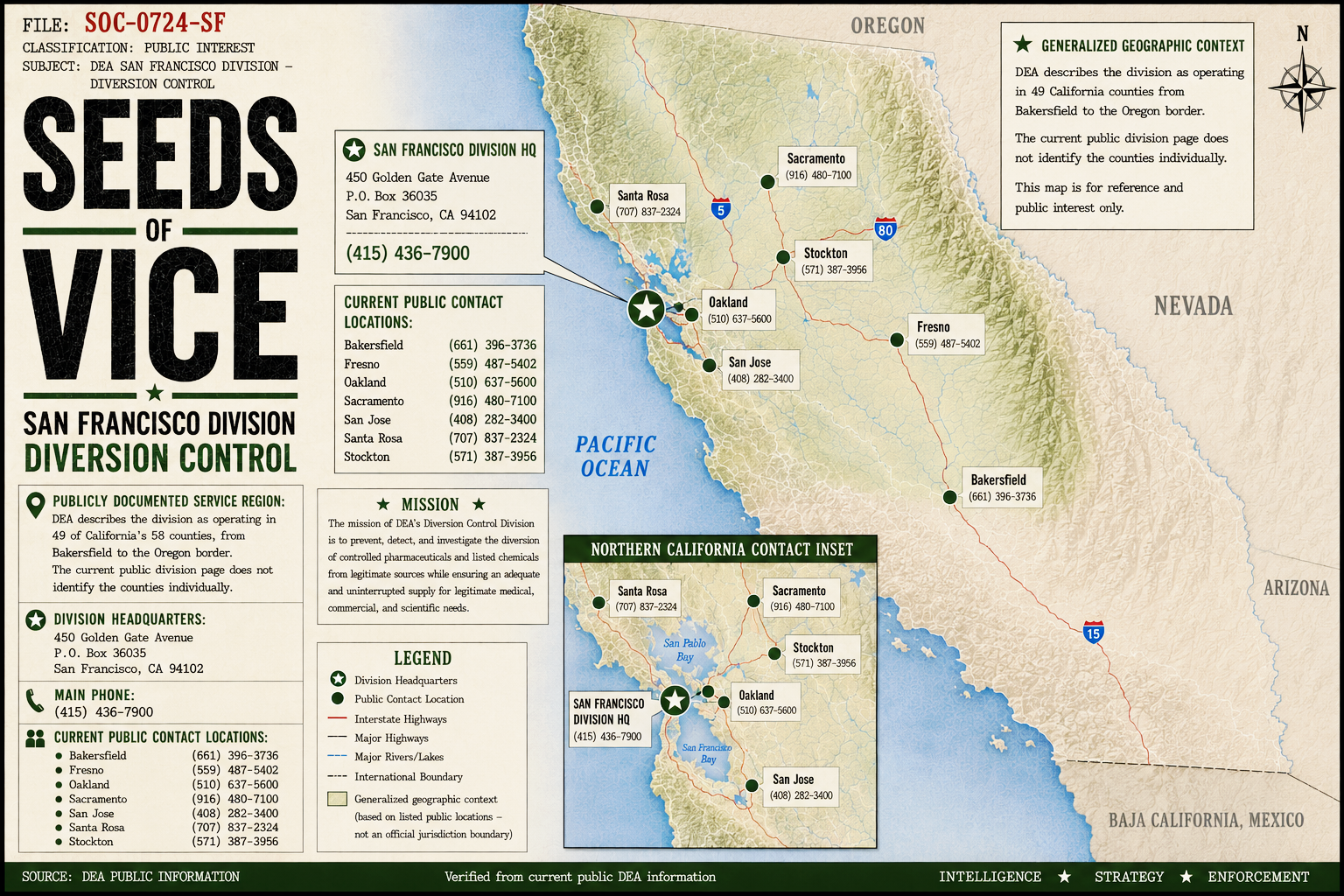
The San Francisco Division
DEA San Francisco Field Division and Its Diversion-Control System
Last fully verified: July 25, 2026
The Drug Enforcement Administration’s San Francisco Field Division is the federal command responsible for most of California.
DEA’s current Special Agent in Charge states that the division oversees enforcement, drug-diversion and regulatory investigations, and administrative operations throughout 49 of California’s 58 counties, extending from Bakersfield to the Oregon border. DEA has separately described the territory as Northern and Central California.
DEA’s live division page is less precise. It states that the division serves Northern California in the:
- Bakersfield
- Fresno
- Oakland
- Sacramento
- San Jose
- Santa Rosa
- Stockton
areas.
Those seven labels are office or service-area descriptions, not a complete territorial definition.
The regional command is officially the San Francisco Field Division. There is no separate regional agency formally titled the “San Francisco Diversion Division.” Diversion Control is one of the functions carried out within the field division under the federal Controlled Substances Act, DEA’s national registration systems, and the broader policy and leadership of the national Diversion Control Division.
The division’s broad territorial reach is clear.
Its public organizational map is not.
DEA does not publish on the division page:
- The complete list of 49 counties.
- The nine California counties excluded from San Francisco jurisdiction.
- County-by-county office assignments.
- Current classifications for most subordinate locations.
- A complete Assistant Special Agent in Charge roster.
- The current Diversion Program Manager.
- A Diversion organization chart.
- The locations of traditional Diversion Groups.
- The boundary among the Fresno, Oakland, and Sacramento Tactical Diversion Squads.
- A named regional registration or medical-practitioner compliance official.
The proper institutional conclusion is:
The San Francisco Field Division has a verified 49-county jurisdiction covering most of Northern and Central California, but DEA has reduced that territory on its public page to seven city “areas” without publishing the county roster, complete office hierarchy, or current Diversion command structure.
Executive Finding
What is official
DEA identifies the San Francisco Field Division headquarters as:
450 Golden Gate Avenue
P.O. Box 36035
San Francisco, California 94102
Main telephone: 415-436-7900
DEA identifies Bob P. Beris as the current Special Agent in Charge. Beris was appointed in October 2024 and oversees all enforcement, drug-diversion, regulatory, and administrative activity throughout 49 California counties.
DEA publishes subordinate contacts in:
| Published location | Telephone |
|---|---|
| Bakersfield | 661-396-3736 |
| Fresno | 559-487-5402 |
| Oakland | 510-637-5600 |
| Sacramento | 916-480-7100 |
| San Jose | 408-282-3400 |
| Santa Rosa | 707-837-2324 |
| Stockton | 571-387-3956 |
Together with the San Francisco headquarters, the public directory exposes eight locations.
The 49-county versus seven-area problem
DEA’s leadership record provides the most precise current territorial description:
- 49 of California’s 58 counties.
- From Bakersfield to the Oregon border.
- Northern and Central California.
- Enforcement, Diversion, regulatory, and administrative jurisdiction.
DEA’s division page instead provides seven city-area labels and describes the entire command only as serving “Northern California.”
That wording is incomplete because:
- Bakersfield and substantial portions of the division are commonly treated as Central California.
- A city-area list does not identify county boundaries.
- The division page does not name the 49 included counties.
- It does not name the nine excluded counties.
- It does not show the boundary with the Los Angeles or San Diego divisions.
- It does not explain whether every DEA function uses the same 49-county line.
The leadership biography establishes that the jurisdiction applies to enforcement, Diversion, regulatory, and administrative operations.
It does not identify the counties individually.
What can be concluded
The San Francisco Field Division is responsible for most of California, including:
- The San Francisco Bay Area.
- Sacramento and much of inland Northern California.
- The northern and central Central Valley.
- Fresno and surrounding counties.
- Bakersfield, Kern County, and Inyo County.
- The North Coast.
- The Oregon border region.
- The Sierra Nevada and mountain counties.
- Major agricultural and food-production regions.
- Major ports, airports, highways, rail systems, warehouses, universities, hospitals, biotechnology companies, pharmacies, and pharmaceutical registrants.
Beris’s biography confirms that the Bakersfield Resident Office historically supervised Kern and Inyo Counties. It also confirms that, while serving as an Assistant Special Agent in Charge, he supervised a Sacramento District Office region containing 27 counties and offices in Sacramento and Stockton.
Current enforcement records expressly identify the Sacramento unit as the Sacramento District Office.
What cannot presently be concluded
The public record does not establish:
- The full list of 49 counties.
- The complete nine-county exclusion list.
- Whether the 49-county boundary has remained unchanged in every year.
- The present county responsibility of Fresno, Oakland, San Jose, Santa Rosa, and Stockton.
- Whether every listed contact represents a permanently staffed public office.
- Whether Bakersfield remains formally classified as a resident office, although the current SAC’s biography uses that classification for his prior service.
- Whether Stockton reports directly through the Sacramento District Office under the current organization.
- The present classification of Fresno, Oakland, San Jose, Santa Rosa, and Stockton.
- The current Diversion Program Manager.
- The complete regional Diversion supervisory structure.
- How Northern California’s three listed Tactical Diversion Squads divide responsibility.
- Which TDS or Diversion Group serves Bakersfield, San Jose, Santa Rosa, and Stockton.
- Whether San Francisco headquarters contains a separately designated Tactical Diversion Squad.
Seeds of Vice will not fill those gaps through assumption.
Who the San Francisco Division Serves
The San Francisco Field Division serves a vast and institutionally diverse region.
Its territory includes:
- Major metropolitan areas.
- Rural agricultural counties.
- Mountain and forest communities.
- Coastal communities.
- Tribal lands.
- Technology and biotechnology centers.
- Major hospital and university systems.
- Ports and international airports.
- Interstate 5 and Highway 99.
- Interstate 80 and other east–west transportation corridors.
- Communities located substantial distances from major medical systems or DEA offices.
The division serves or regulates:
- Patients receiving controlled medications.
- Physicians and other authorized prescribers.
- Pharmacies and pharmacists.
- Hospitals and surgery centers.
- Manufacturers and distributors.
- Researchers and universities.
- Veterinary practices.
- Narcotic-treatment programs.
- Reverse distributors.
- Tribal and federal healthcare facilities.
- State and local law-enforcement agencies.
- Families affected by illicit fentanyl, methamphetamine, counterfeit tablets, addiction, violence, and inadequate medical treatment.
Its responsibilities span two fundamentally different controlled-substance channels.
The illicit channel
The illicit channel includes:
- Unlawful importation.
- Cartel-linked distribution.
- Large clandestine laboratories.
- Methamphetamine conversion and manufacturing.
- Fentanyl powder.
- Counterfeit tablets.
- Cocaine, heroin, and other illicit drugs.
- Firearms connected to trafficking.
- Dark-web distribution.
- Cryptocurrency and money laundering.
- Mail and parcel distribution.
- Drug sales associated with violence and overdose.
- Pharmacy and healthcare theft.
The lawful channel
The lawful channel includes:
- Registered manufacturers.
- Distributors and wholesalers.
- Pharmacies.
- Hospitals and surgery centers.
- Physicians and other practitioners.
- Researchers.
- Veterinary facilities.
- Treatment programs.
- Reverse distributors.
- Patients using controlled substances for legitimate medical purposes.
The channels may intersect when:
- Genuine medicine is stolen.
- A prescription is forged.
- A registrant intentionally distributes outside legitimate professional practice.
- A hospital or surgery center fails to maintain adequate security or records.
- A reverse distributor fails to secure drugs marked for destruction.
- An illicit producer creates tablets resembling authentic medicine.
- A healthcare or postal employee steals medication.
Those intersections do not make every patient, practitioner, pharmacy, hospital, manufacturer, or distributor part of the illicit market.
Territory and Office Structure
San Francisco Division Headquarters
450 Golden Gate Avenue
P.O. Box 36035
San Francisco, California 94102
Main telephone: 415-436-7900
DEA’s page does not publish:
- A floor or room number.
- A division-specific registration telephone number.
- A regional Diversion email.
- A named practitioner-compliance official.
Bakersfield
Telephone: 661-396-3736
Beris’s current biography identifies Bakersfield as a resident office during his service there and states that he supervised DEA activities in Kern and Inyo Counties.
That provides reliable historical and career evidence of:
- Resident-office status.
- Responsibility for Kern and Inyo Counties.
DEA’s live directory does not independently label Bakersfield as a resident office or state whether the same two-county assignment remains unchanged in July 2026.
Fresno
Telephone: 559-487-5402
Fresno is a published DEA contact and one of California’s current Tactical Diversion Squad locations.
DEA does not publish:
- Fresno’s current office classification.
- The counties assigned to it.
- The boundaries of Fresno TDS.
- Whether the TDS and ordinary enforcement office use the same territory.
Oakland
Telephone: 510-637-5600
Oakland is a published contact and current TDS location.
Current cases demonstrate DEA activity connecting East Oakland with San Francisco’s Tenderloin District, but individual cases do not provide a complete office boundary.
Sacramento
Telephone: 916-480-7100
Current DEA records expressly identify the Sacramento unit as the Sacramento District Office.
Beris’s biography states that, during his tenure as Assistant Special Agent in Charge, he supervised operations in 27 California counties through Sacramento and Stockton, including an Organized Crime Drug Enforcement Task Force Strike Force.
Sacramento is also a current Tactical Diversion Squad location.
DEA does not publish the current 27-county roster or confirm whether that exact allocation remains in effect.
San Jose
Telephone: 408-282-3400
DEA publishes San Jose as a regional contact but does not state its current office classification, county assignment, or Diversion structure.
Santa Rosa
Telephone: 707-837-2324
DEA publishes Santa Rosa as a regional contact but does not state whether it is a resident office, post of duty, task-force location, or another form of federal presence.
Stockton
Telephone: 571-387-3956
Beris’s biography establishes that Stockton was supervised with Sacramento during his tenure as Assistant Special Agent in Charge.
The live division page does not identify Stockton’s current classification or supervisory relationship.
Office legend without an office map
DEA’s page displays a legend for:
- Division office.
- District office.
- Resident office.
- Post-of-duty office.
It does not visibly connect those categories to the seven listed subordinate contacts.
The public can find telephone numbers.
It cannot reconstruct the complete command hierarchy.
Current Leadership and Publicly Identified Personnel
Bob P. Beris
Special Agent in Charge
Bob P. Beris was appointed Special Agent in Charge of the San Francisco Field Division in October 2024.
He oversees all enforcement operations, Diversion and regulatory investigations, and administrative operations throughout 49 of California’s 58 counties.
Beris began his DEA career in 2004 in the Bakersfield Resident Office.
His assignments have included:
- Long-term conspiracy investigations.
- Domestic and international drug-trafficking investigations.
- Creation and supervision of Bakersfield’s first DEA task-force group.
- Resident Agent in Charge of the Bakersfield Resident Office.
- Responsibility for Kern and Inyo Counties.
- Inspector assignments with DEA’s Office of Professional Responsibility.
- Internal investigations covering the Western United States, Middle East, and Asia-Pacific regions.
- Assistant Special Agent in Charge of the Sacramento District Office.
- Oversight of enforcement in 27 counties.
- Supervision of Sacramento and Stockton offices.
- Oversight of an OCDETF Strike Force.
Before joining DEA, Beris worked as a forensic scientist with the Illinois State Police.
Akilah Johnson
Media and Community-Outreach Contact
DEA identifies Akilah Johnson as both the division’s media contact and community-outreach contact.
Media telephone: 415-436-7994
Community-outreach telephone: 415-999-0613
Email: Akilah.K.Johnson@dea.gov
The page does not explain whether the two responsibilities are performed through one combined public-affairs unit or whether other personnel also serve in those functions.
Recruitment
Email: SanFranSpecialAgentRecruiter@dea.gov
DEA publishes no individual recruiter’s name or telephone number on the current division page.
Current Diversion leadership
A current San Francisco Division Diversion Program Manager could not be verified through a current official personnel record.
The live division page does not identify:
- A Diversion Program Manager.
- An Assistant Special Agent in Charge responsible for Diversion.
- Traditional Diversion Group supervisors.
- Tactical Diversion Squad supervisors.
- A registration specialist.
- A medical-practitioner contact.
- A pharmacy, manufacturer, distributor, or hospital compliance contact.
National Diversion leadership
DEA’s current leadership directory identifies Cheri Oz as Assistant Administrator of the national Diversion Control Division.
The institutional distinction is:
- Bob P. Beris: commands the San Francisco Field Division.
- Cheri Oz: leads the national Diversion Control Division.
- Regional Diversion personnel: perform regulatory, administrative, civil, and criminal Diversion work within San Francisco’s territory under national law, systems, and policies.
The national Diversion Control Division should not be confused with the San Francisco regional command.
Tactical Diversion Squads
DEA’s current national Tactical Diversion Squad directory identifies three locations within the San Francisco Division’s apparent territory:
- Fresno
- Oakland
- Sacramento
The directory does not list:
- San Francisco.
- Bakersfield.
- San Jose.
- Santa Rosa.
- Stockton.
The omission of a city from the directory does not prove that the city lacks Diversion Investigators or criminal-diversion capacity.
It establishes only that DEA does not currently list a Tactical Diversion Squad there.
Official TDS function
DEA states that Tactical Diversion Squads combine DEA resources with federal, state, and local law-enforcement agencies to investigate, disrupt, and dismantle suspected violations involving diverted pharmaceutical controlled substances or listed chemicals.
DEA states that the squads:
- Unify otherwise separate information, authority, and enforcement programs.
- Coordinate investigations and prosecutions across judicial districts.
- Support traditional Diversion Groups when arrests, evidence purchases, confidential payments, surveillance, or search warrants are required.
A Tactical Diversion Squad is therefore not simply a registration or educational office.
It is a criminal-enforcement structure capable of investigating:
- Counterfeit pharmaceuticals.
- Prescription forgery.
- Pharmacy burglary and theft.
- Healthcare-setting diversion.
- Unlawful prescribing.
- Unlawful dispensing.
- Illicit pill presses.
- Internet distribution.
- Manufacturer or distributor misconduct.
- Reverse-distributor misconduct.
- Healthcare fraud involving controlled substances.
Unanswered structural questions
DEA does not publicly explain:
- The county boundary among Fresno, Oakland, and Sacramento TDS.
- Which squad serves San Francisco.
- Which squad serves Bakersfield.
- Whether San Jose reports to Oakland.
- Whether Santa Rosa reports to Oakland or Sacramento.
- Whether Stockton reports to Sacramento TDS.
- Whether traditional Diversion Groups use the same geography.
- Whether the squads report through one regional Diversion Program Manager.
- Whether some counties receive support from more than one squad.
- Whether criminal Diversion and routine registration work follow the same boundaries.
The public can identify three TDS cities.
It cannot reconstruct the 49-county system.
Official Role and Mission
The San Francisco Field Division enforces the federal Controlled Substances Act and related federal laws throughout its assigned territory.
Its work may include:
- Interstate and international drug-trafficking investigations.
- Cartel and transnational-organization cases.
- Methamphetamine laboratories.
- Fentanyl and counterfeit-pill investigations.
- Cocaine and heroin cases.
- Firearms connected to trafficking.
- Dark-web and cryptocurrency investigations.
- Mail and parcel distribution.
- Money laundering and asset forfeiture.
- Controlled-substance registration.
- Administrative inspections.
- Hospital and surgery-center investigations.
- Pharmacy and practitioner investigations.
- Manufacturer, distributor, and reverse-distributor oversight.
- Theft and loss investigations.
- Suspicious-order investigations.
- Civil referrals.
- Administrative registration proceedings.
- Community outreach and prevention.
DEA defines its national Diversion Control mission as preventing, detecting, and investigating the diversion of controlled pharmaceuticals and listed chemicals from legitimate sources while ensuring an adequate and uninterrupted supply for legitimate medical, commercial, and scientific needs.
Those are simultaneous obligations.
Diversion Control is not officially defined solely as:
- Restricting prescriptions.
- Inspecting registrants.
- Suspending registrations.
- Prosecuting practitioners.
- Reducing pharmaceutical supply.
The mission also requires protection and preservation of the lawful channel.
How the San Francisco System Works in Practice
Historic Northern California methamphetamine laboratory
Arrests, pending charges, and continuing investigation
In February 2026, DEA’s Sacramento District Office and partner agencies dismantled a large alleged methamphetamine-production system involving Valley Springs, Turlock, and Modesto.
DEA reported approximately 2,700 pounds of methamphetamine in various stages of production, including:
- 1,443 pounds of suspected finished methamphetamine.
- 1,270 pounds of partially processed suspected methamphetamine.
- 12 firearms.
- More than 1,000 rounds of ammunition.
- 1,900 cannabis plants.
- More than 100 pounds of processed cannabis.
Eight people were arrested and charged with various state offenses. The investigation remained active, and prosecutors were still evaluating appropriate state or federal jurisdiction when DEA published the announcement.
The defendants remained presumed innocent unless convicted.
The matter demonstrates:
- Sacramento District Office authority.
- Coordination across multiple counties.
- Clandestine chemical production.
- Mountain and Central Valley operations.
- Joint federal, state, and local response.
- The distinction between an arrest announcement and a final adjudication.
Central Valley pill-manufacturing and mail-distribution organization
Indictments
In April 2026, federal authorities announced indictments involving an alleged organization that used the United States mail to distribute controlled substances nationwide.
Investigators reported finding at a Turlock warehouse:
- Three pill presses.
- Powder used in pill production.
- Approximately one million pills containing suspected methamphetamine.
- Cocaine.
- Alprazolam.
- MDMA.
- Psilocybin products.
- Cash and cryptocurrency.
The defendants were charged.
The allegations and suspected substances must still be proved through the judicial process.
Fresno fentanyl transportation
Pending indictment
In June 2026, two defendants were indicted after investigators reported finding seven kilograms of fentanyl powder hidden inside a vehicle door panel during a Fresno County traffic stop.
The charges remain allegations. The defendants are presumed innocent unless convicted.
Fresno County vehicle assault
Pending charges
In January 2026, two defendants were charged after allegedly traveling from Los Angeles County to Fresno to sell five kilograms of fentanyl.
Federal authorities alleged that the defendants rammed government vehicles occupied by DEA agents, led officers on a high-speed pursuit, and discarded fentanyl during the chase.
The charges remain allegations.
Oakland and Tenderloin trafficking
Trial conviction and sentence
In July 2026, Maxfer Palma received a 192-month federal sentence after a jury convicted him of methamphetamine, fentanyl, and firearm offenses.
The evidence connected his activity to East Oakland and San Francisco’s Tenderloin District. Authorities reported that he possessed more than two kilograms of methamphetamine, more than 200 grams of a fentanyl mixture, other drugs, a firearm, and ammunition at a residence where children were present.
This was an adjudicated criminal matter following a jury verdict.
It was not a pending accusation or civil settlement.
Sacramento drug sales
Pending indictment
On July 24, 2026, four Sacramento men were indicted on charges involving cocaine, fentanyl, methamphetamine, and firearms.
The alleged transactions occurred during controlled purchases between January and June 2026.
The indictment contains allegations, and each defendant remains presumed innocent unless convicted.
Diversion Control and Lawful Medicine
San Francisco Division Diversion personnel may regulate or investigate:
- Physicians.
- Dentists.
- Nurse practitioners.
- Physician assistants.
- Pharmacists.
- Hospitals.
- Surgery centers.
- Clinics.
- Veterinary practices.
- Manufacturers.
- Distributors.
- Researchers.
- Narcotic-treatment programs.
- Reverse distributors.
- Other DEA registrants.
Their work may include:
- Registration applications and renewals.
- Inspections.
- Controlled-substance inventories.
- Recordkeeping reviews.
- Security evaluations.
- Theft and significant-loss reporting.
- Suspicious-order investigations.
- Prescription investigations.
- Administrative subpoenas.
- Corrective agreements.
- Voluntary registration surrender.
- Orders to Show Cause.
- Immediate Suspension Orders.
- Civil referrals.
- Criminal investigations where intentional unlawful conduct is suspected.
These processes occupy different legal positions.
Inspection
An inspection is a regulatory or investigative process.
It is not itself proof of wrongdoing.
Corrective agreement
A registrant may agree to improve:
- Inventory.
- Security.
- Recordkeeping.
- Reporting.
- Staff training.
- Controlled-substance handling.
A corrective agreement is not automatically a criminal conviction.
Civil settlement
A civil settlement resolves civil allegations or potential liability.
It is not automatically:
- A guilty plea.
- A trial conviction.
- A criminal sentence.
Deferred prosecution agreement
A deferred prosecution agreement permits criminal charges to be resolved under specified conditions without an immediate conviction, provided the organization satisfies the agreement.
It is not identical to:
- A dismissal without conditions.
- A guilty plea.
- A conviction after trial.
- A purely civil settlement.
Administrative action
An administrative action concerns the authority to manufacture, distribute, prescribe, dispense, research, reverse distribute, or possess controlled substances.
It may occur independently of criminal prosecution.
Complaint or indictment
A criminal complaint or indictment contains allegations.
The accused remains presumed innocent unless convicted.
Guilty plea
A guilty plea is a formal admission to specified criminal conduct.
Trial conviction
A trial conviction is an adjudicated finding of guilt.
Sentence
A sentence follows a plea or conviction.
The word enforcement should never erase these distinctions.
Sutter Medical Center and Sutter Fairfield Surgery Center
Civil settlement with no determination of liability
In March 2026, Sutter Medical Center, Sacramento, and Sutter Fairfield Surgery Center agreed to pay $3.2 million to resolve federal Controlled Substances Act allegations.
The government alleged at least 628 collective recordkeeping and security violations involving failures to:
- Notify DEA of theft or loss.
- Maintain accurate controlled-substance records.
- Complete biennial inventories.
- Preserve complete order records.
- Provide effective controls against diversion.
The investigation began following the death of a pediatric anesthesiologist.
DEA conducted the investigation.
The government expressly stated that:
- The claims were allegations.
- There had been no determination of liability.
The legally precise description is:
- Civil settlement.
- $3.2 million payment.
- Alleged recordkeeping and security violations.
- No identified guilty plea.
- No criminal conviction.
- No determination of liability.
Institutional significance
Hospital and surgery-center controls serve legitimate patient-protection purposes.
Failures involving inventory, theft reporting, and access can contribute to:
- Medication theft.
- Healthcare-worker diversion.
- Tampered medication.
- Missing analgesia or anesthesia.
- Inaccurate patient and facility records.
- Unexplained losses.
- Entry of authentic medicine into the illicit market.
A civil regulatory resolution must still be distinguished from a criminal conviction for intentional trafficking.
Stericycle Reverse-Distribution Resolution
Criminal deferred prosecution and separate civil settlement
Stericycle was registered as a reverse distributor authorized to receive unwanted, expired, or unusable controlled substances from hospitals, pharmacies, and other registrants.
In 2026, Stericycle agreed to resolve parallel criminal and civil investigations involving its handling of controlled substances between 2015 and 2020.
The resolution included:
- A one-year deferred prosecution agreement.
- A $19.08 million criminal penalty.
- A separate $37.81 million civil payment.
- Compliance improvements.
- Independent oversight and reporting obligations.
- Continued cooperation with investigations.
The government stated that Stericycle admitted using unregistered temporary storage facilities and maintaining inadequate security, including unlocked trailers and nonfunctioning cameras at some locations. The company accepted responsibility for criminal conduct covered by the agreement.
The DPA did not include a criminal release for individuals.
Correct legal posture
This was not merely an allegation-only civil settlement.
It involved:
- Criminal charges.
- A deferred prosecution agreement.
- Acceptance of responsibility by the company.
- A criminal penalty.
- A separate civil resolution.
It was also not a trial conviction or guilty plea.
The distinction matters.
Why reverse distribution belongs in the atlas
Controlled-substance authority does not end when medicine expires or is marked for destruction.
Reverse distributors remain part of the closed system because they receive controlled substances that must be:
- Securely transported.
- Accurately tracked.
- Stored at registered facilities.
- Protected against theft.
- Reported when lost.
- Properly destroyed.
The lawful channel includes the end of the pharmaceutical life cycle as well as its manufacture, distribution, prescribing, and dispensing.
California’s State-Control Layer
Federal DEA authority operates alongside:
- California statutes.
- The California Department of Justice.
- CURES.
- The Medical Board of California.
- The California State Board of Pharmacy.
- Other professional boards.
- Insurers.
- Pharmacy corporations.
- Hospitals and health systems.
- Clinic policies.
- Civil-liability systems.
- Individual clinical judgment.
DEA does not independently create every rule affecting controlled-substance treatment in California.
CURES
California’s Controlled Substance Utilization Review and Evaluation System contains dispensing records for Schedule II through Schedule V controlled substances.
California states that CURES serves:
- Public health.
- Regulatory oversight.
- Law enforcement.
The state also states that CURES is committed to reducing prescription-drug abuse and diversion without affecting legitimate medical practice or patient care.
California requires covered practitioners authorized to prescribe Schedule II through Schedule V controlled substances to register for CURES access upon receiving a DEA registration. Licensed pharmacists must also register.
Covered dispensers generally must report dispensing information no later than one working day after releasing the controlled substance to the patient or representative.
Current reporting exception
California’s current CURES page states that, under legislation enacted in 2025, the dispensing of testosterone or mifepristone is not to be reported to CURES or its prescription-data contractor.
This illustrates that the exact contents of a prescription-monitoring database are determined by current state law and may change.
Mandatory consultation
California generally requires covered practitioners to consult CURES:
- The first time a patient is prescribed, ordered, administered, or furnished a covered controlled substance.
- Within 24 hours, or on the previous business day, before the covered action.
- Before later prescribing when a prior exemption no longer applies.
- At least once every six months while the controlled substance remains part of the patient’s treatment plan.
The requirement applies to Schedule II through Schedule V controlled substances and contains statutory exemptions for specified settings and circumstances.
Failure to conduct a required consultation may be referred to the practitioner’s state licensing board for administrative sanctions.
These are California requirements.
They should not be represented as rules created solely by the San Francisco Field Division.
What CURES can reveal
CURES may assist authorized users in identifying:
- Multiple prescribers.
- Multiple pharmacies.
- Concurrent controlled medications.
- Repeated early dispensing.
- Possible prescription forgery.
- Patterns warranting clinical review.
- Potential diversion.
A database record is information.
It is not, by itself, proof that:
- A patient committed a crime.
- A patient is deceptive.
- A patient has a substance-use disorder.
- A prescription lacked a legitimate medical purpose.
- A practitioner acted outside professional practice.
- A pharmacist knowingly dispensed unlawfully.
Those conclusions require context and additional evidence.
No invented universal duration limit
California’s CURES-consultation law contains exemptions connected to limited emergency-department and surgical prescriptions.
Those exemptions are not a universal California law restricting every opioid prescription to five or seven days.
This page does not invent a universal duration rule where one has not been verified.
How the System Affects Pain Patients and Lawful Medicine
Legitimate protective functions
A properly functioning Diversion system can protect patients by:
- Detecting forged prescriptions.
- Investigating hospital and pharmacy theft.
- Enforcing accurate controlled-substance inventories.
- Identifying healthcare-worker diversion.
- Investigating unlawful prescribing or dispensing.
- Removing counterfeit tablets.
- Identifying illicit pill presses.
- Securing expired medication awaiting destruction.
- Preserving traceability within the lawful supply chain.
- Holding intentionally corrupt registrants accountable.
The Sutter and Stericycle matters illustrate two distinct risks inside the lawful channel:
- Diversion or security failures where medication is used in active patient care.
- Diversion or security failures after medication enters the destruction and reverse-distribution system.
Counterfeit medicine
Counterfeit tablets may imitate:
- Oxycodone.
- Alprazolam.
- Amphetamine medication.
- Other recognizable pharmaceutical products.
They may instead contain:
- Illicit fentanyl.
- Methamphetamine.
- Carfentanil.
- Illicit benzodiazepines.
- Inconsistent or unknown mixtures.
The counterfeit product borrows the appearance and implied safety of lawful medicine while bypassing:
- Regulated manufacturing.
- Accurate labeling.
- Dose uniformity.
- A valid prescription.
- Pharmacist review.
- Traceable distribution.
- Individualized medical judgment.
The danger of counterfeit medicine supports protecting authentic medicine.
It does not support treating every controlled medication as counterfeit.
Risk of institutional overcorrection
The same control environment can harm legitimate patients when:
- Numerical thresholds become automatic rules.
- CURES information becomes a verdict.
- Practitioners stop treating pain because they fear investigation.
- Pharmacies refuse valid prescriptions through unpublished policies.
- Patients are rapidly tapered.
- Medication is abruptly discontinued.
- Patients are dismissed rather than clinically managed.
- Testing and treatment agreements become punitive controls.
- Institutional risk management replaces individualized judgment.
- Alternatives are assumed to be available without verifying access.
CDC’s 2022 guideline states that its recommendations are not laws or inflexible standards of care and should not lead to rapid tapering or abrupt discontinuation. It emphasizes individualized, patient-centered decision-making.
CDC also instructs healthcare systems not to establish rigid dosage thresholds and not to penalize clinicians for accepting patients already receiving opioids.
That does not establish that DEA alone causes undertreatment.
The treatment environment is produced through the interaction of:
- Congress.
- DEA.
- Federal prosecutors.
- California lawmakers.
- State licensing boards.
- CURES.
- Insurers.
- Pharmacy corporations.
- Hospitals and clinics.
- Professional organizations.
- Civil-liability systems.
- Individual practitioners.
- Patients.
- The illicit drug market.
DEA should not be assigned sole responsibility for every medical decision.
It should not be removed from the analysis.
The possibility of inspection, registration restriction, civil penalties, administrative action, criminal referral, or prosecution forms part of the risk environment in which controlled-substance decisions are made.
Rural, mountain, and agricultural access
The 49-county division contains communities located far from:
- Pain specialists.
- Major hospital systems.
- Independent pharmacies.
- Physical therapy.
- Behavioral-health services.
- Interventional treatment.
- Addiction-treatment programs.
- Public transportation.
- DEA and state regulatory offices.
A policy that appears manageable in San Francisco, Oakland, Sacramento, or San Jose may impose a different burden in:
- The northern counties.
- The Sierra Nevada.
- Agricultural Central Valley communities.
- The North Coast.
- Rural Kern or Inyo County.
- Mountain and tribal communities.
An alternative is not functionally available merely because it exists somewhere within California.
A serious access analysis should ask whether the patient can:
- Reach it.
- Afford it.
- Obtain insurance approval.
- Receive it within a clinically meaningful period.
- Tolerate it.
- Benefit from it.
Prescribing and Dose-Decline Context
Evidentiary boundary
Seeds of Vice begins its historical inquiry in 1984.
No continuous, directly comparable annual San Francisco Division retail opioid-dispensing series was identified for every year beginning in 1984.
The record must therefore be divided into defensible evidentiary periods.
1984–2005
Historical inquiry may use:
- Federal distribution records.
- Manufacturing and production data.
- Controlled-substance quota records.
- Medicaid and insurer utilization.
- Drug-specific studies.
- Medical literature.
- California regulatory history.
- National prescribing indicators.
Those sources cannot be silently joined to the later CDC retail-pharmacy dispensing series.
Missing annual values should not be interpolated.
Statewide context, not division-specific measurement
CDC’s California dispensing rate applies to the entire state.
It includes counties assigned to:
- San Francisco.
- Los Angeles.
- San Diego.
It is useful as statewide utilization and policy context.
It should not be represented as a direct measurement of the San Francisco Division’s 49 counties.
Selected California retail-dispensing benchmarks
The following figures represent retail opioid prescriptions dispensed per 100 residents:
| Year | California rate |
|---|---|
| 2006 | 51.0 |
| 2012 | 56.4 |
| 2016 | 44.8 |
| 2019 | 30.9 |
| 2024 | 22.4 |
The historical values come from CDC’s archived state tables. CDC identifies California as one of the four lowest-dispensing states in 2024.
Calculated decline
From 2012 through 2024, California’s retail opioid-dispensing rate declined by approximately:
60.3 percent
From 2006 through 2024, it declined by approximately:
56.1 percent
From 2019 through 2024, it declined by approximately:
27.5 percent
These are Seeds of Vice calculations based on the reported CDC values.
National comparison
The national retail opioid-dispensing rate was 35.4 prescriptions per 100 residents in 2024.
California’s rate of 22.4 was approximately 36.7 percent below the national rate.
This establishes that California’s lawful retail opioid-dispensing rate was substantially below the national average.
It does not establish:
- Whether every reduction was medically appropriate.
- Whether every patient retained adequate treatment.
- Whether effective alternatives were available.
- Whether average dosage declined at the same rate.
- Whether prescription duration changed.
- Whether patients were voluntarily tapered.
- Whether patients lost access because of pharmacy refusal.
- Whether DEA caused the decline.
- Whether the decline caused a particular mortality result.
Methodological limits
CDC’s 2019–2024 figures use IQVIA Xponent data projected from approximately 54,600 nonhospital retail pharmacies, representing nearly 94 percent of United States retail prescriptions.
The dataset:
- Includes new and refilled retail prescriptions.
- Includes multiple payment sources.
- Excludes mail-order prescriptions.
- Excludes methadone dispensed through opioid-treatment programs.
- Uses the prescriber’s location.
- Does not establish whether the patient consumed the medication.
- Does not establish clinical appropriateness.
- Does not measure pain severity.
- Does not measure patient function.
- Does not identify voluntary versus involuntary discontinuation.
Beginning in 2019, CDC attributed prescriptions according to the prescriber’s location rather than the dispensing pharmacy’s location.
Prescriptions per 100 residents must not be mixed with:
- Morphine milligram equivalents per capita.
- Average MME per prescription.
- Daily dosage.
- Days supplied.
- Number of patients.
- Number of tablets.
- Total controlled-substance prescriptions.
- Overdose deaths.
- Drug-seizure quantities.
Each measure answers a different question.
Overdose Context
CDC’s final 2024 state data report:
- 9,028 drug-overdose deaths in California.
- An age-adjusted mortality rate of 21.7 deaths per 100,000 residents.
Those figures cover all drug-overdose mortality.
They are not limited to:
- Prescription opioids.
- Illicit fentanyl.
- Methamphetamine.
- Cocaine.
- Heroin.
- Any single drug category.
CDC states that prescription opioids still contribute to opioid-related deaths but are not the principal current driver of the national overdose crisis.
What the combined record establishes
California experienced:
- A decline exceeding 60 percent in retail opioid dispensing from 2012 through 2024.
- One of the country’s lowest state dispensing rates.
- More than 9,000 drug-overdose deaths in 2024.
- Continuing fentanyl, carfentanil, methamphetamine, cocaine, and counterfeit-pill trafficking.
- Large clandestine laboratory and pill-press operations after substantial lawful-prescribing contraction.
Those facts can exist simultaneously.
They do not establish that:
- Every prescribing reduction was medically appropriate.
- Every patient retained adequate treatment.
- DEA enforcement alone caused a mortality change.
- CURES alone caused a mortality change.
- Naloxone alone caused a mortality change.
- Treatment expansion alone caused a mortality change.
- Lawful opioid prescriptions are the principal source of the current illicit fentanyl market.
A reduction in lawful prescribing does not prove that illicit markets disappeared.
The existence of illicit fentanyl does not establish that every legitimate pain patient received adequate care.
Representative San Francisco Division Matters
Valley Springs, Turlock, and Modesto laboratory
Arrests and pending charges
DEA and partner agencies reported the seizure of approximately 2,700 pounds of methamphetamine in various stages of production.
Eight people were arrested and charged. The investigation remained active, and all accused persons were presumed innocent unless convicted.
Central Valley pill-manufacturing organization
Indictments
Federal authorities reported finding approximately one million suspected methamphetamine pills, three pill presses, additional controlled substances, cash, and cryptocurrency.
The allegations remain subject to proof in court.
Fresno seven-kilogram fentanyl seizure
Pending indictment
Two defendants were indicted after investigators reported finding seven kilograms of fentanyl hidden in a vehicle door.
The charges remain allegations.
Fresno vehicle-ramming case
Pending charges
Two defendants were charged with a fentanyl conspiracy, and one was charged with assaulting a federal officer after an alleged high-speed escape attempt.
The defendants remain presumed innocent unless convicted.
Oakland and Tenderloin trafficking
Jury conviction and 192-month sentence
Maxfer Palma received a 192-month sentence after a jury convicted him of methamphetamine, fentanyl, and firearm offenses.
This was an adjudicated criminal outcome.
Sacramento controlled purchases
Indictment
Four defendants were indicted in July 2026 on cocaine, fentanyl, methamphetamine, and firearm charges.
The indictment contains allegations rather than findings of guilt.
Madera methamphetamine and carfentanil case
Guilty plea
A defendant pleaded guilty after authorities reported recovering 86.5 pounds of pure methamphetamine and approximately 4,700 counterfeit M30 tablets containing carfentanil.
The plea constituted an admission to the conduct covered by the agreement.
Sutter facilities
Civil settlement
Two Sutter facilities agreed to pay $3.2 million to resolve recordkeeping and security allegations.
The government stated that there had been no determination of liability.
Stericycle
Deferred prosecution agreement and civil settlement
Stericycle entered a deferred prosecution agreement, accepted responsibility for criminal conduct, agreed to a $19.08 million criminal penalty, and separately agreed to pay $37.81 million to resolve civil liability.
The resolution was not a trial conviction or guilty plea.
Contact Information
San Francisco Field Division Headquarters
Address:
450 Golden Gate Avenue
P.O. Box 36035
San Francisco, California 94102
Main telephone: 415-436-7900
Media
Akilah Johnson
Telephone: 415-436-7994
Community Outreach
Akilah Johnson
Telephone: 415-999-0613
Email: Akilah.K.Johnson@dea.gov
Recruitment
Email: SanFranSpecialAgentRecruiter@dea.gov
Regional Contacts
Bakersfield: 661-396-3736
Fresno: 559-487-5402
Oakland: 510-637-5600
Sacramento: 916-480-7100
San Jose: 408-282-3400
Santa Rosa: 707-837-2324
Stockton: 571-387-3956
National DEA Registration Contact
Telephone: 800-882-9539
California CURES
Telephone: 916-210-3187
Email: CURES@doj.ca.gov
DEA’s current San Francisco page does not publish:
- A division-specific registration number.
- A regional registration email.
- A current Diversion Program Manager.
- A named medical-practitioner contact.
- A hospital, pharmacy, manufacturer, distributor, or reverse-distributor compliance contact.
Callers should verify whether the relevant matter belongs to:
- San Francisco headquarters.
- A geographic field office.
- Fresno Tactical Diversion Squad.
- Oakland Tactical Diversion Squad.
- Sacramento Tactical Diversion Squad.
- A traditional Diversion Group.
- The national Registration Contact Center.
- The national Diversion Control Division.
A federal jurisdictional directory should make that determination possible without repeated calls among offices.
Links to Individual Profiles
The division page should connect to individual profile pages for publicly identifiable personnel who exercise or explain institutional authority.
Bob P. Beris
Current role: Special Agent in Charge
Profile status: Current and officially verified
Profile significance: Commands enforcement, Diversion, regulatory, and administrative operations across 49 counties.
Cheri Oz
Current role: Assistant Administrator, national Diversion Control Division
Profile status: Current and officially verified
Profile significance: Leads the national operational division responsible for controlled-pharmaceutical and listed-chemical policy and programs.
Akilah Johnson
Current role: Media and community-outreach contact
Profile status: Current public contact
Profile significance: Serves as the public-facing contact for division media and outreach.
Current San Francisco Diversion Program Manager
Current role: Not publicly identified
Profile status: Unresolved
Profile significance: The position should be identified because it likely supervises regional registration, regulatory, civil, administrative, and criminal Diversion activity.
Tactical Diversion Squad supervisors
Current roles: Not publicly identified
Locations: Fresno, Oakland, Sacramento
Profile status: Unresolved
Profile significance: These supervisors exercise authority over joint criminal-diversion investigations but are not named in the public directory.
Seeds of Vice Analysis
The San Francisco Division’s principal problem is not uncertainty over whether it exists or whom its current Special Agent in Charge is.
The command and current leader are clear.
The problem is the gap between the size of the institution and the quality of its public map.
DEA states that the division controls:
- 49 counties.
- Most of California.
- Enforcement operations.
- Diversion and regulatory investigations.
- Administrative operations.
- Territory from Bakersfield to the Oregon border.
The public division page provides:
- Seven city-area labels.
- Eight total public locations when headquarters is counted.
- An office-type legend.
- No county roster.
- No county map.
- No complete office classifications.
- No current Diversion Program Manager.
- No Diversion organization chart.
- Three TDS city names without boundaries.
- No regional registration contact.
These are not findings of corruption.
They are findings of inadequate public administration.
Forty-nine counties should be named
A 49-county jurisdiction is not a minor administrative detail.
It determines:
- Which Special Agent in Charge bears responsibility.
- Which field office receives tips.
- Which office conducts inspections.
- Which TDS investigates suspected criminal diversion.
- Which public-information office answers for an operation.
- Which division’s statistics include a case.
- Which office receives legal and public-record inquiries.
- Which command bears responsibility for legitimate-access consequences.
DEA should publish the county list.
The public should not be required to reconstruct it from leadership biographies and individual case announcements.
“Northern California” is incomplete
DEA’s division page describes the command as serving Northern California.
DEA’s leadership records describe the same command as serving Northern and Central California, from Bakersfield to Oregon.
The leadership description is more accurate and more useful.
Bakersfield, Fresno, Turlock, Modesto, Stockton, and much of the Central Valley are central to the division’s current enforcement record.
A territorial description should reflect that reality.
The office structure is partially visible
Two classifications can be defended from official records:
- Bakersfield Resident Office.
- Sacramento District Office.
The remaining public contacts are unclassified on the live page.
The public cannot determine whether Fresno, Oakland, San Jose, Santa Rosa, and Stockton are:
- District offices.
- Resident offices.
- Posts of duty.
- Task-force facilities.
- Specialized groups.
- Shared facilities.
- Telephone contacts without a separately identified public office.
The legend exists.
The organization chart does not.
The TDS map is incomplete
DEA identifies Fresno, Oakland, and Sacramento as Tactical Diversion Squad locations.
It does not identify a San Francisco TDS.
It does not explain which squad serves:
- San Francisco.
- Bakersfield.
- San Jose.
- Santa Rosa.
- Stockton.
- The North Coast.
- The far northern counties.
- Kern and Inyo Counties.
The absence of a city listing does not prove an absence of enforcement capacity.
It proves an absence of public explanation.
The lawful channel is broader than prescribing
The San Francisco record demonstrates that Diversion Control governs:
- Hospital inventories.
- Surgery-center security.
- Pharmacy records.
- Reverse distribution.
- Drug-destruction systems.
- Theft and significant-loss reporting.
- Controlled-substance transportation.
- Practitioner and dispenser conduct.
- Registration authority.
Sutter and Stericycle occupy different parts of that lawful system.
One concerns active healthcare facilities.
The other concerns medication marked for destruction.
Both demonstrate that the closed distribution system extends through the entire life cycle of controlled medicine.
Legal posture must remain exact
The regional record contains:
- Arrests.
- Indictments.
- Pending charges.
- Guilty pleas.
- Jury convictions.
- Prison sentences.
- Civil settlements.
- Allegation-only resolutions.
- A deferred prosecution agreement.
- Acceptance of corporate responsibility.
- Criminal and civil monetary penalties.
Those outcomes are not interchangeable.
Sutter’s settlement included no determination of liability.
Stericycle accepted responsibility through a deferred prosecution agreement but was not convicted after trial.
Palma was convicted by a jury and sentenced.
The Sacramento defendants remain accused.
The Valley Springs investigation remained active.
A credible institutional atlas must preserve each distinction.
Counterfeit medicine strengthens the lawful channel
Northern and Central California investigations include illicit pill presses, counterfeit M30 tablets, fentanyl, carfentanil, and methamphetamine pills.
Those products are dangerous partly because they imitate lawful medicine.
That supports protecting:
- Regulated manufacturing.
- Accurate dosage.
- Authentic labeling.
- Valid prescriptions.
- Licensed pharmacies.
- Pharmacist review.
- Secure hospitals.
- Traceable distribution.
- Individualized medical judgment.
It does not support treating lawful medicine itself as counterfeit.
A pain patient receiving medication through a valid prescription is not situated like a person operating a clandestine pill press.
A practitioner documenting legitimate care is not situated like a trafficker.
A hospital correcting alleged inventory failures is not situated like a convicted fentanyl dealer.
A patient appearing in CURES has not been convicted of anything.
The system must preserve those distinctions.
The prescribing decline is structural
California’s retail opioid-dispensing rate fell from 56.4 prescriptions per 100 residents in 2012 to 22.4 in 2024.
That is a decline of approximately 60.3 percent.
California is now one of the country’s lowest-dispensing states.
This is not a marginal adjustment.
It is a transformation in lawful medicine.
The data do not prove that the entire decline was harmful.
They do not prove that the entire decline was beneficial.
They establish that substantially less lawful opioid medicine was dispensed per resident.
A complete institutional account should ask:
- Which prescriptions were medically unnecessary?
- Which patients benefited from safer care?
- Which patients received effective alternatives?
- Which patients were voluntarily tapered?
- Which were tapered against their wishes?
- Which lost a practitioner?
- Which lost a pharmacy?
- Which were dismissed from care?
- Which remained in severe pain?
- Which recovered function?
- Which lost function?
- Which entered the illicit market?
- Which withdrew from medical care?
- Which died from overdose, suicide, disease, or unrelated causes?
- Which outcomes were measured?
- Which disappeared from institutional records when the prescription ended?
Dispensing statistics cannot answer those questions by themselves.
The overdose record does not close the inquiry
California continued to experience more than 9,000 overdose deaths in 2024 after lawful retail opioid dispensing had fallen dramatically.
That does not prove that prescribing contraction caused those deaths.
It establishes that prescribing contraction did not eliminate the illicit overdose crisis.
Likewise, the persistence of illicit fentanyl does not establish that legitimate opioid treatment lacks medical value.
Both realities must remain visible:
- Illicit fentanyl and carfentanil kill.
- Counterfeit pills kill.
- Methamphetamine causes substantial regional harm.
- Intentional unlawful prescribing can harm patients.
- Healthcare theft can harm patients.
- Abrupt loss of legitimate treatment can also harm patients.
- Monitoring can protect patients.
- Monitoring can be misused.
- Enforcement can preserve the lawful channel.
- Overcorrection can make the lawful channel inaccessible.
The existence of one harm does not erase another.
CURES is a tool, not a verdict
California states that CURES is intended to reduce abuse and diversion without affecting legitimate medical practice or patient care.
That dual purpose is the correct standard.
A database can identify a question.
It cannot independently determine:
- Whether treatment is appropriate.
- Whether a patient is dishonest.
- Whether a dosage is necessary.
- Whether continued treatment improves function.
- Whether a practitioner committed a crime.
The patient still requires individualized judgment.
The dual mandate is the proper standard
DEA’s official Diversion mission requires it to prevent diversion while ensuring an adequate and uninterrupted supply for legitimate medical, commercial, and scientific needs.
Seeds of Vice accepts the first obligation.
It insists upon the second.
The San Francisco system should be capable of:
- Dismantling industrial methamphetamine laboratories without treating ordinary medical care as equivalent conduct.
- Investigating counterfeit pills without making authentic medicine inaccessible.
- Enforcing hospital security without converting allegations into criminal guilt.
- Holding reverse distributors accountable while preserving secure drug-disposal systems.
- Using CURES without treating data as an automatic verdict.
- Regulating practitioners and pharmacies without creating avoidable access deserts.
- Measuring whether legitimate treatment remains available after enforcement and prescribing contraction.
- Publicly identifying the officials and offices exercising Diversion authority.
Drug control governs crime.
Diversion control governs permission.
Across 49 California counties, that permission is administered through one field division, eight published locations, three named Tactical Diversion Squad cities, traditional Diversion personnel, CURES, state professional boards, insurers, pharmacies, hospitals, clinics, manufacturers, distributors, reverse distributors, and individual practitioners.
No single institution bears sole responsibility for the final treatment environment.
Every institution exercising authority bears responsibility for its part.
Recommended Public Disclosures
DEA should publish:
- The complete list of the 49 counties assigned to San Francisco.
- The nine counties excluded from the division.
- A current territorial map.
- The boundary with the Los Angeles Division.
- The boundary with the San Diego Division.
- Confirmation that enforcement, Diversion, regulatory, and administrative boundaries are identical—or an explanation where they differ.
- The classification of every published location.
- The current county responsibility of every office.
- A complete Assistant Special Agent in Charge roster.
- The current Diversion Program Manager.
- The location of each traditional Diversion Group.
- The supervisors of Fresno, Oakland, and Sacramento Tactical Diversion Squads.
- The county boundary assigned to each TDS.
- An explanation of which squad serves San Francisco.
- An explanation of how Bakersfield, San Jose, Santa Rosa, and Stockton receive Tactical Diversion support.
- A division-specific registration telephone number and email.
- A named practitioner- and pharmacy-compliance contact.
- Contacts for hospitals, manufacturers, distributors, researchers, and reverse distributors.
- Annual statistics separating criminal, civil, regulatory, and administrative Diversion matters.
- Outcomes distinguished by inspection, warning, corrective agreement, settlement, surrender, suspension, deferred prosecution agreement, indictment, plea, trial conviction, acquittal, dismissal, and final administrative order.
- County- or office-specific reporting where lawful and practical.
- Measures of legitimate medical access alongside enforcement statistics.
- Reporting concerning registration delays, practitioner departures, pharmacy refusals, controlled-substance shortages, and rural treatment access.
- A public explanation of how regional Diversion personnel interact with the national Diversion Control Division.
Publishing these facts would not require disclosure of confidential investigative methods.
It would establish ordinary institutional accountability.
Methodology and Evidentiary Limits
This page prioritizes current primary sources from:
- The Drug Enforcement Administration.
- DEA’s Diversion Control Division.
- United States Attorney’s Offices for the Northern and Eastern Districts of California.
- The California Department of Justice.
- The Medical Board of California.
- The Centers for Disease Control and Prevention.
The following evidentiary rules were applied:
- The regional command was correctly identified as the San Francisco Field Division.
- The field division was distinguished from the national Diversion Control Division.
- Bob P. Beris was identified as the current Special Agent in Charge.
- The 49-county jurisdiction was taken from his current official biography.
- DEA’s narrower seven-area wording was preserved.
- The page did not invent the 49-county roster or nine-county exclusion list.
- Northern and Central California were distinguished from the division page’s “Northern California” shorthand.
- Bakersfield’s historical resident-office status and Kern–Inyo responsibility were qualified.
- Sacramento was identified as a current district office because a 2026 official record uses that classification.
- Other office classifications were not invented.
- Tactical Diversion Squad locations were reproduced as DEA currently publishes them.
- A San Francisco TDS was not invented.
- A current Diversion Program Manager was not invented.
- Allegations were distinguished from guilty pleas, jury convictions, sentences, civil settlements, and deferred prosecution agreements.
- Sutter’s settlement was identified as allegation-only and containing no determination of liability.
- Stericycle’s criminal and civil resolutions were described separately.
- Arrest and seizure announcements were not converted into convictions.
- Agency seizure totals were not converted into confirmed deaths prevented.
- California law and CURES requirements were separated from federal DEA authority.
- CURES data were not treated as proof of criminal or clinical wrongdoing.
- Limited CURES exemptions were not represented as universal prescription-duration limits.
- Statewide dispensing data were not represented as division-specific data.
- Prescriptions per 100 residents were not mixed with MME, dosage, patient counts, pill counts, days supplied, or mortality.
- Missing historical years were not interpolated.
- CDC’s geographic-methodology change was acknowledged.
- Prescribing decline was not represented as proof of either medical benefit or patient harm.
- Overdose mortality was not attributed to one institution or policy.
- DEA was analyzed as one institution within a broader medical-control system.
- Official mission, factual record, unresolved questions, and Seeds of Vice analysis were kept separate.
Last fully verified: July 25, 2026


Bestsellers
-

A gift of Luck
-

Proof of Progress: Mr. DEA’s Diversion Autographed Hardcover & Seed Pack
$39.99 -

Seeds of Vice ™
$24.99 -

Seeds of Vice Book Set
$119.00 -
Seeds of Vice: On Poppy Tea Autographed Hardcover & Seed Pack
Original price was: $39.99.$29.99Current price is: $29.99. -

Seeds of Vice: On The Poppy Plant Autographed Hardcover & Seed Pack
$55.00
