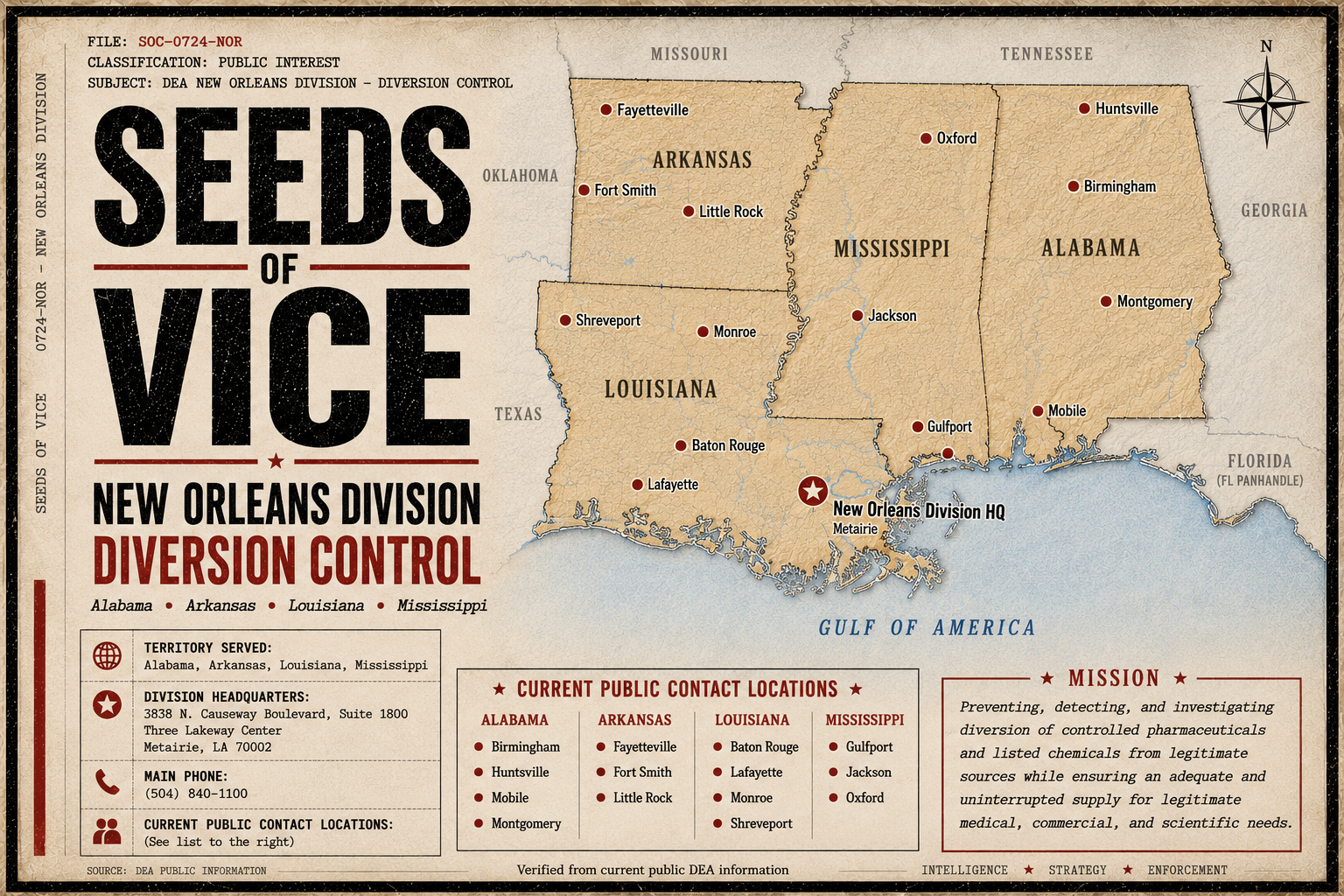
The New Orleans Division
DEA New Orleans Field Division and Its Diversion-Control System
Last fully verified: July 25, 2026
The Drug Enforcement Administration’s New Orleans Field Division serves four states:
- Alabama
- Arkansas
- Louisiana
- Mississippi
The regional command is officially the New Orleans Field Division. There is no separate regional agency formally titled the “New Orleans Diversion Division.” Diversion Control is one of the functions performed within the field division under the authority, systems, regulations, and national leadership of DEA’s Diversion Control Division.
The division’s geographic jurisdiction is clear and consistently stated in current official records. Its public organizational structure is less transparent.
DEA publishes a headquarters and 14 subordinate city contacts across the four states. It also displays a legend for division, district, resident, and post-of-duty offices without clearly identifying which classification applies to each listed location. Current operational records establish the classification of some units—such as DEA’s Little Rock District Office—but do not provide a complete four-state command chart.
DEA’s public pages also identify the same headquarters address differently. The main division page labels it as New Orleans, Louisiana, while DEA’s separate contacts page identifies the physical location as Metairie, Louisiana 70002. This does not create a jurisdictional conflict, but it is an avoidable public-record inconsistency.
Executive Finding
What is official
DEA states that the New Orleans Division serves Alabama, Arkansas, Louisiana, and Mississippi.
The division headquarters is located at:
3838 North Causeway Boulevard
Suite 1800, Three Lakeway Center
Metairie, Louisiana 70002
DEA identifies John P. Scott as the current Special Agent in Charge. Scott assumed command on June 1, 2026, and has responsibility for the division’s enforcement, intelligence, regulatory, and administrative operations across all four states.
DEA publishes subordinate contacts in:
Alabama
- Birmingham
- Huntsville
- Mobile
- Montgomery
Arkansas
- Fayetteville
- Fort Smith
- Little Rock
Louisiana
- Baton Rouge
- Lafayette
- Monroe
- Shreveport
Mississippi
- Gulfport
- Jackson
- Oxford
DEA separately identifies Tactical Diversion Squads in Birmingham, Little Rock, Baton Rouge, New Orleans, Monroe, Jackson, and Gulfport. These published TDS locations provide a partial picture of the division’s Diversion structure, but they do not reveal the complete supervisory chain, staffing, or geographic responsibility of each squad.
Leadership transition
John P. Scott replaced Steven Hofer as Special Agent in Charge on June 1, 2026.
This transition matters when reading older 2026 enforcement announcements. An April 1, 2026, DEA release correctly identified Hofer as the division’s Special Agent in Charge at that time. Hofer was subsequently appointed to lead DEA’s St. Louis Division in July 2026. Older releases naming Hofer are historical records, not evidence that DEA currently has two New Orleans division chiefs.
Where the public record is deficient
Current official public sources do not provide:
- A complete New Orleans Field Division organization chart.
- A current roster of Assistant Special Agents in Charge.
- A publicly verified current Diversion Program Manager.
- The classification of every published subordinate office.
- County- or parish-level office responsibility.
- The boundaries assigned to individual Diversion Groups or Tactical Diversion Squads.
- The number of Diversion Investigators assigned to each state.
- The names of current Diversion supervisors.
- A consolidated directory separating criminal-enforcement, registration, compliance, and practitioner inquiries.
- A consistent city designation for the headquarters.
These are not findings of wrongdoing.
They are findings about the limits of DEA’s current public disclosures.
What can be concluded
The New Orleans Field Division is a large four-state regional command whose work includes:
- Interstate and transnational drug-trafficking investigations.
- Bulk methamphetamine, cocaine, fentanyl, and marijuana cases.
- Counterfeit tablets and illicit pharmaceutical distribution.
- Overdose-response investigations.
- Financial and money-laundering investigations.
- Firearms associated with trafficking.
- Pharmaceutical theft.
- Controlled-substance registration and compliance.
- Investigations of practitioners, pharmacies, manufacturers, distributors, hospitals, and other registrants.
- Coordination with federal, state, local, and tribal agencies.
Current records also show that investigations frequently cross state boundaries within the division. Louisiana and Mississippi cases may arise from the same transportation corridor; Arkansas investigations may involve national pharmacy-burglary or trafficking networks; and Alabama organizations may obtain drugs and launder proceeds across several jurisdictions.
What cannot presently be concluded
The public record does not establish:
- The complete present hierarchy beneath the Special Agent in Charge.
- Whether every city listed by DEA contains a permanent staffed office.
- Which offices are district offices, resident offices, or posts of duty unless another current operational record expressly identifies them.
- Whether every published Tactical Diversion Squad has the same authority, staffing, or territorial scope.
- The present New Orleans Diversion Program Manager.
- The exact division of authority between regional Diversion supervisors and national Diversion leadership.
- The number of medical-practitioner, pharmacy, manufacturer, or distributor investigations initiated in each state.
- The total number of registration actions, voluntary surrenders, administrative proceedings, civil settlements, criminal referrals, or declined matters.
Seeds of Vice will not invent those answers.
Who the New Orleans Division Serves
The New Orleans Division serves the residents, institutions, registrants, and public agencies of four states.
Its regulated population includes:
- Patients receiving controlled medications.
- Physicians and other authorized prescribers.
- Pharmacies and pharmacists.
- Hospitals and clinics.
- Manufacturers and distributors.
- Researchers.
- Veterinary practices.
- Narcotic-treatment programs.
- Importers and exporters.
- State and local law-enforcement agencies.
- Families and communities affected by illicit fentanyl, methamphetamine, cocaine, counterfeit pills, addiction, violence, and inadequate medical care.
Its responsibilities span two fundamentally different channels.
The illicit channel
The illicit channel includes unlawful manufacture, importation, transportation, possession, distribution, money laundering, theft, violence, counterfeit products, and controlled substances produced outside the regulated pharmaceutical system.
The lawful channel
The lawful channel includes registered manufacturers, distributors, pharmacies, hospitals, practitioners, researchers, treatment programs, and patients using controlled substances for legitimate medical, scientific, or commercial purposes.
The channels may intersect when:
- A registrant intentionally diverts controlled substances.
- A pharmacy is burglarized.
- A prescription is forged.
- A lawful product is stolen.
- A manufacturer or distributor violates federal requirements.
- An illicit producer copies the appearance of a legitimate medication.
Those points of intersection do not make every patient, practitioner, pharmacy, or pharmaceutical company part of the illicit market.
Territory and Office Structure
Division Headquarters
3838 North Causeway Boulevard
Suite 1800, Three Lakeway Center
Metairie, Louisiana 70002
Main telephone: 504-840-1100
DEA’s main division page displays the address under a New Orleans label. Its separate contact directory identifies the physical city as Metairie. The division’s institutional name remains “New Orleans” regardless of the headquarters’ municipal location.
Alabama Contacts
| Published location | Telephone |
|---|---|
| Birmingham | 571-362-1600 |
| Huntsville | 571-362-4351 |
| Mobile | 251-441-5831 |
| Montgomery | 334-273-7300 |
Arkansas Contacts
| Published location | Telephone |
|---|---|
| Fayetteville | 479-442-2618 |
| Fort Smith | 479-783-6300 |
| Little Rock | 501-217-6500 |
Louisiana Contacts
| Published location | Telephone |
|---|---|
| Baton Rouge | 225-389-0254 |
| Lafayette | 337-706-3940 |
| Monroe | 318-651-7117 |
| Shreveport | 318-676-4080 |
Mississippi Contacts
| Published location | Telephone |
|---|---|
| Gulfport | 228-863-2992 |
| Jackson | 601-965-4400 |
| Oxford | 662-234-8542 |
These are DEA’s published contact points. Appearance in the directory does not, by itself, establish whether a location is a district office, resident office, post of duty, task-force office, or another type of organizational unit.
Verified office classification
A February 2026 federal announcement expressly identified the DEA New Orleans Field Division’s Little Rock District Office.
That current operational reference supports classifying Little Rock as a district office. The same method should not be used to assign classifications to the other cities unless DEA or another current official record expressly identifies them.
Tactical Diversion Squads
DEA’s national Tactical Diversion Squad directory identifies the following New Orleans Division locations:
| State | Published TDS locations |
|---|---|
| Alabama | Birmingham |
| Arkansas | Little Rock |
| Louisiana | Baton Rouge, New Orleans, Monroe |
| Mississippi | Jackson, Gulfport |
A Tactical Diversion Squad is not synonymous with an entire field office. TDS units combine DEA Diversion Investigators, special agents, and participating state and local officers to investigate controlled-substance diversion and related criminal activity.
The public directory establishes where DEA lists these squads. It does not reveal their staffing, individual commanders, county assignments, caseloads, or internal reporting structure.
Current Leadership and Publicly Identified Personnel
John P. Scott
Special Agent in Charge
John P. Scott assumed command of the New Orleans Field Division on June 1, 2026.
DEA states that he oversees enforcement, intelligence, regulatory, and administrative activities across Alabama, Arkansas, Louisiana, and Mississippi.
Scott joined DEA in 2004 after serving as a police officer in Charlotte, North Carolina, and as a noncommissioned officer in the United States Air Force.
His previous DEA assignments included:
- Drug-trafficking investigations in the Miami Division.
- Service in Mérida, Mexico.
- Service as DEA Country Attaché in Guatemala City.
- Assistant Special Agent in Charge assignments involving Oklahoma and the El Paso Intelligence Center.
- Leadership of DEA’s Asia-Pacific operations from Bangkok.
- Headquarters responsibility for operational strategy and support.
DEA states that his Asia-Pacific command encompassed operations in 34 countries and included work involving precursor chemicals, illicit finance, and transnational criminal organizations.
Scott’s international and headquarters experience is relevant to a division confronting drug flows that frequently originate outside its four-state territory.
Public Information Office
Telephone: 571-362-2805
DEA’s public division page provides a general media number but does not identify an individual public-information officer by name.
Recruitment
Telephone: 571-362-4892
Email: NOFD.Recruiter@dea.gov
Leslie Faulkner
Community-Outreach Contact
Telephone: 504-840-1076
Email: Leslie.M.Faulkner@dea.gov
Current Diversion leadership
A current New Orleans Division Diversion Program Manager could not be verified from the official public sources reviewed for this page.
No historical name should be carried forward as current without confirmation.
National Diversion leadership
DEA identifies Cheri Oz as Assistant Administrator of the national Diversion Control Division.
The institutional distinction is:
- John P. Scott: commands the New Orleans Field Division.
- Cheri Oz: leads DEA’s national Diversion Control Division.
- Regional Diversion personnel: operate within the New Orleans Field Division while using national DEA registration systems, regulations, policies, and program structures.
The regional field division should not be confused with the national operational division.
Official Role and Mission
The New Orleans Field Division enforces the federal Controlled Substances Act and related federal laws within its four-state territory.
Its work may include:
- Criminal investigations.
- Intelligence collection and analysis.
- Registration and compliance activity.
- Administrative inspections.
- Civil referrals.
- Registration proceedings.
- Controlled-substance theft investigations.
- Suspicious-order investigations.
- Counterfeit-drug cases.
- Practitioner and pharmacy cases.
- Manufacturer and distributor oversight.
- Money-laundering investigations.
- Community outreach.
- Drug-disposal initiatives.
- Coordination with federal prosecutors and partner agencies.
DEA describes the Diversion Investigator mission as enforcing federal law governing legally produced controlled substances and listed chemicals to prevent their diversion while ensuring an adequate and uninterrupted supply for legitimate medical, commercial, and scientific needs.
Both obligations are official.
Diversion Control is not defined solely as restriction.
It is also responsible for protecting the legitimate supply channel.
How the New Orleans System Works in Practice
Large interstate and transnational shipments
In April 2026, federal authorities announced two Western District of Louisiana cases involving approximately 550 pounds—or 247 kilograms—of methamphetamine and cocaine.
In one case, investigators alleged that approximately 147 kilograms of methamphetamine had been concealed within fabricated compartments in industrial ice-cream freezers.
In the second, authorities reported finding approximately 100 kilograms of cocaine in a concealed compartment within a tractor-trailer cab.
The defendants were charged. The announcements did not establish guilt, and the defendants remain presumed innocent unless convicted. The release was issued before the June 2026 leadership transition and therefore correctly quoted then-Special Agent in Charge Steven Hofer.
These cases demonstrate the scale of transportation and concealment activity confronting the division. They do not involve ordinary medical prescribing or pharmacy dispensing.
New Orleans cocaine-conversion laboratory
In May 2026, federal investigators announced charges arising from an alleged cocaine-conversion operation in New Orleans.
Authorities stated that the investigation began with a parcel from Houston containing approximately one kilogram of cocaine. A subsequent search allegedly uncovered equipment used to convert powder cocaine into crack cocaine, approximately 2.6 kilograms of cocaine, 1.9 grams of fentanyl, a firearm, cash, and distribution materials.
The matter was pending at the time of the announcement. The allegations should not be described as convictions.
Alabama’s Wiregrass region
In June 2026, Eric Demetrius King received a 420-month federal sentence after pleading guilty to cocaine- and methamphetamine-related conspiracy, methamphetamine distribution, and money laundering.
Federal authorities described the broader organization as involving at least 19 people in Alabama’s Wiregrass region. Eight co-conspirators had already been sentenced, while others were awaiting sentencing.
This was an adjudicated matter based on a guilty plea, not a pending accusation.
Arkansas and the Little Rock District Office
In February 2026, a federal jury convicted three defendants of methamphetamine- and cocaine-trafficking conspiracies. Federal authorities stated that all 18 defendants charged in the larger investigation had been convicted.
The announcement expressly identified DEA’s Little Rock District Office as a participating component of the New Orleans Field Division.
The case provides both an enforcement outcome and current evidence of Little Rock’s administrative classification.
Louisiana–Mississippi transportation activity
In July 2026, Like Chen received a 24-month federal sentence after pleading guilty to conspiracy to distribute marijuana.
Federal authorities described transportation and storage activity involving Louisiana and Mississippi, including seizures in Mississippi and investigative assistance from law-enforcement agencies in both states.
The matter illustrates how a trafficking investigation may cross state lines while remaining within one DEA field division.
Pharmaceutical theft
Federal investigations involving pharmacy-burglary organizations have documented the theft of more than 96,000 Schedule II tablets from pharmacies across several states, including Arkansas.
These cases involve the diversion of genuine medication through theft from the lawful channel. They are legally and institutionally different from prescribing disputes, recordkeeping violations, or counterfeit pills manufactured entirely outside the regulated system.
Fentanyl Overdose Response and Operation Engage
Fentanyl Overdose Response Team
DEA’s Fentanyl Overdose Response Team model is intended to connect individual suspected overdose events to larger suppliers and trafficking organizations.
In July 2026, the St. Tammany Parish Sheriff’s Office announced that it had assigned an investigator to the DEA-led FORT initiative. The stated purpose included real-time intelligence sharing, connecting cases across parish boundaries, strengthening overdose investigations, and identifying broader distribution networks.
A suspected overdose investigation is not automatically proof that a particular person committed a federal offense.
The evidentiary chain still must establish:
- The substance involved.
- Its source.
- The conduct of the suspected supplier.
- Causation where death or injury is alleged.
- The defendant’s legal responsibility.
- The admissibility and reliability of the evidence.
The “Trifecta” model
DEA has described its New Orleans-area strategy as combining:
- Major enforcement against trafficking organizations.
- Fentanyl-overdose response.
- Local prosecution and accountability.
In a December 2025 announcement, DEA stated that the New Orleans Division had seized nearly 1.25 million fentanyl pills—approximately 187 kilograms—during 2025. DEA also associated the initiative with a reported decline in local fentanyl deaths.
Those figures describe DEA’s seizures and institutional interpretation.
They do not independently prove that one program caused the full mortality decline. Overdose outcomes may also be affected by:
- Changes in the illicit drug supply.
- Naloxone availability.
- Emergency response.
- Treatment access.
- Public awareness.
- Demographic changes.
- Toxicology and reporting practices.
- Other law-enforcement activity.
- Random variation.
Agency claims of success should be reported accurately without converting them into stronger causal conclusions than the evidence supports.
Operation Engage
DEA identifies New Orleans as an Operation Engage location.
Operation Engage combines enforcement, prevention, community outreach, education, and partnerships within a selected geographic focus. It is an initiative within the division, not an independent field division or a substitute for the division’s permanent Diversion responsibilities.
Diversion Control and Lawful Medicine
New Orleans Division Diversion personnel may regulate or investigate:
- Physicians.
- Dentists.
- Advanced-practice clinicians.
- Pharmacists.
- Hospitals.
- Clinics.
- Veterinary practices.
- Manufacturers.
- Distributors.
- Researchers.
- Narcotic-treatment programs.
- Importers and exporters.
- Other DEA registrants.
Their work may include:
- Registration applications and renewals.
- Inspections.
- Recordkeeping reviews.
- Inventory reconciliation.
- Security assessments.
- Theft and loss reporting.
- Suspicious-order investigations.
- Prescription investigations.
- Administrative subpoenas.
- Civil referrals.
- Registration restrictions.
- Voluntary registration surrenders.
- Administrative proceedings.
- Criminal investigations when intentional unlawful conduct is suspected.
These actions occupy different legal positions.
Inspection
An inspection is an investigative or compliance process. It is not itself a finding of wrongdoing.
Warning or corrective agreement
A warning, memorandum, or corrective agreement may resolve alleged deficiencies without a criminal charge.
Civil settlement
A civil payment resolves civil allegations or liability. It is not automatically an admission or criminal conviction.
Administrative action
An administrative action concerns the authority to possess, prescribe, manufacture, distribute, or dispense controlled substances. It may occur independently of a criminal prosecution.
Indictment or complaint
A criminal charge is an allegation. The defendant remains presumed innocent unless convicted.
Guilty plea
A guilty plea is a formal admission in court to specified criminal conduct.
Trial conviction
A conviction follows an adjudication of guilt at trial.
Sentence
A sentence follows a guilty plea or conviction.
The word enforcement should never erase these distinctions.
The Four-State Prescription-Control Layer
The New Orleans Field Division operates across four separate state medical and prescription-monitoring systems.
Federal registration does not replace state law, professional licensing, prescription-monitoring requirements, pharmacy regulation, or standards of medical practice.
Alabama
Alabama’s Prescription Drug Monitoring Program receives dispensing information for Schedule II through Schedule V controlled substances. Alabama requires covered dispensers to report controlled-substance transactions daily.
Alabama medical-board rules and guidance also use dosage and risk indicators to establish monitoring and documentation expectations. Those requirements arise from state professional regulation, not from the New Orleans Field Division alone.
Arkansas
Arkansas maintains a Prescription Drug Monitoring Program containing controlled-substance prescriptions dispensed through Arkansas pharmacies.
Arkansas Medical Board rules address acute and chronic opioid prescribing, documentation, treatment agreements, PDMP review, and elevated-dose prescribing. The rules identify an initial acute-pain prescription exceeding seven days as excessive absent documented justification and impose additional documentation expectations at or above 50 morphine milligram equivalents per day in chronic therapy.
These provisions are state professional rules. They should not be represented as a single DEA-created national limit.
Louisiana
Louisiana law generally requires a prescriber or authorized delegate to review the state Prescription Monitoring Program before initially prescribing an opioid and at least every 90 days when covered treatment continues beyond 90 days, subject to statutory exceptions.
Louisiana also limits certain initial outpatient opioid prescriptions for acute conditions to a seven-day supply. That provision should not be represented as a universal seven-day limit on every opioid prescription, every chronic-pain patient, or every clinical setting.
Mississippi
Mississippi professional rules require review of the Mississippi Prescription Monitoring Program at each encounter in which an opioid is prescribed for covered acute or chronic noncancer pain. For certain other controlled substances, the rules require review at the beginning of treatment and periodically thereafter.
Mississippi’s rules also address immediate-release products, effective dosage, documentation, and clinical evaluation. Those are state medical-regulatory requirements operating alongside federal law.
What the state comparison establishes
The four states share broad controlled-substance objectives, but they do not maintain one uniform regional system.
A practitioner may simultaneously face:
- Federal registration requirements.
- DEA inspections or investigations.
- State prescribing statutes.
- State medical-board rules.
- State prescription-monitoring requirements.
- Pharmacy-board requirements.
- Insurer restrictions.
- Hospital or clinic policies.
- Pharmacy corporate policies.
- Civil-liability concerns.
- Professional guidance.
- Individual clinical judgment.
No single institution creates the entire treatment environment.
How the System Affects Pain Patients and Lawful Medicine
Legitimate protective functions
Effective Diversion enforcement can protect patients by:
- Detecting forged prescriptions.
- Investigating pharmacy burglaries.
- Preventing theft from hospitals and clinics.
- Identifying unlawful dispensing.
- Enforcing accurate manufacturer and distributor records.
- Removing counterfeit tablets.
- Investigating illicit pill presses.
- Identifying registrants who intentionally distribute controlled substances outside legitimate practice.
- Preserving traceability within the lawful supply chain.
The protection of lawful medicine is particularly important when illicit products are manufactured to resemble authentic prescriptions.
A counterfeit tablet is dangerous partly because it borrows the appearance and implied safety of regulated medicine while bypassing its manufacturing, prescribing, dispensing, dosage, and labeling safeguards.
The risk of institutional overcorrection
The same control system can injure legitimate patients when enforcement fear, numerical thresholds, corporate policy, or administrative convenience replaces individualized clinical judgment.
The Centers for Disease Control and Prevention has acknowledged that its 2016 opioid-prescribing guideline was misapplied through:
- Rigid dosage thresholds.
- Rapid tapers.
- Abrupt discontinuation.
- Inflexible duration restrictions.
- Application to patients outside the guideline’s intended scope.
- Patient dismissal.
- Patient abandonment.
CDC associated these misapplications with untreated or undertreated pain, withdrawal, worsening pain, psychological distress, overdose, and suicidal ideation or behavior. Its 2022 guideline emphasized individualized, patient-centered decision-making rather than inflexible application.
That acknowledgment does not prove that DEA alone caused these consequences.
The treatment environment is produced by the interaction of:
- Congress.
- DEA.
- Federal prosecutors.
- State legislatures.
- Medical and pharmacy boards.
- Prescription-monitoring programs.
- Insurers.
- Pharmacy corporations.
- Hospitals and clinics.
- Professional associations.
- Civil-liability systems.
- Individual practitioners.
- Patients.
- The illicit market.
DEA should not be assigned sole responsibility for every prescribing decision.
It should not be removed from the analysis either.
The possibility of inspection, registration action, civil referral, criminal investigation, or prosecution forms part of the institutional risk environment in which controlled-substance decisions are made.
Prescribing and Dispensing Context
Evidentiary boundary
Seeds of Vice begins its historical inquiry in 1984.
No continuous, directly comparable annual retail opioid-dispensing series was identified for Alabama, Arkansas, Louisiana, and Mississippi beginning in 1984.
The record must therefore be divided into defensible periods.
1984–2005
Historical inquiry for this period may use:
- Federal drug-distribution records.
- Manufacturer and production data.
- Quota records.
- Medicaid and payer data.
- Drug-specific utilization studies.
- Medical literature.
- State regulatory history.
- National prescribing indicators.
Those sources cannot be silently merged with the later CDC retail-prescription-rate series.
Missing years should not be interpolated.
Selected CDC retail-dispensing benchmarks
The following figures represent retail opioid prescriptions per 100 residents:
| State | 2006 | 2012 | 2016 | 2019 | 2023 | 2024 | 2012–2024 decline |
|---|---|---|---|---|---|---|---|
| Alabama | 115.6 | 143.8 | 121.0 | 85.8 | 71.4 | 68.5 | 52.4% |
| Arkansas | 98.3 | 121.8 | 114.6 | 80.9 | 71.5 | 68.8 | 43.5% |
| Louisiana | 109.2 | 113.0 | 98.1 | 74.6 | 62.7 | 59.2 | 47.6% |
| Mississippi | 102.7 | 121.8 | 105.6 | 67.0 | 63.1 | 61.4 | 49.6% |
The underlying state rates come from CDC’s archived and current retail opioid-dispensing tables. The percentage declines are Seeds of Vice calculations.
Central 2024 finding
In 2024, the four states served by the New Orleans Field Division had the four highest state retail opioid-dispensing rates in the United States:
- Arkansas — 68.8 prescriptions per 100 residents.
- Alabama — 68.5.
- Mississippi — 61.4.
- Louisiana — 59.2.
The national rate was 35.4 prescriptions per 100 residents.
This does not establish that the prescriptions were unnecessary.
It establishes that lawful retail opioid dispensing remained substantially more common in these four states than in the country as a whole.
What the decline establishes
From 2012 through 2024, the reported rate declined:
- Approximately 52.4 percent in Alabama.
- Approximately 43.5 percent in Arkansas.
- Approximately 47.6 percent in Louisiana.
- Approximately 49.6 percent in Mississippi.
The region therefore experienced major prescribing contraction while still retaining the country’s highest 2024 state rates.
Both facts matter.
The division’s states did not avoid the national decline.
They began from unusually high levels and remained comparatively high after that decline.
What the data do not establish
The dispensing data do not reveal:
- Whether an individual prescription was medically appropriate.
- Whether the patient’s pain improved.
- Whether medication was voluntarily discontinued.
- Whether treatment was involuntarily tapered.
- Whether a patient received an effective alternative.
- Whether a patient lost a prescriber or pharmacy.
- Whether average dosage declined at the same rate.
- Whether duration or pill count changed.
- Whether patients moved into or out of the state.
- Whether DEA caused the decline.
- Whether the decline caused a particular mortality outcome.
Prescription volume is a utilization measure.
It is not a complete measure of treatment quality.
Methodological limitations
CDC’s current dispensing estimates use IQVIA retail-pharmacy data covering approximately 54,600 nonhospital retail pharmacies and nearly 94 percent of retail prescriptions.
The data include new and refilled prescriptions paid through commercial insurance, Medicaid, Medicare, and cash. They exclude mail-order prescriptions and methadone administered through opioid-treatment programs.
Current geography is generally assigned according to the prescriber’s location. CDC changed its geographic methodology during the historical series, which must be considered when comparing older and newer values.
Prescriptions per 100 residents must not be mixed with:
- Morphine milligram equivalents per capita.
- Average MME per prescription.
- Daily dosage.
- Days supplied.
- Number of patients.
- Number of tablets.
- Total controlled-substance prescriptions.
- Overdose mortality.
- Drug-seizure quantities.
Those measures answer different questions.
Overdose Context
CDC’s provisional estimates showed that national drug-overdose deaths declined by almost 27 percent in 2024.
Louisiana was among the jurisdictions reporting a decline of at least 35 percent during that period. National opioid-involved deaths were estimated to have fallen from approximately 83,140 in 2023 to 54,743 in 2024.
Provisional national estimates indicated another overdose decline in 2025. Alabama was among the states with a reported decline of at least 25 percent, while estimated national opioid-involved deaths fell from approximately 55,296 in 2024 to 44,564 in 2025.
These figures remain subject to revision. CDC warns that reporting delays and incomplete records may affect recent state estimates and comparisons.
The declines are important.
They do not prove that:
- Every reduction in prescribing was medically appropriate.
- Every patient retained adequate treatment.
- DEA enforcement alone caused the mortality decline.
- Prescription-monitoring programs alone caused it.
- Naloxone distribution alone caused it.
- Treatment expansion alone caused it.
- Changes in the illicit fentanyl supply alone caused it.
The regional record contains several simultaneous facts:
Lawful opioid dispensing declined substantially.
The four states still had the country’s highest dispensing rates in 2024.
Large illicit methamphetamine, cocaine, fentanyl, and counterfeit-drug markets remained active.
Overdose mortality later declined sharply.
A defensible analysis must present all four findings without claiming that one statistic independently explains the others.
Representative New Orleans Division Matters
Western Louisiana bulk-drug seizures
Pending charges
Federal authorities announced two cases involving approximately 247 kilograms of methamphetamine and cocaine concealed in industrial equipment and a tractor-trailer.
The charges remain allegations unless established through a plea or conviction.
New Orleans cocaine-conversion operation
Pending charges
Authorities alleged that a parcel investigation led to a cocaine-conversion laboratory, approximately 2.6 kilograms of cocaine, fentanyl, a firearm, and cash.
The matter was pending at the time of publication.
Alabama Wiregrass organization
Guilty plea and sentence
Eric Demetrius King received a 420-month sentence after pleading guilty to drug-trafficking and money-laundering offenses.
This was an adjudicated criminal disposition.
Arkansas methamphetamine and cocaine conspiracies
Trial convictions
Three defendants were convicted by a federal jury, completing convictions against all 18 defendants charged in the broader investigation.
DEA’s Little Rock District Office participated.
Louisiana–Mississippi marijuana conspiracy
Guilty plea and sentence
Like Chen received a 24-month sentence after pleading guilty in a case involving transportation and storage activity in Louisiana and Mississippi.
Multistate pharmacy-burglary organization
Convictions and sentences
Federal investigators documented the theft of more than 96,000 Schedule II tablets from pharmacies in several states, including Arkansas.
This involved the theft of genuine medication from the lawful channel.
Contact Information
New Orleans Field Division Headquarters
Address:
3838 North Causeway Boulevard
Suite 1800, Three Lakeway Center
Metairie, Louisiana 70002
Main telephone: 504-840-1100
DEA’s main page labels the headquarters as New Orleans, while its separate contacts page identifies Metairie.
Media
Public Information Office: 571-362-2805
Recruitment
Telephone: 571-362-4892
Email: NOFD.Recruiter@dea.gov
Community Outreach
Leslie Faulkner
Telephone: 504-840-1076
Email: Leslie.M.Faulkner@dea.gov
Alabama
Birmingham: 571-362-1600
Huntsville: 571-362-4351
Mobile: 251-441-5831
Montgomery: 334-273-7300
Arkansas
Fayetteville: 479-442-2618
Fort Smith: 479-783-6300
Little Rock: 501-217-6500
Louisiana
Baton Rouge: 225-389-0254
Lafayette: 337-706-3940
Monroe: 318-651-7117
Shreveport: 318-676-4080
Mississippi
Gulfport: 228-863-2992
Jackson: 601-965-4400
Oxford: 662-234-8542
Because DEA does not clearly publish every office’s current classification or geographic assignment, callers should verify which office, Diversion Group, or Tactical Diversion Squad is responsible for the relevant parish, county, registration, inspection, or investigation.
Seeds of Vice Analysis
The New Orleans Division’s jurisdiction is not the institutional problem.
The four-state territory is clear.
The problem is that DEA exercises substantial criminal and regulatory authority across Alabama, Arkansas, Louisiana, and Mississippi without publishing a complete and intelligible account of how that authority is organized.
The public receives:
- Fourteen subordinate city contacts.
- Seven identifiable Tactical Diversion Squad locations.
- A general office-type legend.
- No complete current classification of the listed offices.
- No current public Diversion Program Manager.
- No full Assistant Special Agent in Charge roster.
- No county- or parish-level responsibility map.
- No regional Diversion organization chart.
- Two different city labels for the headquarters.
These are not accusations of corruption.
They are findings of insufficient institutional transparency.
The division contains the nation’s highest-prescribing states
The most important statistical finding is not merely that opioid dispensing declined.
It is that every state served by the New Orleans Division remained among the four highest-dispensing states in the country in 2024.
That places the division in a distinctive position.
Its Diversion personnel operate in a region where:
- Lawful opioid prescribing has contracted substantially.
- Dispensing remains high relative to the national rate.
- Rural and medically underserved areas may have limited specialist access.
- Illicit fentanyl and methamphetamine markets remain active.
- State prescribing systems impose different monitoring and documentation rules.
- Federal enforcement overlaps with four state medical-regulatory regimes.
High prescribing does not prove unlawful prescribing.
Low prescribing does not prove good medical care.
The proper inquiry is whether the lawful system is accurately distinguishing:
- Appropriate treatment from intentional distribution.
- A high-need patient from a fraudulent patient.
- A documented clinical judgment from a sham prescription.
- A recordkeeping deficiency from a criminal enterprise.
- A stolen pharmaceutical from a lawfully dispensed one.
- An authentic tablet from a counterfeit one.
- A physician’s good-faith decision from conduct outside professional practice.
Regional culture and national comparison
The four-state prescribing pattern may reflect several factors:
- Population health.
- Occupational injury.
- Rural healthcare.
- Provider practice.
- State regulation.
- Historical prescribing culture.
- Demographics.
- Pharmacy availability.
- Access to alternatives.
- Differences in data attribution.
The dispensing rate alone cannot determine the contribution of each factor.
It should not be used as a verdict against an entire region.
It should be used as the beginning of a more serious inquiry.
Enforcement and patient access are not opposing truths
The division’s major seizures demonstrate real illicit-market danger.
Hundreds of kilograms of methamphetamine and cocaine, counterfeit pills, pharmacy burglaries, firearms, and overdose-linked distribution networks require investigation.
That does not make the pain patient the enemy.
The protection of lawful medicine requires both:
- Preventing criminal diversion.
- Preserving legitimate access.
DEA’s own mission includes both duties.
A system that measures only seizures, arrests, convictions, surrendered registrations, and prescription decline is measuring only the restrictive side of its work.
A complete institutional account should also measure:
- Registration-processing delays.
- Controlled-substance shortages.
- Pharmacy refusals.
- Practitioner departures.
- Geographic loss of pain care.
- Involuntary tapering.
- Patient abandonment.
- Access to effective alternatives.
- Patient function.
- Patient-reported harm.
- Continuity of treatment.
Without those measurements, the government can describe what it stopped but not what legitimate care remained available afterward.
Tactical Diversion Squads govern more than criminal cases
The presence of seven published Tactical Diversion Squad locations demonstrates that Diversion activity is embedded throughout the four-state command.
These squads may investigate serious criminal conduct, including:
- Counterfeit-pill distribution.
- Pharmacy theft.
- Forged prescriptions.
- Corrupt registrants.
- Illicit prescribing.
- Controlled-substance fraud.
Their presence does not mean that every registrant inquiry is criminal.
That distinction should be visible in DEA’s public reporting.
The public should be able to determine whether an outcome involved:
- An inspection.
- Corrective education.
- A warning.
- A civil settlement.
- A registration surrender.
- An administrative order.
- An indictment.
- A guilty plea.
- A trial conviction.
- A dismissal or acquittal.
Public accountability requires more than counting “actions.”
It requires describing what actually happened.
The correct institutional standard
The New Orleans Division should be capable of:
- Interdicting industrial-scale drug shipments without treating ordinary prescribing as equivalent conduct.
- Investigating overdose deaths without presuming guilt before causation is established.
- Prosecuting pharmacy theft while preserving the lawful supply those pharmacies provide.
- Regulating high-prescribing states without treating a statistical ranking as proof of criminality.
- Using prescription-monitoring data without converting a risk indicator into a verdict.
- Holding intentionally corrupt registrants accountable without frightening legitimate practitioners out of medicine.
- Preserving access for patients whose need remains lawful, documented, and real.
Drug control governs crime.
Diversion control governs permission.
Across Alabama, Arkansas, Louisiana, and Mississippi, that permission is administered through one federal field division, seven publicly listed Tactical Diversion Squads, four state monitoring systems, four state regulatory structures, insurers, pharmacies, hospitals, clinics, and individual practitioners.
No single institution bears sole responsibility for the final outcome.
Every institution exercising authority bears responsibility for its part.
Recommended Public Disclosures
DEA should publish:
- A current New Orleans Field Division organization chart.
- The classification of all 14 published subordinate contacts.
- County- and parish-level office responsibility.
- A complete current Assistant Special Agent in Charge roster.
- The current Diversion Program Manager.
- The names or positions responsible for each Diversion Group.
- The general geographic responsibility of each Tactical Diversion Squad.
- A corrected and consistent headquarters city designation.
- Separate contacts for registration, practitioner compliance, suspicious orders, theft reporting, and criminal tips.
- Annual totals for criminal, civil, and administrative Diversion matters.
- Outcomes separated by allegation, indictment, plea, conviction, acquittal, dismissal, settlement, surrender, and administrative order.
- State-specific reporting rather than only four-state aggregate totals.
- Measures of legitimate medical access alongside enforcement statistics.
- Public reporting concerning controlled-substance shortages and registration delays.
- A method for patients and practitioners to identify the responsible regional office without reconstructing DEA’s organization from scattered press releases.
Publishing this information would not require disclosure of active investigative methods or confidential case material.
It would establish ordinary institutional accountability.
Methodology and Evidentiary Limits
This page prioritizes current primary sources from:
- The Drug Enforcement Administration.
- United States Attorney’s Offices.
- The Centers for Disease Control and Prevention.
- State prescription-monitoring programs.
- State legislatures.
- State medical and regulatory boards.
The following evidentiary rules were applied:
- The regional command was correctly identified as the New Orleans Field Division.
- The field division was distinguished from the national Diversion Control Division.
- The June 1, 2026, leadership transition was preserved.
- Older releases naming Steven Hofer were treated as historical records.
- DEA’s New Orleans–Metairie headquarters labeling inconsistency was preserved rather than silently corrected.
- Office classifications were not invented.
- Little Rock was identified as a district office because a current official record expressly used that classification.
- Tactical Diversion Squad locations were taken from DEA’s national directory.
- Historical Diversion personnel were not represented as current.
- Allegations were distinguished from guilty pleas, convictions, and sentences.
- Agency claims of causal success were not converted into independent causal findings.
- State prescribing requirements were separated from federal DEA authority.
- Four separate state systems were not represented as one uniform regional law.
- Prescriptions per 100 residents were not mixed with MME, patient counts, tablet counts, days supplied, or overdose deaths.
- Missing years were not interpolated.
- The CDC methodology change was acknowledged.
- National values were not substituted for state values.
- Prescription decline was not represented as proof of either medical benefit or patient harm.
- DEA was analyzed as one institution within a broader medical-control system.
- Official mission statements were separated from Seeds of Vice analysis.
Last fully verified: July 25, 2026


Bestsellers
-

A gift of Luck
-

Proof of Progress: Mr. DEA’s Diversion Autographed Hardcover & Seed Pack
$39.99 -

Seeds of Vice ™
$24.99 -

Seeds of Vice Book Set
$119.00 -
Seeds of Vice: On Poppy Tea Autographed Hardcover & Seed Pack
Original price was: $39.99.$29.99Current price is: $29.99. -

Seeds of Vice: On The Poppy Plant Autographed Hardcover & Seed Pack
$55.00
