The Dallas Division
DEA Dallas Division
Last fully verified: July 24, 2026
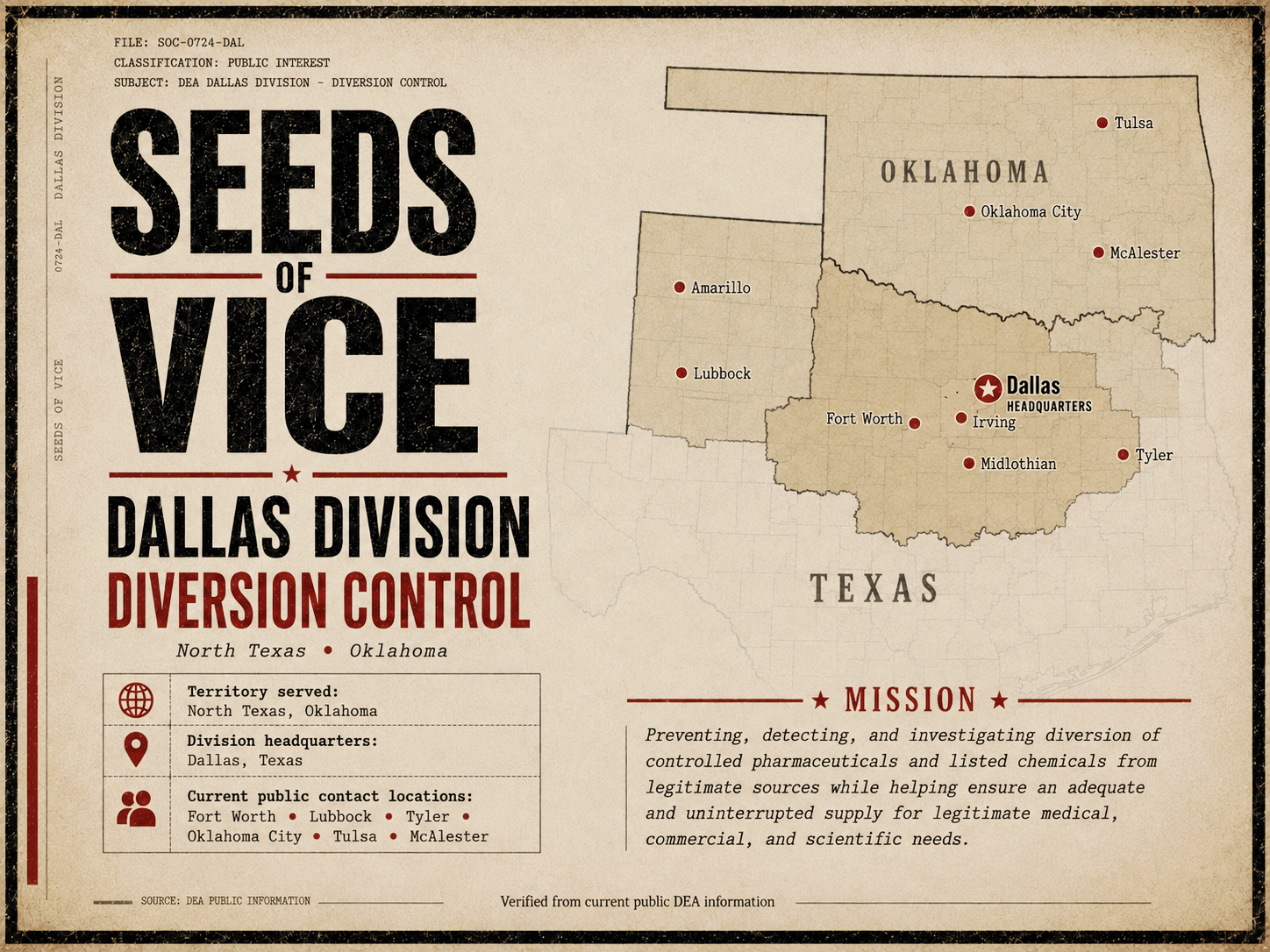
The Drug Enforcement Administration’s Dallas Division serves North Texas and the entire State of Oklahoma.
That jurisdiction must be stated carefully.
The Dallas Division does not administer DEA operations throughout all of Texas. Texas is divided among multiple DEA field divisions. The Dallas Division’s Texas responsibility is regional, while its Oklahoma responsibility extends statewide.
DEA Special Agent in Charge Joseph B. Tucker’s current official biography identifies operational offices in Dallas, Irving, Midlothian, Fort Worth, Lubbock, Amarillo, and Tyler, Texas. It also states that the division covers all of Oklahoma through offices in Oklahoma City, Tulsa, and McAlester.
DEA’s main Dallas Division page presents a narrower public contact list. It publishes telephone numbers for Dallas, Fort Worth, Lubbock, Tyler, Oklahoma City, Tulsa, and McAlester, but it does not currently provide public numbers for Irving, Midlothian, or Amarillo. The main page’s introductory description also names Fort Worth, Lubbock, Tyler, and Oklahoma without fully describing the office network documented in Tucker’s biography.
This page distinguishes between:
- The division’s broader operational office network;
- The locations for which DEA publishes direct public contact information;
- The entire State of Oklahoma;
- North Texas rather than Texas as a whole.
The Dallas Division investigates illicit drug trafficking, transnational criminal organizations, violent drug networks, money laundering, fentanyl distribution, and other violations of federal law. It also administers and enforces the federal controlled-substance system governing lawful manufacturers, distributors, pharmacies, hospitals, clinics, practitioners, researchers, and other DEA registrants.
This page concerns that lawful system.
It explains who leads the division, which offices and personnel are publicly identified, how diversion-control authority operates in North Texas and Oklahoma, how federal and state regulatory systems overlap, what actual diversion investigations look like, and what the available prescribing evidence can—and cannot—prove about lawful medicine.
The Name Matters
The official regional organization is the DEA Dallas Division.
It is not formally named the “Dallas Diversion Division.”
The Dallas Division is a regional DEA field division responsible for multiple enforcement missions. Pharmaceutical diversion control is one component of that broader organization.
The national Diversion Control Division is a separate operational component within DEA headquarters. It administers national programs involving controlled-substance registration, regulations, production quotas, imports and exports, listed chemicals, distribution monitoring, policy, and major diversion investigations.
The two are connected, but they are not interchangeable.
National DEA components develop and administer much of the federal controlled-substance framework. Dallas Division personnel implement and enforce portions of that framework within their jurisdiction.
The Dallas Division does not independently:
- Enact the Controlled Substances Act;
- Establish national manufacturing quotas;
- Write national DEA regulations;
- Create CDC clinical recommendations;
- License Texas or Oklahoma physicians;
- Determine the national medical standard of care;
- Establish every hospital, pharmacy, or insurance policy affecting pain treatment.
Its personnel can, however:
- Inspect DEA registrants;
- Examine controlled-substance records;
- Audit inventories;
- Investigate thefts and losses;
- Investigate suspected unlawful prescribing or dispensing;
- Work with state regulators and law-enforcement agencies;
- Execute warrants when legally authorized;
- Support administrative proceedings;
- Refer civil or criminal matters for prosecution.
National policies should not be attributed solely to one field division.
A field division should also not be treated as a passive observer when its personnel possess federal authority over the lawful controlled-substance channel.
Who This Division Serves
North Texas
DEA’s current leadership biography identifies the division’s North Texas office network as:
- Dallas
- Irving
- Midlothian
- Fort Worth
- Lubbock
- Amarillo
- Tyler
These locations span a vast and medically diverse portion of Texas.
The region includes the Dallas–Fort Worth metropolitan area, smaller cities, agricultural communities, the Texas Panhandle, West Texas population centers, and substantial rural territory. Access to hospitals, specialists, pharmacies, transportation, and pain care can differ considerably across that geography.
DEA does not publish a sufficiently detailed, current county-by-county jurisdiction list on the public pages reviewed for this publication.
That limitation matters statistically.
A statewide Texas prescribing rate includes patients and prescribers outside the Dallas Division. It includes regions administered by other DEA field divisions. Therefore, statewide Texas data can provide broad context, but it cannot honestly be labeled a Dallas Division prescribing rate.
Without an authoritative county boundary, Seeds of Vice will not construct one from assumptions.
Oklahoma
The Dallas Division serves the entire State of Oklahoma.
DEA identifies Oklahoma offices in:
- Oklahoma City
- Tulsa
- McAlester
Unlike Texas statewide data, Oklahoma statewide prescribing data correspond geographically to the complete Oklahoma portion of the Dallas Division.
That does not mean the Oklahoma rate describes every local community equally. Oklahoma City, Tulsa, rural western Oklahoma, southeastern Oklahoma, and tribal or frontier communities can have very different medical environments.
It does mean the state boundary and the DEA divisional boundary align.
Headquarters
The Dallas Division headquarters is publicly listed at:
DEA Dallas Division
10160 Technology Boulevard East
Dallas, Texas 75220
Main telephone: (214) 366-6900
The headquarters coordinates the division’s regional operations and serves as its principal public contact location.
Current Leadership
Joseph B. Tucker
Special Agent in Charge
As of July 24, 2026, Joseph B. Tucker is the publicly identified Special Agent in Charge of the DEA Dallas Division. DEA states that he was appointed to the position in September 2025 after serving as Acting Special Agent in Charge beginning in July 2025.
Tucker began his DEA career in 2005 in the Los Angeles Field Division, where he investigated Mexican transnational criminal organizations.
In 2009, he joined DEA’s Foreign-deployed Advisory and Support Team program. DEA states that he deployed to Afghanistan and participated in additional operational rotations in Kenya, Honduras, Guatemala, and Peru.
Tucker transferred to the Dallas Division in April 2017 as a group supervisor. His group investigated organizations trafficking cocaine, methamphetamine, and heroin.
In 2021, he moved to DEA headquarters and worked in the Office of Foreign Operations. In June 2022, he became Section Chief of the International Impact Section. DEA states that his responsibilities included the Sensitive Investigative Unit Program, Vetted Unit Program, Foreign Judicial Wire Intercept Program, Operation All Inclusive, and an annual budget exceeding $26 million.
Tucker returned to Dallas in June 2023 as an Assistant Special Agent in Charge. He supervised enforcement groups, the division’s Special Response Team, and the North Texas Strike Force before becoming Acting Special Agent in Charge and then receiving the permanent appointment.
Before joining DEA, Tucker worked for the United States Navy as a budget analyst responsible for tactical-aviation financial work involving an average annual budget exceeding $28 billion. He grew up in rural Nebraska and earned a bachelor’s degree in accounting with a minor in business management from Asbury College.
His official biography documents extensive experience in law enforcement, foreign operations, organizational leadership, budgeting, and investigations involving transnational criminal organizations.
It does not identify him as a physician, pharmacist, pain specialist, epidemiologist, or clinical researcher.
That distinction does not negate his legal authority. It clarifies the institutional perspective from which the division is led.
The Public Office Record Is Incomplete
DEA’s current public records provide two different levels of information.
Tucker’s biography identifies the fuller operational network:
- Dallas
- Irving
- Midlothian
- Fort Worth
- Lubbock
- Amarillo
- Tyler
- Oklahoma City
- Tulsa
- McAlester
The main Dallas Division page publishes direct contact numbers only for:
- Dallas
- Fort Worth
- Lubbock
- Tyler
- Oklahoma City
- Tulsa
- McAlester
No public number is currently displayed there for Irving, Midlothian, or Amarillo.
That does not prove those offices are inactive. Tucker’s current official biography says they are part of the office network.
It means the public-facing division page does not provide the same level of detail as the leadership biography.
This page will not invent telephone numbers, addresses, classifications, staffing levels, or internal boundaries to fill those gaps.
Publicly Identified Personnel
DEA does not publish a complete roster of Dallas Division special agents, diversion investigators, intelligence analysts, task-force officers, supervisors, attorneys, or administrative employees.
Seeds of Vice will not build one from social-media profiles, commercial databases, unsupported directories, former assignments, or undated biographies.
The following personnel are included because DEA currently identifies them in public-facing roles.
Cynthia M. Velazquez
Media Inquiries
DEA lists Cynthia M. Velazquez as the Dallas Division’s media contact.
Telephone: (571) 324-7481
Email: Dallas.Field.Division.PIO@dea.gov
Special Agent Lorie Valdez
Special Agent Recruitment
DEA identifies Special Agent Lorie Valdez as the Dallas Division recruitment contact.
Telephone: (571) 324-7440
Email: DallasSpecialAgentRecruiter@dea.gov
Erin J. Fischer
Community Outreach and Red Ribbon
DEA identifies Erin J. Fischer as the division’s Community Outreach and Red Ribbon contact.
Telephone: (214) 724-3020
Email: Erin.J.Fischer@dea.gov
Community outreach and Red Ribbon activities are distinct from diversion investigations. Outreach personnel generally work with schools, organizations, prevention programs, parents, and other community stakeholders.
Their public role should not be confused with command of diversion groups or responsibility for individual prescribing investigations.
Public Contact Locations
Texas
Dallas Headquarters
(214) 366-6900
Fort Worth
(817) 639-2000
Lubbock
(806) 798-7189
Tyler
(903) 579-2400
Oklahoma
McAlester
(918) 426-5020
Oklahoma City
(405) 475-7500
Tulsa
(918) 459-9600
DEA’s public page does not clearly state the organizational classification of every listed location.
Accordingly, this page calls them publicly listed contact locations unless DEA separately identifies a more specific classification.
A telephone listing does not establish:
- Staffing levels;
- Internal reporting structure;
- Exact geographical boundaries;
- Whether a location is a district office, resident office, post of duty, satellite office, or another organizational unit;
- Whether diversion personnel are permanently assigned there.
Those details should not be inferred without an official record.
Diversion-Control Infrastructure
DEA publicly lists Tactical Diversion Squads in Dallas and Fort Worth.
For Oklahoma, DEA’s national Tactical Diversion Squad directory directs inquiries to the Dallas Division rather than publicly identifying a separate Oklahoma squad location.
A Tactical Diversion Squad is not merely an educational or administrative unit.
DEA describes these squads as multiagency enforcement groups combining DEA personnel with federal, state, and local participants. Their purpose is to investigate, disrupt, and dismantle organizations or individuals suspected of violating the Controlled Substances Act or related laws involving pharmaceutical controlled substances or listed chemicals.
DEA states that Tactical Diversion Squads can:
- Share information and intelligence across agencies;
- Combine federal, state, and local investigative authority;
- Coordinate cases across judicial districts;
- Support traditional diversion groups when law-enforcement powers are required;
- Conduct physical surveillance;
- Conduct controlled purchases of evidence;
- Recruit and manage confidential sources;
- Pay informants;
- Make arrests;
- Execute search warrants;
- Seize evidence.
This structure demonstrates that diversion control can move along a continuum.
A matter may begin with:
- Registration information;
- An inspection;
- An inventory discrepancy;
- A suspicious-order report;
- An unusual prescribing pattern;
- A theft or loss report;
- A complaint from healthcare personnel;
- Information from a state licensing authority;
- Information from a patient, employee, pharmacy, or law-enforcement agency.
If investigators believe the evidence indicates criminal conduct, the case may develop into a conventional law-enforcement investigation using surveillance, informants, warrants, arrests, and prosecution.
That does not mean every inspection becomes a criminal case.
It means the diversion system possesses both regulatory and criminal enforcement capacity.
Broader Enforcement Units
Tucker’s biography identifies the Dallas Division’s Special Response Team and North Texas Strike Force among the operations he previously supervised.
Those are broader enforcement structures.
Their existence should not be used as evidence that they routinely participate in medical or pharmaceutical investigations. Tactical Diversion Squads are the publicly documented units specifically associated with controlled-pharmaceutical diversion.
The distinction matters because the Dallas Division performs many missions unrelated to lawful medical practice.
Illicit fentanyl trafficking, cartel investigations, violent organizations, money laundering, and pharmaceutical diversion may all exist under one divisional command, but they are not identical categories of conduct.
A person trafficking illicit fentanyl is not equivalent to a physician prescribing a federally approved medication for a legitimate medical purpose.
The legal system depends upon preserving that distinction.
The Official Diversion-Control Mission
DEA’s Diversion Control Division describes its mission as preventing, detecting, and investigating the diversion of controlled pharmaceuticals and listed chemicals from legitimate sources while ensuring an adequate and uninterrupted supply for legitimate medical, commercial, and scientific needs.
That is a dual obligation.
Prevent Diversion
DEA is responsible for protecting the lawful channel from conduct such as:
- Theft;
- Fraud;
- Forgery;
- Record falsification;
- Employee diversion;
- Unlawful prescribing;
- Unlawful dispensing;
- Improper distribution;
- Security failures;
- Suspicious ordering;
- Other transfers from lawful possession into unlawful use.
Preserve Legitimate Supply
DEA also accepts responsibility for ensuring that controlled substances remain available for legitimate purposes, including:
- Surgery;
- Emergency medicine;
- Cancer treatment;
- Palliative and end-of-life care;
- Treatment of acute and chronic pain;
- Treatment of substance-use disorders;
- Veterinary medicine;
- Scientific research;
- Pharmaceutical manufacturing;
- Other lawful commercial purposes.
The mission is not written as preventing diversion regardless of the consequences to lawful medicine.
Both responsibilities matter.
A complete evaluation of diversion control must ask not only what was seized, stopped, surrendered, revoked, or prosecuted.
It must also ask whether legitimate patients, practitioners, hospitals, pharmacies, researchers, and manufacturers could obtain an adequate and uninterrupted lawful supply.
The Closed System of Distribution
Federal controlled-substance law operates through what DEA calls a closed system of distribution.
Manufacturers, distributors, importers, exporters, pharmacies, hospitals, practitioners, researchers, and other lawful handlers generally must be registered or otherwise authorized.
They must comply with applicable requirements concerning:
- Security;
- Inventories;
- Ordering;
- Records;
- Prescribing;
- Dispensing;
- Theft and loss reporting;
- Suspicious orders;
- Transfers;
- Disposal;
- Imports and exports.
DEA describes electronic prescribing and other controls as mechanisms for maintaining the closed system and reducing opportunities for diversion.
DEA registration is not ceremonial.
For many practitioners and businesses, it is the federal permission required to participate in the controlled-substance channel.
A physician may hold a state medical license but still require DEA registration to prescribe federally controlled substances.
A pharmacy may possess state authority but still require federal registration to handle them.
A hospital depends on registered practitioners, pharmacies, manufacturers, and distributors.
A patient experiences the closed system through each authorized participant standing between manufacturing and medical use.
Federal and State Permission
Controlled-substance practice in North Texas and Oklahoma is governed by overlapping institutions.
A practitioner may need:
- A state professional license;
- State controlled-substance authority where applicable;
- Federal DEA registration;
- Compliance with state prescribing law;
- Compliance with federal prescribing law;
- Participation in a prescription-monitoring program;
- Hospital or health-system credentials;
- Pharmacy acceptance;
- Insurance authorization;
- Compliance with professional-board expectations.
Those requirements arise from different institutions.
They should not all be attributed to DEA.
They should also not be treated as unrelated when their combined operation determines whether a lawful patient receives medicine.
Texas Prescription Monitoring Program
The Texas Prescription Monitoring Program is administered by the Texas State Board of Pharmacy, not DEA.
The program collects outpatient prescribing and dispensing information for Schedule II through Schedule V controlled substances dispensed in Texas or dispensed by participating out-of-state pharmacies to Texas residents. It is intended to support patient care and the identification of potentially improper prescribing, dispensing, or use.
Current Texas guidance states that prescribers and pharmacists generally must review a patient’s controlled-substance history before prescribing or dispensing:
- Opioids;
- Benzodiazepines;
- Barbiturates;
- Carisoprodol.
Texas identifies exceptions and special circumstances, including certain cancer, sickle-cell, hospice, and access-related situations.
Law-enforcement access is not supposed to be unlimited public browsing. Texas provides access through defined legal and investigative processes, including qualifying official duties and appropriate compulsory process.
The Texas monitoring program is a state database.
It should not be described as though DEA created or directly administers every search performed within it.
DEA may lawfully obtain and use relevant information in appropriate investigations, but the state and federal systems remain institutionally distinct.
Oklahoma Prescription Monitoring Program
Oklahoma’s Prescription Monitoring Program is administered through the Oklahoma Bureau of Narcotics and Dangerous Drugs Control.
Oklahoma requires controlled dangerous substances dispensed within or into the state to be reported to the program, subject to applicable law and exceptions.
Oklahoma law generally requires a prescriber to consult the monitoring program before issuing certain prescriptions for opiates, synthetic opiates, semisynthetic opiates, benzodiazepines, or carisoprodol. For continuing treatment, another review is generally required at least every 180 days, subject to statutory exceptions such as certain hospice, end-of-life, and institutional circumstances.
Oklahoma also maintains a state controlled-dangerous-substance registration system for persons and businesses that manufacture, distribute, prescribe, administer, or dispense covered substances.
That state registration is distinct from DEA registration.
A practitioner may therefore operate under overlapping state and federal permissions, each of which can be essential to lawful controlled-substance practice.
What the Dallas Division Can Do
Depending on the evidence and applicable legal process, Dallas Division personnel can:
- Conduct regulatory inspections;
- Review controlled-substance records;
- Audit inventories;
- Examine ordering and distribution patterns;
- Investigate thefts and significant losses;
- Interview registrants and employees;
- Investigate prescribing and dispensing;
- Work with state professional boards;
- Coordinate with local and federal law enforcement;
- Use subpoenas and other compulsory process;
- Conduct surveillance;
- Use confidential sources;
- Execute warrants;
- Seize evidence;
- Make arrests;
- Seek administrative action against a DEA registration;
- Refer civil or criminal matters to prosecutors.
The precise legal authority depends on the investigation, the personnel involved, the type of registrant, and the process being used.
What the Dallas Division Does Not Do
The Dallas Division does not ordinarily examine a pain patient, diagnose the cause of suffering, perform surgery, observe functional improvement, evaluate every alternative treatment, or assume the clinician’s continuing duty of care.
DEA does not issue Texas or Oklahoma medical licenses.
It does not decide every hospital credentialing matter.
It does not control every insurance authorization.
It does not make every pharmacy-level dispensing decision.
It does not write every pain contract or health-system policy.
The Dallas Division therefore does not bear sole responsibility for every refused prescription, involuntary taper, pharmacy denial, untreated postoperative patient, or person unable to find pain care in North Texas or Oklahoma.
Prescribers, pharmacists, insurers, health systems, corporate pharmacies, state licensing boards, legislatures, professional organizations, federal agencies, and individual clinical decisions can all affect access.
DEA nevertheless bears a distinct federal responsibility.
It controls access to the federal registration system and possesses enforcement authority capable of changing conduct well beyond the person or organization directly investigated.
That influence should not be exaggerated into sole causation.
It should not be minimized into irrelevance.
How Diversion Control Works in Practice
The clearest way to understand diversion control is to examine actual cases.
The following matters demonstrate three different forms of enforcement:
- A small pharmacy and its owner;
- An individual physician;
- A major academic medical institution.
The legal status of each case must be preserved. Allegations, settlements, acknowledgments, guilty pleas, and convictions are not interchangeable.
Thackerville Pharmacy
In August 2024, Thackerville Pharmacy and its owner, nurse practitioner Dana Sprott, agreed to pay $115,000 to resolve federal allegations involving the Controlled Substances Act.
The government alleged that a rubber stamp bearing a physician’s signature was used to issue controlled-substance prescriptions without the physician’s knowledge or approval.
According to the Justice Department, a DEA diversion investigation identified at least 21 patients for whom prescriptions had allegedly been issued and filled without the doctor’s knowledge. The government also alleged that certain prescriptions were issued to members of Sprott’s family and that the pharmacy improperly ordered controlled substances as office inventory.
The matter was resolved through a civil settlement.
A settlement of allegations is not the same as a criminal conviction.
The case nevertheless illustrates the kinds of conduct diversion investigators examine:
- Whether the named prescriber actually authorized a prescription;
- Whether a legitimate practitioner-patient relationship existed;
- Whether pharmacy records were accurate;
- Whether controlled drugs were ordered or possessed through a permitted channel;
- Whether professional authority was used as the appearance of permission without actual approval.
Those questions go to the integrity of the lawful system.
Dr. Juan Kurdi
In August 2025, Lubbock cardiologist Juan Kurdi agreed to pay $1.2 million to resolve federal allegations involving controlled-substance prescriptions. He also voluntarily relinquished his DEA registration.
The government alleged that Kurdi issued prescriptions in the names of family members and friends, sometimes without legitimate physician-patient relationships, adequate examinations, or appropriate medical records.
The substances identified by the government included oxycodone, alprazolam, tramadol, dextroamphetamine-amphetamine, and lisdexamfetamine. Prosecutors alleged that Kurdi personally collected some of the prescriptions and that some were intended for his own use rather than the person named on the prescription.
The legal distinctions within the resolution are important.
Kurdi publicly acknowledged issuing certain prescriptions in the names of relatives or friends to obtain controlled substances, including oxycodone, for his personal use. Other claims were resolved as allegations without a general admission of civil liability.
The investigation was conducted by the DEA Fort Worth Diversion Squad.
This matter represents conduct fundamentally different from legitimate pain treatment.
Using another person’s identity to obtain controlled substances for the prescriber’s own use is not ordinary medical judgment.
It is not equivalent to a physician evaluating a patient, documenting a diagnosis, monitoring treatment, and prescribing for a legitimate medical purpose.
Diversion control is strongest when it preserves that distinction.
U.T. Southwestern Medical Center
In December 2021, the United States announced a $4.5 million settlement with the University of Texas Southwestern Medical Center concerning alleged failures involving controlled-substance security, records, and reporting.
At the time, the Justice Department described it as the largest hospital drug-diversion settlement in Texas and the second largest in the United States.
The investigation followed the deaths of two nurses associated with fentanyl or other opioids allegedly diverted from the hospital in 2016 and 2018.
The government alleged that U.T. Southwestern failed to maintain adequate records and safeguards, failed to report certain thefts or significant losses in a timely manner, and maintained deficient policies concerning controlled substances.
The settlement did not amount to an admission of every government allegation.
The institution did acknowledge that controlled substances had been stolen or significantly lost, that some reporting was delayed, and that certain policies or practices required correction.
The corrective measures included:
- Additional audits;
- Employee training;
- A diversion-reporting hotline;
- Expanded surveillance-camera use;
- A centralized employee-information system;
- Greater access for DEA compliance review.
The investigation was conducted by the DEA Dallas Diversion Squad.
This case demonstrates that diversion control is not limited to street-level trafficking or individual prescribers.
It can reach a major medical institution’s systems for:
- Storage;
- Inventory;
- Employee access;
- Internal detection;
- Loss reporting;
- Institutional accountability.
When controlled substances are stolen from a hospital, the harm can extend in several directions.
Patients may be deprived of medicine.
Medical containers may be tampered with.
Employees may be harmed or die.
Records may cease to reflect what is actually available.
The integrity of patient care depends on institutions knowing where controlled substances went.
What These Cases Establish
The official record establishes that actual diversion occurs through multiple mechanisms.
It can involve:
- A false or unauthorized prescriber signature;
- Controlled substances ordered through an improper channel;
- Prescriptions placed in another person’s name;
- A practitioner obtaining drugs for personal use;
- Employee theft;
- Institutional failures to detect or report losses;
- Deficient records or security.
Those are legitimate subjects of investigation.
The cases do not establish that every high-dose prescription is unlawful.
They do not establish that every long-term pain patient is a source of diversion.
They do not establish that an unusual treatment plan lacks a legitimate medical purpose.
They do not establish that a practitioner should abandon a patient merely because controlled-substance medicine carries regulatory risk.
Each case must turn on its own evidence.
Administrative, Civil, and Criminal Paths
Diversion matters do not all follow the same legal path.
A case may result in:
- Education or corrective action;
- A memorandum of agreement;
- Civil monetary penalties;
- Voluntary surrender of registration;
- An administrative order to show cause;
- Registration suspension or revocation;
- State professional discipline;
- Civil litigation;
- Criminal charges;
- A guilty plea;
- Trial and conviction;
- No action if the evidence is insufficient.
These outcomes carry different meanings.
An administrative registration case does not require the same process as a criminal prosecution.
A civil settlement does not automatically establish criminal guilt.
An indictment is an accusation.
A guilty plea or conviction establishes criminal responsibility for the admitted or proven offenses.
Responsible publication must preserve those distinctions.
The Necessary Distinction
The following circumstances are not equivalent:
- A pharmacy employee stealing inventory;
- A practitioner issuing prescriptions in another person’s name for personal use;
- A forged prescription;
- A falsified inventory;
- A doctor treating severe chronic pain;
- A surgeon treating acute postoperative pain;
- A palliative-care physician treating a dying patient;
- A pharmacist resolving a lawful but unusual prescription;
- A patient physically dependent after long-term authorized therapy;
- A person selling medication illegally.
The purpose of the controlled-substance framework is not merely to recognize that a drug can be dangerous.
It is to distinguish lawful possession, prescribing, dispensing, and use from unlawful conduct.
When diversion control maintains that distinction, it protects the lawful channel.
When suspicion becomes generalized, the lawful channel itself can become inaccessible.
How Enforcement Pressure Travels
Formal prosecutions are only the most visible part of the system.
Federal authority can affect conduct before an agent files a case.
A physician knows that DEA registration may be essential to practice.
A pharmacy knows that its dispensing decisions and records may be reviewed.
A hospital knows that missing medication can trigger federal scrutiny.
A distributor knows that suspicious orders must be identified and reported.
Those realities create necessary safeguards.
They can also produce defensive behavior extending beyond what the law specifically requires.
A healthcare institution may impose an inflexible dosage ceiling.
A pharmacy may decline lawful prescriptions viewed as burdensome or risky.
A practitioner may stop accepting pain patients because controlled-substance treatment appears professionally dangerous.
A clinic may require drug testing, pill counts, treatment contracts, mandatory procedures, one-pharmacy rules, or immediate discharge for conduct not itself proven unlawful.
An insurer may convert a clinical recommendation into a rigid payment rule.
DEA does not necessarily order each of those actions.
The institution nevertheless operates within a regulatory environment partly shaped by federal registration and enforcement authority.
A rigorous analysis must distinguish among:
- Direct DEA action;
- State legal requirements;
- Professional-board rules;
- Corporate pharmacy policy;
- Hospital risk management;
- Insurance restrictions;
- Clinical judgment;
- Anticipatory compliance;
- Personal fear or prejudice.
Without those distinctions, one institution is blamed for everything while every institution avoids responsibility for its own decisions.
How This Affects Pain Patients and Lawful Medicine
Diversion control can protect patients.
It protects them when:
- Stolen medication is recovered;
- Tampered containers are discovered;
- Fraudulent prescriptions are stopped;
- Corrupt employees are identified;
- Institutional inventories become accurate;
- Controlled substances remain traceable;
- Prescribers using patients as fronts are removed from practice.
Control can also affect patients through the reactions of lawful institutions.
Patients may encounter:
- Difficulty finding a physician willing to treat pain;
- Difficulty finding a pharmacy willing or able to fill a prescription;
- Involuntary dosage reductions;
- Abrupt discontinuation;
- Delayed postoperative medication;
- Restrictive treatment contracts;
- Repeated drug testing;
- Mandatory pill counts;
- One-pharmacy requirements;
- Refusal because of cannabis use;
- Mandatory procedures as a condition of medication;
- Discharge after disagreement;
- Insurance denials;
- Pharmacy-stock limitations;
- Treatment based on a numerical threshold rather than individual circumstances.
No single one of those outcomes proves misconduct by the Dallas Division.
They remain relevant to the federal mission because DEA has expressly accepted responsibility for preserving an adequate and uninterrupted supply for legitimate medical needs.
A control system cannot evaluate itself solely by counting what it prevented.
It must also examine what lawful care remained available.
CDC’s Current Clinical Position
CDC’s 2022 opioid-prescribing guideline provides voluntary clinical recommendations intended to support individualized, patient-centered decision-making.
It is not intended to replace clinical judgment or function as an inflexible standard applied without regard to the patient.
CDC warns against abrupt discontinuation or rapid involuntary tapering for patients already receiving opioid therapy except where an immediate, life-threatening danger requires urgent action.
CDC also excludes pain related to sickle-cell disease, cancer, palliative care, and end-of-life care from the guideline’s intended scope.
The distinction between guidance and command matters.
A recommendation can be transformed as it moves through institutions.
A clinical consideration can become a corporate ceiling.
A dosage guidepost can become a legal boundary that was never written into law.
A population-level risk association can become a presumption against an individual patient.
When that happens, the resulting institutional policy should be judged on its own terms rather than defended solely by invoking CDC.
Prescribing and Dose-Decline Context
Why There Is No Honest 1984-to-Present Line
No single official dataset measures opioid prescribing in North Texas and Oklahoma continuously from 1984 through 2026 using one stable definition.
The historical record changes:
- Geography;
- Population;
- Data source;
- Drug category;
- Sampling method;
- Unit of measurement;
- Prescriber setting;
- Pharmacy setting.
Different records measure:
- Drug mentions during physician visits;
- Number of prescriptions;
- Prescriptions per 100 residents;
- Morphine milligram equivalents;
- Average daily dosage;
- High-dose prescriptions;
- Long-acting or extended-release prescriptions;
- Days supplied;
- Medicare claims;
- Medicaid claims;
- Particular patient populations.
Those measures cannot be fused into one uninterrupted line without misleading the reader.
The responsible method is to preserve each measure under its original definition and acknowledge every gap.
1984: Historical Analgesic Utilization
In March 1984, the National Center for Health Statistics published a federal report titled Utilization of Analgesic Drugs in Office-Based Ambulatory Care.
The report relied on National Ambulatory Medical Care Survey data collected during 1980 and 1981 and described analgesic drug mentions during physician-office encounters.
It was not a Dallas Division study.
It did not produce a North Texas or Oklahoma retail-opioid-dispensing rate.
It did not use prescriptions per 100 residents.
It does provide a defensible historical point showing that the federal government was measuring analgesic use in ordinary medical practice during the early 1980s.
That historical record belongs in the chronology.
It must not be mathematically merged with modern retail-pharmacy data.
Texas and Oklahoma Retail Dispensing Rates
The following table reports opioid prescriptions dispensed per 100 persons.
The 2006–2018 figures come from CDC’s historical state dispensing tables. The 2023 values reproduce figures attributed to CDC’s state data.
Texas is presented only as statewide context. It is not a Dallas Division rate.
Oklahoma corresponds to the division’s complete Oklahoma jurisdiction.
| Year | Texas statewide context | Oklahoma |
|---|---|---|
| 2006 | 66.8 | 108.7 |
| 2007 | 71.2 | 114.4 |
| 2008 | 71.3 | 111.3 |
| 2009 | 71.8 | 115.0 |
| 2010 | 73.0 | 119.6 |
| 2011 | 72.0 | 122.3 |
| 2012 | 73.4 | 127.4 |
| 2013 | 70.0 | 123.3 |
| 2014 | 67.0 | 110.9 |
| 2015 | 59.8 | 104.4 |
| 2016 | 57.6 | 97.9 |
| 2017 | 52.2 | 88.6 |
| 2018 | 47.2 | 79.1 |
| 2023 | 32.2 | 52.9 |
The 2006–2009 figures come from CDC’s archived annual state tables.
The 2010–2013 figures document the period in which both states reached the highest values shown in this series.
The 2014–2018 figures document sustained declines in both states.
The 2023 figures report Texas at 32.2 and Oklahoma at 52.9 prescriptions per 100 persons.
No values were interpolated for 2019 through 2022.
What the Texas Series Shows
Texas rose from 66.8 prescriptions per 100 persons in 2006 to 73.4 in 2012.
By 2018, the statewide rate had declined to 47.2.
By 2023, it had declined to 32.2.
That represents an approximate 56 percent decline from the 2012 peak.
The statewide change is substantial.
It does not tell us precisely what happened within the Dallas Division.
Texas includes regions outside the division, and the official public sources reviewed here do not provide a current county-by-county Dallas Division boundary suitable for aggregating CDC county data.
The statewide line should therefore be understood as background describing the larger Texas medical environment.
It should not be relabeled as North Texas evidence.
What the Oklahoma Series Shows
Oklahoma rose from 108.7 prescriptions per 100 persons in 2006 to 127.4 in 2012.
By 2018, the rate had fallen to 79.1.
By 2023, it had fallen to 52.9.
That represents an approximate 58 percent decline from the 2012 peak.
Oklahoma remained substantially above Texas in every year shown.
That numerical difference does not by itself establish that Oklahoma practiced worse medicine or that Texas practiced better medicine.
The states differ in:
- Population health;
- Rurality;
- Injury burden;
- Occupational patterns;
- Prescriber availability;
- Hospital access;
- Insurance coverage;
- Age distribution;
- Pharmacy access;
- Medical practice;
- State law;
- Reporting;
- Treatment alternatives.
A dispensing rate measures prescriptions relative to population.
It does not independently evaluate why those prescriptions existed.
The 2017 Dosage Record
A separate CDC surveillance report provides additional detail for 2017.
Because the surveillance product and the historical map series used somewhat different analytical treatments, their overall figures may differ slightly. Data from one CDC product should therefore be used consistently rather than mixed selectively with another version.
The 2017 surveillance report identified Oklahoma as one of the states with particularly high rates of long-acting or extended-release opioid prescriptions.
The report gave Oklahoma a long-acting or extended-release rate of approximately 9.0 prescriptions per 100 persons.
Texas was among the lower-rate states for that measure, at approximately 3.3 per 100 persons.
The same report placed Texas among the states with comparatively low rates of prescriptions at or above 90 morphine milligram equivalents per day, at approximately 2.6 prescriptions per 100 persons.
Separate peer-reviewed research also identified Oklahoma as one of the highest states in 2017 for opioid volume measured in morphine milligram equivalents per person, exceeding 820 MME per resident.
These measures describe different things:
- Overall prescriptions per population;
- Long-acting or extended-release prescriptions;
- High-dose prescriptions;
- Total MME per population.
They should not be added together.
They should not be treated as interchangeable.
They do demonstrate that Oklahoma’s historical prescribing environment differed not only in the number of prescriptions but also in portions of the dosage and formulation profile.
They still do not determine whether any individual prescription was medically appropriate.
2019 Through 2024
CDC’s current retail-pharmacy series reports that the national opioid-dispensing rate declined from 46.8 prescriptions per 100 persons in 2019 to 35.4 in 2024.
CDC states that the underlying IQVIA Xponent data are based on approximately 54,600 non-hospital retail pharmacies representing nearly 94 percent of United States retail prescriptions.
The data include new and refilled prescriptions and incorporate multiple payment sources.
They exclude mail-order prescriptions.
Geographic assignment is based on the prescriber’s location rather than necessarily the patient’s home or the dispensing pharmacy.
Methadone dispensed through opioid-treatment programs is excluded.
The numerators are projected estimates, while population denominators come from Census estimates.
CDC’s current interactive presentation contains state information through 2024, but the static version available during this review did not expose stable, individually citable 2024 rows for Texas and Oklahoma.
This page therefore reports:
- The verified national series through 2024;
- The recoverable Texas and Oklahoma state series through 2023;
- No estimated or guessed 2024 state values.
An unavailable number is not permission to create one.
What the Prescribing Record Proves
The available record proves that:
- Texas and Oklahoma dispensing increased during the early portion of the CDC series;
- Both states reached their highest reported rate in 2012;
- Both experienced sustained and substantial declines afterward;
- Oklahoma’s rate remained above Texas in every year shown;
- Oklahoma’s 2017 prescribing profile included comparatively high long-acting or extended-release use and high total MME per population;
- Texas statewide data cannot be treated as a Dallas Division-specific rate;
- Oklahoma statewide data align geographically with the division’s Oklahoma jurisdiction;
- National dispensing continued to decline through 2024;
- Different measures cannot be merged into a single continuous 1984-to-present line.
What the Prescribing Record Cannot Prove
The data cannot prove that every prescription removed from the system was unnecessary.
They cannot prove that every prescription remaining in the system was appropriate.
They cannot determine whether an individual patient:
- Could walk;
- Could sleep;
- Could work;
- Could recover from surgery;
- Could care for family;
- Could remain independent;
- Received enough medicine;
- Received too much medicine;
- Was abandoned;
- Was involuntarily tapered;
- Could locate a pharmacy;
- Could find a willing practitioner.
The data do not count prescriptions that were never written because a physician refused to accept the patient.
They do not count lawful prescriptions that a pharmacy declined to fill.
They do not identify every medication shortage.
They do not directly measure pain severity, function, quality of life, suicide, or untreated suffering.
They do not isolate the effect of:
- DEA;
- Texas or Oklahoma law;
- Prescription-monitoring programs;
- Medical boards;
- CDC guidance;
- Insurers;
- Pharmacy chains;
- Hospital systems;
- Civil litigation;
- Manufacturers;
- Distributors;
- Clinical judgment;
- Patient preferences.
The numbers measure portions of medicine distributed.
They do not fully measure the human consequences of what was withheld.
Seeds of Vice Analysis
What the Official Record Proves
The Dallas Division is a two-state field command with an asymmetrical jurisdiction.
It serves all of Oklahoma but only part of Texas.
Its operational office network is broader than the public contact list displayed on the main division page.
Joseph B. Tucker is the current Special Agent in Charge.
His professional history is rooted in transnational-organized-crime investigations, foreign operations, enforcement management, and government budgeting.
The division has publicly identified Tactical Diversion Squads in Dallas and Fort Worth.
Those squads possess access to surveillance, confidential sources, controlled evidence purchases, warrants, arrests, and other conventional law-enforcement methods.
The official record also proves that diversion from the lawful medical channel is real.
A physician acknowledged using prescriptions in other people’s names to obtain controlled substances for himself.
A major hospital experienced controlled-substance thefts and acknowledged reporting and policy failures.
A pharmacy and its owner settled allegations involving unauthorized prescriptions and controlled-substance ordering.
Those are legitimate subjects of federal investigation.
The record also proves that DEA’s mission contains a second obligation: preserving an adequate and uninterrupted supply for legitimate needs.
That obligation must remain part of every evaluation of the division.
What the Record Suggests
The Dallas Division’s structure suggests that pharmaceutical enforcement is a permanent, institutionalized regional function rather than an occasional assignment.
Dallas and Fort Worth each have publicly documented Tactical Diversion Squads.
The division covers a major healthcare market in North Texas while also administering federal controlled-substance authority across every part of Oklahoma.
The prescribing record suggests a profound regional transformation.
Texas and Oklahoma both reduced retail opioid dispensing by more than half from their reported 2012 peaks to 2023.
The scale and duration of that change cannot reasonably be attributed to one physician, one investigation, one agency, or one policy.
It reflects systemic change.
DEA enforcement formed part of that environment.
So did state monitoring programs, legislatures, medical boards, insurers, hospital systems, corporate pharmacies, civil litigation, CDC recommendations, public-health campaigns, and changes in medical culture.
The official record reviewed here does not quantify each institution’s individual contribution.
The patient experiences their combined effect.
The evidence also suggests that state averages conceal sharp local differences.
A patient in Dallas, Amarillo, Lubbock, Tyler, rural Oklahoma, Tulsa, or southeastern Oklahoma may face different numbers of practitioners, pharmacies, hospitals, specialists, and transportation options.
One statewide number cannot describe all those circumstances.
The absence of an authoritative public county-level Dallas Division boundary also prevents an honest calculation of a North Texas divisional rate.
That is a limitation of the available record.
It should be acknowledged rather than concealed by presenting statewide Texas data as something it is not.
What Seeds of Vice Concludes
Diversion control has a legitimate purpose.
A stolen hospital vial is not lawful pain treatment.
A false prescriber signature is not medical judgment.
A prescription placed in a relative’s name to obtain drugs for the prescriber is not patient care.
A falsified inventory is not a clinical decision.
Investigating those acts protects the lawful channel.
The patient who legitimately needs controlled medicine is also part of the lawful channel.
That patient is not an accidental exception to the system.
The patient is one of the reasons the system exists.
The Dallas Division should therefore be judged by both halves of DEA’s official mission.
Does it detect and stop actual diversion?
Does it preserve adequate and uninterrupted access for legitimate medical needs?
Does it distinguish documented fraud from an unusual but lawful treatment plan?
Does it recognize the difference between physical dependence and criminal conduct?
Does it measure how enforcement affects practitioners who have committed no crime?
Does it identify when hospitals, insurers, clinics, or pharmacies impose restrictions that federal law never required?
Does it protect patients from theft without treating every patient as a likely source of theft?
Does it measure whether rural and medically underserved communities retain a lawful path to treatment?
Does it regard a declining prescription line as evidence requiring interpretation—or as proof of success by itself?
Control alone is not enough.
Availability alone is not enough.
A system that permits uncontrolled theft, fraud, falsification, and unlawful distribution is unsafe.
A system in which lawful medicine exists in statutes and warehouses but cannot be obtained by legitimate patients is also unsafe.
The proper standard is lawful control and lawful availability.
Texas and Oklahoma have experienced extraordinary reductions in opioid dispensing.
The burden is not merely to display the descending line and call it progress.
The burden is to prove what improved, who was protected, what harms were prevented, what harms were created, and whether the harmless patient left without medicine still had a lawful place to go.
Contact Information
Headquarters
DEA Dallas Division
10160 Technology Boulevard East
Dallas, Texas 75220
Main telephone: (214) 366-6900
Media Inquiries
Cynthia M. Velazquez
(571) 324-7481
Dallas.Field.Division.PIO@dea.gov
Special Agent Recruitment
Special Agent Lorie Valdez
(571) 324-7440
DallasSpecialAgentRecruiter@dea.gov
Community Outreach and Red Ribbon
Erin J. Fischer
(214) 724-3020
Erin.J.Fischer@dea.gov
Texas Public Contacts
Fort Worth: (817) 639-2000
Lubbock: (806) 798-7189
Tyler: (903) 579-2400
DEA’s current leadership biography also identifies operational offices in Irving, Midlothian, and Amarillo, but the main division page does not publish direct public contact numbers for them.
Oklahoma Public Contacts
McAlester: (918) 426-5020
Oklahoma City: (405) 475-7500
Tulsa: (918) 459-9600
Sources and Methodology
This page was assembled primarily from current official records published by:
- The Drug Enforcement Administration;
- DEA’s Diversion Control Division;
- The United States Department of Justice;
- The Centers for Disease Control and Prevention;
- The Texas State Board of Pharmacy;
- The Texas Medical Board;
- The Oklahoma Bureau of Narcotics and Dangerous Drugs Control.
Official DEA pages were compared with one another rather than assumed to contain identical information.
The current Special Agent in Charge was verified through DEA’s active division page and Joseph B. Tucker’s official biography.
The office network in Tucker’s biography was preserved separately from the smaller list of direct public contacts on the main division page.
No office telephone number, classification, address, staffing level, or internal boundary was invented.
No complete employee roster was constructed from social-media profiles, commercial databases, stale releases, or former assignments.
Enforcement matters were described according to their legal posture.
Allegations were identified as allegations.
Civil settlements were not described as criminal convictions.
Acknowledged conduct was distinguished from disputed or unadmitted allegations.
State prescription-monitoring systems were not mislabeled as DEA databases.
Historical prescribing measures were kept separate according to their original definitions.
No interpolation was performed across missing years.
Drug mentions during office visits were not treated as retail prescriptions.
Prescription counts were not treated as dosage.
MME was not treated as a diagnosis or individual medical judgment.
Texas statewide data were explicitly labeled as statewide context rather than a Dallas Division rate.
Oklahoma statewide data were identified as geographically corresponding to the division’s full Oklahoma jurisdiction.
The national retail-pharmacy series is presented through 2024.
The individual Texas and Oklahoma series is presented through the latest recoverable values used here: 2023.
An unavailable number is reported as unavailable.
It is not replaced with a convenient estimate.
Verification date: July 24, 2026


Bestsellers
-

A gift of Luck
-

Proof of Progress: Mr. DEA’s Diversion Autographed Hardcover & Seed Pack
$39.99 -

Seeds of Vice ™
$24.99 -

Seeds of Vice Book Set
$119.00 -
Seeds of Vice: On Poppy Tea Autographed Hardcover & Seed Pack
Original price was: $39.99.$29.99Current price is: $29.99. -

Seeds of Vice: On The Poppy Plant Autographed Hardcover & Seed Pack
$55.00
