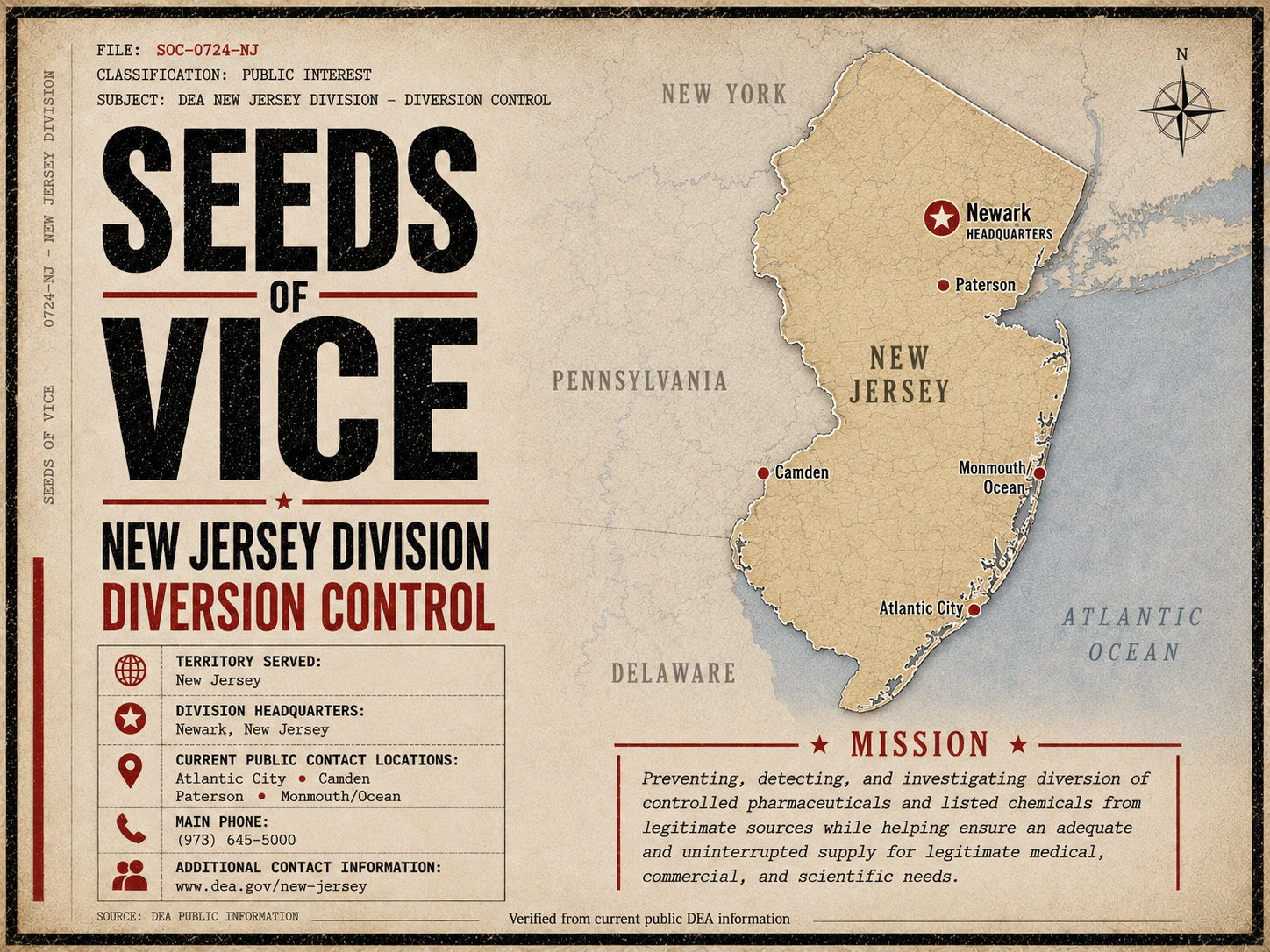
The New Jersey Division
DEA New Jersey Field Division and Its Diversion-Control System
Last fully verified: July 25, 2026
The official regional command is the DEA New Jersey Field Division.
There is no separate regional agency formally titled the “New Jersey Diversion Division.” Diversion Control is one of the functions carried out within the New Jersey Field Division under the broader authority, policy, registration systems, and leadership of DEA’s national Diversion Control Division.
DEA identifies the New Jersey Field Division as serving the entire State of New Jersey through its headquarters in Newark and published contacts in Atlantic City, Camden, Monmouth/Ocean, and Paterson. Towanda R. Thorne-James has served as Special Agent in Charge since September 2025.
The division’s statewide jurisdiction is clear.
Its public presentation of office classifications, current Diversion leadership, and contact information is not.
DEA’s main New Jersey page displays one “Main Phone” number, while its separate New Jersey contacts page displays a different number for the same Newark headquarters. The main page also provides a legend for division, district, resident, and post-of-duty offices without visibly assigning those classifications to the individual New Jersey locations.
Executive Finding
What is official
DEA states that the New Jersey Division serves the entire state with offices or published contacts in:
- Atlantic City
- Camden
- Monmouth/Ocean
- Newark
- Paterson
The headquarters is located at:
80 Mulberry Street, 2nd Floor
Newark, New Jersey 07102-4206
DEA identifies Towanda R. Thorne-James as the division’s Special Agent in Charge and states that she has oversight responsibility for New Jersey.
The division investigates conventional drug trafficking, interstate and transnational organizations, counterfeit pharmaceuticals, unlawful prescribing and dispensing, controlled-substance recordkeeping, healthcare fraud involving controlled medications, and other violations affecting both illicit and lawful channels.
What DEA’s public record does not clearly disclose
DEA’s current public pages do not clearly identify:
- The present classification of each subordinate location.
- A complete Assistant Special Agent in Charge roster.
- The current Diversion Program Manager.
- The number or location of Diversion Groups.
- The number or location of Tactical Diversion Squads.
- Which office supervises each county.
- Whether any specialized groups operate statewide rather than through one geographic office.
- The number of Diversion Investigators assigned to New Jersey.
- A state-specific registration official.
- A single, consistently published headquarters telephone number.
DEA’s current page provides a legend for four types of office but does not connect the legend to the listed cities. An older official DEA record described Atlantic City and Camden as resident offices and Paterson and Monmouth/Ocean as posts of duty. That historical structure should not automatically be represented as the current structure without a present official confirmation.
The conflicting headquarters numbers
DEA’s main division page publishes:
Main telephone: 571-362-3700
DEA’s separate New Jersey contacts page publishes:
Newark headquarters telephone: 973-776-1300
Both pages identify the same Newark address. DEA does not explain whether one number is a centralized call-routing service, whether the other is the local headquarters switchboard, or whether one page is outdated.
The numbers should therefore be reproduced as separate published contacts rather than silently choosing one as correct.
What can be concluded
The New Jersey Field Division is a statewide federal command headquartered in Newark.
Current enforcement records demonstrate operational activity involving northern, central, coastal, and southern New Jersey. They also show coordination with Philadelphia-area investigators, New Jersey State Police, county task forces, Homeland Security Task Force personnel, federal prosecutors, healthcare-fraud agencies, local police departments, and Diversion Investigators.
What cannot presently be concluded
The public record does not establish:
- The precise current reporting relationships among Newark, Atlantic City, Camden, Paterson, and Monmouth/Ocean.
- Whether every historical office classification remains in effect.
- Whether the Monmouth/Ocean contact represents one combined facility, one regional group, or more than one physical location.
- Which office handles each county’s registration and compliance inquiries.
- Whether the publicly identified 2024 Diversion Program Manager still holds that position.
- The current size and deployment of New Jersey’s Diversion workforce.
- Which current personnel exercise supervisory authority over medical-practitioner, pharmacy, manufacturer, distributor, or hospital investigations.
Seeds of Vice will not fill those gaps through inference.
Who the New Jersey Division Serves
The New Jersey Field Division serves the entire state.
Its territory lies between two major metropolitan and trafficking centers—New York City and Philadelphia—and contains:
- Major interstate highways.
- The Port of New York and New Jersey.
- Newark Liberty International Airport.
- Dense urban markets.
- Suburban and coastal communities.
- Pharmaceutical manufacturers.
- Distributors and wholesalers.
- Hospitals and medical systems.
- Pharmacies and medical practices.
- Universities and research institutions.
- Interstate mail and parcel routes.
- Controlled-substance registrants throughout the state.
The division’s responsibilities affect two distinct systems.
The first is the illicit channel, involving unlawful manufacture, importation, transportation, possession, sale, money laundering, violence, and counterfeit drugs.
The second is the lawful controlled-substance channel, involving registered manufacturers, distributors, pharmacies, physicians, other practitioners, hospitals, researchers, and patients.
Those systems may intersect when a registrant intentionally diverts medicine or when illicit manufacturers imitate legitimate pharmaceuticals.
They are not otherwise interchangeable.
Territory and Office Structure
New Jersey Field Division Headquarters
80 Mulberry Street, 2nd Floor
Newark, New Jersey 07102-4206
Published telephone numbers
Main number shown on division page: 571-362-3700
Number shown on separate contacts page: 973-776-1300
DEA does not explain the discrepancy.
Published New Jersey Contacts
| Location | Published telephone |
|---|---|
| Atlantic City | 609-383-3322 |
| Camden | 856-321-2420 |
| Paterson | 973-357-4037 |
| Monmouth/Ocean | 732-431-7160, extension 2242 |
These locations are current published DEA contacts. Their exact present classifications are not identified on the live page.
Historical office structure
A 2019 official DEA announcement described:
- Newark as the New Jersey Division Office.
- Atlantic City as a resident office.
- Camden as a resident office.
- Paterson as a post of duty.
- Monmouth/Ocean as a post of duty.
That historical record is useful for understanding the organization, but it is not sufficient proof that every classification remains unchanged in July 2026.
Current operational references
Recent federal records identify or reference units including:
- DEA New Jersey Field Division.
- DEA Camden Resident Office.
- DEA Atlantic County HIDTA Task Force.
- DEA New Haven Tactical Diversion Squad in an interstate matter.
- New Jersey Diversion Investigators.
- Specialized enforcement groups operating through New Jersey offices.
These records show that the actual operating structure is more complex than the five-location directory suggests.
Current Leadership and Publicly Identified Personnel
Towanda R. Thorne-James
Special Agent in Charge
Towanda R. Thorne-James became the 16th Special Agent in Charge of the New Jersey Field Division in September 2025.
DEA states that she has oversight responsibility for the entire state.
Thorne-James began her law-enforcement career with the Philadelphia Police Department in 1993 and joined DEA in 1998. Her DEA assignments have included domestic, headquarters, and international work. She previously served as Special Agent in Charge of the El Paso Division and became director of the El Paso Intelligence Center in March 2025 before taking command in New Jersey.
Her prior assignments have included positions connected to:
- New Orleans.
- DEA headquarters.
- Belize.
- Atlantic City.
- Camden.
- Newark.
- Philadelphia.
- The El Paso Division.
- The El Paso Intelligence Center.
Her biography reflects experience involving both regional enforcement and transnational operations.
Timothy P. McMahon
Media Contact
Telephone: 862-849-9863
DEA identifies Timothy P. McMahon as the division’s media-inquiries contact.
Joanna Mlicka-Anderko
Community-Outreach Contact
Telephone: 202-294-3823
Email: Joanna.A.Mlicka-Anderko@dea.gov
DEA identifies Joanna Mlicka-Anderko as the New Jersey community-outreach contact.
Recruitment Contact
Email: NewJerseySpecialAgentRecruiter@dea.gov
Diversion Program Manager
Robert J. Slavkovsky was publicly identified as the New Jersey Field Division’s Diversion Program Manager when he signed an April 2024 memorandum of agreement with Novel Laboratories.
The agreement was designed to remain in effect for three years, but the duration of an agreement does not establish that every signatory remains in the same position for its entire term. No current official personnel page reviewed for this report confirms that Slavkovsky still holds the position in July 2026.
The defensible description is therefore:
Robert J. Slavkovsky was publicly identified as New Jersey’s Diversion Program Manager in April 2024. The current officeholder has not been independently verified through a current DEA personnel record.
National Diversion leadership
DEA’s national leadership page identifies Cheri Oz as Assistant Administrator of the Diversion Control Division.
This is a separate national operational division.
Cheri Oz does not serve as the New Jersey Special Agent in Charge, and Towanda R. Thorne-James does not lead the national Diversion Control Division.
The distinction is:
- Towanda R. Thorne-James: regional command of the New Jersey Field Division.
- Cheri Oz: national leadership of DEA’s Diversion Control Division.
- New Jersey Diversion personnel: regional personnel operating within the field division and under national Diversion law, policy, systems, and oversight.
Official Role and Mission
The New Jersey Field Division is responsible for enforcing the federal Controlled Substances Act and related federal law within its territory.
Its work may involve:
- Drug-trafficking investigations.
- Organized-crime and cartel activity.
- Interstate and international distribution.
- Counterfeit tablets.
- Illicit pill presses.
- Money laundering.
- Firearms connected to drug trafficking.
- Civil Controlled Substances Act enforcement.
- Administrative registration actions.
- Inspections and audits.
- Prescription and dispensing investigations.
- Manufacturer and distributor compliance.
- Healthcare fraud involving controlled substances.
- Community outreach and prevention.
DEA states that the mission of its Diversion Control Division is to prevent, detect, and investigate the diversion of controlled pharmaceuticals and listed chemicals from legitimate sources while ensuring an adequate and uninterrupted supply for legitimate medical, commercial, and scientific needs.
Both portions of that mission matter.
Diversion Control is not officially defined solely as reducing prescriptions, suspending registrations, or prosecuting practitioners.
It is also charged with protecting the legitimate channel and ensuring that lawful medical and scientific needs can be met.
How the New Jersey System Works in Practice
Interstate and transnational trafficking
New Jersey’s geography makes the division part of a larger regional system.
Trafficking organizations may use New Jersey as:
- A destination market.
- A storage location.
- A transportation corridor.
- A connection between New York and Philadelphia.
- A point of access to ports and airports.
- A distribution center for drugs entering from other states or countries.
- A base for financial and communications activity.
In May 2026, federal authorities charged two men following the seizure of more than 260 pounds of methamphetamine. Prosecutors described it as the largest methamphetamine seizure in New Jersey history. The charges are allegations, and the defendants remain presumed innocent unless convicted.
Days later, five alleged members and associates of an organization operating in southern New Jersey and Philadelphia were charged with conspiring to distribute methamphetamine, fentanyl, and cocaine. Federal authorities described the organization as operating across state and national boundaries. Those charges also remain allegations.
These matters demonstrate that the New Jersey division’s operating environment cannot be understood solely through county boundaries.
Counterfeit and industrial drug production
Illicit pills may be manufactured to resemble lawful medicine while containing fentanyl, methamphetamine, or another undisclosed substance.
Investigations involving pill presses, bulk powders, counterfeit markings, online communications, and interstate distribution require DEA to distinguish between:
- Legitimate pharmaceutical manufacturing.
- Lawful dispensing.
- Theft from lawful channels.
- Intentional diversion by registrants.
- Completely illicit manufacturing designed to imitate medicine.
That distinction is essential because the danger of counterfeit medicine arises from its false resemblance to the lawful channel.
Unlawful prescribing
In June 2026, a Cape May County psychiatrist pleaded guilty to 17 felony counts involving invalid prescriptions for Adderall, Vyvanse, Xanax, and other drugs.
Federal prosecutors stated that the prescriptions were issued outside legitimate medical practice, including prescriptions to sexual partners and people known to have substance-use problems. The plea resolved the defendant’s criminal liability on those counts; it was not merely an allegation. The investigation involved DEA special agents, task-force officers, and Diversion Investigators.
This case represents admitted intentional conduct—not an ordinary disagreement over dosage, treatment philosophy, monitoring, or medical judgment.
Pharmacy investigations
In June 2026, a Camden County pharmacist was indicted on allegations that he dispensed oxycodone on 15 occasions using prescriptions he knew or should have known were forged.
An indictment is not a conviction. The pharmacist remains presumed innocent unless proven guilty.
In a separate Mercer County case, former pharmacist Florence Ndubizu was convicted after trial of conspiracy to unlawfully distribute and dispense Schedule II controlled substances and maintaining a premises for unlawful distribution. She received a 120-month federal sentence in June 2026.
These two cases occupy different legal positions:
- The Camden matter involves pending charges.
- The Mercer County matter resulted in a trial conviction and sentence.
They should not be described as equivalent outcomes.
Manufacturer compliance
In 2024, Novel Laboratories agreed to pay $2.25 million to resolve federal Controlled Substances Act allegations and entered an administrative memorandum of agreement with DEA.
The resolution concerned alleged failures involving controlled substances and manufacturer responsibilities.
It was a civil and administrative resolution—not a criminal conviction.
The case demonstrates that New Jersey Diversion oversight extends beyond physicians and pharmacies to pharmaceutical manufacturing.
Healthcare fraud and controlled substances
A July 2026 federal matter involved several defendants accused or convicted in connection with a healthcare-fraud and kickback scheme involving medically unnecessary prescriptions and more than $20 million in alleged losses to public insurance programs.
Some defendants had already pleaded guilty, while others were newly charged. Each defendant’s legal posture must therefore be stated individually rather than describing the entire group as convicted.
Diversion investigations can overlap with:
- Medicare and Medicaid fraud.
- Kickbacks.
- False claims.
- Unnecessary prescriptions.
- Pharmacy benefit systems.
- Money laundering.
- Healthcare-business ownership.
- Professional licensing.
DEA is not always the sole or lead agency in those matters.
Diversion Control and Lawful Medicine
New Jersey Diversion personnel may interact with:
- Physicians.
- Dentists.
- Advanced-practice nurses.
- Physician assistants.
- Pharmacists.
- Hospitals.
- Clinics.
- Veterinary practices.
- Manufacturers.
- Distributors.
- Researchers.
- Narcotic-treatment programs.
- Importers and exporters.
- Other DEA registrants.
Their work may include:
- Registration reviews.
- Inspections.
- Controlled-substance inventories.
- Recordkeeping audits.
- Security evaluations.
- Loss and theft investigations.
- Suspicious-order investigations.
- Prescription reviews.
- Administrative subpoenas.
- Civil referrals.
- Registration surrender or restriction.
- Administrative proceedings.
- Criminal investigations where intentional unlawful conduct is suspected.
These processes should not be collapsed into one undifferentiated category.
A recordkeeping settlement is not a criminal conviction.
A surrendered registration is not necessarily proof of a crime.
An indictment is not a conviction.
A guilty plea is an admission in court.
A conviction after trial is an adjudicated finding.
A sentence follows a conviction or guilty plea.
The legal posture is part of the fact.
New Jersey’s State-Control Layer
Federal DEA authority operates alongside New Jersey law and professional regulation.
The State of New Jersey maintains its own:
- Prescription Monitoring Program.
- Medical and pharmacy boards.
- Controlled-dangerous-substance statutes.
- Prescribing requirements.
- Professional-discipline systems.
- Healthcare-fraud enforcement.
- Public-health programs.
- Naloxone and harm-reduction initiatives.
DEA does not independently create or administer all of these requirements.
Initial prescriptions for acute pain
Current New Jersey law generally limits an initial opioid prescription for acute pain to no more than a five-day supply.
The prescription must use the lowest effective dose of an immediate-release opioid. The provision applies to an initial prescription for acute pain and should not be represented as a universal five-day limit on every opioid prescription or every established chronic-pain treatment.
New Jersey Prescription Monitoring Program
The New Jersey Prescription Monitoring Program records controlled-dangerous-substance dispensing and allows authorized prescribers and pharmacists to review a patient’s controlled-medication history.
New Jersey’s published requirements include consultation:
- The first time a Schedule II controlled dangerous substance or opioid is prescribed for acute or chronic pain.
- The first time a benzodiazepine is prescribed.
- At quarterly intervals while covered treatment continues.
- When a prescriber or pharmacist suspects that medication is being sought for something other than treatment of an existing medical condition.
The program may assist clinicians in detecting:
- Multiple prescribers.
- Multiple pharmacies.
- Concurrent opioid and benzodiazepine prescriptions.
- Prolonged controlled-substance use.
- Potential forgery or diversion.
- Prior dispensing across participating jurisdictions.
The existence of an alert or risk indicator does not independently establish criminal conduct, addiction, deception, or inappropriate medical care.
A monitoring system provides information.
It does not replace clinical judgment.
How the System Affects Pain Patients and Lawful Medicine
Legitimate protective effects
A functioning Diversion system can protect patients by:
- Detecting forged prescriptions.
- Preventing theft from pharmacies and hospitals.
- Identifying unlawful dispensing.
- Holding intentionally corrupt registrants accountable.
- Enforcing accurate manufacturer inventories.
- Removing counterfeit pills from circulation.
- Identifying illicit pill presses.
- Preserving traceability within the lawful channel.
- Preventing patients from unknowingly receiving counterfeit or contaminated products.
The Cape May psychiatrist plea, the Mercer County pharmacist conviction, the pending Camden pharmacist case, and the Novel Laboratories settlement demonstrate distinct ways in which controlled-substance authority can be abused or compliance duties can allegedly be violated.
The danger of overcorrection
The same system can affect legitimate patients when enforcement risk, state mandates, insurer rules, pharmacy policies, or institutional fear are treated as substitutes for individualized treatment.
The CDC has acknowledged that its 2016 opioid guideline was misapplied through:
- Rigid dosage thresholds.
- Rapid tapers.
- Abrupt discontinuation.
- Inflexible duration limits.
- Application to patients outside the guideline’s intended scope.
- Patient dismissal.
- Patient abandonment.
CDC’s 2022 guideline states that its recommendations are not laws or inflexible standards of care and should not replace individualized, patient-centered clinical judgment.
That does not establish that DEA alone caused undertreatment.
The practical medical environment is created by the combined actions of:
- DEA.
- Federal prosecutors.
- New Jersey lawmakers.
- State licensing boards.
- The Prescription Monitoring Program.
- Insurers.
- Pharmacy corporations.
- Hospitals.
- Clinic owners.
- Professional associations.
- Civil-liability systems.
- Individual practitioners.
- Patients.
- The illicit drug market.
A credible analysis must recognize shared institutional responsibility.
DEA should not be assigned sole responsibility for every treatment decision.
It should not be treated as irrelevant either.
The possibility of investigation, registration action, civil penalties, or criminal referral is part of the risk environment in which controlled-substance decisions are made.
Prescribing and Dose-Decline Context
Evidentiary boundary
Seeds of Vice begins its historical inquiry in 1984.
No continuous, directly comparable annual New Jersey retail opioid-dispensing series was identified for every year beginning in 1984.
The historical record must therefore be divided into separate evidentiary periods.
1984–2005
No comparable annual New Jersey series of retail opioid prescriptions per 100 residents was located for this period.
Historical inquiry may use:
- Federal distribution records.
- Manufacturer and quota records.
- Medicaid or insurer datasets.
- Drug-specific utilization studies.
- Medical literature.
- Professional guidance.
- State regulatory history.
- National prescribing indicators.
Those measures cannot be silently joined to later CDC retail-pharmacy dispensing rates.
No missing annual values should be interpolated.
2006–2019
Archived CDC state tables provide a directly comparable measure of retail opioid prescriptions dispensed per 100 residents.
| Year | New Jersey prescriptions per 100 residents |
|---|---|
| 2006 | 54.7 |
| 2007 | 57.2 |
| 2008 | 59.5 |
| 2009 | 59.9 |
| 2010 | 61.0 |
| 2011 | 61.5 |
| 2012 | 60.1 |
| 2013 | 58.3 |
| 2014 | 57.2 |
| 2015 | 56.0 |
| 2016 | 52.6 |
| 2017 | 45.0 |
| 2018 | 38.9 |
| 2019 | 34.8 |
The highest rate in this reviewed series was 61.5 prescriptions per 100 residents in 2011. The 2019 rate was 34.8. Beginning with the 2019 map, CDC assigned geography according to the prescriber’s location rather than the dispensing pharmacy’s location.
2020–2023
CDC’s broader interactive series covers these years, but the currently accessible static federal page reviewed for this report did not expose every New Jersey intermediate value in a form suitable for direct transcription.
The confirmed endpoints show that the decline continued.
CDC reported a New Jersey rate of 26.3 prescriptions per 100 residents in 2023.
Intermediate values should be taken directly from the underlying CDC data table rather than estimated from a visual chart.
2024
CDC reported that New Jersey’s 2024 retail opioid-dispensing rate was:
23.7 prescriptions per 100 residents
That was among the four lowest state rates in the country. The national rate was 35.4.
Calculated decline
From the reviewed 2011 peak of 61.5 to the 2024 rate of 23.7, New Jersey’s retail opioid-dispensing rate declined by approximately:
61.5 percent
From 2006 to 2024, it declined by approximately:
56.7 percent
From 2019 to 2024, it declined by approximately:
31.9 percent
These are Seeds of Vice calculations based on the reported CDC rates.
Methodological limitations
CDC’s current data use IQVIA Xponent information from approximately 54,600 non-hospital retail pharmacies representing nearly 94 percent of U.S. retail prescriptions.
The dataset:
- Includes new and refilled retail prescriptions.
- Uses projected totals.
- Uses the prescriber’s geographic location.
- Excludes mail-order prescriptions.
- Excludes methadone dispensed through opioid-treatment programs.
- Does not measure whether the patient took the medication.
- Does not measure whether pain improved.
- Does not identify whether treatment was voluntarily or involuntarily discontinued.
Prescriptions per 100 residents must not be treated as interchangeable with:
- MME per capita.
- Average MME per prescription.
- Daily dosage.
- Days supplied.
- Number of patients.
- Number of pills.
- Total controlled-substance prescriptions.
- Overdose mortality.
- Illicit-drug availability.
Each measure answers a different question.
Overdose Context
New Jersey reported 2,816 overdose deaths among state residents in 2023, compared with 3,171 in 2022.
That represents a decline of approximately 11.2 percent. The state described the 2023 figures as preliminary and reported that deaths declined across all racial and ethnic groups, although substantial disparities remained.
New Jersey later reported that preliminary 2024 data indicated a further decline, but the state announcement reviewed for this page did not provide a final confirmed 2024 death count.
The overdose decline is important.
It does not establish that:
- Every reduction in lawful prescribing was medically appropriate.
- Every patient retained adequate pain treatment.
- DEA enforcement alone caused the reduction.
- Prescription monitoring alone caused the reduction.
- Harm-reduction expansion alone caused the reduction.
- Naloxone alone caused the reduction.
- Changes in the illicit fentanyl market alone caused the reduction.
CDC currently states that prescription opioids contribute to overdose deaths but are not the principal driver of the present national overdose crisis.
The New Jersey record therefore contains two simultaneous findings:
Lawful retail opioid dispensing fell by more than 60 percent from its reviewed peak.
Major illicit fentanyl, methamphetamine, cocaine, and counterfeit-drug markets remained active.
One fact does not erase the other.
Representative New Jersey Matters
Record methamphetamine seizure
Pending charges
Two men were charged in May 2026 following the seizure of more than 260 pounds of methamphetamine, described by federal prosecutors as the largest methamphetamine seizure in New Jersey history.
The defendants remain presumed innocent unless convicted.
Southern New Jersey and Philadelphia organization
Pending charges
Five alleged members or associates of a trafficking organization were charged with distributing methamphetamine, fentanyl, and cocaine across southern New Jersey, Philadelphia, and international boundaries.
The charges remain allegations.
Cape May County psychiatrist
Guilty plea
A psychiatrist pleaded guilty to 17 felony counts involving invalid controlled-substance prescriptions issued outside legitimate medical practice.
The matter involved admitted criminal conduct and participation by DEA Diversion Investigators.
Camden County pharmacist
Indictment
A pharmacist was indicted on allegations that he dispensed oxycodone using prescriptions he knew or should have known were forged.
The charges remain pending, and the defendant is presumed innocent.
Mercer County pharmacist
Trial conviction and sentence
A former Trenton pharmacist was convicted after trial and sentenced to 120 months in federal prison for controlled-substance distribution offenses committed through a pharmacy.
This was an adjudicated conviction, not a settlement or pending allegation.
Novel Laboratories
Civil and administrative resolution
The manufacturer agreed to pay $2.25 million to resolve Controlled Substances Act allegations and entered a three-year memorandum of agreement with DEA.
The resolution was civil and administrative, not a criminal conviction.
Healthcare-fraud and kickback matter
Mixed legal postures
Several defendants were charged or had pleaded guilty in connection with a scheme involving unnecessary prescriptions, kickbacks, and more than $20 million in alleged government-program losses.
Because the defendants occupied different procedural positions, they should not all be described as either convicted or merely accused.
Contact Information
New Jersey Field Division Headquarters
Address:
80 Mulberry Street, 2nd Floor
Newark, New Jersey 07102-4206
Main number published on division page: 571-362-3700
Headquarters number published on contacts page: 973-776-1300
DEA does not explain the difference between the two numbers.
Media
Timothy P. McMahon
Telephone: 862-849-9863
Community Outreach
Joanna Mlicka-Anderko
Telephone: 202-294-3823
Email: Joanna.A.Mlicka-Anderko@dea.gov
Recruitment
Email: NewJerseySpecialAgentRecruiter@dea.gov
Registration and Suspicious Pharmaceutical Activity
DEA-registration inquiries: 973-776-1172
Suspicious pharmaceutical activities: 973-776-1172
New Jersey Tip Line
Telephone: 571-776-1263
Published Regional Contacts
Atlantic City: 609-383-3322
Camden: 856-321-2420
Paterson: 973-357-4037
Monmouth/Ocean: 732-431-7160, extension 2242
Because DEA does not clearly publish present office classifications or county assignments, callers should verify which office or group has responsibility for the relevant investigation, registration, inspection, or compliance matter.
Seeds of Vice Analysis
The New Jersey Division does not suffer from uncertainty over which state it serves.
Its jurisdiction is direct and complete.
The institutional problem is visibility.
DEA publicly identifies a statewide field command exercising authority over conventional trafficking, pharmaceutical manufacturing, pharmacies, prescribers, healthcare businesses, and patients, yet it does not publish:
- A current regional organization chart.
- A complete supervisory roster.
- A confirmed current Diversion Program Manager.
- The location of Diversion Groups.
- The location of Tactical Diversion Squads.
- County-by-county office responsibility.
- A consistent headquarters telephone number.
- Clear current classifications for its subordinate locations.
These are not findings of corruption or illegality.
They are findings of inadequate public administration.
New Jersey illustrates the full reach of Diversion authority
The New Jersey record includes:
- A pharmaceutical manufacturer.
- A psychiatrist.
- Pharmacists.
- Forged prescriptions.
- Healthcare-fraud allegations.
- Civil settlements.
- Administrative agreements.
- Criminal indictments.
- Guilty pleas.
- Trial convictions.
- Long federal sentences.
That range demonstrates why “Diversion enforcement” cannot be treated as one uniform event.
It can mean an audit.
It can mean a recordkeeping agreement.
It can mean a civil payment.
It can mean the surrender of a registration.
It can mean a pending criminal charge.
It can mean a conviction for intentional unlawful distribution.
Institutional credibility requires stating which occurred.
The lawful and counterfeit channels must remain distinct
New Jersey faces a genuine danger from counterfeit tablets and illicit substances transported through regional and international networks.
That danger supports protecting lawful medicine.
It does not support treating lawful medicine itself as counterfeit.
A patient receiving medication from a licensed practitioner and pharmacy is not situated like an organization manufacturing fraudulent pills.
A practitioner exercising documented medical judgment is not automatically situated like a prescriber who admits issuing drugs without a legitimate purpose.
A pharmacy with a recordkeeping deficiency is not automatically situated like a pharmacist knowingly dispensing forged prescriptions.
A manufacturer entering a civil compliance agreement has not necessarily committed a criminal offense.
The system must preserve these distinctions.
The prescribing decline requires institutional accounting
New Jersey’s retail opioid-dispensing rate fell from 61.5 prescriptions per 100 residents in 2011 to 23.7 in 2024.
That is a structural transformation in lawful medicine.
The data do not establish that the entire decline was harmful.
They do not establish that the entire decline was beneficial.
They establish that substantially less lawful opioid medicine was dispensed.
A complete account should ask:
- Which prescriptions were unnecessary?
- Which patients benefited from safer treatment?
- Which patients received effective alternatives?
- Which patients were voluntarily tapered?
- Which were tapered against their wishes?
- Which lost access because a practitioner retired or stopped prescribing?
- Which could not find a pharmacy?
- Which were dismissed from care?
- Which remained in severe pain?
- Which sought illicit substitutes?
- Which recovered function?
- Which lost function?
- Which consequences were measured?
- Which consequences disappeared from the record when the prescription ended?
Dispensing statistics cannot answer these questions by themselves.
The dual mandate is the correct standard
DEA’s official mission does not end with preventing diversion.
It also requires an adequate and uninterrupted supply for legitimate medical, commercial, and scientific needs.
Seeds of Vice accepts the duty to prevent intentional diversion.
It insists that the access obligation be evaluated with equal seriousness.
The New Jersey system should be capable of:
- Prosecuting forged prescriptions without presuming every patient is deceptive.
- Investigating unlawful dispensing without making ordinary pharmacy practice impossible.
- Regulating manufacturers without creating avoidable shortages.
- Identifying intentional criminal prescribing without reducing medical judgment to a numerical threshold.
- Using monitoring data without converting risk scores into verdicts.
- Protecting the public from counterfeit drugs while preserving access to authentic medicine.
Drug control governs crime.
Diversion control governs permission.
In New Jersey, that permission is administered through one federal field division, a national Diversion bureaucracy, state statutes, professional boards, a prescription-monitoring database, pharmacies, insurers, healthcare institutions, and individual practitioners.
No single institution bears sole responsibility.
Every institution exercising authority bears some responsibility.
Recommended Public Disclosures
DEA should publish:
- A current New Jersey Field Division organization chart.
- The present classification of every listed office.
- County-by-county office responsibility.
- A reconciled headquarters telephone number.
- A complete current Assistant Special Agent in Charge roster.
- The current Diversion Program Manager.
- The location and general responsibility of each Diversion Group.
- The location of each Tactical Diversion Squad.
- A named registration and practitioner-compliance contact.
- Clear instructions distinguishing tips, registration inquiries, and compliance questions.
- Annual totals for criminal, civil, and administrative Diversion matters.
- Outcomes separated by indictment, plea, conviction, dismissal, settlement, surrender, and administrative order.
- Measures of legitimate medical access alongside enforcement statistics.
- Public reporting on shortages, registration delays, and practitioner departures where DEA activity may be relevant.
This information can be disclosed without compromising active investigations.
It would allow the public to understand the institution exercising authority over them.
Methodology and Evidentiary Limits
This page prioritizes current primary sources from:
- The Drug Enforcement Administration.
- The United States Attorney’s Office for the District of New Jersey.
- The New Jersey Legislature.
- The New Jersey Division of Consumer Affairs.
- The New Jersey Department of Health.
- The Centers for Disease Control and Prevention.
The following rules were applied:
- The regional command was correctly identified as the New Jersey Field Division.
- The regional field division was distinguished from the national Diversion Control Division.
- Historical office classifications were not automatically represented as current.
- Conflicting official telephone numbers were preserved rather than silently reconciled.
- Historical Diversion personnel were not represented as current without confirmation.
- Allegations were distinguished from guilty pleas, convictions, settlements, and administrative resolutions.
- Current cases were not used to invent an unpublished county map.
- State law was separated from DEA authority.
- Initial acute-pain limits were not represented as universal chronic-pain limits.
- Prescription-monitoring data were not treated as proof of wrongdoing.
- Prescriptions per 100 residents were not mixed with MME, pill counts, patient counts, days supplied, or mortality.
- Missing years were not interpolated.
- National values were not substituted for New Jersey values.
- Correlation was not represented as causation.
- DEA was analyzed as one institution within a broader medical-control system.
- Official mission statements were separated from Seeds of Vice analysis.
Last fully verified: July 25, 2026


Bestsellers
-

A gift of Luck
-

Proof of Progress: Mr. DEA’s Diversion Autographed Hardcover & Seed Pack
$39.99 -

Seeds of Vice ™
$24.99 -

Seeds of Vice Book Set
$119.00 -
Seeds of Vice: On Poppy Tea Autographed Hardcover & Seed Pack
Original price was: $39.99.$29.99Current price is: $29.99. -

Seeds of Vice: On The Poppy Plant Autographed Hardcover & Seed Pack
$55.00
