The Philadelphia Division
DEA Philadelphia Field Division and Its Diversion-Control System
Last fully verified: July 25, 2026
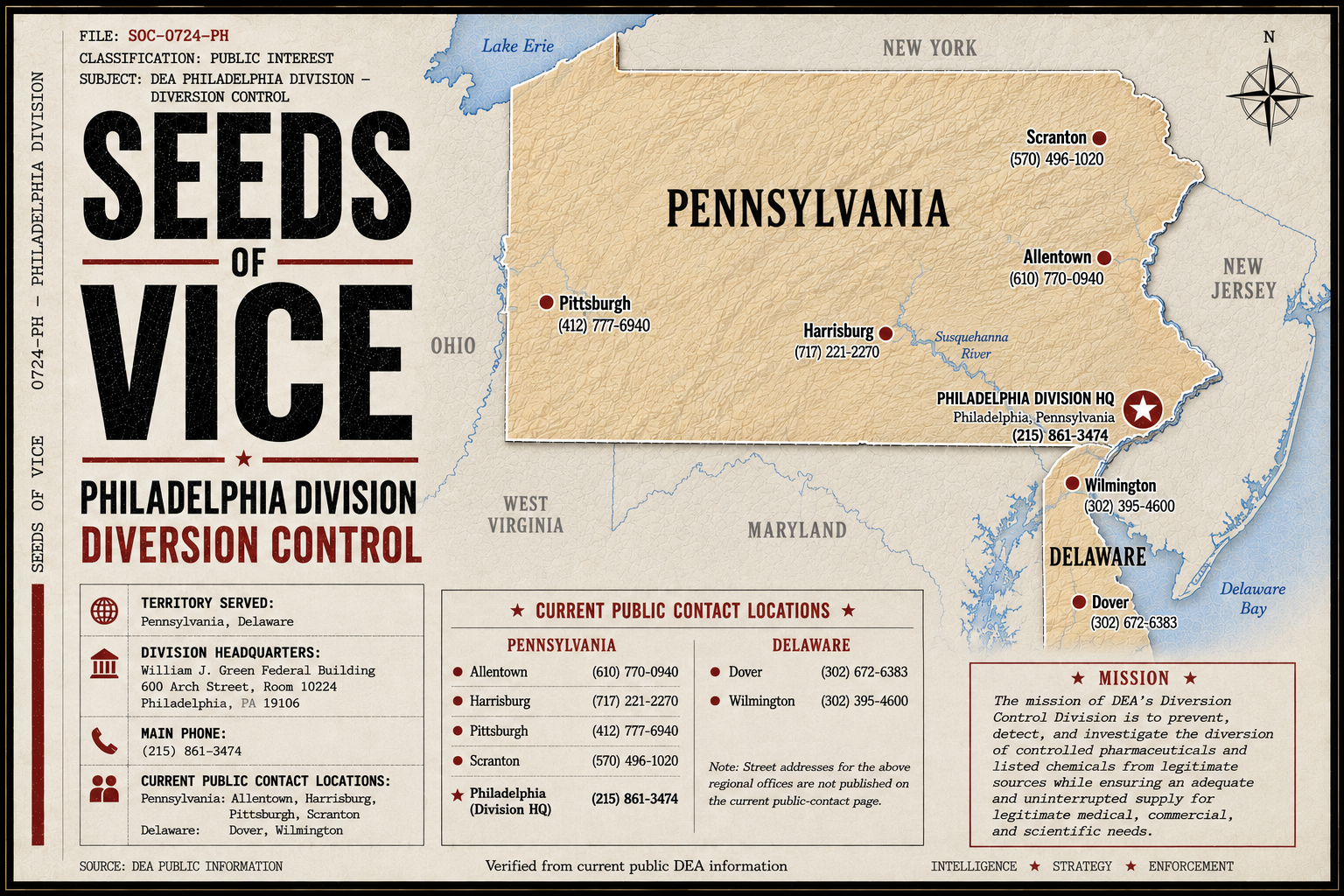
The Drug Enforcement Administration’s Philadelphia Field Division serves:
- Pennsylvania
- Delaware
The regional command is officially the Philadelphia Field Division. There is no separate regional agency formally titled the “Philadelphia Diversion Division.” Diversion Control is one of the functions carried out within the field division under federal law, national DEA policy, the agency’s registration systems, and the broader leadership of DEA’s national Diversion Control Division.
The division headquarters is located in Philadelphia, with six additional published contacts in Pennsylvania and Delaware.
DEA’s territorial statement is clear.
Its organizational presentation is not.
DEA publishes a legend for division, district, resident, and post-of-duty offices but does not clearly apply those classifications to the individual Philadelphia Division locations. It does not publish a complete current command roster, identify a current regional Diversion Program Manager, show the location of its traditional Diversion Groups, or explain the chain of authority connecting the Philadelphia Field Division to DEA’s newly established Northeast regional-management structure.
Executive Finding
What is official
DEA states that the Philadelphia Field Division serves Pennsylvania and Delaware.
The headquarters is located at:
William J. Green Jr. Federal Building
600 Arch Street, Room 10224
Philadelphia, Pennsylvania 19106
Main telephone: 215-861-3474
DEA publishes subordinate contacts in:
Delaware
- Dover
- Wilmington
Pennsylvania
- Allentown
- Harrisburg
- Pittsburgh
- Scranton
DEA identifies Thomas Hodnett as the division’s current Special Agent in Charge.
The Northeast regional layer
DEA appointed Frank A. Tarentino III as Northeast Associate Chief of Operations in November 2025.
DEA states that Tarentino oversees a Northeast region containing:
- New England
- New York Enforcement
- New York Task Force
- New Jersey
- Philadelphia
- Washington, D.C.
The appointment occurred under a new regional-operations management framework. DEA has not explained on the Philadelphia Division page how the regional office interacts with Thomas Hodnett’s authority, regional Diversion leadership, budgeting, personnel assignments, or operational accountability.
The defensible conclusion is that:
- Thomas Hodnett remains the Special Agent in Charge of the Philadelphia Field Division.
- Frank Tarentino exercises a higher Northeast regional-operations role.
- The precise allocation of authority between the regional layer and division command is not fully described on DEA’s public pages.
Public organizational deficiencies
Current official public sources do not provide:
- A complete Philadelphia Field Division organization chart.
- A current Assistant Special Agent in Charge roster.
- The current Diversion Program Manager.
- The names of current Diversion Group supervisors.
- The number of Diversion Investigators assigned to Pennsylvania and Delaware.
- The classification of each published subordinate location.
- County-level office responsibility.
- A separate regional registration or medical-practitioner contact.
- An explanation of how Delaware Diversion matters are assigned.
- An explanation of the reporting relationship between Philadelphia and the Northeast Associate Chief of Operations.
DEA’s Tactical Diversion Squad directory identifies Philadelphia and Pittsburgh as Pennsylvania squad locations. For Delaware, the directory instructs the public to contact DEA Philadelphia rather than identifying a separate Delaware squad.
What can be concluded
The Philadelphia Field Division is a two-state federal command responsible for a territory containing:
- Philadelphia and its surrounding metropolitan region.
- Pittsburgh and western Pennsylvania.
- The Lehigh Valley.
- Central and northeastern Pennsylvania.
- Wilmington and northern Delaware.
- Dover and southern Delaware.
- Major interstate highways.
- The Port of Philadelphia and Delaware River facilities.
- Philadelphia International Airport.
- Interstate connections with New York, New Jersey, Maryland, Ohio, West Virginia, and the District of Columbia.
- Extensive pharmaceutical, hospital, university, research, pharmacy, and healthcare systems.
Current records demonstrate activity involving:
- Fentanyl and counterfeit pills.
- Methamphetamine and cocaine.
- Interstate and transnational organizations.
- Firearms associated with trafficking.
- Open-air drug markets.
- Healthcare and pharmaceutical investigations.
- Physicians and pharmacies.
- Controlled-substance inventory and recordkeeping.
- Civil settlements and DEA compliance agreements.
- Criminal prosecutions involving intentional unlawful distribution.
What cannot presently be concluded
The public record does not establish:
- Whether Allentown, Harrisburg, Pittsburgh, and Scranton retain historical district, resident, or post-of-duty classifications.
- Whether Dover and Wilmington are administratively separate offices or contacts within one Delaware group.
- Which office has primary responsibility for each Pennsylvania county.
- Whether Delaware has permanently assigned Diversion Investigators.
- Whether Delaware criminal and Diversion matters report through Wilmington, Dover, Philadelphia, or a shared regional group.
- The current Philadelphia Diversion Program Manager.
- Whether traditional Diversion Groups and Tactical Diversion Squads report through the same Assistant Special Agent in Charge.
- Whether Pittsburgh’s Tactical Diversion Squad serves all western Pennsylvania.
- Whether the Philadelphia Tactical Diversion Squad serves Delaware.
- How Northeast regional leadership affects local registration and enforcement decisions.
Seeds of Vice will not fill those gaps through assumption.
Who the Philadelphia Division Serves
The Philadelphia Division serves the approximately two-state population, institutions, practitioners, registrants, and public agencies of Pennsylvania and Delaware.
Its regulated community includes:
- Patients receiving controlled medications.
- Physicians and other authorized prescribers.
- Pharmacists and pharmacies.
- Hospitals and health systems.
- Pharmaceutical manufacturers.
- Controlled-substance distributors.
- Researchers and universities.
- Veterinary practices.
- Narcotic-treatment programs.
- Importers and exporters.
- State and local law-enforcement agencies.
- Families affected by illicit fentanyl, counterfeit tablets, addiction, violence, and inadequate medical treatment.
The division operates across two fundamentally different controlled-substance channels.
The illicit channel
The illicit channel includes:
- Unlawful importation.
- Fentanyl and heroin distribution.
- Cocaine and methamphetamine trafficking.
- Counterfeit-tablet production.
- Illicit pill presses.
- Open-air drug markets.
- Drug-related firearms.
- Money laundering.
- Theft and forged prescriptions.
- Interstate and transnational organizations.
- Online distribution outside lawful pharmacy systems.
The lawful channel
The lawful channel includes:
- Registered manufacturers.
- Distributors and wholesalers.
- Pharmacies.
- Hospitals.
- Physicians and other practitioners.
- Researchers.
- Treatment programs.
- Veterinary facilities.
- Patients receiving controlled substances for legitimate purposes.
The two channels may intersect when:
- Genuine medicine is stolen.
- A prescription is forged.
- A registered practitioner intentionally distributes outside legitimate professional practice.
- A pharmacy knowingly fills fraudulent prescriptions.
- A manufacturer or distributor fails to maintain required controls.
- An illicit producer makes a tablet resembling legitimate medicine.
Those points of intersection do not make every patient, practitioner, pharmacy, hospital, or pharmaceutical company part of the illicit market.
Territory and Office Structure
Philadelphia Division Headquarters
William J. Green Jr. Federal Building
600 Arch Street, Room 10224
Philadelphia, Pennsylvania 19106
Main telephone: 215-861-3474
The same number is published for media requests. DEA does not identify a named current public-information officer on the division page.
Delaware Contacts
| Published location | Telephone |
|---|---|
| Dover | 302-672-6383 |
| Wilmington | 302-395-4600 |
Pennsylvania Contacts
| Published location | Telephone |
|---|---|
| Allentown | 610-770-0940 |
| Harrisburg | 717-221-2270 |
| Pittsburgh | 412-777-6940 |
| Scranton | 570-496-1020 |
These are current DEA-published contacts. Their appearance in the directory does not, by itself, establish whether each location is a district office, resident office, post of duty, task-force facility, or another type of organizational unit.
Seven published locations
The public directory identifies:
- One headquarters.
- Four additional Pennsylvania contacts.
- Two Delaware contacts.
That produces seven published locations across the division.
DEA does not provide:
- A numbered office list.
- Current office classifications.
- Supervisory assignments.
- Staffing totals.
- County boundaries.
- Specialized group locations beyond the limited Tactical Diversion Squad directory.
Historical organizational evidence
Thomas Hodnett’s official biography states that, before becoming Special Agent in Charge, he served as an Assistant Special Agent in Charge with responsibility for DEA operations in:
- Allentown.
- Harrisburg.
- Scranton.
- The division’s financial-investigations program.
That record confirms that those locations operated as identifiable components under Philadelphia leadership before Hodnett became Special Agent in Charge. It does not establish their exact July 2026 classifications or present supervisory structure.
Current Leadership and Publicly Identified Personnel
Thomas Hodnett
Special Agent in Charge
Thomas Hodnett was appointed Special Agent in Charge of the Philadelphia Field Division on November 18, 2021.
DEA identifies him as the official responsible for the division’s operations across Pennsylvania and Delaware.
Hodnett joined DEA in 1997.
After completing special-agent training, he was assigned to Philadelphia, where he worked on:
- Complex drug-conspiracy investigations.
- Organized trafficking matters.
- Clandestine-laboratory investigations.
- Enforcement operations involving regional and national organizations.
His later assignments included:
- Group supervision in Philadelphia.
- Service with DEA’s Office of Professional Responsibility in Newark.
- Return to Philadelphia as an Assistant Special Agent in Charge.
- Supervision of operations associated with Allentown, Harrisburg, and Scranton.
- Responsibility for financial investigations.
Hodnett holds a law degree and practiced law before joining DEA.
That background is institutionally relevant because a Special Agent in Charge oversees operations that may involve criminal investigations, civil Controlled Substances Act matters, administrative registration proceedings, interagency relationships, and public representations concerning legal standards.
Frank A. Tarentino III
Northeast Associate Chief of Operations
Frank Tarentino serves as Northeast Associate Chief of Operations.
DEA states that his region includes the Philadelphia Division together with New England, New York’s two operational divisions, New Jersey, and Washington, D.C.
Tarentino should not be represented as the Philadelphia Special Agent in Charge.
The public record supports the following distinction:
- Thomas Hodnett: direct command of the Philadelphia Field Division.
- Frank Tarentino: regional Northeast operational oversight.
- National Diversion leadership: policy and program authority over DEA’s national Diversion Control functions.
- Philadelphia Diversion personnel: regional personnel carrying out registration, regulatory, administrative, civil, and criminal Diversion work.
Recruitment Contact
Telephone: 571-362-5348
Email: PhiladelphiaSpecialAgentRecruiter@dea.gov
DEA’s division page does not identify an individual recruiter by name.
Josh Romig
Community-Outreach Contact
Telephone: 484-661-9938
Email: Joshua.B.Romig@dea.gov
Media Requests
Telephone: 215-861-3474
DEA does not identify a named media representative on the current division page.
Current Diversion leadership
A current Philadelphia Division Diversion Program Manager could not be verified through the current official public sources reviewed for this page.
DEA also does not publicly identify:
- Diversion Group supervisors.
- Tactical Diversion Squad supervisors.
- A named practitioner-compliance official.
- A named registration official.
- A Delaware-specific Diversion official.
- The Assistant Special Agent in Charge responsible for regional Diversion operations.
Historical names should not be carried forward as though they remain current.
Tactical Diversion Squads
DEA’s national Tactical Diversion Squad directory identifies:
Pennsylvania
- Philadelphia
- Pittsburgh
Delaware
- Contact DEA Philadelphia
The directory does not identify a separate Delaware squad location.
Official TDS function
DEA describes Tactical Diversion Squads as combined federal, state, and local structures intended to coordinate information, investigative authority, and prosecution across jurisdictional boundaries.
DEA states that Tactical Diversion Squads can assist traditional Diversion Groups when operations require capabilities such as:
- Surveillance.
- Controlled purchases.
- Confidential payments.
- Search warrants.
- Arrest authority.
- Criminal prosecution support.
A Tactical Diversion Squad is therefore not simply a registration or compliance office.
It is an enforcement component capable of investigating:
- Counterfeit pharmaceuticals.
- Forged prescriptions.
- Pharmacy theft.
- Illicit pill presses.
- Unlawful prescribing.
- Unlawful dispensing.
- Internet distribution.
- Healthcare-related controlled-substance fraud.
- Criminal diversion by registrants.
Unanswered structural questions
DEA does not publicly explain:
- Which Pennsylvania counties are assigned to Philadelphia TDS.
- Which counties are assigned to Pittsburgh TDS.
- Whether Delaware is served exclusively through Philadelphia TDS.
- Whether traditional Diversion Groups use the same geographic boundaries.
- Whether Harrisburg, Allentown, and Scranton have permanently assigned Diversion personnel.
- Whether the two squads report to one regional Diversion supervisor.
- Whether the Northeast regional structure altered TDS reporting relationships.
The public can identify that two Pennsylvania squads exist.
It cannot reconstruct the complete system from the directory.
Official Role and Mission
The Philadelphia Field Division enforces the federal Controlled Substances Act and related federal laws within Pennsylvania and Delaware.
Its work may include:
- Criminal drug-trafficking investigations.
- Intelligence collection and analysis.
- Interstate and international investigations.
- Fentanyl and counterfeit-pill cases.
- Cocaine and methamphetamine organizations.
- Firearms and money-laundering investigations.
- Controlled-substance registration.
- Administrative inspections.
- Recordkeeping investigations.
- Theft and loss reporting.
- Suspicious-order investigations.
- Practitioner and pharmacy investigations.
- Manufacturer and distributor oversight.
- Civil referrals.
- Administrative registration proceedings.
- Community outreach.
- Drug-disposal programs.
DEA states that the mission of its national Diversion Control Division is to prevent, detect, and investigate the diversion of controlled pharmaceuticals and listed chemicals from legitimate sources while ensuring an adequate and uninterrupted supply for legitimate medical, commercial, and scientific needs.
Those are concurrent obligations.
Diversion Control is not officially defined solely as:
- Reducing prescribing.
- Suspending registrations.
- Prosecuting practitioners.
- Restricting pharmacy supply.
Its mission also includes protecting and preserving the lawful controlled-substance channel.
How the Philadelphia System Works in Practice
Philadelphia and the southeastern Pennsylvania market
Philadelphia is both a major regional city and an interstate transportation center.
Organizations operating in southeastern Pennsylvania may obtain controlled substances through:
- Interstate highways.
- Mail and parcel systems.
- Regional ports.
- International suppliers.
- New York and New Jersey distribution networks.
- Southwest-border trafficking routes.
- Local packaging and distribution operations.
The region’s enforcement record includes investigations involving fentanyl, heroin, cocaine, crack cocaine, methamphetamine, firearms, money laundering, counterfeit tablets, and open-air distribution markets.
Operation Engage is currently identified as a Philadelphia Division initiative. DEA describes Operation Engage nationally as combining enforcement with prevention, community outreach, education, and local partnerships. The presence of an Operation Engage initiative does not create a separate field division or replace the division’s permanent Diversion responsibilities.
Western Pennsylvania and transnational supply
In June 2026, a federal court sentenced a defendant described as an enforcer and distributor for a transnational trafficking organization to 35 years in prison.
Trial evidence connected the organization to distribution involving millions of fentanyl pills, hundreds of pounds of methamphetamine, and cocaine. The sentenced defendant was held responsible for 29 kilograms of fentanyl and 82.5 kilograms of methamphetamine.
The sentence followed a trial conviction and was therefore an adjudicated criminal disposition—not a pending allegation.
The case demonstrates that western Pennsylvania investigations may connect local distribution directly to organizations based far outside the division.
Delaware fentanyl and firearms investigation
In March 2026, federal prosecutors charged two Wilmington men following searches that allegedly produced:
- More than 400 grams of fentanyl pills from a vehicle.
- Approximately one kilogram of suspected fentanyl from a residence.
- Four firearms, including a privately made firearm.
The charges were allegations at the time of the announcement. The defendants remain presumed innocent unless convicted.
The case demonstrates that Delaware is not merely an administrative appendage of the Philadelphia headquarters. It is an active enforcement territory with local, state, and federal investigative partnerships.
Dover fentanyl and methamphetamine case
In July 2026, Kyle Scott received a 147-month federal sentence after pleading guilty to fentanyl-distribution and firearm offenses.
Investigators recovered:
- 307 grams of fentanyl.
- 757 grams of methamphetamine.
- Three loaded firearms.
The guilty plea and sentence made this an adjudicated criminal matter.
Counterfeit pharmaceutical operations
Philadelphia Division investigations have included industrial-scale counterfeit-tablet cases involving fentanyl pressed to resemble legitimate medications.
Counterfeit tablets occupy a distinct position within controlled-substance enforcement.
They may visually imitate:
- Oxycodone.
- Alprazolam.
- Amphetamine products.
- Other recognizable pharmaceuticals.
They are manufactured outside the lawful system and may contain fentanyl, methamphetamine, illicit benzodiazepines, or another undisclosed substance.
The danger arises partly from the counterfeit product’s resemblance to authentic medicine.
That distinction strengthens the need for a protected lawful pharmaceutical channel.
Diversion Control and Lawful Medicine
Philadelphia Division Diversion personnel may regulate or investigate:
- Physicians.
- Dentists.
- Nurse practitioners.
- Physician assistants.
- Pharmacists.
- Hospitals.
- Clinics.
- Veterinary practices.
- Manufacturers.
- Distributors.
- Researchers.
- Narcotic-treatment programs.
- Importers and exporters.
- Other DEA registrants.
Their work may include:
- Registration applications and renewals.
- Scheduled inspections.
- Controlled-substance inventories.
- Recordkeeping reviews.
- Security assessments.
- Theft and loss investigations.
- Suspicious-order investigations.
- Prescription reviews.
- Administrative subpoenas.
- Civil referrals.
- Memoranda of agreement.
- Registration restrictions.
- Voluntary registration surrender.
- Orders to Show Cause.
- Immediate Suspension Orders.
- Criminal investigation where intentional unlawful conduct is suspected.
These procedures occupy different legal positions.
Inspection
An inspection is a compliance or investigative process.
It is not itself a finding that a registrant violated federal law.
Corrective agreement
A registrant may accept additional recordkeeping, training, reporting, monitoring, or security obligations without being criminally convicted.
Civil settlement
A civil settlement resolves civil allegations or potential liability.
It is not automatically a guilty plea or criminal conviction.
Administrative action
An administrative action concerns the authority to manufacture, distribute, prescribe, dispense, or possess controlled substances.
It may occur independently of criminal prosecution.
Criminal charge
A complaint or indictment is an allegation.
The defendant remains presumed innocent unless convicted.
Guilty plea
A guilty plea is a formal admission to specified criminal conduct.
Trial conviction
A trial conviction is an adjudicated finding of guilt.
Sentence
A sentence follows a guilty plea or conviction.
The word enforcement should never erase these distinctions.
Pottstown and Wayne-Area Physician
Civil settlement and DEA compliance agreement
In July 2026, physician Xiang Yuan agreed to pay $100,000 to resolve federal Controlled Substances Act allegations.
The government alleged that Yuan:
- Failed to maintain complete and accurate controlled-substance records.
- Wrote a prescription “for stock.”
- Improperly moved controlled substances from his registered address.
The settlement included a three-year memorandum of agreement with DEA imposing compliance requirements more stringent than the generally applicable regulations.
The matter was a civil settlement.
It was not described as:
- A guilty plea.
- A criminal conviction.
- A prison sentence.
- A finding following trial.
The settlement illustrates how the closed system of controlled-substance distribution reaches beyond the act of prescribing. DEA registration also governs:
- Where controlled substances are stored.
- How they are inventoried.
- How they are transferred.
- Whether records remain complete.
- Whether controlled substances remain within authorized channels.
Institutional significance
A recordkeeping case is not necessarily trivial.
Accurate inventory can help prevent:
- Theft.
- Unrecorded distribution.
- Unexplained loss.
- Diversion to unauthorized individuals.
- Breakdown of the controlled distribution chain.
It is equally important not to describe a civil recordkeeping resolution as though it were a conviction for intentionally trafficking controlled substances.
The legal posture is part of the fact.
Pennsylvania’s State-Control Layer
DEA’s federal authority operates alongside Pennsylvania law, state professional boards, the Pennsylvania Department of Health, the state Prescription Drug Monitoring Program, insurers, pharmacies, hospitals, and clinical institutions.
Pennsylvania Prescription Drug Monitoring Program
Pennsylvania requires prescribers and dispensers with active professional licenses to register with the state Prescription Drug Monitoring Program.
The state instructs prescribers to query the program:
- Each time they prescribe an opioid drug product.
- Each time they prescribe a benzodiazepine.
- The first time they prescribe a controlled substance to a patient, to establish a baseline.
- When they have reason, using clinical judgment, to suspect abuse or diversion.
Pennsylvania requires pharmacies and dispensing practitioners to submit covered dispensing data by the close of the next business day.
What the PDMP can reveal
The database may help identify:
- Multiple prescribers.
- Multiple pharmacies.
- Concurrent controlled medications.
- Repeated early dispensing.
- Potential forgery.
- Patterns requiring clinical review.
- Possible diversion.
A database record is information.
It is not, by itself, proof that:
- A patient committed a crime.
- A patient is deceptive.
- A patient has a substance-use disorder.
- A prescription lacked a legitimate medical purpose.
- A prescriber acted outside professional practice.
- A pharmacist knowingly dispensed unlawfully.
Those conclusions require context and additional evidence.
Pennsylvania prescribing limits
Pennsylvania maintains profession-specific, patient-specific, setting-specific, and program-specific controlled-substance requirements.
A single universally applicable statewide adult chronic-pain dosage or duration limit was not verified for this page.
The Pennsylvania control layer is therefore described through its confirmed PDMP requirements and applicable professional regulation rather than by inventing one universal prescribing rule.
Delaware’s State-Control Layer
Delaware maintains its own controlled-substance registration, prescription-monitoring, professional-regulation, and prescribing systems.
Those state requirements operate alongside federal DEA authority.
Delaware Prescription Monitoring Program
Delaware’s Prescription Monitoring Program collects covered Schedule II through Schedule V dispensing information.
Pharmacies and dispensing practitioners submit data, and authorized professionals may review a patient’s controlled-substance history.
Delaware describes the system as serving two connected purposes:
- Reducing misuse and diversion.
- Supporting professional practice and patient care.
The existence of those dual purposes matters.
Monitoring is not officially intended solely as an enforcement mechanism.
Initial outpatient acute-pain prescription
Delaware generally limits a first-time outpatient opioid prescription for an acute-pain episode to a seven-day supply.
The regulation allows a practitioner to prescribe a greater amount when professional medical judgment supports it, provided the medical record documents the condition and the reasons the additional supply is necessary.
For subsequent acute-pain prescriptions, Delaware’s rule requires further evaluation and a Prescription Monitoring Program query, together with other documented clinical steps.
The seven-day provision should not be represented as:
- A universal seven-day limit on every opioid prescription.
- A prohibition on longer legitimate treatment.
- A complete chronic-pain standard.
- A federal DEA rule.
- A rule without a professional-judgment exception.
Two states, two systems
A practitioner within the Philadelphia Division may simultaneously face:
- Federal Controlled Substances Act requirements.
- DEA registration requirements.
- DEA inspection or investigation.
- Pennsylvania or Delaware prescribing law.
- State medical, nursing, dental, or pharmacy-board rules.
- State prescription-monitoring requirements.
- Insurer restrictions.
- Pharmacy corporate policies.
- Hospital or clinic protocols.
- Civil-liability concerns.
- Professional guidance.
- Individual clinical judgment.
No single institution creates the entire treatment environment.
How the System Affects Pain Patients and Lawful Medicine
Legitimate protective functions
A properly functioning Diversion system can protect patients by:
- Detecting forged prescriptions.
- Investigating pharmacy theft.
- Enforcing accurate inventories.
- Identifying intentional unlawful prescribing.
- Investigating knowing unlawful dispensing.
- Removing counterfeit tablets.
- Identifying illicit pill presses.
- Preventing unauthorized pharmaceutical distribution.
- Preserving traceability within the lawful supply chain.
- Holding intentionally corrupt registrants accountable.
The protection of the lawful channel is particularly important where counterfeit pills are present.
A person purchasing a pill represented as oxycodone may instead receive an illicitly manufactured tablet containing fentanyl.
That person does not receive the protections associated with:
- Regulated manufacturing.
- Quality control.
- Accurate dosage.
- Authentic labeling.
- A valid prescription.
- Pharmacist review.
- Traceable distribution.
Counterfeit medicine is not evidence that authentic medicine should become inaccessible.
It is evidence that the authentic channel should remain identifiable, trusted, and available.
Risk of institutional overcorrection
The same control environment can harm legitimate patients when:
- Numerical thresholds become inflexible rules.
- Monitoring data become verdicts.
- Practitioners stop treating pain because they fear investigation.
- Pharmacies refuse valid prescriptions through undisclosed policies.
- Patients are rapidly tapered.
- Medication is abruptly discontinued.
- Patients are dismissed from care.
- Contracts and drug testing become punitive rather than clinical.
- Statistical risk replaces individualized judgment.
- Effective alternatives are assumed to exist without confirming availability.
CDC’s 2022 opioid-prescribing guideline emphasizes informed, patient-centered decision-making. It warns against rapid tapering or abrupt discontinuation and documents harms associated with inflexible implementation of prior guidance, including untreated pain, withdrawal, psychological distress, overdose, and suicidal ideation or behavior.
That finding does not establish that DEA alone caused these harms.
The treatment environment is produced through the interaction of:
- Congress.
- DEA.
- Federal prosecutors.
- Pennsylvania and Delaware lawmakers.
- State licensing boards.
- Prescription-monitoring programs.
- Insurers.
- Pharmacy corporations.
- Hospitals and clinics.
- Professional associations.
- Civil-liability systems.
- Individual practitioners.
- Patients.
- The illicit market.
DEA should not be assigned sole responsibility for every treatment decision.
It should not be treated as irrelevant.
The possibility of inspection, registration restriction, administrative action, civil penalties, criminal referral, or prosecution is part of the institutional risk environment in which controlled-substance decisions are made.
Prescribing and Dose-Decline Context
Evidentiary boundary
Seeds of Vice begins its historical inquiry in 1984.
No continuous, directly comparable annual retail opioid-dispensing series was identified for Pennsylvania and Delaware beginning in 1984.
The historical record must therefore be divided into distinct evidentiary periods.
1984–2005
Historical inquiry may use:
- Federal distribution records.
- Manufacturing and production data.
- Controlled-substance quota records.
- Medicaid and insurer utilization.
- Drug-specific studies.
- Medical literature.
- State regulatory history.
- National prescribing indicators.
Those sources cannot be silently merged into the later CDC retail-pharmacy dispensing series.
Missing years should not be interpolated.
Selected retail-dispensing benchmarks
The following figures represent retail opioid prescriptions dispensed per 100 residents:
| State | 2006 | 2012 | 2019 | 2023 | 2012–2023 decline |
|---|---|---|---|---|---|
| Pennsylvania | 69.5 | 83.3 | 47.0 | 36.4 | 56.3% |
| Delaware | 86.6 | 94.0 | 51.6 | 39.5 | 58.0% |
The 2006, 2012, and 2019 figures come from CDC’s archived state dispensing tables. The 2023 figures come from the later CDC state series. The percentage changes are Seeds of Vice calculations.
What the comparison establishes
From 2012 through 2023, the retail opioid-dispensing rate declined:
- Approximately 56.3 percent in Pennsylvania.
- Approximately 58.0 percent in Delaware.
From 2006 through 2023, the rate declined:
- Approximately 47.6 percent in Pennsylvania.
- Approximately 54.4 percent in Delaware.
From 2019 through 2023, it declined:
- Approximately 22.6 percent in Pennsylvania.
- Approximately 23.4 percent in Delaware.
The two-state region therefore experienced a profound contraction in lawful retail opioid dispensing.
What the data do not establish
The dispensing figures do not establish:
- Whether an individual prescription was appropriate.
- Whether a patient’s pain improved.
- Whether the patient’s function improved.
- Whether a prescription ended voluntarily.
- Whether medication was involuntarily tapered.
- Whether the patient received an effective alternative.
- Whether a pharmacy refused a valid prescription.
- Whether average dosage declined at the same rate.
- Whether prescription duration changed.
- Whether DEA caused the decline.
- Whether the decline caused a particular mortality outcome.
- Whether patients entered the illicit market.
- Whether patients disappeared from care.
Prescription volume is a utilization measure.
It is not a complete measure of medical quality.
2024 national context
CDC reported that the national retail opioid-dispensing rate declined from 46.8 prescriptions per 100 residents in 2019 to 35.4 in 2024.
Exact 2024 rates for both Pennsylvania and Delaware were not reproduced in the accessible static official material reviewed for this page.
The latest fully transcribed two-state comparison presented here therefore ends in 2023.
The missing state values should be added only after direct verification from the underlying CDC data.
They should not be estimated from map shading or surrounding years.
Methodological limits
CDC’s current dispensing estimates use IQVIA Xponent data projected from approximately 54,600 nonhospital retail pharmacies representing nearly 94 percent of retail prescriptions.
The dataset:
- Includes new and refilled retail prescriptions.
- Includes multiple payment sources.
- Excludes mail-order prescriptions.
- Excludes methadone dispensed through opioid-treatment programs.
- Uses the prescriber’s geographic location in the current series.
- Does not establish whether the patient consumed the medication.
- Does not establish medical appropriateness.
- Does not measure pain severity or patient function.
- Does not identify voluntary versus involuntary discontinuation.
CDC changed geographic attribution beginning in 2019 from the dispensing pharmacy’s location to the prescriber’s location. That change should be considered when comparing earlier and later figures.
Prescriptions per 100 residents must not be mixed with:
- Morphine milligram equivalents per capita.
- Average MME per prescription.
- Daily dosage.
- Days supplied.
- Number of patients.
- Number of tablets.
- Total controlled-substance prescriptions.
- Overdose deaths.
- Drug-seizure quantities.
Each measure answers a different question.
Overdose Context
Pennsylvania
Pennsylvania reported in January 2026 that early estimates indicated the state experienced its lowest number of overdose deaths in more than a decade during 2025.
The state also reported more than 11,400 overdose reversals associated with naloxone distributed through its Overdose Prevention Program between October 2024 and September 2025.
These were early estimates and program reports.
They should not be converted into final mortality counts or treated as proof that one policy independently caused the decline.
Delaware
Delaware confirmed 338 drug-related deaths during 2024, compared with:
- 527 in 2023.
- 537 in 2022.
The 2024 count represented a decline of nearly 36 percent from 2023.
Delaware officials attributed the change to multiple factors, including naloxone distribution, treatment access, public-health messaging, changing drug-use patterns, screening, medications for opioid-use disorder, and services directed toward high-risk populations.
The state’s own explanation is multifactorial.
That is more defensible than attributing the decline to DEA enforcement, prescribing contraction, or any other single intervention.
What the combined record establishes
The Philadelphia Division’s two states experienced:
- Major declines in lawful retail opioid dispensing.
- Continuing fentanyl and methamphetamine enforcement matters.
- Continuing counterfeit-drug danger.
- Major recent declines in reported overdose mortality.
Those findings can exist simultaneously.
They do not prove that:
- Every prescribing reduction was medically appropriate.
- Every patient retained adequate treatment.
- DEA enforcement alone caused the mortality decline.
- Prescription monitoring alone caused it.
- Naloxone alone caused it.
- Treatment expansion alone caused it.
- Changes in the illicit drug supply alone caused it.
A reduction in overdose deaths does not establish that every lawful patient received adequate pain treatment.
Evidence of undertreated pain does not negate the value of preventing fatal illicit fentanyl distribution.
Both realities must remain visible.
Representative Philadelphia Division Matters
Pottstown and Wayne-Area physician
Civil settlement and compliance agreement
A physician agreed to pay $100,000 to resolve allegations involving controlled-substance recordkeeping, a stock prescription, and movement of controlled substances from a registered address.
The physician also entered a three-year DEA memorandum of agreement.
This was a civil resolution, not a criminal conviction.
Wilmington fentanyl and firearms investigation
Pending charges
Two defendants were charged after investigators allegedly recovered more than 400 grams of fentanyl pills, approximately one kilogram of suspected fentanyl, and four firearms.
The charges remain allegations unless established through guilty pleas or convictions.
Dover fentanyl and methamphetamine case
Guilty plea and sentence
Kyle Scott received a 147-month sentence after pleading guilty to fentanyl-distribution and firearm offenses.
Investigators recovered fentanyl, methamphetamine, and three loaded firearms.
This was an adjudicated criminal disposition.
Western Pennsylvania transnational organization
Trial conviction and sentence
A defendant described as an enforcer and distributor for a transnational organization received a 35-year sentence.
Trial evidence connected him to 29 kilograms of fentanyl and 82.5 kilograms of methamphetamine.
This was a conviction and sentence, not a pending accusation.
Philadelphia trafficking and firearm case
Sentence
A Philadelphia defendant received a ten-year federal sentence in January 2026 for a fentanyl- and cocaine-trafficking conspiracy and a firearm offense.
The sentencing represented an adjudicated outcome rather than an allegation.
Kensington organization
Pending charges
Federal authorities charged alleged members and associates of an organization accused of distributing fentanyl, heroin, crack cocaine, and cocaine through an open-air market in Philadelphia’s Kensington area.
The charges remain allegations unless established in court.
Professional Pharmacy
Civil settlement and registration surrender
A Pottstown-area pharmacy agreed in 2024 to pay $150,000 and surrender its DEA registration to resolve allegations involving improper dispensing of opioids and other controlled substances.
The outcome was a civil and administrative resolution—not a criminal conviction.
Contact Information
Philadelphia Field Division Headquarters
Address:
William J. Green Jr. Federal Building
600 Arch Street, Room 10224
Philadelphia, Pennsylvania 19106
Main telephone: 215-861-3474
Media Requests
Telephone: 215-861-3474
DEA does not identify a named current public-information officer on the division page.
Recruitment
Telephone: 571-362-5348
Email: PhiladelphiaSpecialAgentRecruiter@dea.gov
Community Outreach
Josh Romig
Telephone: 484-661-9938
Email: Joshua.B.Romig@dea.gov
Delaware Contacts
Dover: 302-672-6383
Wilmington: 302-395-4600
Pennsylvania Contacts
Allentown: 610-770-0940
Harrisburg: 717-221-2270
Pittsburgh: 412-777-6940
Scranton: 570-496-1020
National DEA Registration Contact
Registration Contact Center: 800-882-9539
The current Philadelphia page does not provide a named regional registration official or a Pennsylvania- or Delaware-specific registration email.
Because DEA does not publish current office classifications, county assignments, or a complete Diversion organization chart, callers should verify whether the relevant matter belongs to:
- Philadelphia headquarters.
- A published geographic contact.
- Philadelphia Tactical Diversion Squad.
- Pittsburgh Tactical Diversion Squad.
- A traditional Diversion Group.
- The national Registration Contact Center.
- Northeast regional leadership.
Seeds of Vice Analysis
The Philadelphia Division’s jurisdiction is clear.
The public institutional map is not.
DEA serves Pennsylvania and Delaware through one field division, yet its public record provides:
- One headquarters.
- Six subordinate contacts.
- An office-type legend without office classifications.
- Two named Tactical Diversion Squad locations in Pennsylvania.
- No separate Delaware squad.
- No current public Diversion Program Manager.
- No current Assistant Special Agent in Charge roster.
- No regional Diversion organization chart.
- No county-level responsibility map.
- No named regional registration official.
- A new Northeast management layer that is not explained on the division page.
These are not findings of corruption or unlawful conduct.
They are findings of inadequate public administration.
Two states require two-state accountability
Pennsylvania and Delaware do not operate one uniform medical or regulatory system.
They maintain separate:
- Legislatures.
- Medical boards.
- Pharmacy boards.
- Prescription-monitoring programs.
- Controlled-substance rules.
- Health departments.
- Professional-discipline systems.
- Healthcare markets.
- Insurance environments.
- Rural and urban access conditions.
DEA operates across both.
That makes federal coordination useful.
It also makes public clarity necessary.
A practitioner in rural western Pennsylvania does not operate in the same healthcare environment as a physician in Philadelphia.
A patient in northeastern Pennsylvania may face different transportation, pharmacy, specialist, and hospital access from a patient in Wilmington.
A Delaware practitioner is subject to a confirmed initial acute-pain rule that should not be silently projected onto Pennsylvania.
Federal law is national.
Medical access remains local.
Philadelphia and Pittsburgh form visible enforcement poles
DEA publicly identifies Tactical Diversion Squads in Philadelphia and Pittsburgh.
That strongly suggests two major Diversion-enforcement centers within Pennsylvania.
It does not explain:
- Where central Pennsylvania reports.
- Where northeastern Pennsylvania reports.
- Whether Allentown and Scranton receive support from Philadelphia.
- Whether Harrisburg matters are divided between Philadelphia and Pittsburgh.
- Whether Delaware is served through Philadelphia.
- Whether traditional Diversion Groups follow the same boundaries.
The public should not have to infer a federal regulatory structure from city names.
Delaware should not disappear into Philadelphia
Delaware has two published DEA contacts and a distinct state controlled-substance system.
Its investigations include substantial fentanyl, methamphetamine, cocaine, and firearms matters.
Yet DEA’s national Tactical Diversion Squad directory provides only the instruction:
Contact DEA Philadelphia.
That may be operationally adequate within DEA.
It is not adequate as a public institutional description.
DEA should explain:
- Which Philadelphia official supervises Delaware Diversion activity.
- Whether Diversion Investigators are permanently assigned in Delaware.
- Which office handles inspections.
- Which office handles practitioner inquiries.
- Which squad investigates suspected criminal diversion.
- Whether Dover and Wilmington have distinct responsibilities.
Civil enforcement must remain distinct from criminal prosecution
The division’s record includes:
- Recordkeeping allegations.
- Compliance agreements.
- Civil payments.
- Registration surrender.
- Pending criminal charges.
- Guilty pleas.
- Trial convictions.
- Long prison sentences.
These are not equivalent.
A physician who enters a civil memorandum of agreement has not necessarily committed the same conduct as a convicted fentanyl trafficker.
A pharmacy surrendering its registration through a settlement has not necessarily been criminally convicted.
A defendant charged with possessing fentanyl remains presumed innocent until the case is resolved.
A person sentenced after trial occupies a different legal position from all three.
Institutional credibility requires precise legal language.
Counterfeit medicine strengthens the case for lawful access
The Philadelphia region faces a genuine danger from counterfeit tablets and illicit fentanyl.
That danger supports protecting:
- Authentic manufacturing.
- Accurate dosage.
- Valid prescriptions.
- Licensed pharmacies.
- Traceable distribution.
- Individualized medical judgment.
- Honest practitioner–patient relationships.
It does not support treating lawful controlled medication as though it were counterfeit.
A pain patient receiving medication through a licensed practitioner and pharmacy is not situated like a person manufacturing fentanyl pills with an illicit press.
A practitioner documenting legitimate care is not situated like a person intentionally selling prescriptions without a medical purpose.
A pharmacist reviewing a valid prescription is not situated like a trafficker.
A patient appearing in a monitoring database has not been convicted of anything.
The system must preserve those distinctions.
The prescribing decline is a regional transformation
Pennsylvania’s retail opioid-dispensing rate fell approximately 56.3 percent from 2012 through 2023.
Delaware’s fell approximately 58 percent.
Those are not marginal adjustments.
They represent a structural transformation in lawful medicine.
The data do not establish that the entire decline was harmful.
They do not establish that the entire decline was beneficial.
They establish that substantially less lawful opioid medicine was dispensed per resident.
A complete institutional account should ask:
- Which prescriptions were medically unnecessary?
- Which patients benefited from safer care?
- Which patients received effective alternatives?
- Which patients were voluntarily tapered?
- Which were tapered against their wishes?
- Which lost a prescriber?
- Which lost a pharmacy?
- Which were dismissed from care?
- Which remained in severe pain?
- Which recovered function?
- Which lost function?
- Which entered the illicit market?
- Which withdrew from medical care?
- Which died from overdose, suicide, disease, or unrelated causes?
- Which outcomes were measured?
- Which disappeared from the institutional record when the prescription ended?
Dispensing statistics cannot answer those questions by themselves.
The overdose decline does not close the inquiry
Pennsylvania and Delaware have both reported substantial recent progress in reducing fatal overdoses.
That progress should be recognized.
It does not establish that every lawful patient retained adequate care.
Likewise, evidence of patient undertreatment does not negate the benefit of reducing illicit fentanyl deaths.
A serious system must be capable of holding both findings:
- Illicit fentanyl kills.
- Counterfeit pills kill.
- Intentional unlawful prescribing can cause harm.
- Abrupt withdrawal of legitimate treatment can also cause harm.
- Monitoring can protect patients.
- Monitoring can be misused.
- Enforcement can preserve the lawful channel.
- Overcorrection can make the lawful channel inaccessible.
The existence of one harm does not erase the other.
The dual mandate is the proper standard
DEA’s official Diversion mission requires it to prevent diversion while ensuring an adequate and uninterrupted supply for legitimate medical, commercial, and scientific needs.
Seeds of Vice accepts the first obligation.
It insists upon the second.
The Philadelphia system should be capable of:
- Prosecuting industrial-scale fentanyl trafficking without treating legitimate pain care as equivalent conduct.
- Investigating forged prescriptions without presuming every patient is deceptive.
- Enforcing pharmacy records without creating avoidable access deserts.
- Regulating manufacturers and distributors without creating preventable shortages.
- Identifying intentional criminal prescribing without reducing medical judgment to a numerical threshold.
- Using monitoring data without converting risk indicators into verdicts.
- Protecting Delaware and Pennsylvania from counterfeit drugs while preserving authentic medicine.
Drug control governs crime.
Diversion control governs permission.
Across Pennsylvania and Delaware, that permission is administered through one federal field division, a Northeast regional office, two publicly identified Tactical Diversion Squads, traditional Diversion personnel, two state monitoring systems, professional boards, insurers, pharmacies, hospitals, clinics, and individual practitioners.
No single institution bears sole responsibility for the final treatment environment.
Every institution exercising authority bears responsibility for its part.
Recommended Public Disclosures
DEA should publish:
- A current Philadelphia Field Division organization chart.
- The classification of all six subordinate contacts.
- County-level office responsibility.
- A complete current Assistant Special Agent in Charge roster.
- The current Diversion Program Manager.
- The location of each traditional Diversion Group.
- The name or position supervising each Tactical Diversion Squad.
- The territory assigned to Philadelphia TDS.
- The territory assigned to Pittsburgh TDS.
- A clear explanation of how Delaware receives Tactical Diversion support.
- A named registration and practitioner-compliance contact.
- Separate Pennsylvania and Delaware Diversion contacts.
- The reporting relationship between Thomas Hodnett and Northeast regional leadership.
- Annual statistics separating criminal, civil, and administrative Diversion matters.
- Outcomes distinguished by inspection, warning, settlement, surrender, suspension, indictment, plea, conviction, acquittal, dismissal, and final administrative order.
- State-specific outcomes rather than only two-state aggregate figures.
- Measures of legitimate medical access alongside enforcement statistics.
- Reporting concerning registration delays, practitioner departures, pharmacy refusals, and controlled-substance shortages.
- Clear instructions allowing patients, registrants, attorneys, and journalists to identify the responsible office.
Publishing these facts would not require disclosure of confidential investigative methods.
It would establish ordinary institutional accountability.
Methodology and Evidentiary Limits
This page prioritizes current primary sources from:
- The Drug Enforcement Administration.
- DEA’s Diversion Control Division.
- United States Attorney’s Offices.
- Pennsylvania state agencies.
- Delaware state agencies.
- The Centers for Disease Control and Prevention.
The following evidentiary rules were applied:
- The regional command was correctly identified as the Philadelphia Field Division.
- The field division was distinguished from the national Diversion Control Division.
- The jurisdiction was limited to Pennsylvania and Delaware.
- Thomas Hodnett was identified as the current Special Agent in Charge.
- Frank Tarentino’s Northeast regional role was treated separately.
- A formal allocation of authority between the division and regional office was not invented.
- Office classifications were not assigned where DEA did not publish them.
- Historical organizational references were not automatically treated as current.
- Tactical Diversion Squad locations were reproduced as DEA publishes them.
- A separate Delaware squad was not invented.
- A current Diversion Program Manager was not invented.
- Allegations were distinguished from guilty pleas, trial convictions, sentences, civil settlements, and administrative outcomes.
- A civil settlement was not represented as a criminal conviction.
- State law was separated from federal DEA authority.
- Delaware’s acute-pain limit was not represented as a universal chronic-pain rule.
- A universal Pennsylvania prescribing limit was not invented.
- Prescription-monitoring information was not treated as proof of wrongdoing.
- Prescriptions per 100 residents were not mixed with MME, dosage, patient counts, tablet counts, days supplied, or mortality.
- Missing historical years were not interpolated.
- CDC’s geographic-methodology change was acknowledged.
- Exact unverified 2024 state values were not estimated.
- Prescription decline was not represented as proof of either benefit or harm.
- Overdose decline was not attributed to one institution or intervention.
- DEA was analyzed as one institution within a broader medical-control system.
- Official mission statements were separated from Seeds of Vice analysis.
Last fully verified: July 25, 2026


Bestsellers
-

A gift of Luck
-

Proof of Progress: Mr. DEA’s Diversion Autographed Hardcover & Seed Pack
$39.99 -

Seeds of Vice ™
$24.99 -

Seeds of Vice Book Set
$119.00 -
Seeds of Vice: On Poppy Tea Autographed Hardcover & Seed Pack
Original price was: $39.99.$29.99Current price is: $29.99. -

Seeds of Vice: On The Poppy Plant Autographed Hardcover & Seed Pack
$55.00
