The St. Louis Division
DEA St. Louis Field Division and Its Diversion-Control System
Last fully verified: July 25, 2026
Executive Finding
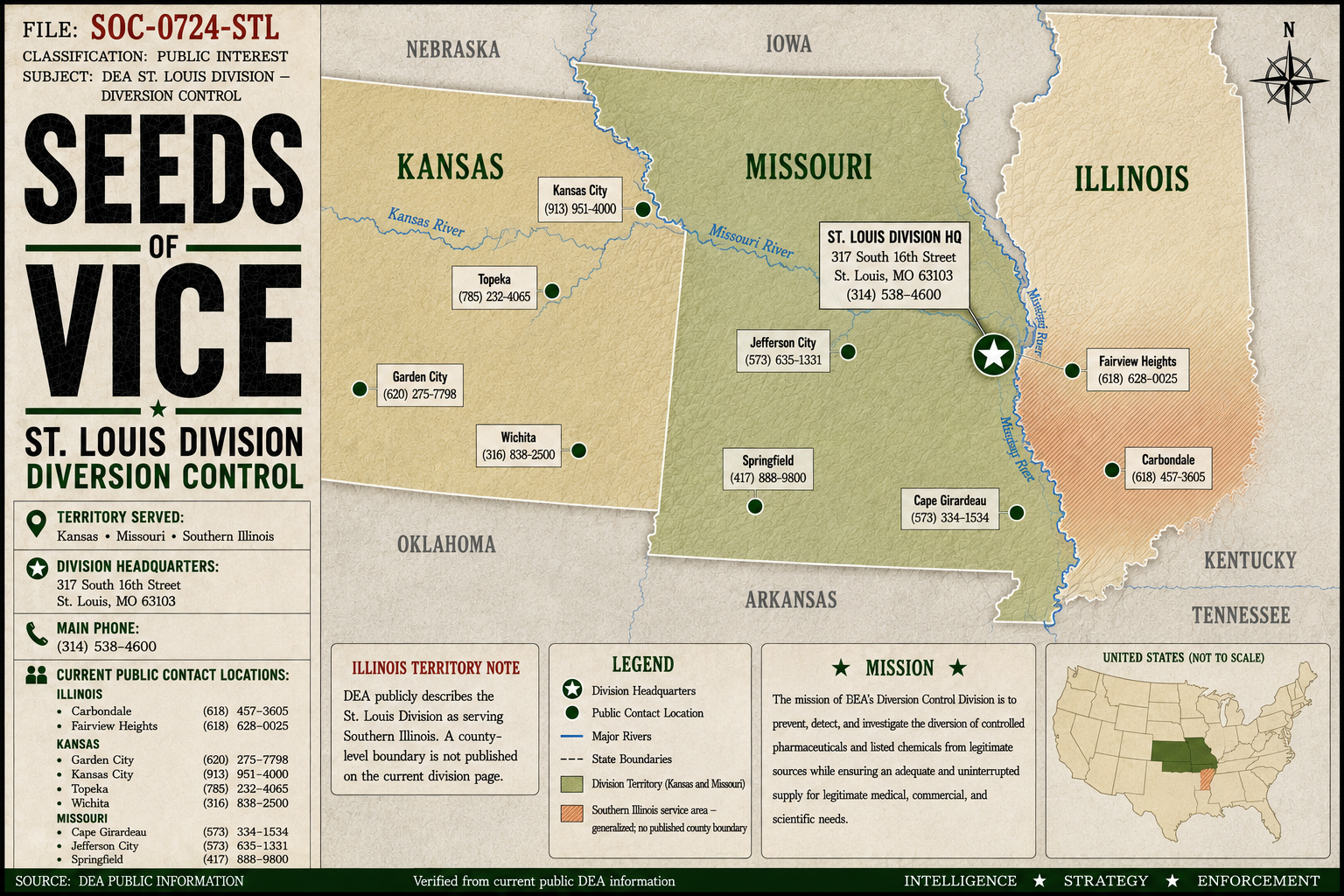
The Drug Enforcement Administration’s St. Louis Division is the regional DEA command responsible for Missouri, Kansas, and at least the southern portion of Illinois.
The exact public description of that territory is inconsistent.
DEA’s live St. Louis Division page states that the division serves:
- Illinois
- Kansas
- Missouri
A current DEA leadership announcement dated July 6, 2026, describes the division more narrowly as operating through ten offices across:
- Kansas
- Missouri
- Southern Illinois
Other DEA materials also describe the territory as Kansas, Missouri, and southern Illinois. Meanwhile, DEA’s live Chicago Division page independently states that the Chicago Division serves Illinois, Indiana, and Wisconsin.
These official descriptions cannot all be read literally without creating an unexplained overlap across Illinois.
The most defensible conclusion is:
The St. Louis Division unquestionably serves all of Missouri and Kansas and exercises responsibility in southern Illinois. DEA’s current public materials do not provide a precise county-by-county boundary explaining where St. Louis Division responsibility ends and Chicago Division responsibility begins.
Seeds of Vice does not silently assign the entire state of Illinois to either division.
The division’s office network is comparatively clear. DEA currently identifies the St. Louis headquarters and nine subordinate field locations, producing the ten-office structure referenced in the July 2026 leadership announcement.
Its diversion-control command structure is less transparent.
DEA publicly identifies:
- The Special Agent in Charge
- Headquarters and field-office locations
- General telephone numbers
- A community-outreach contact
- A recruitment contact
- A regional Diversion Outreach telephone number and email address
DEA does not currently publish:
- The name of the division’s Diversion Program Manager
- A diversion-control organizational chart
- The supervisory chain for Missouri, Kansas, and southern Illinois
- The number or placement of Diversion Investigators
- Division-level registration statistics
- Inspection and compliance totals
- Administrative-action totals
- Processing times
- Patient continuity-of-care measurements
The public can therefore identify the division’s general leadership and geography, but it cannot fully examine the regional federal system governing lawful controlled substances.
Who the St. Louis Division Serves
The St. Louis Division operates across a territory containing two complete states and an undefined portion of a third.
Its regional responsibilities include major metropolitan areas, smaller industrial cities, agricultural communities, remote western Kansas counties, Missouri’s Ozark region, the Kansas City metropolitan area, the St. Louis metropolitan area, and communities across southern Illinois.
The region contains:
- Physicians
- Dentists
- Pharmacies
- Hospitals
- Veterinarians
- Researchers
- Manufacturers
- Distributors
- Narcotic treatment programs
- Institutional practitioners
- Other DEA registrants
It also contains millions of patients whose access to controlled medication depends upon the continued legal operation of those registrants.
DEA’s authority is federal. Healthcare delivery, professional licensure, pharmacy regulation, prescription-monitoring requirements, and treatment availability remain substantially state-based.
The result is one regional DEA command operating across three different state regulatory environments.
The Illinois Jurisdiction Conflict
What DEA’s Live Division Pages State
DEA’s current St. Louis page uses the heading:
Serving Illinois, Kansas and Missouri
DEA’s current Chicago page states that the Chicago Division serves:
- Illinois
- Indiana
- Wisconsin
Read literally, both pages claim Illinois.
What DEA’s Current Leadership Announcement States
When Steven L. Hofer was appointed Special Agent in Charge in July 2026, DEA stated that he would oversee operations across ten offices in:
- Kansas
- Missouri
- Southern Illinois
The announcement did not say that the St. Louis Division serves all of Illinois.
What the Office List Suggests
DEA lists two Illinois field locations under the St. Louis Division:
- Carbondale
- Fairview Heights
Both are in southern Illinois.
No northern or central Illinois office is listed under St. Louis. The placement of the listed offices is consistent with the narrower “southern Illinois” description, but office locations alone do not establish an exact legal boundary.
What Can Be Concluded
The evidence supports the following conclusions:
- Missouri belongs to the St. Louis Division.
- Kansas belongs to the St. Louis Division.
- Southern Illinois is within the St. Louis Division’s operational territory.
- DEA’s live St. Louis summary page uses broader statewide Illinois language.
- DEA’s live Chicago page also claims Illinois.
- DEA has not provided an accessible county-level jurisdictional explanation resolving the overlap.
What Cannot Be Concluded
The public materials reviewed do not establish:
- The exact Illinois counties assigned to St. Louis
- The precise boundary between the St. Louis and Chicago divisions
- Whether responsibility is divided by county, judicial district, office function, case type, or another administrative arrangement
- Whether the broad statewide headings are merely website shorthand
- Whether one of the live pages is outdated or overinclusive
The conflict is itself a finding.
It should not be corrected through assumption.
Territory and Office Structure
DEA’s current public materials identify ten St. Louis Division offices: the headquarters and nine additional field locations.
Division Headquarters
DEA St. Louis Division
317 South 16th Street
St. Louis, Missouri 63103
Main telephone: (314) 538-4600
Illinois Field Locations
Carbondale
Telephone: (618) 457-3605
Fairview Heights
Telephone: (618) 628-0025
Kansas Field Locations
Garden City
Telephone: (620) 275-7798
Kansas City
Telephone: (913) 951-4000
Topeka
Telephone: (785) 232-4065
Wichita
Telephone: (316) 838-2500
Missouri Field Locations
Cape Girardeau
Telephone: (573) 334-1534
Jefferson City
Telephone: (573) 635-1331
Springfield
Telephone: (417) 888-9800
DEA’s public office list therefore consists of:
- One headquarters
- Two listed Illinois locations
- Four Kansas locations
- Three additional Missouri locations
Together, these form the ten-office network described in DEA’s July 2026 leadership announcement.
Office Classifications
DEA displays a legend using the following terms:
- Division Office
- District Office
- Resident Office
- Post of Duty Office
The accessible public text does not clearly and consistently associate every listed city with one of those classifications.
Accordingly, Seeds of Vice describes them as DEA-listed field locations unless DEA expressly identifies the office type.
No classification has been inferred from:
- City size
- Telephone number
- Geographic importance
- Historical office descriptions
- Assumed staffing levels
What Is Not Published
The office list does not disclose:
- Which offices contain Diversion Investigators
- Which offices process registration matters
- Which offices conduct regulatory inspections
- Whether diversion personnel are assigned permanently to all three states
- Which office supervises each Illinois county
- Whether any locations are enforcement-only
- How diversion cases are distributed among the offices
- The number of personnel at each location
A location appearing on the field-division page does not establish that every DEA function is available there.
The Name Matters
The St. Louis Field Division is not the national Diversion Control Division.
The St. Louis Division is a regional DEA command. It performs criminal enforcement, intelligence, administrative, community-outreach, and diversion-related functions throughout its assigned territory.
The national Diversion Control Division administers major parts of DEA’s nationwide regulatory system governing controlled pharmaceuticals and listed chemicals.
Regional Diversion Investigators operate within this larger national structure.
The accurate description is therefore:
DEA St. Louis Field Division and its diversion-control system
It is not a separate federal entity formally called the “St. Louis Diversion Division.”
Current Leadership and Publicly Identified Personnel
Steven L. Hofer
Special Agent in Charge
Steven L. Hofer is the current Special Agent in Charge of the St. Louis Field Division.
DEA announced his appointment on July 6, 2026. The agency stated that Hofer oversees enforcement, intelligence, diversion, and administrative operations across ten offices in Kansas, Missouri, and southern Illinois.
Hofer joined DEA in 2004 after more than ten years in the United States Army. DEA states that he commanded a company in Ramadi, Iraq, and received the Bronze Star.
His prior DEA assignments include:
- The St. Louis Division’s Violent Traffickers Task Force
- Group supervision in Springfield, Missouri
- DEA headquarters work involving national initiatives directed at pharmaceutical opioid manufacturers and distributors
- Service as an Assistant Special Agent in Charge in Baton Rouge
- Service as Special Agent in Charge of the New Orleans Division
DEA states that, while leading the New Orleans Division, Hofer was responsible for more than 600 employees operating across Alabama, Arkansas, Louisiana, and Mississippi.
He holds an undergraduate degree in business marketing with a minor in military science from Missouri Western State University and a master’s degree in criminology and criminal justice from the University of Missouri–St. Louis.
Hofer succeeded Michael A. Davis.
Significance for Diversion Control
Hofer’s current official biography expressly places diversion operations within his division-wide command responsibility.
His biography also identifies headquarters experience involving pharmaceutical opioid manufacturers and distributors. That experience is relevant to diversion-control administration, but it does not establish the division’s current internal diversion hierarchy or identify who manages the program’s daily regional operations.
Publicly Identified Support Contacts
Community Outreach
Dan Plumb
Telephone: (571) 362-7591
Email: STLDiv.PublicAffairs@dea.gov
Recruitment
Special Agent Chris Most
Telephone: (314) 538-4600
Email: StLouisSpecialAgentRecruiter@dea.gov
Media Inquiries
Telephone: (571) 362-5149
Diversion Outreach
Telephone: (571) 387-5067
Email: StLouisDiversionOutreach@dea.gov
These contacts appear on DEA’s current St. Louis Division page.
The Diversion Outreach contact is a regional public point of contact. DEA does not describe it as the direct telephone line for a particular Diversion Investigator, supervisor, enforcement group, or registration adjudicator.
Current Diversion Leadership Is Not Publicly Named
The live St. Louis Division page does not identify a current Diversion Program Manager.
The most recent official DEA materials located during this review publicly named Kimberly “Kim” Daniels as the Diversion Program Manager responsible for Missouri, Kansas, and southern Illinois. Those materials were published in 2023 and 2024.
Because no current 2026 DEA source located for this page confirms that Daniels still holds the position, Seeds of Vice does not present her as the current manager.
Her last verified public role should be described as:
Kimberly “Kim” Daniels — publicly identified by DEA as the regional Diversion Program Manager in official materials published through 2024; current status not established by the live 2026 division page.
That distinction prevents an older official identification from being silently converted into a current personnel claim.
Publicly Unidentified Positions
DEA does not currently identify:
- The current Diversion Program Manager
- Deputy or assistant diversion managers
- Diversion group supervisors
- The official responsible for Kansas
- The official responsible for Missouri
- The official responsible for southern Illinois
- Tactical Diversion Squad supervisors
- Registration-program supervisors
- Diversion personnel assigned to individual field offices
- Diversion-focused public-information personnel
The absence of names does not prove that the positions are vacant.
It means the personnel structure is not publicly visible.
Official Role and Mission
DEA states that the national Diversion Control Division exists to prevent, detect, and investigate the movement of controlled pharmaceuticals and listed chemicals from legitimate sources into unlawful traffic while also ensuring an adequate and uninterrupted supply for legitimate medical, scientific, and commercial needs.
The mission contains two obligations:
- Protect the lawful system from theft, fraud, falsification, unlawful prescribing, improper dispensing, and other forms of diversion.
- Preserve an adequate and uninterrupted supply for legitimate use.
Both obligations matter.
A complete assessment cannot measure diversion control only through:
- Arrests
- Search warrants
- Convictions
- Civil penalties
- Registration surrenders
- Suspensions
- Revocations
- Reduced dispensing
It must also examine whether lawful patients, practitioners, hospitals, pharmacies, veterinarians, researchers, manufacturers, and distributors retain workable access to the controlled substances they legitimately require.
The Closed System of Distribution
Federal controlled-substance law establishes a regulated distribution system extending from production and distribution through prescribing and dispensing.
Participants may include:
- Manufacturers
- Distributors
- Importers
- Exporters
- Pharmacies
- Hospitals
- Physicians
- Dentists
- Veterinarians
- Researchers
- Narcotic treatment programs
- Mid-level practitioners where authorized
- Other institutional and individual registrants
DEA registration generally authorizes specified activities involving specified schedules of controlled substances.
Registration does not replace state authorization.
A practitioner may require:
- A state professional license
- State controlled-substance authority
- DEA registration
- Institutional credentials
- Compliance with state prescription-monitoring requirements
- Compliance with employer, insurer, hospital, or pharmacy policies
A person may therefore possess federal registration but lack state authority, or possess state licensure but lack the necessary federal registration.
Federal Regulatory Responsibilities
Depending on registrant type, the system may govern:
- Initial registration
- Renewal
- Registration modification
- Authorized schedules
- Recordkeeping
- Inventories
- Ordering
- Transfers
- Storage
- Physical security
- Theft and significant-loss reporting
- Prescription issuance
- Dispensing
- Disposal
- Employee access
- Automated dispensing systems
- Suspicious orders
- Registration surrender
- Suspension or revocation
Diversion control is broader than investigating physicians.
It reaches the entire lawful channel.
Traditional Regional Diversion-Control Work
Regional diversion activity may include:
- Reviewing registration applications
- Conducting regulatory inspections
- Auditing controlled-substance inventories
- Examining purchasing and dispensing records
- Investigating thefts and significant losses
- Investigating employee diversion
- Reviewing suspicious-order practices
- Examining prescription legitimacy
- Investigating forged or altered prescriptions
- Reviewing institutional security
- Examining automated dispensing records
- Coordinating with state licensing authorities
- Coordinating with prescription-monitoring programs
- Negotiating corrective agreements
- Seeking civil penalties
- Requesting or accepting registration surrender
- Recommending administrative action
- Supporting criminal investigations
- Referring evidence to federal prosecutors
Not every inspection becomes an investigation.
Not every regulatory deficiency is criminal.
Not every settlement establishes that all government allegations were proven.
Not every registration surrender is an admission to a criminal offense.
Legal posture must be preserved matter by matter.
Broader Drug Enforcement Is Not the Same as Diversion Control
The St. Louis Division also investigates:
- Fentanyl trafficking
- Methamphetamine distribution
- Cocaine distribution
- Heroin trafficking
- Drug-trafficking organizations
- Cartel-linked activity
- Money laundering
- Firearms associated with drug trafficking
- Pharmacy burglaries and illicit resale
- Interstate distribution networks
Those operations are part of DEA’s broader criminal-enforcement mission.
They should not automatically be counted as diversion-control activity.
For example:
- A fentanyl seizure does not reveal how many registrants were inspected.
- A cocaine prosecution does not measure registration-processing time.
- A cartel investigation does not establish whether legitimate medical supply remained adequate.
- A pharmacy burglary may involve controlled drugs, but it does not by itself establish regulatory misconduct by the pharmacy.
The illicit market and the lawful regulated channel can intersect. They remain analytically distinct.
How the System Works in Practice
Registrants
A registrant operating within the St. Louis Division may answer to several authorities simultaneously:
- DEA
- State medical, dental, nursing, veterinary, or pharmacy boards
- State controlled-substance agencies
- State prescription-monitoring programs
- State health departments
- Federal and state prosecutors
- Hospitals and credentialing bodies
- Insurers
- Pharmacy chains
- Institutional compliance departments
When prescribing or dispensing changes, responsibility may be distributed among several institutions.
A treatment interruption should not automatically be attributed solely to DEA.
A decline in prescribing may result from:
- Federal investigation
- State-board action
- State law
- Prescription-monitoring requirements
- Insurer limits
- Hospital policy
- Pharmacy policy
- Supply shortages
- Clinical guidelines
- Corporate risk management
- Practitioner judgment
- Fear of regulatory scrutiny
Determining causation requires more than observing that the decline occurred.
Prescribers
Federal law requires controlled-substance prescriptions to be issued for a legitimate medical purpose by a practitioner acting in the usual course of professional practice.
That federal standard interacts with state law and professional regulation.
Prescribers may also be expected to consider:
- Patient history
- Examination and diagnosis
- Prescription-monitoring information
- Medication combinations
- Dosage and duration
- Prior treatment
- Documented treatment objectives
- Signs of misuse or diversion
- Follow-up and monitoring
- State-specific requirements
The existence of a prescription does not prove that it was legitimate.
The existence of a high dosage does not independently prove that it was illegitimate.
The legitimacy of an individual prescription depends upon the applicable law, professional practice, patient circumstances, and evidence.
Pharmacists
Pharmacists have independent legal and professional responsibilities.
They may evaluate:
- Whether the prescription appears valid
- Whether the prescriber is authorized
- Whether the prescription was altered
- Refill timing
- Drug combinations
- Dosage
- Quantity
- Geographic distance
- Patient identification
- Payment method
- Multiple-prescriber or multiple-pharmacy patterns
- Other warning signs
A pharmacist may refuse to dispense even when a prescriber considers the prescription medically appropriate.
That refusal may result from:
- Federal or state law
- Professional judgment
- Corporate policy
- Insurer requirements
- Inventory limitations
- Supply-chain restrictions
- Concern about regulatory exposure
The public record rarely identifies which factor controlled a particular refusal.
Hospitals and Institutional Registrants
Hospitals and other institutions must maintain systems capable of detecting and responding to controlled-substance discrepancies.
Institutional controls may include:
- Inventory reconciliation
- Restricted employee access
- Automated dispensing-cabinet monitoring
- Wastage documentation
- Override review
- Discrepancy investigation
- Surveillance
- Theft-and-loss reporting
- Employee testing or assessment where lawful
- Referral to licensing and law-enforcement authorities
Diversion within a hospital can harm:
- The institution
- The employee involved
- Patients who receive diluted, substituted, or missing medication
- The public if stolen medication enters illicit channels
Regulatory oversight in this setting has a clear patient-safety function.
Veterinarians
Veterinary practitioners and facilities are also part of the controlled-substance system.
Their responsibilities may include:
- Secure storage
- Accurate inventory
- Documentation of administration
- Proper prescribing
- Employee-access controls
- Theft reporting
- Disposal
- Protection against diversion involving animal patients
The fact that the patient is an animal does not remove the drugs from federal regulation.
The Three State-Control Layers
The St. Louis Division applies one federal statutory framework across three state systems.
Kansas
Kansas operates the K-TRACS Prescription Drug Monitoring Program through the Kansas Board of Pharmacy.
The program is intended to provide authorized healthcare professionals with controlled-substance dispensing information that may assist clinical decision-making and patient safety. Kansas separately regulates who must report dispensing information and how authorized users may obtain access.
K-TRACS is a Kansas state system.
It should not be described as a database created or exclusively controlled by the DEA St. Louis Division.
Kansas practitioners and pharmacies remain subject to independent state licensing and professional requirements in addition to federal registration.
Missouri
Missouri’s statewide Prescription Drug Monitoring Program operates under a Joint Oversight Task Force.
The current program collects information concerning prescribed Schedule II, III, and IV controlled substances submitted by Missouri dispensers. Authorized Missouri healthcare providers may use the information when evaluating prescription histories.
Missouri’s system differs from many other state programs in important respects.
Current program materials state that:
- Access is limited to qualifying Missouri-licensed or authorized healthcare providers.
- Interstate sharing is not permitted under the governing state statute.
- Individually identifiable dispensing information is protected.
- Law-enforcement and prosecutorial access is restricted by state law.
- Publicly released research or statistical data must remove identifying information.
The program publishes quarterly public dashboards, including a 2026 first-quarter dashboard. Those public reports can provide state-level context but do not reveal the St. Louis Division’s internal investigative use, registration workload, or enforcement decisions.
Missouri’s PDMP and DEA’s registration system are separate institutions.
Illinois
Illinois operates the Illinois Prescription Monitoring Program through the Illinois Department of Public Health.
The program collects dispensing information involving Schedule II through V controlled substances. Illinois requires covered pharmacies to report qualifying dispensing information, and state law imposes checking or documentation duties in specified prescribing circumstances.
The Illinois PMP is statewide.
The DEA St. Louis Division, however, appears to exercise operational responsibility only in southern Illinois, notwithstanding the broader language on its live division page.
Therefore:
- Statewide Illinois PMP data cannot automatically be treated as St. Louis Division data.
- Northern and central Illinois activity may involve the Chicago Division.
- Any regional analysis must avoid assigning the whole Illinois dataset to St. Louis.
Cross-State Complications
The division’s three state systems are not interchangeable.
Differences may include:
- Which substances are reported
- Who may access the database
- Whether interstate sharing is allowed
- How long data are retained
- Whether prescribers must check
- Which exceptions apply
- Whether law enforcement may obtain direct access
- What legal process is required
- How veterinary prescriptions are treated
- How delegates and institutional users are authorized
A multistate federal division must operate without pretending those state systems are identical.
Missouri’s prohibition on interstate sharing is particularly important. A regional DEA command does not automatically convert three state databases into one unified regional record.
Diversion Control and Lawful Medicine
The need for diversion control is real.
Controlled substances can be:
- Stolen from pharmacies or hospitals
- Diverted by employees
- Obtained through forged prescriptions
- Prescribed without lawful medical purpose
- Dispensed despite unresolved warning signs
- Purchased through fraudulent identities
- Removed from veterinary facilities
- Concealed through false inventories
- Distributed outside authorized channels
The St. Louis Division’s record contains examples of several of these forms of misconduct.
The need for legitimate access is also real.
Controlled substances are used in:
- Surgery
- Emergency care
- Anesthesia
- Cancer treatment
- Palliative care
- Hospice
- Acute-pain treatment
- Chronic-pain treatment
- Mental-health treatment
- Addiction treatment
- Veterinary medicine
- Research
DEA’s own national mission expressly includes maintaining an adequate and uninterrupted legitimate supply.
That obligation does not prevent lawful enforcement.
It means enforcement and access must both be measured.
What Is Not Publicly Measured
The public record reviewed for this page does not show whether the St. Louis Division systematically measures:
- Patients who lose access after a registration action
- Patients displaced when a clinic closes
- Patients affected by pharmacy restrictions
- Whether records are transferred
- Whether patients receive notice
- Whether alternate prescribers are available
- Whether rural communities retain local treatment
- Whether a hospital action disrupts medication continuity
- Whether abrupt discontinuation occurs
- Whether pain or palliative-care patients are separately evaluated
- Whether registrants receive technical correction before punitive action
- Whether legitimate supply remained adequate after an intervention
The absence of published measurements does not prove that DEA performs no internal review.
It establishes that the public cannot evaluate that review.
Prescribing Statistics Without False Continuity
Seeds of Vice uses 1984 as the historical starting point for examining the transformation of lawful medicine.
That does not mean one continuous, comparable dataset exists from 1984 through 2026.
It does not.
No defensible public source located for this page provides an annual, same-definition, state-by-state retail opioid-dispensing series for Missouri, Kansas, and the St. Louis Division’s portion of Illinois beginning in 1984.
Accordingly:
- Missing years are not interpolated.
- Statewide Illinois figures are not assigned exclusively to St. Louis.
- Prescription counts are not treated as dosage measurements.
- Prescriptions per 100 residents are not treated as MME per capita.
- Retail dispensing is not treated as total medical utilization.
- Overdose deaths are not treated as prescribing rates.
- State trends are not described as DEA performance statistics.
- Different datasets are not joined into a false continuous line.
1984–2005
For this period, the historical record must be assembled from separate evidence, including:
- Federal controlled-substance policy
- DEA registration and regulatory history
- National pharmaceutical distribution
- Medical practice
- Drug-utilization research
- State laws
- Professional guidance
- Later retrospective datasets
These sources can establish historical conditions and institutional change.
They do not create a continuous St. Louis Division dispensing rate.
Seeds of Vice does not manufacture missing annual state values.
2011 State Benchmark
CDC’s archived state retail-dispensing estimates report the following 2011 opioid prescription rates:
| State | Opioid prescriptions per 100 residents |
|---|---|
| Illinois | 64.3 |
| Kansas | 87.8 |
| Missouri | 91.6 |
These were statewide estimates.
The Illinois figure includes areas outside the St. Louis Division’s apparent southern Illinois territory. It therefore cannot be used as a direct measurement of the division.
The figures also do not reveal:
- How many individual patients received medication
- The average dose
- Duration of treatment
- Diagnosis
- Whether the prescription was medically appropriate
- Whether medication was diverted
- Whether patients were adequately treated
- Whether changes resulted from DEA action
- Whether state rules, insurers, hospitals, pharmacies, or clinical practice caused later declines
A prescription rate measures dispensing volume under a defined methodology.
It does not decide the legitimacy of individual treatment.
Current National Retail Series
CDC reports that the national retail opioid-dispensing rate declined from:
- 46.8 prescriptions per 100 persons in 2019
- To 35.4 prescriptions per 100 persons in 2024
That represents a decline of approximately 24.4 percent over the period.
CDC states that the estimates are based on IQVIA Xponent information from approximately 54,600 nonhospital retail pharmacies representing nearly 94 percent of United States retail prescriptions.
The methodology excludes:
- Mail-order prescriptions
- Methadone dispensed through opioid treatment programs
Geography is generally assigned according to the prescriber’s location rather than the patient’s residence.
These limitations are material.
The figures do not measure:
- All hospital administration
- All institutional use
- All opioid treatment
- All patient exposure
- All dosage
- All pain treatment
- Whether an individual prescription was justified
- Whether a patient retained continuity of care
What the Prescribing Evidence Establishes
The defensible conclusion is limited:
Retail opioid dispensing has declined substantially from the higher levels documented during the early twenty-first century.
The evidence does not independently establish:
- Why every decline occurred
- Whether the St. Louis Division caused it
- Whether every reduction improved care
- Whether every discontinued prescription was unnecessary
- Whether diversion declined proportionately
- Whether pain prevalence declined
- Whether undertreatment increased
- Whether patients moved toward illicit substances
- Whether pharmacies became more restrictive
- Whether clinicians became more accurate or simply more fearful
Prescribing volume is an important indicator.
It is not a complete measure of medical justice.
Illicit-Market and Overdose Context
The present illicit drug environment must be kept separate from the retail-prescription record.
CDC states that prescription opioids remain involved in overdose deaths but are not the primary current driver of the national opioid-overdose crisis. Illicitly manufactured fentanyl and related synthetic opioids now account for a large portion of opioid deaths.
That distinction does not establish that lawful prescribing is risk-free.
It establishes that:
- Retail prescriptions
- Illicit fentanyl
- Heroin
- Counterfeit tablets
- Polysubstance use
- Pharmaceutical diversion
are different analytical categories.
A seizure of illicit fentanyl should not be used as a direct measurement of lawful prescribing.
A decline in retail prescriptions should not automatically be credited with reducing illicit-market harm.
A rise in illicit deaths does not, by itself, prove that prescribing reductions caused those deaths.
Causation requires evidence.
Representative Diversion-Control Matters
The following matters illustrate the types of cases arising within the St. Louis Division’s territory.
They are not a complete list, a random sample, or a division-wide performance measure.
Kansas and Missouri Nurse
Guilty plea and criminal sentence
In July 2026, DEA reported that a Missouri nurse was sentenced after pleading guilty to obtaining controlled substances through deception and subterfuge.
According to the official account, she used a nurse practitioner’s prescription pad and DEA registration number to create fraudulent prescriptions for Percocet and oxycodone. She admitted responsibility for thirteen fraudulent prescriptions involving medication obtained in Kansas and Missouri.
The court imposed:
- Three years of probation
- A $5,000 fine
The case also resulted in the loss of her nursing license and permanent exclusion from federal healthcare programs. DEA investigated the matter.
This was not merely an unresolved allegation.
It involved a guilty plea and criminal sentence.
The case illustrates:
- Misuse of another practitioner’s DEA registration
- Forged prescriptions
- Cross-state acquisition
- Diversion by a healthcare professional
- Coordination between criminal and professional consequences
Olathe, Kansas, Pharmacy
Civil settlement of allegations
In 2023, Four B Corporation, operating a Price Chopper pharmacy in Olathe, Kansas, agreed to pay $250,000 to settle federal Controlled Substances Act allegations.
The government alleged that the pharmacy:
- Dispensed controlled substances before receiving valid prescriptions
- Improperly completed partial fills
- Failed to maintain required inventory records
The allegations concerned conduct occurring between February 2019 and June 2022. DEA investigated the matter.
This was a civil settlement.
The settlement resolved asserted government claims. It should not be rewritten as a criminal conviction or as a jury finding that every allegation was proven.
The case illustrates the regulatory side of diversion control:
- Prescription documentation
- Partial-fill requirements
- Inventory accountability
- Pharmacy compliance
- Civil monetary resolution
St. Louis-Area Physician
Guilty pleas and imprisonment
In September 2025, a federal court sentenced Dr. Asim Muhammad Ali to 70 months in prison.
The official record states that Ali had admitted involvement in healthcare fraud, illegal controlled-substance prescribing, kickbacks, and later conduct involving another physician’s DEA registration and ketamine-related operations.
The government described prescriptions issued without legitimate medical need, prescriptions prepared without appropriate patient visits, and conduct involving patients believed to be diverting medication. DEA participated in the investigation.
This matter involved guilty pleas and a criminal sentence.
It should not be described merely as an accusation.
The case also demonstrates that one investigation can involve:
- Controlled-substance law
- Healthcare fraud
- Registration misuse
- Billing misconduct
- Professional authority
- Multiple federal investigative agencies
Saint Francis Medical Center
Civil settlement concerning institutional responsibility
Saint Francis Medical Center in Cape Girardeau agreed to pay approximately $1.625 million to resolve federal Controlled Substances Act allegations connected to opioid prescriptions attributed to a physician associated with the institution.
The settlement also required the creation of an opioid-prescribing education foundation. DEA, the Department of Health and Human Services Office of Inspector General, and Missouri authorities participated in the investigation.
This was a civil settlement of government allegations.
It was not a criminal conviction of the medical center.
The matter illustrates that federal scrutiny may extend beyond the individual prescriber to an institution’s:
- Oversight
- Compliance systems
- Employment relationships
- Billing
- Credentialing
- Response to prescribing practices
Southern Illinois Pharmacy Burglaries
Indictment and unresolved charges
In May 2026, federal authorities announced charges against four defendants accused of participating in a multistate pharmacy-burglary conspiracy.
The indictment included burglaries or attempted burglaries involving pharmacies in southern Illinois communities including:
- Bethalto
- Maryville
- Lebanon
- Breese
- Neoga
DEA participated in the investigation.
These were charges contained in an indictment.
The defendants are presumed innocent unless proven guilty.
The case illustrates an important distinction:
- The controlled substances originated in lawful pharmacies.
- The alleged diversion occurred through outside criminal theft.
- The existence of stolen medication does not necessarily establish wrongdoing by the affected pharmacies.
Diversion control must be capable of distinguishing registrant misconduct from registrant victimization.
What the Representative Matters Show
The cases establish that controlled substances may leave lawful channels through:
- Forged prescriptions
- Misuse of another person’s DEA registration
- Healthcare-professional diversion
- Recordkeeping failures
- Improper dispensing
- Institutional oversight failures
- Unlawful prescribing
- Outside burglary and theft
They do not establish how frequently those events occur among all registrants.
DEA and DOJ press releases are selected case announcements.
They do not reveal:
- The total number of registrants
- The number inspected
- The number found compliant
- The number receiving technical assistance
- The number of complaints found unsubstantiated
- The number of investigations closed without action
- The number of administrative cases contested
- The number dismissed
- The number of patients affected
- The average duration of investigations
- The frequency of corrective action compared with punishment
A collection of successful cases proves that cases exist.
It does not describe the complete regulatory system.
Legal Posture Must Be Preserved
The following categories are not interchangeable:
Allegation
A government agency asserts that conduct occurred.
Indictment or charge
A prosecutor formally accuses a person or entity. Guilt has not been established.
Guilty plea
A defendant admits guilt to an offense in court.
Conviction
Guilt has been established through a plea or verdict.
Criminal sentence
A court imposes punishment after conviction.
Civil settlement
Parties resolve civil claims, often without litigating every allegation to judgment.
Administrative action
DEA or another regulator acts against a registration, license, or authorization through an administrative process.
Voluntary surrender
A registrant relinquishes an authorization. The surrender may occur under pressure or as part of an agreement, but it is not automatically a criminal conviction.
Dismissal or acquittal
Charges or claims are dismissed, or the accused is found not guilty.
Seeds of Vice preserves these distinctions because institutional accountability requires accuracy in both directions.
Government allegations should not be minimized.
They also should not be upgraded into findings that were never made.
Practical Consequences for Registrants
A DEA registration matter can result in:
- No action
- Education
- Technical correction
- Additional documentation
- Corrective-action requirements
- A memorandum of agreement
- Civil penalties
- Restrictions on schedules or activities
- Voluntary surrender
- An order to show cause
- Immediate suspension
- Revocation
- Criminal referral
- Criminal prosecution
The public record does not reveal how often the St. Louis Division uses each outcome.
That omission makes it difficult to determine whether the regional program operates primarily through:
- Compliance assistance
- Negotiated correction
- Administrative restriction
- Punitive enforcement
- Criminal referral
The cases publicly announced are generally the most serious or newsworthy.
Routine compliance work is less visible.
Practical Consequences for Patients
Patients are ordinarily not the direct targets of registration enforcement.
They may nevertheless experience its effects.
Legitimate Benefits
Diversion-control action may:
- Stop forged prescriptions
- Detect stolen medication
- Remove impaired personnel from drug access
- Correct unsafe pharmacy practices
- Prevent unlawful prescribing
- Improve institutional controls
- Protect patients from substituted or diluted medication
- Prevent stolen pharmaceuticals from entering illicit markets
Possible Adverse Consequences
An action may also contribute to:
- Loss of a prescriber
- Clinic closure
- Pharmacy refusal
- Delayed refills
- Longer travel
- Difficulty transferring records
- Abrupt treatment interruption
- Reduced willingness among clinicians to accept complex patients
- Emergency-department use
- Loss of local treatment in rural communities
The existence of these possible consequences does not establish that every DEA action causes patient harm.
It establishes why patient outcomes should be measured.
Rural and Regional Effects
The St. Louis Division’s geography includes areas where healthcare alternatives may be limited.
A patient in metropolitan St. Louis or Kansas City may have access to multiple hospitals, pharmacies, specialists, and transportation routes.
A patient in:
- Western Kansas
- Rural Missouri
- The Ozarks
- Southern Illinois
may have few nearby alternatives.
When a sole local prescriber, pharmacy, hospital, or treatment program loses controlled-substance authority, the practical effect may be greater than the same action in a dense metropolitan market.
That is a geographic inference.
It is not an allegation that DEA applies different legal standards in rural areas.
It means equal enforcement decisions can produce unequal access consequences.
Public Contact Information
St. Louis Division Headquarters
317 South 16th Street
St. Louis, Missouri 63103
Main telephone: (314) 538-4600
Media Inquiries
Telephone: (571) 362-5149
Community Outreach
Dan Plumb
Telephone: (571) 362-7591
Email: STLDiv.PublicAffairs@dea.gov
Recruitment
Special Agent Chris Most
Telephone: (314) 538-4600
Email: StLouisSpecialAgentRecruiter@dea.gov
Diversion Outreach
Telephone: (571) 387-5067
Email: StLouisDiversionOutreach@dea.gov
The public page does not describe the Diversion Outreach contact as:
- A patient-complaint office
- A direct enforcement line
- A local investigator’s telephone
- An administrative-hearing office
- A guarantee of immediate registration assistance
People should identify the nature of their inquiry clearly and verify current submission instructions before transmitting confidential records.
Seeds of Vice Analysis
The following is Seeds of Vice analysis.
It is not an official DEA statement.
The Division’s First Accountability Problem Is Its Own Boundary
The St. Louis Division’s public record begins with an unresolved geographic contradiction.
One live DEA page says the division serves all Illinois.
Current leadership materials say southern Illinois.
The Chicago Division simultaneously states that it serves Illinois.
This may be a website-labeling problem rather than an operational failure. But the public should not have to infer the jurisdiction of a federal field division from office geography and conflicting headings.
A national law-enforcement agency should publish:
- Exact state coverage
- County-level boundary maps where states are divided
- Which office handles each county
- Which division receives registration and diversion inquiries
- How overlapping metropolitan or judicial areas are administered
Jurisdiction is basic public information.
The Ten-Office Structure Is Visible; Diversion Placement Is Not
DEA identifies ten regional offices.
It does not identify which contain diversion personnel.
That prevents the public from knowing whether:
- Diversion Investigators are distributed across the territory
- Diversion work is centralized in St. Louis
- Kansas has its own diversion supervisory structure
- Southern Illinois matters are handled locally
- Rural registrants must rely on distant personnel
- Registration and enforcement work are housed in the same locations
An office map without functional assignments shows presence, not structure.
Transparency Is Strongest at the Top
The public can readily identify:
- Steven L. Hofer
- His professional background
- The headquarters
- The field locations
- General outreach contacts
The structure becomes less visible below the Special Agent in Charge.
The public cannot readily identify:
- The current Diversion Program Manager
- Diversion supervisors
- State assignments
- Investigator distribution
- Regulatory workload
- Registration delays
- Inspection outcomes
- Administrative-action totals
- Patient-access effects
The last publicly named regional Diversion Program Manager located in official materials was identified in 2024.
The current 2026 page supplies only a generic diversion contact.
That is a meaningful transparency gap.
Selected Cases Cannot Demonstrate Overall Performance
The representative matters show that diversion oversight can address serious misconduct.
They do not reveal whether the overall system is:
- Proportionate
- Consistent
- Timely
- Educational
- Punitive
- Effective
- Protective of legitimate supply
A regulatory program cannot be evaluated solely from the cases it chooses to announce.
The public also needs to know:
- How many registrants comply
- How many problems are corrected
- How many allegations are unsupported
- How long cases remain unresolved
- How many registrations are delayed
- How many patients are displaced
- Whether lawful access remains adequate
Enforcement visibility is not the same as institutional accountability.
State Prescribing Data Are Not Division Performance Data
Missouri, Kansas, and Illinois prescribing rates are shaped by many institutions.
They are not controlled exclusively by the DEA St. Louis Division.
Influences include:
- State law
- State licensing boards
- Prescription-monitoring programs
- Federal law
- Insurers
- Hospitals
- Pharmacy chains
- Manufacturers and distributors
- Clinical guidance
- Supply conditions
- Prescriber judgment
- Patient demographics
- Disease and injury prevalence
A decline in state prescribing does not prove that the regional DEA office caused the decline.
It also does not prove that all reductions were medically beneficial.
The proper inquiry is not merely whether prescribing decreased.
It is whether:
- Diversion decreased
- Unsafe prescribing decreased
- Legitimate treatment remained available
- Patient outcomes improved
- Rural access was preserved
- Clinicians could still exercise individualized judgment
Those are separate questions.
Missouri’s Data Restrictions Complicate Regional Oversight
Missouri’s statewide PDMP limits interstate sharing and restricts law-enforcement access.
That is a state policy choice.
It means the St. Louis Division operates across three states without one automatically unified prescription database.
This can protect confidentiality and limit generalized law-enforcement access.
It may also require different legal processes and investigative methods in each state.
The division should publicly explain, at a general level:
- How it lawfully obtains state PDMP information
- What legal process is required
- Who may authorize access
- How searches are audited
- How inaccurate data are corrected
- How raw volume is prevented from becoming a substitute for evidence
These disclosures need not reveal active investigative techniques.
Access Must Be Measured Alongside Enforcement
DEA’s stated mission already requires legitimate supply to remain adequate and uninterrupted.
The division therefore should be capable of reporting not only what it removed or restricted, but what remained available.
That does not require DEA to guarantee every prescription.
It requires the agency to evaluate whether its interventions produce foreseeable access failures.
The relevant questions include:
- Was another practitioner available?
- Were patients notified?
- Were records transferred?
- Did the pharmacy remain open?
- Did the community retain another controlled-substance provider?
- Were cancer, hospice, surgical, addiction-treatment, and chronic-pain patients considered?
- Did a rural action create a treatment desert?
- Was legitimate supply interrupted?
A system that counts surrendered registrations but does not count displaced patients measures only one side of its own mission.
The Central Question
The St. Louis Division has participated in legitimate cases involving:
- Forgery
- Registration misuse
- Unlawful prescribing
- Pharmacy noncompliance
- Institutional failures
- Theft
The central accountability question is not whether those cases should exist.
It is whether the division can demonstrate, with equal seriousness, that it:
- Distinguishes misconduct from medical complexity
- Uses proportionate remedies
- Corrects technical problems where correction is sufficient
- Protects due process
- Preserves lawful access
- Measures unintended consequences
- Publishes enough information for the public to evaluate the system
DEA’s own mission provides the standard.
Recommended Public Disclosures
Seeds of Vice recommends that DEA publish an annual St. Louis Division diversion-control report.
Jurisdiction
The report should identify:
- The exact Illinois counties within the division
- The boundary with the Chicago Division
- The office responsible for each county
- Procedures for matters crossing division boundaries
- Whether separate boundaries apply to enforcement and registration work
Personnel and Structure
DEA should disclose:
- The current Diversion Program Manager
- The regional diversion organizational chart
- Supervisory responsibility by state
- Office classification for each location
- Offices containing Diversion Investigators
- Number of diversion personnel by state
- Vacant supervisory positions
- Public-facing registration contacts
Registration
The report should include:
- Active registrants by state
- Registrants by category
- New applications
- Renewals
- Modifications
- Denials
- Withdrawals
- Average processing times
- Pending applications
- Applications delayed beyond established targets
- Reasons for material delays
Compliance
DEA should report:
- Regulatory inspections
- Registrants found compliant
- Technical deficiencies
- Corrective letters
- Follow-up inspections
- Memoranda of agreement
- Compliance conferences
- Voluntary corrective actions
- Matters closed without formal enforcement
Enforcement
The report should distinguish:
- Administrative subpoenas
- Inspection warrants
- Search warrants
- Civil settlements
- Civil penalties
- Voluntary surrenders
- Orders to show cause
- Immediate suspension orders
- Registration restrictions
- Revocations
- Criminal referrals
- Criminal charges
- Guilty pleas
- Convictions
- Acquittals
- Dismissals
- Government withdrawals
Theft and Loss
DEA should disclose:
- Theft-and-loss reports received
- Registrant categories involved
- Substances and quantities
- Employee-diversion matters
- Outside burglaries
- Average reporting delays
- Average closure times
- Institutional corrective actions
- Matters determined not to involve diversion
State Data Use
DEA should explain:
- How Kansas K-TRACS information is obtained
- How Missouri PDMP restrictions are observed
- How Illinois PMP information is obtained
- Whether administrative subpoenas are required
- Access-audit procedures
- Data-retention practices
- Correction procedures
- Interstate data limitations
- Safeguards against treating prescribing volume as proof
Patient and Community Effects
The report should measure:
- Patients potentially affected by registration action
- Advance-notice procedures
- Record-transfer arrangements
- Referral coordination
- Rural-access consequences
- Hospital and pharmacy continuity
- Treatment-program continuity
- Complaints involving abrupt discontinuation
- Whether alternate providers were available
- Whether legitimate supply remained adequate
These disclosures can be aggregated and anonymized.
They need not reveal confidential patient information, investigative techniques, or protected personnel information.
Methodology and Evidentiary Limits
This page was fully reviewed through July 25, 2026.
Priority was given to:
- DEA
- DEA Diversion Control
- United States Department of Justice
- Centers for Disease Control and Prevention
- Kansas state agencies
- Missouri state agencies
- Illinois state agencies
The following rules were applied:
- Current personnel are identified only through current official sources.
- Historical personnel are not silently presented as current officials.
- The current Special Agent in Charge is distinguished from the prior SAC.
- Kimberly Daniels is identified only according to her last verified public role.
- The St. Louis Field Division is distinguished from the national Diversion Control Division.
- DEA’s conflicting Illinois descriptions are preserved rather than silently reconciled.
- No county boundary is invented.
- Office classifications are not inferred where DEA does not clearly provide them.
- Broader narcotics enforcement is separated from diversion-control work.
- Allegations, indictments, settlements, guilty pleas, convictions, sentences, administrative actions, and registration surrenders are treated as different legal events.
- Press releases are treated as selected case records rather than comprehensive statistics.
- Missouri, Kansas, and Illinois prescribing data are treated as state context—not St. Louis Division performance data.
- Statewide Illinois data are not assigned exclusively to the St. Louis Division.
- Prescription counts, MME measurements, patient percentages, overdose deaths, and drug seizures are not merged into one statistical series.
- Missing historical years are not interpolated.
- No causal claim is made solely because enforcement, prescribing, and overdose trends overlap in time.
- Possible patient consequences are identified as possible effects or reasoned inferences unless direct evidence establishes them.
- Seeds of Vice analysis is separated from the official record.
The public record establishes that the St. Louis Division is a substantial regional federal command with ten offices across Missouri, Kansas, and southern Illinois.
It does not yet provide the information required to measure its complete diversion-control workload, establish its exact Illinois boundary, examine the proportionality of its interventions, or determine whether it consistently fulfills the lawful-access side of DEA’s stated mission.


Bestsellers
-

A gift of Luck
-

Proof of Progress: Mr. DEA’s Diversion Autographed Hardcover & Seed Pack
$39.99 -

Seeds of Vice ™
$24.99 -

Seeds of Vice Book Set
$119.00 -
Seeds of Vice: On Poppy Tea Autographed Hardcover & Seed Pack
Original price was: $39.99.$29.99Current price is: $29.99. -

Seeds of Vice: On The Poppy Plant Autographed Hardcover & Seed Pack
$55.00
