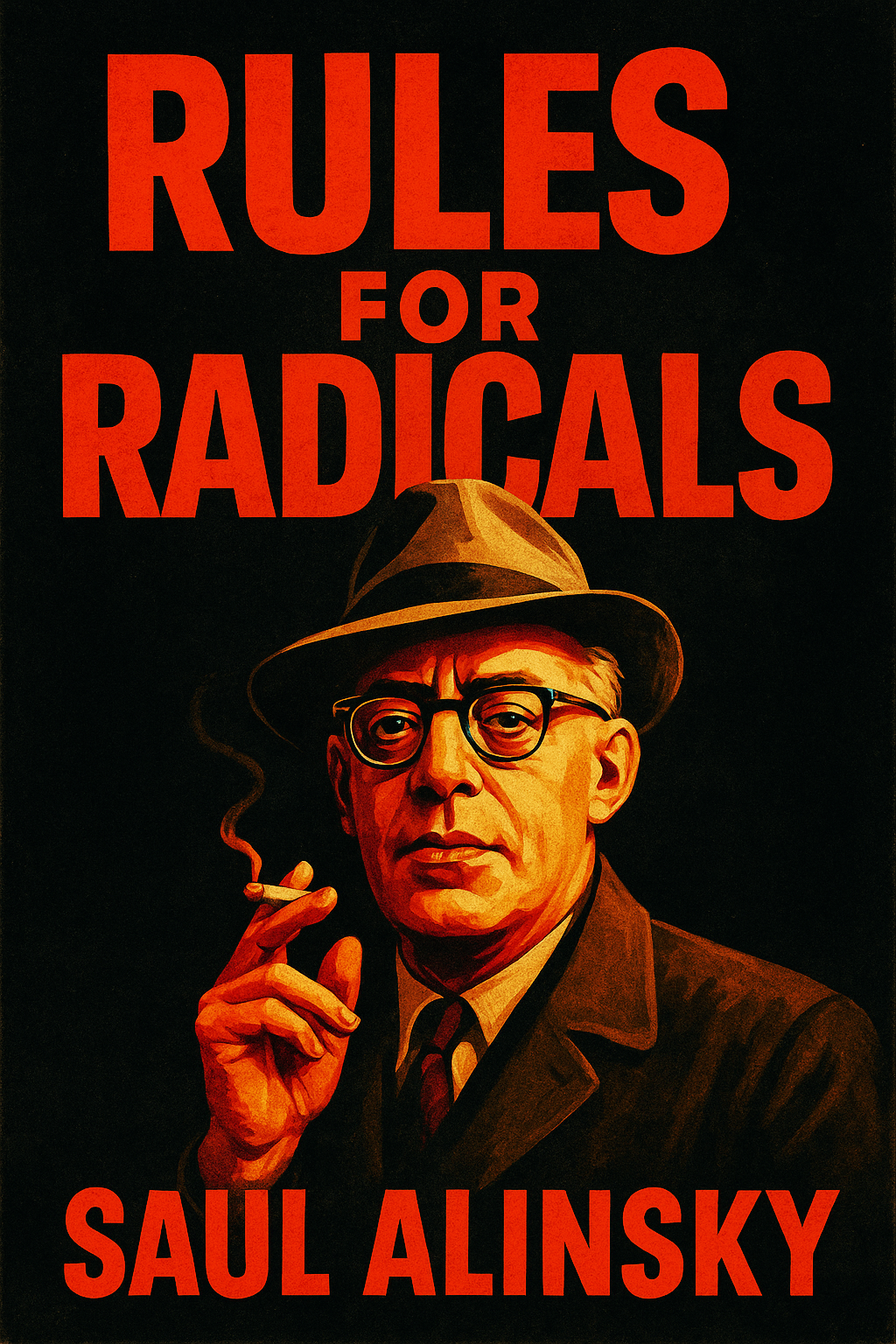
Rules for Radicals
So you want Change
Saul Alinsky’s Tactics are the Key: Tools Any Movement Can Use to change any time & any place.
This is why his ideas belong to everyone & not to a party, ideology, or faction.
Saul Alinsky is one of the most debated figures in American political strategy. Some praise him as a master of nonviolent organizing. Some demonize him as a radical progressive which is true. But when the heat and rhetoric are stripped away, one fact remains:
His tactics are neutral.
They can be used by anyone for any cause.
They serve whoever adopts them.
Alinsky didn’t invent anger, protest, community pressure, or discipline.
He simply codified ancient human strategies into written rules that anyone (left, right, or apolitical) can apply to influence slow, unresponsive systems.
Below is a clear breakdown of his core tactics, with neutral historical examples showing how they’ve been used across the political spectrum.
1. “Power is not only what you have, but what the enemy thinks you have.”
Meaning:
Perception matters as much as numbers. A small group with unity can appear larger than they are.
Examples:
Civil Rights Movement:
MLK’s marches were designed to look massive and disciplined, even when the initial organizing core was small.
Mothers Against Drunk Driving (MADD):
A handful of grieving parents created the impression of a national force and soon it became one. They dressed for success and faked it till they made it.
Tea Party Movement:
Early rallies presented themselves as a rising wave to attract serious political attention. Same thing.
Small gets screwed by big so don’t use the word I as much as the word we even if it is just a mouse in your pocket.
Ideology doesn’t matter.
The tactic do.
(Tp be clear this man wrote Rules for Radicals, dedicated it to Satan the original rebel, and believed the worse means were justified by pure ends.)
2. “Never go outside the experience of your people.”
Meaning:
Use tactics your supporters can handle taking care to overwhelm them with complexity or danger.
Examples:
Church-led boycotts that rely on actions congregations are comfortable with: prayer, donation withholding, public letters.
Farmers’ protests use tractors, markets, litteral shit, and agricultural networks they know.
Parents’ groups use school boards and petitions.
This is not radicalism.
This is practicality.
3. “Whenever possible, go outside the experience of the authority.”
Meaning:
Force institutions to deal with actions they’re not prepared for without breaking the law. You must be above reproach.
Examples:
The Montgomery Bus Boycott shocked officials because they didn’t expect long-term, peaceful non-cooperation.
ACT UP staged die-ins in public health offices that were unexpected, nonviolent, disruptive but legal.
Veterans using FOIA requests overwhelm underprepared agencies with lawful paperwork.
This is compliant resistance, not rebellion.
4. “Make the enemy live up to their own book of rules.”
Meaning:
Hold systems accountable using their own regulations, not by breaking them.
Examples:
Civil Rights attorneys used the Constitution and federal law to force states to adhere to their own principles.
Modern disability advocates press institutions to follow ADA requirements.
Environmental groups use companies’ stated ethical policies against them.
This tactic is the backbone of lawful activism.
These are our advocates TheDoctorPatientForum.com
5. “Ridicule is man’s most potent weapon.”
Meaning:
Public embarrassment forces institutions to respond faster than polite requests.
Examples:
Late-night comedians use satire to push political accountability.
Parents mock failing school boards online.
Consumers use social media humor to pressure corporations into fixing problems.
Ridicule cuts across every ideology.
6. “A good tactic is one your people enjoy.”
Meaning:
Motivation sustains movements.
Examples:
Civil Rights songs unified and energized marches.
Labor movements held communal picnics during strikes.
Modern digital activists use memes to energize supporters.
Enjoyment builds participation.
7. “A tactic that drags on too long becomes a drag.”
Meaning:
Movements must adapt or lose power.
Examples:
Long occupations or sit-ins lose attention after novelty wears off.
Boycotts must evolve or expire.
Online campaigns need phases to maintain momentum.
This is strategic time management, not ideology.
8. “Keep the pressure on. Never let up.”
Meaning:
Real change requires sustained effort not one big action.
Examples:
Civil Rights leaders filed lawsuit after lawsuit, decade after decade.
Gun rights advocates lobby tirelessly year-round.
Unions negotiate over years, not weeks.
Persistence belongs to all sides.
9. “The threat is usually more terrifying than the thing itself.”
Meaning:
Institutions fear what could happen more than what does happen.
Examples:
Corporations settle lawsuits to avoid public trials.
School districts cooperate to avoid public protests.
Agencies buckle under the threat of mass FOIA filings.
This is leverage not lawbreaking.
10. “If you push a negative hard enough, it will push through and become a positive.”
Meaning:
A weakness can be turned into strength if embraced correctly.
Examples:
MLK embraced jail time as a badge of honor.
Veterans highlight wounds to gain moral standing.
Patients’ rights groups turn suffering into advocacy power.
Suffering transformed becomes legitimacy.
This is why I embraced the label they gave me even though I know the truth.
11. “The price of a successful attack is a constructive alternative.”
Meaning:
Don’t criticize anything without a solution.
Examples:
Civil Rights leaders proposed the Civil Rights Act.
Conservative activists propose alternative school programs alongside protests.
Medical advocates offer policy reforms, not just complaints.
Movements without solutions collapse.
12. “Pick the target, freeze it, personalize it, and polarize it.”
Meaning:
Focus pressure on institutions, not abstractions.
Examples:
Civil Rights: specific bus lines, specific laws, specific officials.
Conservative activists: specific school boards or agencies.
Consumer activists: specific companies.
This tactic is often misunderstood as personal attack but historically it means clarity, not cruelty.
Alinsky was an ideologue, but his tactics are ideology-free
People argue about Alinsky because they argue about his politics, not strategy.
But his rules are just tools.
Hammers don’t care who holds them.
Neither do tactics.
Left, right, center, apolitical.
Any group seeking lawful, nonviolent reform can apply these principles.
Rules for Radicals by Saul Alinsky
Rules for Radicals is one of the most misunderstood books in American political history. People hear the title and their guard goes up because of his politics. They hear the author’s name and they assume ideology, extremism, and partisan warfare. But that reaction has nothing to do with the book itself. Alinsky didn’t write a manifesto. He wrote a field manual. A book of tactics. A handbook on how regular people without money, without power, without institutions can organize themselves and push slow, unresponsive systems to do the jobs they were already supposed to be doing.
The controversy lives in the dedication and the author’s politics, not in the tactics. Alinsky’s own ideology was progressive and confrontational, but his rules aren’t ideological at all. The rules are simply human behavior written down. They’re the patterns you see anytime a small group has to force a massive machine to pay attention. They’re how parents challenge school boards, how farmers challenge agencies, how citizens challenge bureaucracy, and how any community under pressure insists on being heard without stepping outside the law. You don’t have to agree with Alinsky… I do not. It’s important to understand the power of a tool. A hammer doesn’t become conservative or liberal when you pick it up. Neither do the tactics taught in Rules for Radicals.
What makes the book important is its honesty. Alinsky didn’t pretend change happens through polite requests or wishful thinking. He wrote bluntly about perception, discipline, unity, pressure, and how institutions respond when the people they serve stop being quiet. He showed that power isn’t just what you have it’s what the opposition thinks you have. He showed that ridicule exposes hypocrisy faster than petitions. He showed that persistent, lawful pressure outperforms outrage every time. These aren’t radical ideas. They’re human truths.
If you strip away the rhetoric, the book becomes something simple: a mirror held up to society. Rules for Radicals explains how change has always happened. It shows the mechanisms behind the marches, the boycotts, the petitions, the pressure campaigns, and the “impossible victories” history keeps delivering. You don’t have to adopt Alinsky’s worldview to learn from his clarity. You only have to recognize that any system responds to organized people who refuse to go away.
If you want change, this book shows you the mechanics. What you do with those mechanics is your own morality, your own conscience, and your own cause. I highly suggest you consume this book if you are of the mind to change things.


Leave a Reply