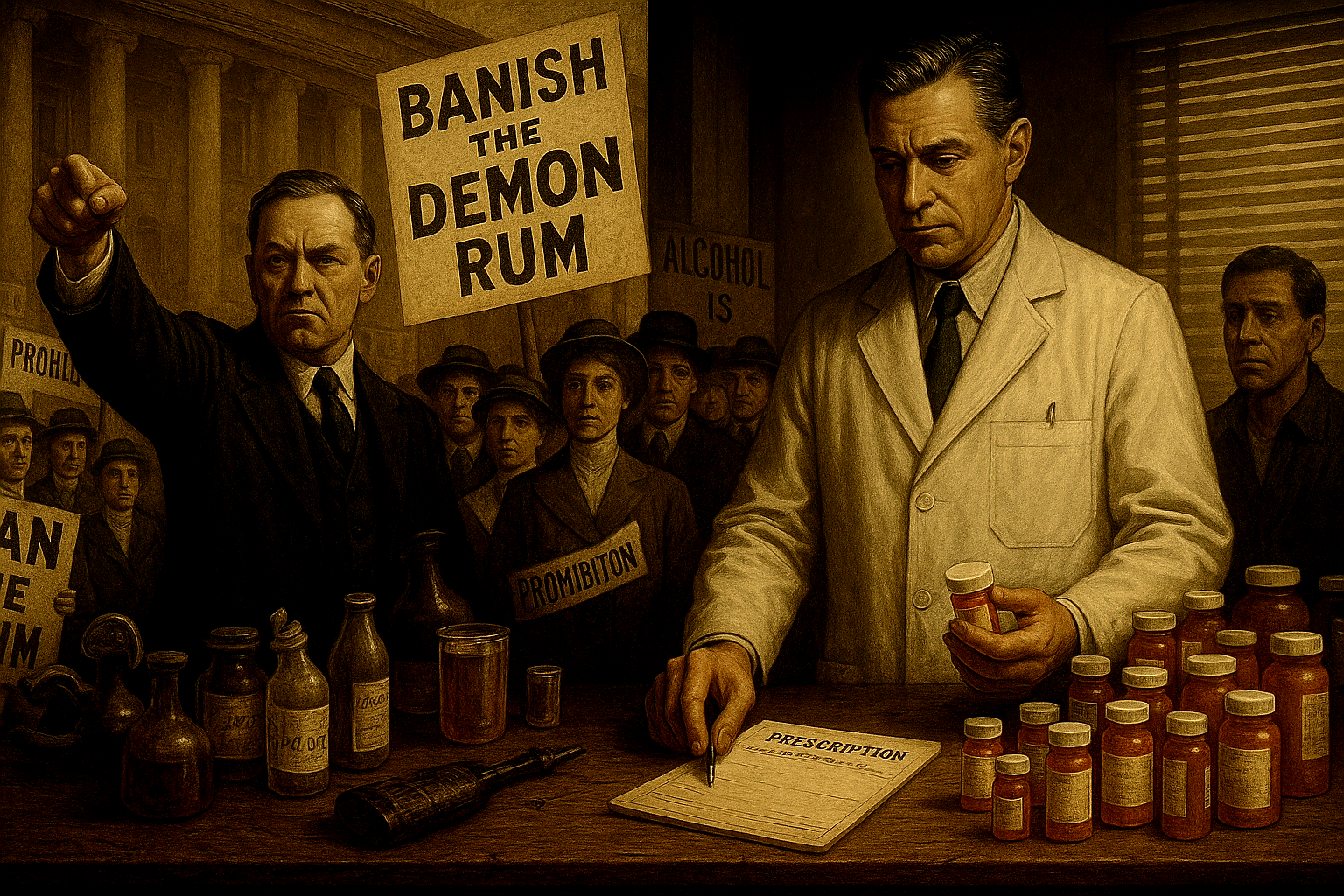
The Prescriptionist
From Prohibition to Prescription.
In the beginning, there was the Prohibitionist. He was the moral crusader of the temperance movement in the 19th and early 20th centuries. They are figure born from the fires of revivalist Christianity and the age of industrial reform. To them, temperance was salvation. Alcohol was sin in liquid form, opium the serpent’s whisper, and abstinence the only path to virtue. Their cause was framed as moral hygiene: the belief that by removing temptation, one could redeem the soul of the nation. The age of collective salvation had come bringing with it collective damnation.
But like all moral crusades, Prohibition was never just about sin. It was about control of behavior, of commerce, of medicine, and ultimately our options with regards to our body itself by the government.
The Age of Prohibition
At the dawn of the 20th century, the United States stood on the edge of three revolutions: the industrial, chemical, and the revolution of Progressivism. Factories were mass-producing everything from canned foods to morphine tablets, and medicine was transforming from folk art to science. All this while our nation was being given a New Deal… For centuries, tinctures of opium, alcohol, and cocaine were sold openly, prescribed freely, and trusted as part of daily life yet rarely used and abused even less. The day they were told they can’t though people began out of spite and a natural inclination to rebel.
That change came with the Harrison Narcotics Tax Act of 1914.
Disguised as a tax measure, the Harrison Act was the first federal drug law in U.S. history to criminalize the possession and sale of opiates and coca products without a prescription.
It redefined the doctor patient relationship, not as one of trust and mutual respect, but as one of surveillance. Under the Act, physicians who continued to maintain dependent patients on morphine were prosecuted. Thousands of doctors were arrested between 1915 and 1938.
The new Prohibitionist wasn’t just a preacher or a housewife to a drunk anymore. They wore a badge and carried a warrant. They became legislators, doctors, law enforcers and remained committed to their ideals of collective good, public health, collective salvation, and collective damnation. The state had adopted the pulpit, and the pulpit the state.
When the Volstead Act took effect in 1920, enforcing the 18th Amendment’s ban on alcohol, the pattern was set: a moral panic followed by federal enforcement, followed by black markets, corruption, and violence. It lasted only thirteen years. By 1933, the nation was exhausted, disillusioned, and thirsty… not just for drink, but for sanity. Prohibition failed, yet its spirit survived. The idea that human weakness could be cured by legal control became part of American society itself.
The Medicalization of Morality
As the 20th century matured, the language of control changed. The moral vocabulary of sin gave way to the scientific vocabulary of disease. The addict, once a sinner, was now a patient. The Prohibitionist, once a preacher, evolved into a professionals. Physicians, Psychiatrists, and Politicians.
This transformation was not sudden it like the people who designed this reset America were both progressive. It emerged from decades of cultural evolution. From the narcotics scares of the 1910s, through the reefer madness of the 1930s, to the bureaucratic order of the Bureau of Narcotics under Harry Anslinger.
Anslinger’s influence was immense; he spent three decades turning moral fear into federal policy. By the time he left office in 1962, the nation’s approach to drugs was fully institutionalized and the New Deal was the only deal most people knew.
But in replacing religion with medicine, the state did not abandon control. It refined it.
Through the 1950s and 1960s, the medical establishment began to act as both gatekeeper and moral arbiter. Judge and Jury. Substances once available to anyone such as morphine, cocaine, barbiturates, amphetamines became accessible only by prescription. The Controlled Substances Act of 1970, signed by President Nixon, codified this structure. It grouped drugs into “schedules,” defining their moral and medical worth simultaneously.
Schedule I substances, like heroin and LSD, were deemed to have “no accepted medical use”. A phrase not based on clinical data, but on political judgment. Meanwhile, Schedule II substances such as morphine, cocaine, methamphetamine… were recognized as medically valid but tightly controlled. The underlying message was clear: morality had been rebranded as medicine, and authority had moved from the pulpit to the prescription pad.
The War on Drugs that followed was both moral and medical. Addiction was labeled a disease, yet treated as a crime. Society claimed compassion while building prisons. The state promised rehabilitation while funding enforcement. The Prohibitionist had not died; he had simply donned a white coat, a state uniform, or a blue suit and they all grew very wealthy.
The Age of the Prescriptionist
Where the Prohibitionist sought to ban, the Prescriptionist sought to manage. They did not destroy the substance they sought to domesticated it. They medicalized desire itself.
By the 1990s, new synthetic opioids like oxycodone were marketed as safe, humane alternatives to older narcotics. Pharmaceutical companies, aided by regulatory complacency and aggressive marketing, promised a world without pain. Physicians were encouraged to treat pain as the “fifth vital sign,” and opioids as the moral solution to suffering.
It was a stunning inversion. What had been condemned as vice was now prescribed as virtue. Yet when the inevitable wave of dependency followed, society rediscovered its familiar scapegoat: the patient.
By the early 2000s, the opioid crisis exposed the hollowness of both prohibition and prescription. The pendulum swung again from under-prescription to over-prescription to fear of prescribing at all. In 2016, the CDC issued new guidelines that effectively chilled legitimate pain treatment nationwide. By 2020, chronic pain patients were being tapered off medication or cut off entirely, often with catastrophic results. Some turned to illicit opioids. Some turned to suicide. At this point I had been ran through the ringer and turned around to face it all and find out why.
The Prescriptionist, once hailed as healer, must be rebranded as villain. Yet his philosophy… will remain and is firmly embedded in the nations of the world.
Today, we live in times that are progressively trying our hearts in intensity. Cannabis is legal in much of the country. Psychedelics are being studied for depression and trauma. Harm reduction programs distribute clean syringes and naloxone but at the same time, doctors face prosecution for prescribing opioids, and patients endure stigma for needing them. The pendulum still swings, but the conversation is changing.
The Overton Window is that range of what society considers acceptable thought and it’s ours to shift. The idea that substances can be managed intelligently, that morality and medicine can coexist, that pain deserves treatment rather than judgment, does not have to come off as radical. It is, increasingly, the mainstream view amongst most people who have been in pain and denied help. Everyone hurts eventually. That’s the only kind of progress I support.
Prescription as a New Moral Framework
The term Prescriptionist describes not just a profession but a worldview. It asserts that regulation without understanding is tyranny, and compassion without discernment is chaos. It is a call for moral adulthood for a society mature enough to handle the tools it invents. Personal responsibility is the name of this game. That and keeping oneself in one’s own hand.
Prescriptionism recognizes what Prohibition ignored: that human beings have always sought to alter consciousness, to soothe pain, to commune with the divine or escape despair. These impulses are neither new nor evil. They are elemental. Designed by nature and Nature’s God.
Every culture throughout history has had its medicines, its intoxicants, and its rituals… they never lacked for people who wished to govern their use either. The Greeks had wine and symposium; the Chinese, tea and opium; the Native Americans, tobacco and peyote. None were purely medicinal or purely recreational — they were instruments of meaning. The modern world stripped them of that context, reducing them to chemicals and crimes.
Prescriptionism seeks to restore that balance — not by romanticizing drugs, but by acknowledging their power and demanding responsibility. It insists that knowledge is the true regulator and conscience one’s true compass.
The modern Prescriptionist is not a dealer nor a doctor in the traditional sense. He is an educator, an ethicist, and a steward of humanity in their own eyes. They believe that access must be earned through submission, that freedom must be weighed with accountability to the publicist health. Financial health that is…
They know that medicine without morality becomes addiction, and morality without mercy becomes tyranny. They have also learned how to profit of never letting a public health crises go to waste… so they keep it going. America’s longest running war is the War on Drugs. Something being escalated south of us as I write this.
The Future Beyond Fear
We stand today between two failed models. Prohibition criminalized suffering. Prescription, as it exists now, commodified it. The ball is ours, I say we move in our hearts towards wanting neither forbidden nor freely exploited medicines in the pursuit of understanding and our health as individuals.
Such a system would treat pain patients not as liabilities but as individuals. It would see addiction not as a crime or a chemical destiny, but as a wound of spirit, deserving treatment rooted in dignity. It would demand that policymakers listen to science, that science respect experience, and that society remember compassion. I wish this peace and security on you all.
It would recognize that no law, no pill, no policy can erase the fundamental truth: human beings will always seek relief. The question is whether that relief comes through knowledge or ignorance, through prescription and prohibition of from family gardens and God.
The Return of Conscience and personal responsibility
In The Rules of Vice, a chapter in the book im working on a argument is made that virtue is not abstinence, but sovereignty of will and the ability to separate emotion from sensation, and to act with conscience rather than compulsion. The Prescriptionist is born from this same sense of truth and truly believes their pursuit is righteous. Don’t hate them, but don’t join them either. The time for agreeing to disagree has come and passed.
I understand that pain is not evil, and pleasure is not sin. Both are signals. Both require mastery and the ability to assume personal responsibility.
I do not worship the medicine, nor fear it. I have learned from it and bet you have too. Learned a lot about yourself and the world that you wouldn’t otherwise know.
The Prohibitionist sought purity through denial. The Prescriptionist seeks balance through management. I as an individual being forced to suffer simply wants to be left alone.
And as the world moves deeper into an age of synthetic temptation and algorithmic control, it is the Prescriptionist… not the Prohibitionist… who refuses.
“We do not fear the flower, nor worship it.
We study it, respect it, and learn from its mercy.
These are Seeds of Vice.

Leave a Reply