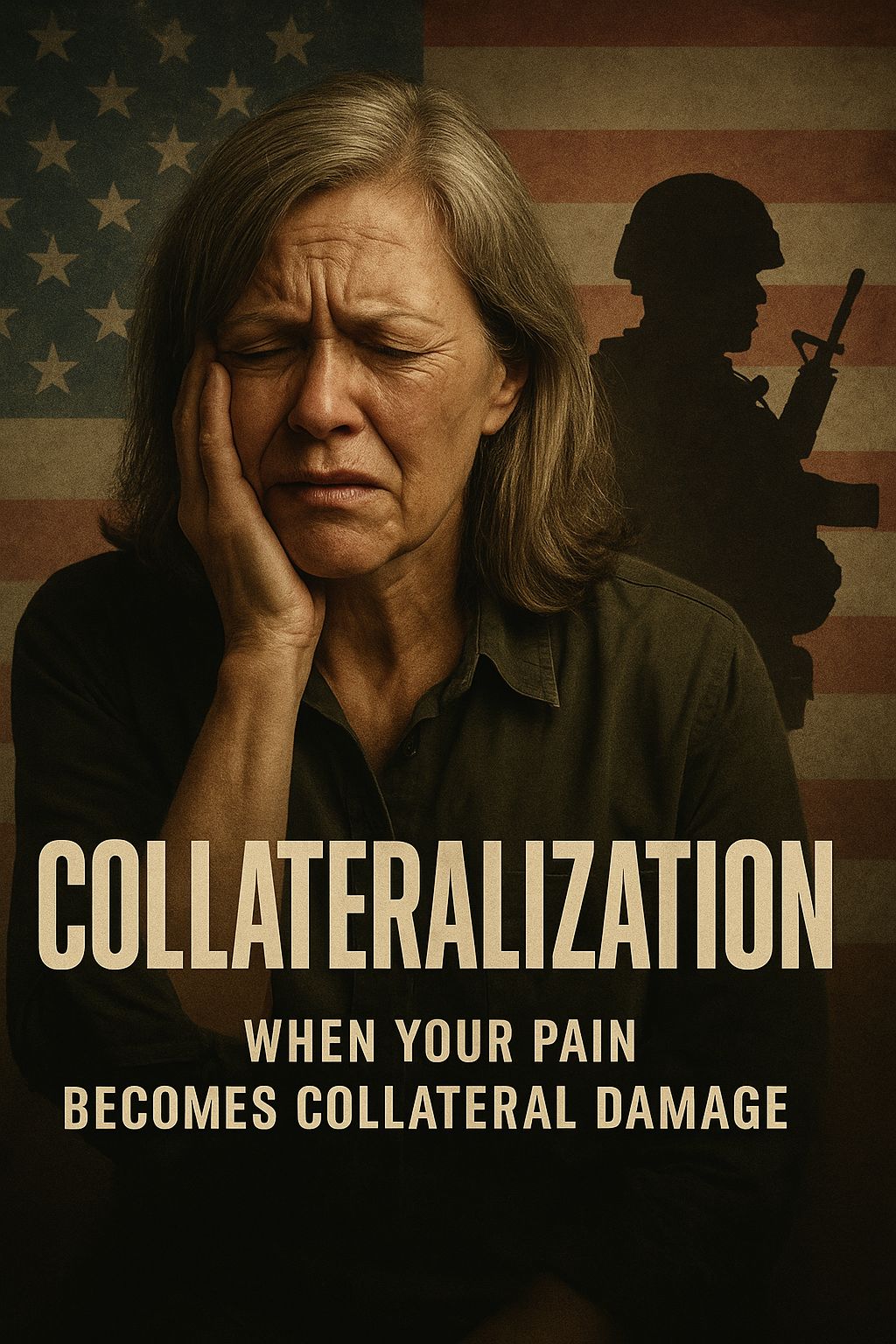
Pain and War Time Powers
Collateral Damage
When a government shifts opioid policy into wartime framing, opioids stop being seen primarily as medicine and start being treated as materials connected to a threat environment.
This is the core point:
In wartime logic, the mission comes first, and anything connected to the supply chain becomes collateral.
All Opioids fall into that category not because patients are enemies,
but because the substance itself enters the battlefield narrative.
1. Peacetime Thinking vs. Wartime Thinking
Peacetime:
Opioids are medicine. Use them carefully but make sure patients get what they need.
Wartime:
Opioids are part of the enemy’s supply network. Disrupt the supply. Damage the chain. Tighten access. Zero tolerance, almost Zero dependence allowed nationwide.
When a substance is reclassified psychologically as a threat,
the people who depend on it are no longer centered in decision-making.
That is collateralization. And we are the Expendables.
2. The Patient Is Not the Target — the Patient Is the Cost
This is the hard truth people must hear:
Collateral doesn’t mean intentional harm.
It means allowed harm. Ending the use of opioids will come at the price of your medicine and they’re perfectly fine with you paying that price for society in the war effort.
Collateral means:
They know some people will suffer.
They know legitimate patients will lose access.
They know hospitals will run short.
They know chronic pain patients will go into withdrawal.
They accept these losses because the mission is more important.
That is what wartime framing does.
It’s about to be your patriotic duty to go without.
3. Why Opioids Become Collateral
Because the government is reframing opioids as:
poison
a threat
the weapon of cartels
a national security issue
a foreign enemy’s delivery system.
Once that happens, the logic shifts from:
How do we treat pain?
to
How do we shut down everything connected to this substance?
And in that shift, the patient disappears from the equation.
Not targeted.
Just not considered.
4. The Pain Patient’s Experience Under Collateralization
Doctors stop prescribing out of fear.
Pharmacies don’t stock the medication.
Insurance rejects anything high-risk.
Withdrawal becomes common, untreated, and ignored.
Chronic pain becomes a “luxury problem” in wartime logic.
The message becomes:
“Your suffering is sad, but stopping the supply is more important.”
That is the definition of collateralization.
6. Why This Matters Right Now
Because governments are shifting language from:
opioid crisis → to poisoning Americans…
cutting off supply is in defense of the patient…
the terrorist networks bet violent and their product degrades into something legitimately close to poison.
war on opioids becomes the poisoning of a nation.
take the fight inland again becomes in defense of us why they push us to suicide and fundamentally transform our nation and the worlds.
zero tolerance… That means all the responsibility but no control over your healthcare.
Your suffering is a personal problem. They will treat you like you are self harming. They will load you up on anti depressants and tell you and everyone else you are mentally ill. And they will still call you fat, or too young to get medicine. They’ll stack the reasons but the main reason is our government assuming control over our individual pursuits of health collectively.
Wartime words justify wartime actions.
Wartime actions produce collateral damage.
Chronic pain patients are that collateral.
We are entering a moment where the government’s mission is to eliminate a supply chain, not manage our medical realities.
And when that happens, the people who hurt… the ones who depend on these medicines to stand, to work, to live…
they become invisible to the system.
That invisibility is what I mean by collateral.
This mirrors what I have already lived through being mislabeled an addict. You all are about to be forced to live like I have been. I almost did myself in. To be shunned by the medical industry in a world where they drugs are controlled by people who can destroy your life on both sides of the law is almost unimaginable.
Imagine it anyway and then print off all the articles on here and do everything you can to help yourself be healthy. It’s the best bet you can make going forward. That in the end you are going to be the only one who can save you any given day.
I. ACCESS TO MEDICINE
What you are used to:
Doctors decide what patients need.
Prescriptions follow medical judgment (within tight limits).
Pharmacies stock standard doses.
Appeals and second opinions are possible.
Pain management is a recognized medical field (even if restricted).
What to expect under wartime powers:
Doctors lose discretion while dosing becomes dictated by policy.
Wartime supply chains mean shortages, not just restrictions.
Pharmacies carry fewer opioids or none at all.
Appeals are slow or pointless because wartime rules override civilian review.
“I think you are going to find this is War” ~ President Trump
Pain management becomes risk management, not relief.
II. SURVEILLANCE & OVERSIGHT
What you are used to:
Prescription monitoring programs, but doctors still decide.
Pharmacies report patterns, not individuals.
Investigations require cause.
What to expect under wartime powers:
Automatic surveillance of patients flagged as high risk.
Doctors questioned for any opioid prescribing.
Pharmacies required to report every controlled substance transaction.
Medicine treated as likely contraband.
Minimal judicial oversight because war language expands authority. Meaning they are going to make a lot up as they go.
III. DOCTOR–PATIENT RELATIONSHIP
What you are used to:
Doctors advocate for the patient.
Medical necessity matters.
Chronic pain is a recognized condition.
What to expect under wartime powers:
Doctors fear prescribing much more than they already do. Not because of regulation, but because wartime frames turn prescribing into supporting a supply chain by creating potential customers for the nations enemies.
Medical necessity becomes irrelevant; risk avoidance rules.
Chronic pain becomes a non-priority compared to combating “poison.”
And no legal means of recourse. The “medical cartel” will be protected as were the vaccine producers.
IV. SUPPLY CHAINS
What you are used to:
Domestic production controlled but predictable.
Pharmacies refill on schedule.
Manufacturers maintain quotas.
What to expect under wartime powers:
Wartime interdiction abroad means domestic shortages at home.
Quotas lowered sharply
Hospitals reserving opioids for trauma, surgery, and palliative care only.
Civilian pharmacies phased out of opioid distribution.
V. LEGAL STATUS OF OPIOIDS
What you are used to:
Legal but controlled medicine.
Schedule II drugs require paperwork but are available.
Diversion is punished, not use.
What to expect under wartime powers:
Wartime language reclassifies opioids as “battlefield materials” — meaning the default assumption becomes danger, not treatment.
Entire categories may be removed from civilian use for “national security reasons.”
Schedule tightening to the point of practical elimination.
VI. CONSEQUENCES FOR PATIENTS
What they are used to:
Frustration, shortages, stigma… but access still exists in some form in most cases.
Specialists can still advocate for exceptional cases.
Some pathways still function.
What to expect under wartime powers:
Rapid cuts to medication without warning.
Forced switches to weaker drugs that do not work.
Increased withdrawal cases in the medical system.
No appeals process because wartime decisions override patient rights.
Suffering explained away as “necessary to fight the poison.”
VII. CONSEQUENCES FOR DOCTORS
What you are used to:
Risk of investigation but still humane flexibility.
Ability to justify treatment decisions.
What to expect under wartime powers:
Prescribing becomes a liability.
A single opioid prescription could trigger audits.
Doctors preemptively drop all chronic pain patients.
Many exit pain management entirely.
VIII. GOVERNMENT MESSAGING
What you are used to:
“Opioid crisis,”
“Overprescribing,”
“Addiction prevention.”
What to expect under wartime powers:
“Poison,”
“War,”
“Terror networks,”
“Cut off at the source,”
“Total elimination,”
“Zero tolerance.”
Wartime language justifies wartime action.
Wartime action does not accommodate chronic pain.
IX. THE BOTTOM LINE
NORMAL ERA:
Medicine is controlled.
WARTIME ERA:
Medicine becomes collateral.
You should expect less access,
more surveillance,
stricter rules,
unpredictable shortages,
and a system that views opioids as a strategic threat rather than a tool of care that’s abused.

Leave a Reply