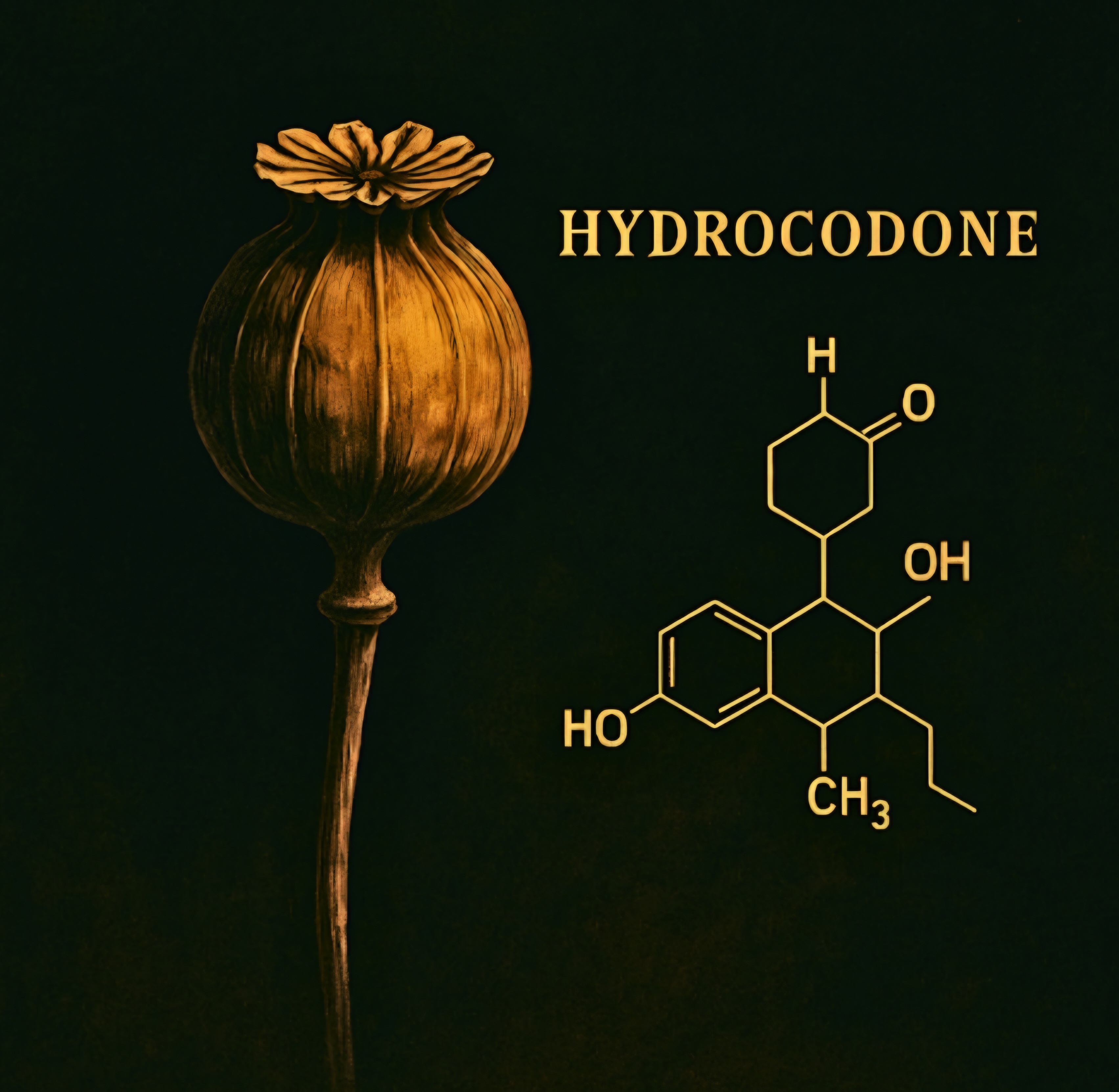
On Hydrocodone
The story of hydrocodone doesn’t start in a lab or on a prescription pad. It starts where every narcotic story begins: in the sap of Papaver somniferum… that bitter, milky resin carrying both mercy and danger in the same breath. Inside that sap is the blueprint of relief and ruin, a design older than any chemist.
By the 19th century, humanity wasn’t content to take the flower as it grew. Chemists learned to take the poppy apart molecule by molecule, isolating its crystalline alkaloids, reshaping and refining them into new medicines. Medicines that worked. Medicines people were grateful for. Medicines that didn’t need marketing because freedom itself was their selling point.
Codeine: The Gentle Brother of Morphine
In 1832, French chemist Pierre Robiquet pulled something remarkable from the poppy’s depths: codeine. Gentler than morphine, it quickly became the household remedy trusted for coughs, colds, and the softer aches of ordinary life. Morphine belonged to the battlefield and the operating table. Codeine belonged to the bedside. Physicians praised its reliability and its mercy, calling it the safer sibling in a family of powerful medicines.
By the turn of the century, codeine was everywhere. It lived in cough syrups, tonics, “cure-alls,” and more than a few snake oils. It became the civilized narcotic. The one mothers kept in the cupboard and gave their children when a night cough tore at their lungs.
As hydrocodone emerged and codeine syrup took hold, laudanum slipped quietly into the shadows of history. Not because it failed. Not because it lost its power. But because medicine had found something more precise, more predictable, and, for a time, more acceptable to the world. This is how the how and when laudanum was forgotten.
Thebaine: The Poisonous Clay
Alongside morphine and codeine lay thebaine, a less abundant alkaloid. To the body it was convulsive, toxic, unusable. But to chemists it was treasure. Its reactive double bonds made it pliable, a skeleton that could be transformed into countless derivatives. Thebaine became the clay from which semi-synthetic opioids were sculpted: oxycodone, naloxone, buprenorphine and later, hydrocodone. The poppy they lean on the most for Thebaine is the Tazmanian Poppy. The super poppy. High in Thebaine doesn’t make for High morphine content however. It’s main use is for it’s Thebaine to be used in synthetics.
The German Chemical Century
By the late 19th century, Germany had become the crucible of chemical innovation. Firms like Bayer, Merck, Hoechst, and Knoll dominated the world market. They produced dyes, fertilizers, explosives and medicines. German laboratories refined morphine, created heroin in 1874 (marketed in 1898), and soon turned their attention to codeine.
Heroin was supposed to be the answer to morphine’s addiction. Almost all synthetic opioids produced are first produced in the pursuit of a non habit forming opioid that people can not feel working. Heroin… it proved to be worse. By the 1910s, the illusion had collapsed.
Governments banned heroin, the United States leading with the Harrison Act (1914), followed by international treaties. Yet the demand for narcotics did not vanish. Doctors still needed strong painkillers. Patients still sought relief. The pharmaceutical industry, stripped of heroin, turned to codeine as the next best source of modification. Safer equaled better and so they pushed it on people needing help and the people were thankful.
The Search for a “Better” Opiate is ongoing and intertwined with the War on Drugs
After World War I, the world’s appetite for medicine was immense. Soldiers returned home with wounds that lingered, both visible and invisible. Morphine was too strong, too binding. Codeine was too weak for the battlefield’s legacy of injuries. People needed a stronger medicine. Morphine was taboo, Heroine was Heroin, and cough syrup wasn’t enough for broken bones and bent backs that had to work every day come hell or high water. At this point people started to miss out on business opportunities, and were beginning to fall into the cracks where they had to watch life pass them by. The industry yearned to cover the middle ground left bare by prohibitions prescriptions and a growing war on drugs. They were drug seeking at it’s finest looking for a narcotic as effective as morphine, but as safe as codeine. It was here that the story of hydrocodone began.
Chemists at Knoll in Germany, heirs to a century of morphinan experiments, looked to codeine as their raw material. If codeine could be modified by its skeleton being bent by oxidation, hydrogenation, and substitution perhaps it could yield something stronger yet still “civilized.” Something potent but less addictive, effective but less prone to abuse. (The search for such a medicine is the search for the Philosopher’s Stone.)
In 1920, hydrocodone was born.
Hydrocodone did not appear by accident. It was the product of a time, a people, and a problem. Germany after the First World War was a wounded nation, stripped of colonies, bound by reparations, its factories choked by treaty. Yet its chemical industry remained the envy of the world. The same furnaces and flasks that had once produced dyes and explosives now turned their attention to medicines, for commerce, for prestige, and for survival.
The Minds at Knoll
The laboratories of Knoll AG, in Ludwigshafen, were filled with chemists trained in the proud tradition of German organic chemistry. They worked with glassware blown by hand, reagents stored in corked bottles, and notebooks written in spidery script. Among them were men like Carl Mannich remembered for the “Mannich reaction” still taught to chemists today. Younger researchers as well who saw codeine not as a finished drug but as raw material.
Though the records do not always preserve their names as clearly as Sertürner or Bayer’s heroin pioneers, these were men cut from the same cloth: restless, precise, ambitious. They had grown up in a world where morphine was a King, seen heroin rise and fall, and now carried the charge to create a narcotic that would escape scandal and secure Germany’s role in global medicine.
The Chemical Vision
Their idea was straightforward in their mind: codeine was too weak, morphine too strong. Somewhere between them, hidden in the morphinan skeleton, lay a compound that balanced power with safety.
They imagined codeine’s skeleton as a machine, its gears and levers turning in the locks of the human brain. What if hydrogenation could soften its harsh edges? What if oxidation could sharpen its activity? What if the right balance of modifications could produce a medicine smoother, cleaner, more versatile?
So many what ifs.
It was a vision born not only of science but of necessity. The world’s governments wanted effective pain relief and cough suppression but had declared heroin and morphine unacceptable. A gap in medicine had opened, and chemists at Knoll moved to fill it. The entire time people around the worlds had begun to be made into criminals by the stroke of pens over their pursuit of health and desire to self medicate rather than be medicated by the government.
The Laboratory Work
The process began with codeine, isolated from the poppy or synthesized from morphine. The chemists subjected it to hydrogenation, a process that even in the 1920s was familiar but still delicate. Glass vessels were rigged with metal catalysts, platinum oxide or palladium on carbon. Hydrogen gas hissed into the flasks under measured pressure. Hours passed as bonds broke and reformed, the double bond between the 7th and 8th carbon atoms saturated with hydrogen.
Next came oxidation at the 6th carbon. Chromium salts, known for their reactivity, were used to strip away a hydrogen atom and transform a hydroxyl group into a ketone. The air in the lab carried the sharp tang of acetic acid, the metallic bite of chromium, the faint sweetness of codeine itself. Chemists peered into the changing mixture, monitoring color, pH, and crystallization.
At last, the crude product was washed, filtered, and recrystallized. What fell from solution was not codeine, not morphine, not heroin, but a new crystalline salt: hydrocodone. White, sharp-edged, bitter to taste, soluble in water.
The First Trials
In hospital wards, doctors began administering the new drug in small doses. Hydrocodone showed its dual face: potent against pain, steady against cough. It acted more strongly than codeine but did not sedate as heavily as morphine. Patients with tuberculosis coughed less and slept more. Patients with injuries reported relief without slipping as deeply into narcotic haze.
The results were modest, careful, but promising. Here, perhaps, was the balance long sought.
A Child of Its Century
The year was 1920, the world still staggering from war. Men limped home from the front with shattered bones and seared lungs. Influenza had scythed through millions. Tuberculosis remained a scourge. Pain and cough were not abstract afflictions but rather were daily companions for millions.
Into this landscape hydrocodone entered, not as a miracle, but as a tool. Morphine a gift from God, Hydrocodone a gift from the governments of the world regulating a demand into existence where there otherwise was none. Another attempt to bring equilibrium between mercy and ruin, between relief and control. It was, like all the poppy’s children, both a gift and a gamble the government didn’t care if a person used or rejected as long as it was there a defendable option offered up after prohibition bore prescription.
The Chemistry of Hydrocodone
Every drug begins with a question of structure. The story of hydrocodone begin nor end with a pill bottle but in the strange geometry of the morphinan skeleton. Five fused rings that bind the human brain like a lock and key. To alter that skeleton is to alter destiny: relief, ruin, or something in between.
The Morphinan Core
The poppy’s alkaloids share a morphinan nucleus: a rigid, polycyclic cage of carbon atoms with a single nitrogen bridgehead. This nucleus gives them their power. Its geometry fits into the μ-opioid receptor like a key into a lock, turning on signals that suppress pain, slow breathing, and induce euphoria.
Morphine, codeine, thebaine all carry this nucleus, but the position and nature of their functional groups (hydroxyls, methyls, double bonds) dictate how tightly they bind, how strongly they activate, and what shadows they cast on the body.
Hydrocodone, though born of codeine, would shift this balance through subtle changes at two positions: saturation of the 7,8 double bond, and oxidation of the hydroxyl at carbon-6 into a ketone. These tweaks sound small; in pharmacology, they are seismic.
Step One: Preparing Codeine
The substrate was codeine (3-methylmorphine). Codeine could be: Directly isolated from opium, though present in smaller amounts than morphine. Synthesized by methylating morphine at the 3-hydroxyl position, a method already familiar by the late 19th century. Either way, the chemist began with a crystalline alkaloid ready to undergo transformation.
Step Two: Hydrogenation at the 7,8 Bond
Codeine carries a double bond between carbons 7 and 8. This bond contributes to the rigidity of the morphinan cage and subtly influences how the molecule sits in the receptor.
1920s Process: Codeine was dissolved in ethanol or acetic acid and placed in a hydrogenation vessel. A catalyst of platinum oxide (Adams’ catalyst) or palladium on carbon was introduced. Hydrogen gas was bubbled into the flask under controlled pressure. Heat was applied gently. Over hours, hydrogen atoms added across the double bond, saturating it. The 7,8 bond was no longer a hinge but a fixed join.
Modern Process: Hydrogenation is done in stainless-steel autoclaves under precise controls. Catalysts are immobilized, hydrogen is metered in exact molar equivalents, and reactions are monitored by in-line spectrometry. Where the chemists of Knoll relied on sight, smell, and patience, today’s engineers rely on sensors and software. Making drugs is a big business these days. Some would say too big to fail… Which is why it is protected.Anyway, The result was dihydrocodeine, a softened scaffold, ready for the next stroke.
Step Three: Oxidation at the 6th Carbon
The decisive move was at carbon-6. In codeine, this carbon bore a hydroxyl group. In hydrocodone, it would bear a ketone.
1920s Process: Chromium trioxide in acetic acid was the tool of choice as it is powerful, harsh, effective. The hydroxyl was oxidized, stripping hydrogen, inserting oxygen, yielding the ketone. But chromium chemistry was unforgiving. Too much, and the molecule collapsed into useless debris. Too little, and the transformation was incomplete. Chemists watched carefully: changes in color, pH, and crystal formation guided their hands.
Modern Process: Chromium salts have largely been abandoned. Today, oxidations are performed with TEMPO-based catalysts (stable nitroxyl radicals) or via enzymatic oxidations using engineered microbes. Flow chemistry allows the reaction to be run continuously, with real-time analysis ensuring near-perfect yields. Waste is minimized, and purity is assured.
This oxidation at C-6 reshaped the pharmacology. The ketone increased binding affinity to the μ-opioid receptor, enhancing analgesic potency compared to codeine.
Step Four: Purification and Crystallization
The crude product was purified through solvent washes, charcoal filtration, and recrystallization. Hydrocodone was often prepared as the bitartrate salt, chosen for its stability and solubility. The result was a fine white powder, bitter on the tongue, soluble in water, suitable for compounding into syrups or pressing into tablets.
The Stereochemistry
Hydrocodone, like its relatives, is chiral. Its atoms are arranged in a 3D geometry that matters deeply to its effect. Only the (–)-isomer, matching the handedness of morphine, binds strongly to the μ-opioid receptor. The synthetic process at Knoll preserved this stereochemistry, carefully avoiding racemization (the production of inactive mirror-image isomers). This was not an accident but the fruit of Germany’s long expertise in stereochemical control.
Binding to the Brain
When hydrocodone enters the bloodstream, it crosses the blood–brain barrier and meets the μ-opioid receptor. Compared to codeine, hydrocodone binds more strongly and activates the receptor more fully. Compared to morphine, it binds with less affinity but still delivers potent analgesia.
Pharmacologists describe hydrocodone as a partial agonist: it activates the receptor enough to dull pain and suppress cough, but not with the full force of morphine. This partial nature was what made it attractive, strong, but not overwhelming. In practice, of course, dependency still followed.
See dependency isn’t going to be found in the plant but the individual.
The Alchemy of Refinement
In the hands of the Knoll chemists, this was no mere laboratory trick. It was alchemy of a new age. They took the gentle brother, codeine, and through hydrogenation and oxidation sharpened it into something closer to morphine, but still clothed in civility. Hydrocodone was not a wild child like heroin, but a polished one, suited for prescriptions, for syrups, for pills.
The molecule was proof of a principle: that by reshaping the skeleton of the flower, man could fashion new destinies from old.
From Bench to Factory
The same steps were soon repeated not in milliliters but in liters, then tons. Pilot plants scaled hydrogenation in steel reactors, oxidation in industrial vessels, crystallization in vats that filled whole rooms. Workers shoveled codeine into hoppers, valves hissed, centrifuges spun. By mid-century, hydrocodone was flowing into pharmacies by the ton.
Yet whether coaxed in a flask or conjured in a factory, the molecule was the same: a ketone where once there was a hydroxyl, a saturated bond where once there was a double bond. Hydrocodone is the child of codeine, forged by man’s restless hand.
Into the Clinic
Hydrocodone stepped from the glassware of Knoll’s chemists into the sickrooms of Europe in the early 1920s. No grand announcement heralded it, no bold advertisements like Bayer’s heroin had once enjoyed. Its entry was quiet, clinical, almost cautious. Doctors who had grown wary of morphine’s chains and horrified by heroin’s scandal now tested this new derivative with measured hands.
The Dual Promise: Pain and Cough
Two things mattered most to physicians in that era: pain relief and cough suppression. They cared but this was before the era of doctors paid to not treat people…
Pain Relief: Soldiers returning from the First World War carried injuries that haunted them and would kill anyone who tried to take their medicine. Good men. Shrapnel lodged in bones, amputations that never fully healed, nerves burned by mustard gas. Morphine could still soothe, but too often it brought stupor and dependency. The stupor they appreciated as the distraction it was and no one who has to take medicine for the rest of their life cares about dependency. Hydrocodone seemed to offer a middle ground: strong enough to dull the ache, lighter in its narcotic haze. It works extremely well.
Cough Suppression: Tuberculosis was still a killer. Influenza had just ravaged the globe in 1918, leaving the memory of lungs torn raw by coughing fits. A medicine that could calm the cough was not only merciful but, life-preserving. Hydrocodone’s antitussive properties, stronger than codeine’s, quickly got everyone’s attention. Here was a drug that could serve both the soldier and the consumptive on the battlefield as well as at home.
The doses were modest, usually 5–10 mg, sometimes paired with expectorants or other analgesics. Physicians praised its reliability, noting fewer complaints of nausea and sedation compared to morphine.
Why Doctors Trusted It
Doctors of the interwar period were pragmatic. They needed drugs that worked, that could be dosed orally, and that would not scandalize their practice. Hydrocodone seemed to check those boxes.
Potent but manageable: Not as overwhelming as morphine, but stronger than codeine.
Oral effectiveness: Unlike morphine, which often required injection for full effect, hydrocodone worked well by mouth.
Versatility: Equally at home in cough syrups and pain tablets.
Physicians began to prescribe it widely, especially in America, where the pharmaceutical industry was growing rapidly and pain relief was increasingly seen as a moral imperative.
The Seeds of the Future
What no one yet realized was how these early prescriptions planted the seeds of dependency on a national scale. Hydrocodone was mild enough to be trusted, effective enough to be demanded, and versatile enough to be prescribed for countless conditions. Its very success in the clinic ensured that it would one day become not just another narcotic, but one of the most consumed drugs in the United States.In the 1920s and 1930s, it was simply another tool in the physician’s kit. By the late 20th century, it would be a household name.
The Hydrocodone Era
There was a time, not long ago, when hydrocodone was everywhere. The names Vicodin, Lortab, Norco. Families shared their supply over the dinner tabke when one of them hurt. They were written on prescription pads, tucked into bathroom cabinets in every home. The media, made an ordinary part of everyone’s life a scandal. To the government, it was an opportunity to further legislate. But to those who lived inside bodies broken by accident, disease, or the slow grind of age, this was the Hydrocodone Era, and it was nothing short of the best of times.
A Pill That Gave Back Dignity
For the man with crushed vertebrae who had worked his whole life, hydrocodone meant rising from his chair and walking without tears. For the woman with lupus whose joints screamed every morning, it meant cooking for her family instead of lying in bed. For veterans carrying wounds from Vietnam and the Gulf, it meant sleep uninterrupted by fire in their bones.
It was not luxury. It was not indulgence. It was functionality. Hydrocodone gave back the ordinary parts of life. The ability to bend, to cook, to drive, to laugh and play. Parts of life that pain had stolen. In that way, it was not just medicine but life.
A Shared Language of Relief
Doctors trusted it. Patients trusted it. Families recognized the bottles and measured out pills with care. There was, in those years, a shared experience of independence and relief.
A dentist prescribed a few after surgery. A primary care doctor renewed them for a back injury. A grandmother kept them by her bedside, taken sparingly, reverently, like a sacrament. These small white tablets became woven into the fabric of every American’s life.
Pain was no longer endured in silence. Relief was expected, available, affordable, and in the moment allowed. For many, this was the first and last time in history that medicine had truly matched their need.
The Golden Window
In retrospect, the Hydrocodone Era was a golden window. A time when the balance between pain and relief tilted, however briefly, toward mercy. Before prohibition tightened the rope that had already been looped around our necks, before fentanyl darkened the scene and made escaping pain a game of Russian Roulette , hydrocodone was widely available, widely prescribed, and widely effective.
Yes, dependency came. But dependency was a personal problem that only popped its head up when ends didn’t meet and someone had to go without till they could afford more. The whole story was real relief, offered to millions who had spent lifetimes without it. For a time it was blissful.
A Blessing Remembered
Ask the people who lived through it, and they will not tell you of pill mills or scandals. They will tell you they don’t really remembering anyone complaining of hurting and that they remember the medicines they use to have out of nostalgia.
For them, hydrocodone was not a vice but a blessing that existed in the background of daily life. It was the medicine that gave them back pieces of their lives thought lost due to prohibitions prescription system over fears of morphinism and heroin abuse.
The era has ended. Prescriptions have tightened, stigma has spread, and fentanyl has risen to fill the vacuum. But in memory, the Hydrocodone Era remains a chapter of reprieve. The time when pain met its match, and relief was not forbidden but shared.
This is the next article from the Start Here page

Leave a Reply