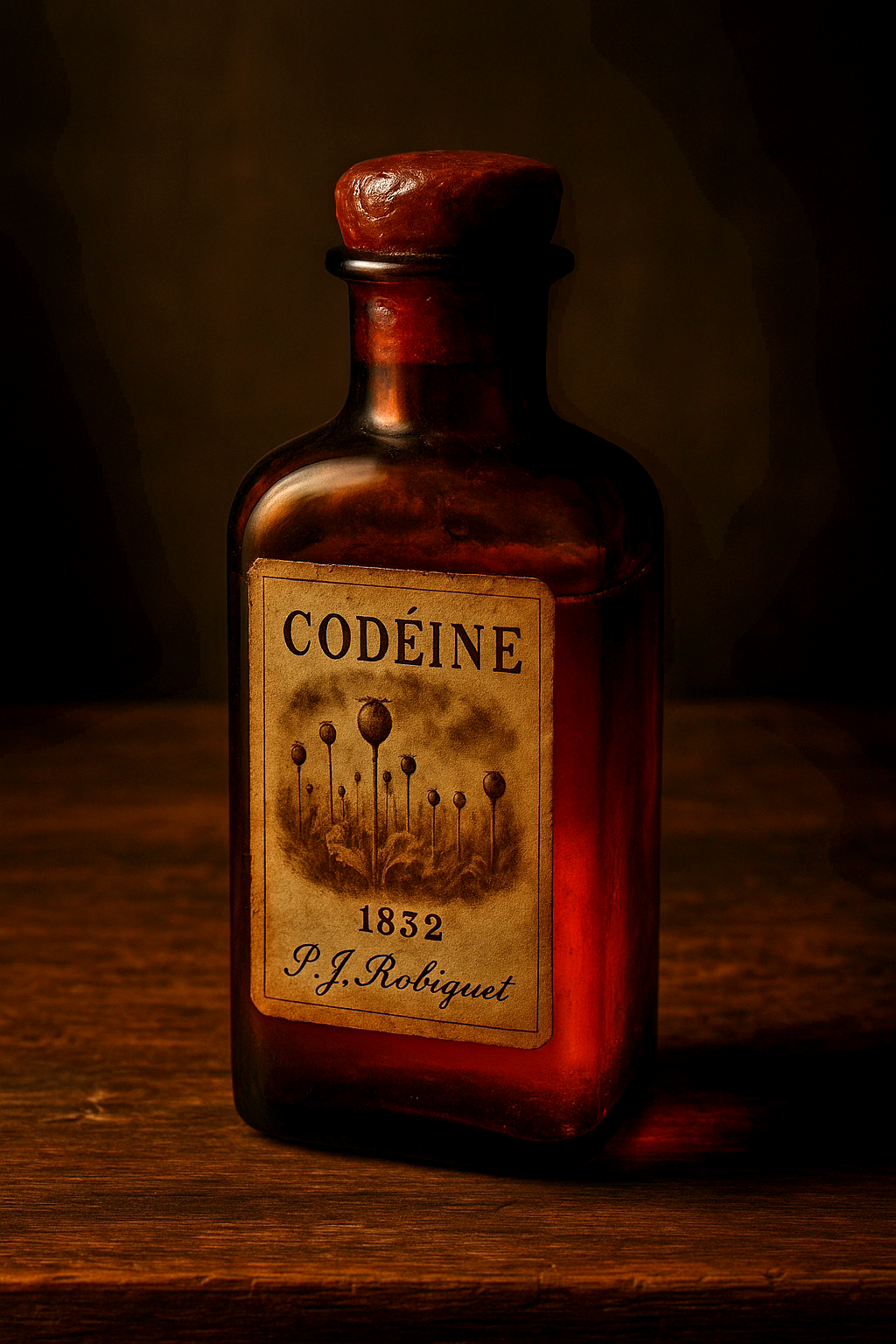
On Codeine
The Birth of the Gentle Narcotic and the forgotten history of the introduction to Codeine to the world.
From ancient opium to the birth of codeine this is a story of chemistry, conscience, and the human search for pain relief. Before the world spoke of codeine, it spoke of opium. It was commonly said for millennia, the sap of the poppy was a gift from God.
Codeine starts with the white latex that hardened into brown resin, traded across continents, swallowed, smoked, steeped, or distilled into tinctures. It was medicine and a weapon, prayer and a punishment. By the seventeenth and eighteenth centuries, opium was not exotic but ordinary. It was the most important drug in the world. It fueled empires and colonial trade. It lay in the cabinets of peasants and kings alike.
A lump of resin might contain dozens of alkaloids in unknown ratios. A spoonful might ease pain or stop a man’s breath. It gave relief, but always at risk. The Age of Coughing and Conscience The progressive insistence of a guiltless substitute. The nineteenth century really was an age of coughing. Tuberculosis, “consumption,” claimed millions. Hospitals overflowed with hollow-chested men and women who wasted away through years of agony. Their nights were torn apart by coughing that left them bloodied, sleepless, gasping from Influenza that struck in waves. Bronchitis and pneumonia stalked the poor. Whooping cough carried children to their graves. To silence a cough was not merely for comfort but for dignity, rest, and survival itself.
Morphine worked, but it intoxicated which was no longer a personal problem but a societal offense. Laudanum soothed, but it came from the same plant… Physicians longed for something merciful, legal, and safe: a narcotic that could suppress cough without stupor, ease pain without physical enslavement… Something to comfort children and soldiers alike. They were searching for the Philosopher’s Stone of medicine… a sinless derivative of the poppy.
Pierre Jean Robiquet: The Man and His Century
Pierre Jean Robiquet was not a poet like Coleridge or a soldier like Sertürner. He was a chemist — a man of glassware and fire, of powders and crystals, of notebooks filled with symbols only others of his craft could read. Born in Paris in 1780, Robiquet came of age in the shadow of the French Revolution and Napoleon’s rise. Chemistry itself was being reborn. Lavoisier’s head had fallen to the guillotine, but his theories on oxygen, combustion, and chemical order survived him. Robiquet inherited that revolution of reason. By the time he began his work, Sertürner had already isolated morphine from opium which was THE discovery that shook medicine to its roots.
Morphine could be measured, weighed, and prescribed with precision. But it was also too dangerous an instrument as far as prescriptionist were concerned. It cured, but it enslaved the body and entrapped individuals minds while possibly corrupting their soul. Robiquet suspected that the poppy held more than one secret. Within that bitter gum, he believed gentler spirits were hidden within and he set out to find them.
The Discovery of Codeine in 1832, in a modest Parisian laboratory, Robiquet began a series of careful extractions. He dissolved raw opium in water, filtered it, treated it with acids and bases. Morphine was removed first, leaving a solution that still carried unseen power. After patient evaporation and pH adjustment, he obtained tiny, colorless crystals that were bitter, sharp, distinct. When tested, they calmed pain and stilled coughs without the heaviness of morphine. Their touch was gentle, their effects precise.
Robiquet named the new alkaloid codeine, from the Greek kodeia, meaning poppy head. It was lighter, purer. Possibly the flower’s most respectable child. Codeine was a mercy without madness, the respectable narcotic the world had been seeking.
The discovery of codeine was more than chemistry. It was moral redemption for the poppy. For the first time, physicians had an opiate safe enough for the weak, the young, the dying. Tuberculosis, influenza, bronchitis all found some respite in its sweetness. Codeine syrups spread from Paris to London to the New World.
Where morphine was a battlefield necessity, codeine was a bedside mercy. Where laudanum was scandal, codeine was science that proved that the poppy could be tamed. Nature’s fiercest gift could be civilized into compassion. And in that daily spoonful lay not only chemistry, but hope.
The Chemistry of Gentleness
When Pierre Robiquet pulled codeine from the dark mire of opium, he revealed how small changes in nature yield vast changes in effect. Chemically, codeine is 3-methylmorphine, morphine with a methyl group attached to the hydroxyl at the 3-position. That single carbon and three hydrogens change everything. Morphine’s free hydroxyl binds tightly to μ-opioid receptors, flooding them with signal.
Codeine’s methyl group masks that site, softening its grip. Where morphine overwhelms, codeine whispers. This subtle difference makes codeine less potent, less intoxicating, yet more orally effective and soothing to the cough reflex. It is the soft-spoken sibling of morphine. A strength tempered by restraint.
The Receptor’s Embrace is codeine’s mercy, one must look at its dance with the human body. Inside our nervous system live opioid receptors, microscopic locks awaiting specific keys.
Morphine is a full agonist: when it binds, it throws the lock wide open, flooding the brain with analgesia and euphoria. Codeine, masked by its methyl group, binds weakly. It is a partial agonist, never twisting the lock fully. But in the liver, an enzyme called CYP2D6 can strip away that methyl group, converting a small portion of codeine back into morphine. For most people, only 5–10% transforms. This is just enough to ease pain and calm the mind without overwhelming it. For some, the conversion is stronger; for others, barely noticeable. What to one patient is peace may to another be nothing but syrup and sugar.
Each body interprets the poppy differently which should be a reminder that mercy, too, is personal.
Because codeine was weaker, it was allowed into homes by the government. It crossed the threshold without fear. Morphine belonged to soldiers; codeine belonged to mothers. Dissolved in syrup, flavored with lemon or licorice, fortified with sugar and alcohol, codeine became the civilized narcotic, the nightly spoonful of sleep.
Its bitterness was hidden, its violence subdued. A soldier’s morphine was necessity. A mother’s codeine syrup was compassion. The poppy, once the emblem of war and ruin, became in this form a symbol of gentleness. It is easy to forget how profoundly codeine changed daily life. It did not abolish pain; it made it bearable. It brought mercy to the bedside, not public shame.
The Extraction of Codeine from Poppy Sap
Every act of chemistry begins with the plant itself. Papaver somniferum, when its green pods are scored, bleeds white latex from the wounds.
That latex hardens into opium, a resin rich with over twenty alkaloids: Morphine (polar, potent, pain-relieving), Codeine (less polar, gentler), Thebaine (convulsant, chemically reactive), Papaverine and Noscapine (non-narcotic, soothing to smooth muscle).
To separate this orchestra of molecules, 19th-century chemists turned to lime and acid.
Stepwise Separation is number 1.
Maceration: Opium is soaked in warm water; acids in the resin keep alkaloids soluble.
Alkalization: Slaked lime (calcium hydroxide) is added. Morphine precipitates first; codeine, less polar, stays dissolved.
Acidification: The solution is acidified with dilute sulfuric acid, drawing other alkaloids into view.
Crystallization: Slow evaporation yields fine, colorless crystals — codeine sulfate or phosphate — washed and purified.
This delicate dance of solubility and pH exploits that single methyl group which keeps codeine in solution while morphine falls away. A chemist’s patience turned poppy sap into mercy.
From Bench to Factory: Semi-Synthesis and Modern Refinements by the late nineteenth century, demand outpaced nature. Only about 1% of opium could become codeine through extraction. The solution was semi-synthesis. By creating codeine directly from morphine the problem of supply would be solved. Chemists discovered they could methylate morphine’s 3-hydroxyl group using dimethyl sulfate or methyl iodide, producing codeine in high yield.
Factories like Merck industrialized the process, feeding an entire world’s cough. Today, codeine is still produced this way although under stricter controls. Morphine is extracted from poppy straw concentrate, methylated, and purified through chromatography and spectroscopy. The tools are modern, but the principle remains ancient: a single methyl group can turn power into gentleness.
The chemist produced crystals that the apothecaries turned into mercy. Pure codeine crystals were useless to a child. They were bitter, sharp, impossible to swallow. So apothecaries returned to the oldest solvent of all: syrup. Sugar, honey, and alcohol masked bitterness, preserved the medicine, and delivered it softly to the throat. The syrup’s viscosity soothed inflammation and extended absorption, letting patients rest through the night.
A 19th-century compounder’s bench might hold: Codeine salt (phosphate or sulfate, 10–20 mg per dose) Syrup base (sugar water or diluted honey) Demulcents (glycerin, marshmallow root, gum arabic) Flavorings (anise, licorice, orange peel, peppermint) Preservatives (often brandy or spirit).
The apothecary dissolved the codeine into warmth, stirred in sweetness, and bottled it in amber glass labeled: “One teaspoon at bedtime for cough.”
Codeine syrup became a ritual of civilization. Morphine was for the wounded; laudanum for the desperate; but codeine syrup lived on the nightstand and kitchen shelf. For the poor, it meant peace from coughing fits. For the wealthy, it was proof of progress. Chemistry conquering suffering… Before codeine, narcotics were wild. After codeine, they were civilized. To drink a spoonful was to partake in the age of science, not superstition. It was a small act of faith in reason and in the mercy of the poppy.
Today we live in an age of prohibition and suspicion, where words like narcotic carry shame and fear. But once, codeine syrup was mercy in a bottle. A trusted, humble, and deeply human part of life. It did not make sinners or saints of us. It made nights bearable.
A spoonful of syrup could turn chaos into calm, torment into rest, coughing into silence. It was not perfection, but it was hope distilled through the poppy which is all those in pain ever asks of its medicines. That was the romance of codeine cough syrup. That was its gift.

Leave a Reply