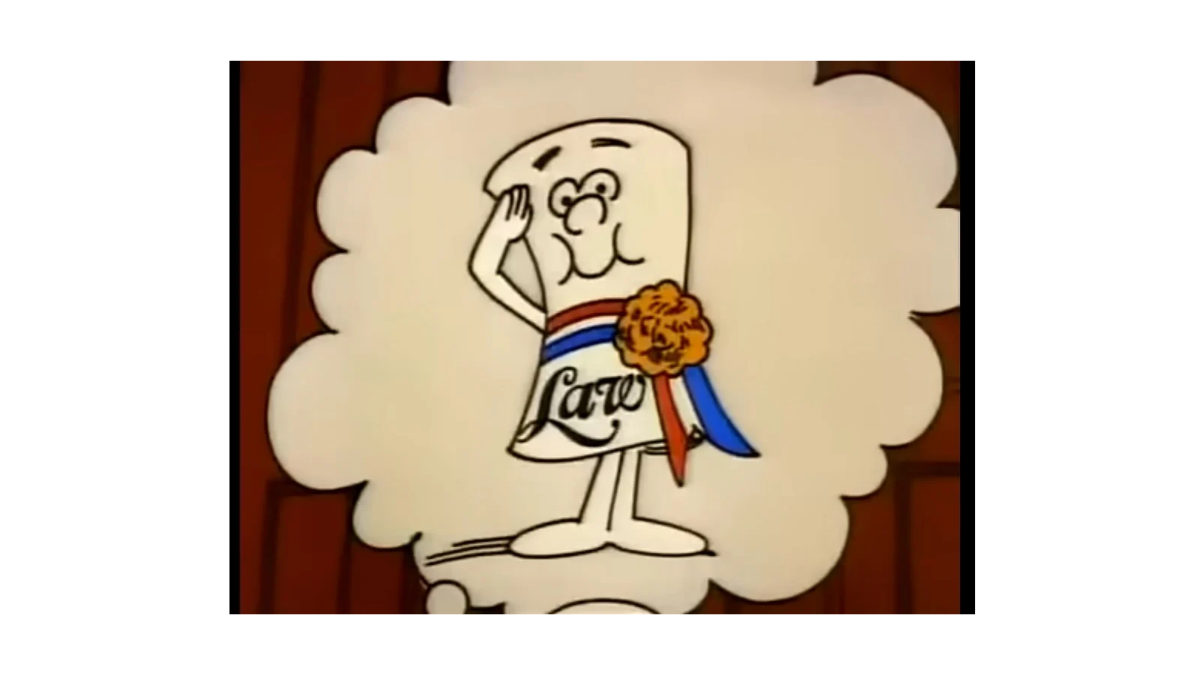
Bill Bill on Capitol Hill
THE BILL ON CAPITOL HILL AND THE AMERICA THAT DOESN’T EXIST ANYMORE
Old Deal vs. New Deal: How the United States Quietly Changed Governments Without Changing Its Constitution
The Cartoon That Lied by Telling the Truth

Every American of a certain age remembers him:
The sad little scroll with big eyes, sitting on the Capitol steps, singing about how a bill becomes a law.
A cartoon designed to teach generations of schoolchildren how their government works.
The message was simple:
Congress writes laws.
Congress debates laws.
Congress passes laws.
The President signs them.
And that is how America functions.
It is optimistic. It is wholesome.
It is completely wrong.
Not wrong for 1789.
Not wrong for 1889.
Not even wrong for 1910.
But wrong for the last 90 years.
The “Bill” represents Old Deal America… a nation where Congress actually made most laws.
But that America died with the Great Depression, and in its place rose an entirely new system:
The Administrative State.
The New Deal America.
A government of agencies, not legislators.
A government built on Acts, not debates.
A government where rule making replaced lawmaking.
Today, when Americans watch that cartoon, they are watching a ghost.
A memory.
A constitutional ideal that no longer reflects the machinery that governs over our nation.
This is the story of the difference between Old Deal America and New Deal America and why understanding that difference explains everything from drug policy, to pain medicine, to surveillance, to wartime powers, to the feeling that “someone else” is running the country and nobody will tell you who.
PART I: OLD DEAL AMERICA THE WORLD THE BILL BELONGED TO
Before the New Deal, the United States was built on four foundational concepts and the Bill on the Capitol Hill reflected all four.
1. Laws Were Actually Written by Congress
In Old Deal America:
Federal agencies were tiny or nonexistent
There were no comprehensive regulatory codes
There were few bureaucrats
Congress wrote the rules that governed American life
If Congress wanted to restrict medicine, they passed a law.
If Congress wanted to regulate business, they passed a law.
If Congress wanted to outlaw something, they passed a law.
The people’s representatives actually legislated.
The cartoon wasn’t a fairy tale back then.
It was civics.
2. States Held Most of what little Authority there was over people
Old Deal America was a true federation:
Medicine, Policing, Welfare, Drug regulation, Education, and
Commerce were mostly state-level
Federal authority was intentionally limited.
The Founders feared creating powers even for themselves.
3. Crises Did Not Reshape the Government
When national emergencies hit (wars, epidemics, panics), federal power increased but always receded afterward.
America didn’t believe in permanent centralized authority over peoples daily lives.
4. The Federal Government Could Not Manage Suffering
There was:
no FDA, DEA, CDC,
no Medicare or Medicaid,
no Social Security
no federal welfare boards
no national emergency infrastructure
If you were sick, injured, addicted, or starving, the federal government had no legal role in your personal crisis. People’s lives back then were theirs to gamble with and responsibility for their well being fell at their feet as they wanted.
Medicine was local. Pain was personal.
Healing belonged to families, communities, and private practitioners.
This gave Americans freedom… but also left them exposed.
When the Great Depression hit, exposure became catastrophe.
PART II: WHY OLD DEAL AMERICA COLLAPSED
Old Deal America could not survive what happened next.
People began buying stocks not with money they had, but with margin loans… borrowing up to 90% of the purchase price. Banks and brokers extended credit far beyond anything they actually possessed. As more people flooded into the market, prices rose not because of value, but because of leveraged speculation. It was a bubble built on promises.
When the Federal Reserve tightened monetary policy in 1928 and 1929 to slow the speculation, the bubble burst. Falling stock prices triggered margin calls… demands for repayment on loans people could never cover. Banks were forced to liquidate assets at massive losses. As their balance sheets collapsed, they called in ordinary loans from farmers, homeowners, and small businesses, causing a chain reaction of failure.
Our great grandparents didn’t use credit the way we do because they lived through the consequences of a system that was built on debt and collapsed under debt. They understood that dependence comes at the expense of freedom.
By 1932, America was breaking.
People demanded:
stability, food, work, security, relief, leadership, action…
For something… anything to be done.
“We have nothing to fear but fear itself” Roosevelt delivered action on a scale unseen in American history.
But action requires tools.
And so, those tools were built.
PART III: THE NEW DEAL REPLACING THE OLD GOVERNMENT WITH A NEW ONE
Between 1933 and 1939, the New Deal did not simply pass new laws.
It created a new structure of governance.
It built:
federal agencies, regulatory commissions, permanent bureaus,
inspectors, auditors, emergency powers,
administrative courts, oversight boards,
mandatory compliance systems
This wasn’t a repair… It was a replacement.
The Supreme Court Tried to Stop It…
Early New Deal programs were struck down as unconstitutional.
So FDR threatened to expand the Court.
The Court relented.
The result is what legal scholars call:
The Constitutional Revolution of 1937... This is America’s socialist revolution we are not taught in their education programs.
After 1937, the Supreme Court:
reinterpreted the Commerce Clause
upheld broad delegation of power to agencies
allowed regulatory authority to expand
accepted permanent federal intervention in economic life
This is when everything about Old Deal America died except the History and Propaganda of the Old Deal. The New Deal Nation wrapped itself in the imagery of the government that had come before and then the wait for our society to forget began.
PART IV: NEW DEAL AMERICA THE SYSTEM WE ACTUALLY LIVE IN TODAY
Now we return to the Bill on Capitol Hill.
In the cartoon, the process ends when:
Congress votes
The President signs
The Bill becomes a Law

But in New Deal America, that’s not the end.
It’s barely the beginning.
Under the New Deal’s structure:
1. Congress Writes Broad Acts, Not Detailed Laws
These Acts contain vague language like:
“The Secretary shall issue regulations necessary to protect public health.”
or
“The Attorney General may schedule substances.”
Those sentences become tens of thousands of pages of binding rules.
Congress stops being a lawmaker.
Congress becomes a delegator.
2. Federal Agencies Write the Real Laws
FDA decides what medicines exist.
DEA decides what substances are crimes.
CDC decides when society shuts down.
ATF decides what devices are firearms.
EPA decides what pollutants are illegal.
FTC decides what you’re allowed to claim about your own products.
IRS defines how your money is measured and taken.
These decisions:
are not voted on by Congress
are not debated publicly
cannot easily be overturned
are binding on all Americans
are enforced with federal power
The Bill on the Capitol died in 1937.
The Rule in the Federal Register replaced him.
3. Agencies Interpret the Acts Themselves
If Congress writes a vague law (and they nearly all are vague now), the agency fills in the blanks.
That means:
the FDA interprets drug safety
the DEA interprets “potential for abuse”
the CDC interprets public health
the DHS interprets threats
the Treasury interprets financial compliance
the DOJ interprets enforcement thresholds
Interpretation becomes legislation.
Interpretation is power.
4. Agencies Enforce Their Own Rules
They hold:
administrative hearings
administrative courts
compliance audits
civil penalties
criminal referrals
Often without the constitutional protections available in federal court.
5. Emergencies Override Everything
Once a president declares an emergency:
the Defense Production Act activates
federal command over supply chains is triggered
rationing becomes legal
medical resources can be seized
agencies gain extraordinary authority
Congress becomes a spectator
This is New Deal machinery.
And it affects your life far more than anything Congress debates.
PART V: THE DOCTRINAL DIFFERENCES THAT MATTER MOST
A. LAWMAKING: WHO WRITES THE RULES?
Old Deal:
Congress.
New Deal:
Agencies.
—
B. MEDICINE: WHO DECIDES WHAT YOU’RE ALLOWED TO TAKE?
Old Deal:
You and your doctor.
New Deal:
FDA approves it.
DEA schedules it.
CDC can restrict it.
HHS can seize it in emergencies.
Pain became regulated, not treated.
—
C. DRUG POLICY: WHO DEFINES A FELONY?
Old Deal:
States.
New Deal:
The Controlled Substances Act (1970) + the DEA.
One bureaucratic decision can criminalize millions overnight.
—
D. ECONOMY: WHO RUNS IT?
Old Deal:
The market.
New Deal:
Federal Reserve
SEC
FDIC
Treasury
Commerce Department
Labor Department
Defense Production Act in emergencies
The economy is now governed administratively.
—
E. SPEECH & COMMUNICATION: WHO REGULATES INFORMATION?
Old Deal:
Nobody.
New Deal:
FCC
FTC
Homeland Security partnerships
Cybersecurity and Infrastructure Security Agency
DOJ national security authorities
Narrative control flows through regulation, not censorship laws.
—
F. WARTIME & EMERGENCY POWERS
Old Deal:
Temporary, limited, exceptional.
New Deal:
Permanent infrastructure.
Codified emergency powers.
Executive authority that can bypass Congress entirely.
—
PART VI: WHY AMERICANS STILL BELIEVE IN THE BILL
Because no one ever updated the cartoon.
The government taught one system in schools while operating another in Washington.
A population that thinks Congress is in control will never Change the real machinery:
the agencies
the interpretations
the emergency frameworks
the Acts
the administrative state
This disconnect is why Americans feel powerless.
They’re fighting shadows, not structures. Yelling at walls.
My doctrine teaches people the truth that was hidden by simplicity, inertia, and civics myths.
Understanding the agency-state is the first step in reclaiming your autonomy.
Especially in pain.
Especially in medicine.
Especially in suffering.
WHAT THIS MEANS FOR PAIN PATIENTS, POLICY, AND POWER
Everything in my doctrine leads back to this point:
The administrative state controls medicine.
The administrative state controls pain.
The administrative state controls suffering.
Pain patients are not victims of Congress.
They are victims of:
the FDA
the DEA
HHS
CMS
the Controlled Substances Act
emergency powers doctrine
Once you see that, you realize how the system must be changed:
At the level of Acts and agencies, not elections.
THE REAL CIVICS LESSON:
The Bill on the Capitol Hill sings about a world long gone.
It is beautiful, but it is history from a different nation.
The New Deal created a new government inside the old one.
A quiet revolution of agencies, Acts, and administrative power.
If you want to understand the world, heal suffering, restore autonomy, or reform drug policy, you must understand this truth:
Congress is the stage.
The agencies are the hands.
The Acts are the levers.
The emergencies are the key.
This is the doctrine.
This is SeedsOfVice.
This is how you give people back the knowledge that was taken from them.


2 Comments