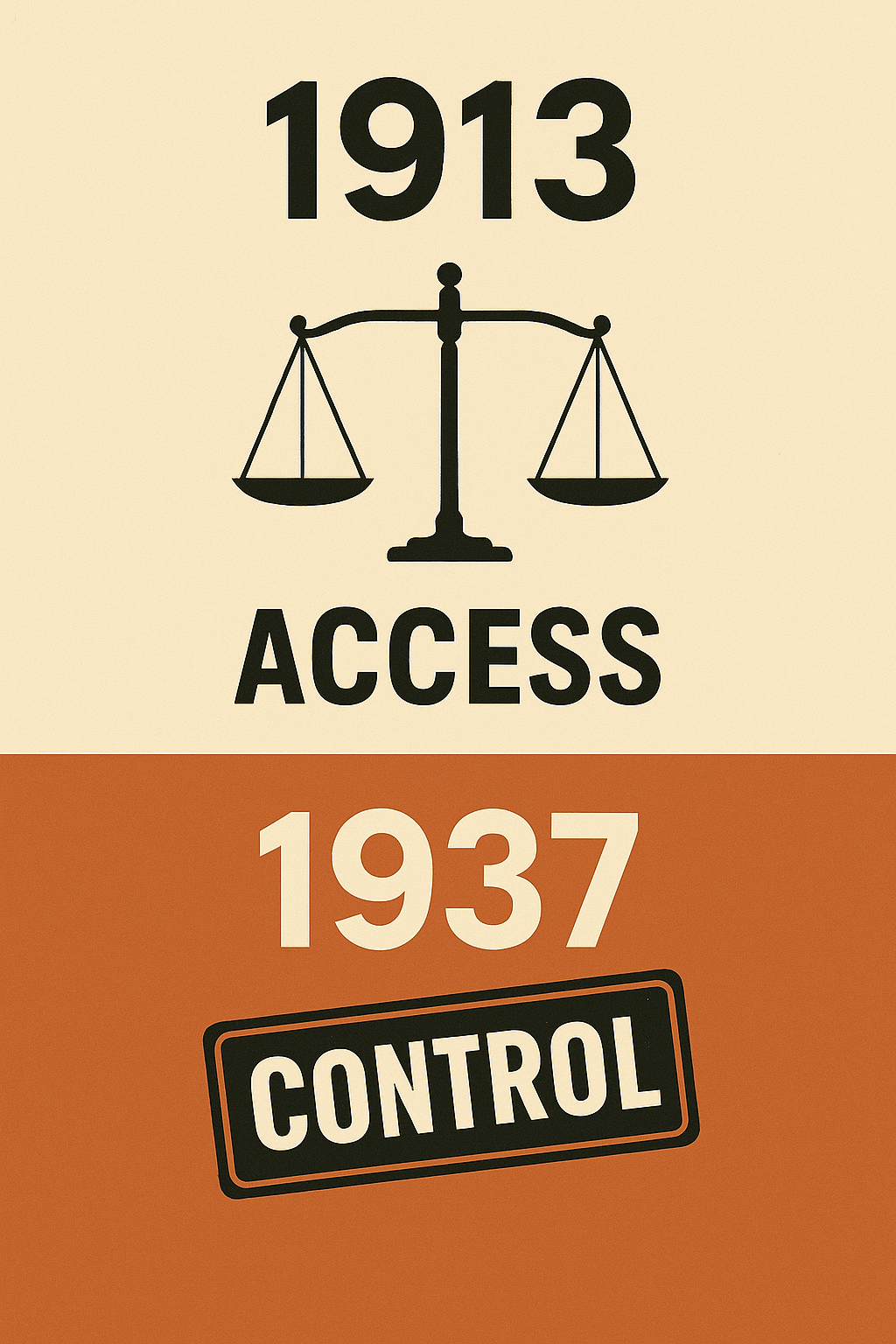
1913 & 1937
1913 & 1937
The American Revolution No One Was Taught to Name
You should start by asking yourself if no one else ever has whether the most consequential American revolution did not occur in 1776, but in 1937.
Ask whether a new form of government was established inside the Constitution rather than outside it.
No amendment announced it.
No coup declared it.
No army enforced it.
The document remained intact.
The structure of power did not.
Between 1913 and 1929, the architecture was built quietly: a permanent central bank, a national credit system, and a stock market designed not merely for investment, but for participation by ordinary Americans… encouraged, normalized, and fueled by borrowed money.
Credit expanded.
Speculation was celebrated.
Risk was distributed downward.
Then interest rates were raised.
Liquidity tightened.
The system collapsed.
The crash is remembered as a tragedy.
What followed is remembered as rescue.
But between 1929 and 1937, something else happened… something more fundamental than recovery. Emergency became justification. Justification became precedent. And precedent became permanent.
In 1937, the Supreme Court reinterpreted the Constitution in a way it never had before… not to restrain power, but to permit its delegation. Authority that once belonged to legislatures and, ultimately, to the people, was transferred to administrative agencies operating through rules, expertise, and necessity.
This was not a rejection of the Constitution.
It was a transformation of how it functioned.
Law did not disappear.
Rights were not revoked.
They were re-routed.
What emerged was not dictatorship, but something more durable: a system where power no longer required direct accountability because it could operate through policy, credit, emergency, and regulation… all while remaining technically legal.
This is not conspiracy… It is History.
It is recorded history… rarely read as a single sequence.
And once you see that the collapse preceded the reinterpretation…
that the emergency justified the shift…
and that the shift never reversed…
You begin to understand why so many modern restraints feel inevitable, untouchable, and “just the way things are,” even when they violate the spirit of the Constitution they claim to serve.
This is the revolution people were never taught to name.
And it explains the government we are actually living under.
The American Revolution of 1937
There are two years every American in pain should understand.
Not because they explain politics.
Not because they explain parties.
But because they explain why your suffering is procedural.
Those years are 1913 and 1937.
Together, they mark the moment America stopped treating people as sovereign adults and began treating them as manageable risks.
Before 1913: The Old Deal
Before 1913, the federal government was limited in two critical ways:
1. It did not fund itself directly from individual labor 2. It did not presume authority over daily life
This mattered more than people realize.
If you were in pain:
You sought relief You made decisions You bore consequences You were trusted with your own body
Life was harder. Mistakes were real. Failure existed.
But failure was not moral condemnation. Pain was a condition, not a character flaw.
There was no federal apparatus designed to manage your health, your risk profile, or your compliance.
The government’s job was not to save you from yourself. It was to leave you alone unless you harmed someone else.
That was the Old Deal in spirit.
1913: When the Government Gained Direct Access to You
The 16th Amendment changed something fundamental.
For the first time, the federal government could tax income directly, without relying on states or indirect mechanisms.
This was not just a revenue change… It was a relationship change. The federal government no longer depended primarily on:
States Trade Tariffs Borders
It could fund itself from the individual.
But even then, something still held. Money alone did not equal control.
The Constitution still mattered as a restraint.
Between 1913 and 1937: The Last Barrier
Even after the income tax, the federal government was still constrained. It could collect money, but it could not:
Regulate purely local activity Control labor conditions nationwide Police health decisions
Manage individual behavior under vague authority and social programs.
The Supreme Court still treated the Constitution as a limit, not a suggestion.
For people in pain, this meant something critical… Relief was not federally managed. Risk was personal. Doctors answered to patients and communities more than to bureaucracies.
You were still a King.
1937: When the Meaning of the Constitution Changed
In 1937, under political pressure, the Supreme Court reversed course. This is often sanitized as legal evolution.
It wasn’t. It was a philosophical surrender.
The Court stopped asking: “Where is the authority?”
And started asking: “Is this reasonable?”
That single shift changed everything.
What Changed After 1937
Commerce
Before: interstate trade After: anything that affects commerce
General Welfare
Before: a description of taxing purpose After: a justification for control
Delegated Powers
Before: government had to prove authority After: the citizen had to prove limits
The Constitution did not change on paper.
It changed in practice… and once interpretation replaces restraint, nothing ever shrinks again.
The New Deal Reality
After 1937, the federal government became a manager.
Managers must:
Measure Classify Predict Approve Deny
And management requires compliance. This is where people in pain were quietly redefined. Not as humans in need of relief… but as risk vectors.
Life in Pain Under the Old Deal
Under the Old Deal:
Pain was real Relief was a decision Failure did not erase dignity Harm was the threshold for intervention You could suffer. You could recover. You could choose badly. But you were not suspect by default.
Life in Pain Under the New Deal
Under the New Deal:
Pain is filtered through policy Relief requires permission Permission requires compliance Compliance requires surrender You are assessed. Categorized. Flagged.
Your pain is secondary to:
Guidelines Optics Liability Narrative
You are not denied because medicine doesn’t exist… You are denied because management demands consistency… and consistency does not tolerate sovereignty.
Why This Feels Like an Alley
This is why modern Americans in pain feel trapped.
Every option has a cost. Every appeal leads to a form. Every conversation ends with “we’d love to help, but…” This is not cruelty. It is structure.
1913 provided the funding. 1937 removed the limits.
Everything else followed naturally.
The Old Deal vs The New Deal
The Old Deal treated people as kings who bore consequence. The New Deal treats people as subjects who must be managed. Among kings, there are no losers. Only outcomes. Among subjects, failure is noncompliance and non-participation.
I do not write in the pursuit of permission to suffer less.
It write to remind myself and others of something older:
If we are not harming anyone,
and are not about to,
and have not already…
We are entitled to not be coerced or manipulated through harm or the threat of.
Pain does not revoke that. Risk does not revoke that. Failure does not revoke that. Only compliance and consent of the system do.
1913 & 1937 Were only the first Turns down this road we are on.
1913 made the individual financially legible. 1937 made the individual administratively manageable.
And that is how pain became political, relief became conditional, and adults became cases.
The Old Deal is not gone. It is simply no longer taught. Because it has not been taught things have naturally progressed to where the government has merged the unending war on drugs with the War on Terror and established 1 in 4 Americans over 12 as having known ties to narco terrorist organizations…

2 Comments