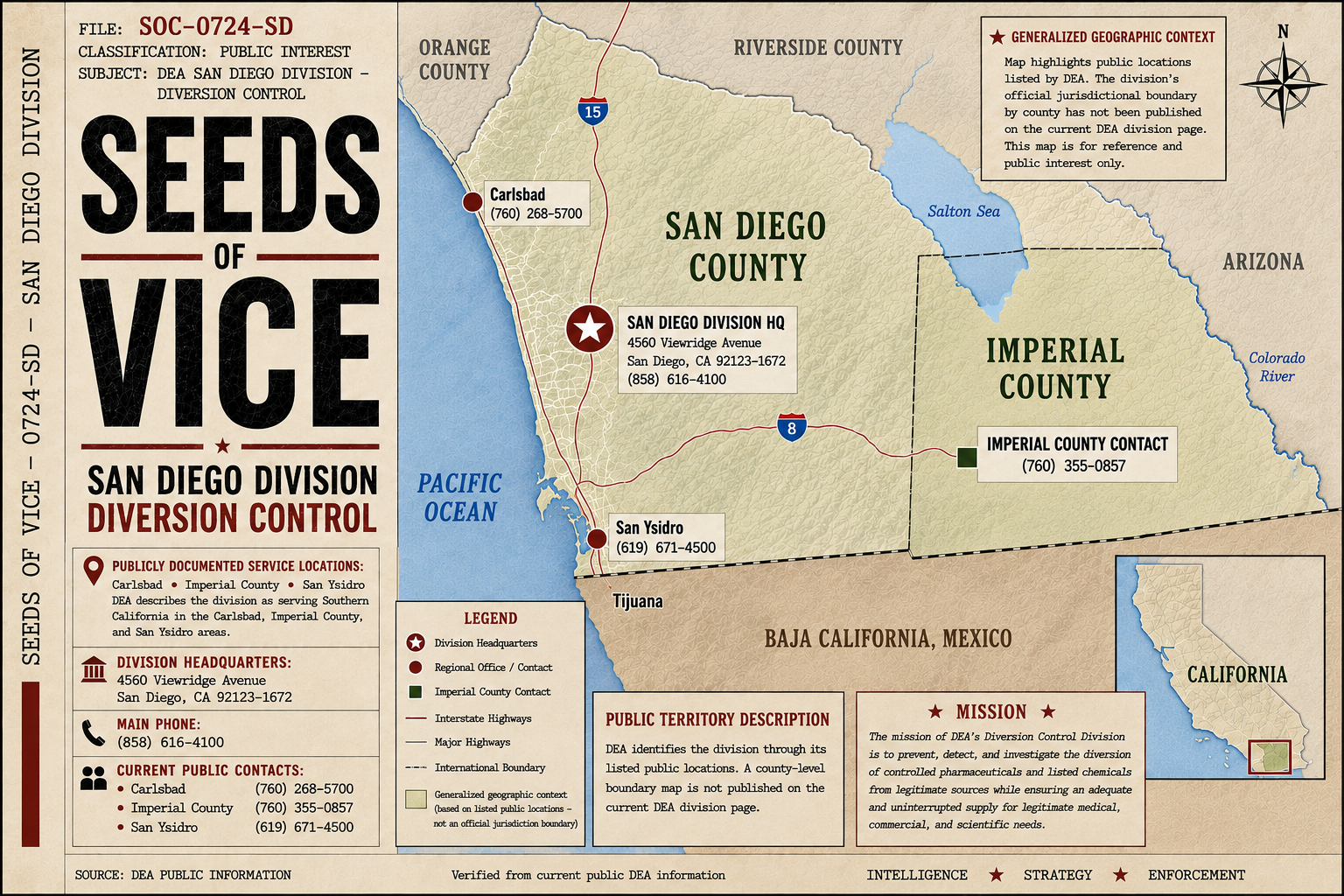
The San Diego Division
DEA San Diego Field Division and Its Diversion-Control System
Last fully verified: July 25, 2026
The Drug Enforcement Administration’s San Diego Field Division operates in the southernmost portion of California along the United States–Mexico border.
DEA’s live division page describes its jurisdiction as:
“Serving Southern California in the Carlsbad, Imperial County, and San Ysidro areas.”
The page does not expressly state that the division serves all of San Diego County and Imperial County. A separate DEA recruitment page, however, seeks applicants in San Diego and Imperial County, while current enforcement records show division activity throughout both regions. The available official evidence therefore supports treating San Diego as DEA’s operational command for San Diego and Imperial Counties, but DEA has not published a formal county map or a direct county-by-county jurisdictional statement.
The regional command is officially the San Diego Field Division.
There is no separate regional agency formally titled the “San Diego Diversion Division.” Diversion Control is one of the functions performed within the field division under federal law, DEA’s national registration systems, and the policies and leadership of the national Diversion Control Division.
The division headquarters is in San Diego, with three subordinate contacts:
- Carlsbad
- Imperial County
- San Ysidro
Its public territorial structure is compact compared with many DEA field divisions.
Its Diversion structure is not transparent.
DEA’s current division page publishes:
- A Diversion Outreach Coordinator.
- A Diversion recruitment contact.
- No current Diversion Program Manager.
- No regional registration specialist.
- No Diversion organization chart.
- No identified traditional Diversion Groups.
- No current Tactical Diversion Squad location.
The omission from the current Tactical Diversion Squad directory is particularly significant. DEA’s national directory lists six California TDS locations—Fresno, Los Angeles, Oakland, Orange County, Riverside, and Sacramento—but does not list San Diego. Historical federal records establish that a San Diego Tactical Diversion Squad previously existed. DEA has not explained whether it was disbanded, renamed, reorganized, incorporated into another component, or merely omitted from the current directory.
The proper institutional conclusion is:
The San Diego Field Division has a recognizable two-county operating footprint and a highly consequential border-enforcement mission, but DEA has not published a complete current account of its territorial boundaries, office hierarchy, Diversion leadership, or Tactical Diversion structure.
Executive Finding
What is official
DEA’s live San Diego page identifies the headquarters as:
4560 Viewridge Avenue
San Diego, California 92123-1672
Main telephone: 858-616-4100
DEA publishes subordinate contacts in:
| Published location | Telephone |
|---|---|
| Carlsbad | 760-268-5700 |
| Imperial County | 760-355-0857 |
| San Ysidro | 619-671-4500 |
DEA identifies James Nunnallee as the current Special Agent in Charge. He was selected to lead the division in August 2025.
What the official page says about territory
The page names three service areas:
- Carlsbad.
- Imperial County.
- San Ysidro.
Those labels are not organizationally equivalent.
Carlsbad and San Ysidro are geographic communities within San Diego County.
Imperial County is an entire county.
The page does not explain whether the labels represent:
- Office locations.
- Service regions.
- Administrative commands.
- Border corridors.
- Geographic sectors.
- A complete description of division territory.
DEA’s recruitment page separately refers to applicants in “San Diego and Imperial County,” supporting a broader two-county interpretation.
Current office classifications
A March 2026 DEA announcement expressly identified the Carlsbad Resident Office. That current operational record supports classifying Carlsbad as a resident office.
The live division page does not identify the current classification of:
- Imperial County.
- San Ysidro.
It displays a legend for:
- Division office.
- District office.
- Resident office.
- Post-of-duty office.
The legend is not visibly connected to the individual contacts.
What can be concluded
The San Diego Field Division’s core operational territory includes:
- San Diego County.
- Imperial County.
- The San Diego–Tijuana border region.
- The Imperial Valley–Mexicali border region.
- Coastal northern San Diego County.
- San Ysidro and the southern-border corridor.
- Metropolitan San Diego.
- Rural desert and agricultural communities.
- International ports of entry.
- Major highways and commercial transportation routes.
- Maritime, air, mail, vehicle, and pedestrian border traffic.
Current cases show San Diego personnel participating in investigations extending from Tijuana and Mexicali into San Diego County, Imperial County, and destinations across the United States.
What cannot presently be concluded
The current public record does not establish:
- A formal county-by-county boundary.
- Whether any portion of San Diego or Imperial County is assigned to another DEA division.
- The internal boundary between Carlsbad and San Diego headquarters.
- The internal boundary between headquarters and San Ysidro.
- The office responsible for each Imperial County community.
- The current classification of the Imperial County contact.
- The current classification of the San Ysidro contact.
- A complete Assistant Special Agent in Charge roster.
- The current Diversion Program Manager.
- The number and locations of traditional Diversion Groups.
- The current status of the former San Diego Tactical Diversion Squad.
- Whether Carlsbad, San Ysidro, or Imperial County contain permanently assigned Diversion Investigators.
- The geographic responsibility of regional Diversion personnel.
- The number of criminal, civil, and administrative Diversion actions initiated each year.
Seeds of Vice will not fill those gaps through assumption.
Who the San Diego Division Serves
The San Diego Field Division serves a region shaped by international commerce, border enforcement, tourism, military installations, agriculture, healthcare, universities, biotechnology, dense metropolitan development, and remote desert communities.
Its jurisdiction includes or affects:
- Patients receiving controlled medications.
- Physicians and other authorized prescribers.
- Pharmacies and pharmacists.
- Hospitals and medical systems.
- Pharmaceutical and biotechnology companies.
- Manufacturers and distributors.
- Researchers and universities.
- Veterinary practices.
- Narcotic-treatment programs.
- Military and federal healthcare facilities.
- Tribal communities.
- State and local law-enforcement agencies.
- Families affected by illicit fentanyl, methamphetamine, cocaine, counterfeit tablets, addiction, violence, and inadequate medical treatment.
The region contains two fundamentally different controlled-substance channels.
The illicit channel
The illicit channel includes:
- International drug importation.
- Cartel-linked transportation and distribution.
- Fentanyl powder.
- Counterfeit fentanyl tablets.
- Methamphetamine.
- Cocaine.
- Heroin.
- Illicit pill presses.
- Cross-border tunnels.
- Commercial and passenger smuggling.
- Money laundering.
- Firearms connected to trafficking.
- Drug distribution resulting in death.
- Internet and cryptocurrency transactions.
- Prescription forgery and pharmaceutical theft.
The lawful channel
The lawful channel includes:
- Registered manufacturers.
- Distributors.
- Pharmacies.
- Hospitals.
- Physicians and other practitioners.
- Researchers.
- Veterinary facilities.
- Treatment programs.
- Patients receiving controlled substances for legitimate medical purposes.
The channels may intersect when:
- A lawful pharmaceutical is stolen.
- A prescription is forged.
- A registrant intentionally distributes outside legitimate professional practice.
- A pharmacy fails to account for controlled inventory.
- A healthcare employee removes medication.
- An illicit manufacturer copies the appearance of a regulated medication.
Those intersections do not make every patient, practitioner, pharmacy, hospital, or pharmaceutical company part of the illicit market.
Territory and Office Structure
San Diego Division Headquarters
4560 Viewridge Avenue
San Diego, California 92123-1672
Main telephone: 858-616-4100
Carlsbad
Telephone: 760-268-5700
DEA expressly identified this unit as the Carlsbad Resident Office in March 2026. Its current activity included participation in a multiagency vape- and smoke-shop compliance operation in Oceanside.
The public record does not state precisely which northern San Diego County cities or communities are assigned to Carlsbad.
Imperial County
Telephone: 760-355-0857
DEA publishes a county name rather than a city or street address.
The directory does not identify:
- The physical location of the office.
- Whether it is in El Centro, Calexico, or another community.
- Its organizational classification.
- Whether it contains permanent Diversion personnel.
- Its relationship with the Imperial Valley’s federal border and task-force infrastructure.
Current criminal cases establish active DEA participation in Imperial County investigations involving trafficking networks supplied through Mexicali and connected to destinations across the United States.
San Ysidro
Telephone: 619-671-4500
The San Ysidro contact represents the division’s direct presence at or near one of the country’s busiest international-border corridors.
DEA does not publicly identify whether San Ysidro is:
- A district office.
- A resident office.
- A post of duty.
- A task-force facility.
- Another specialized border unit.
The page also does not explain whether San Ysidro supervises all southern San Diego County border matters or only a defined corridor.
Four published locations
The public directory therefore reveals:
- San Diego headquarters.
- Carlsbad Resident Office.
- Imperial County contact.
- San Ysidro contact.
DEA does not publish:
- A regional organization chart.
- County or municipal boundaries.
- Current supervisory assignments.
- Staffing totals.
- Diversion assignments.
- A separate public address for any subordinate unit.
Current Leadership and Publicly Identified Personnel
James Nunnallee
Special Agent in Charge
James Nunnallee was selected to lead the San Diego Field Division in August 2025.
DEA describes San Diego as a significant Southwest-border trafficking corridor and states that Nunnallee has more than 25 years of law-enforcement experience.
Nunnallee began his career as a police officer in Prince William County, Virginia, where he served for eight years.
He joined DEA in 2004 and was assigned to the Los Angeles Field Division, working investigations involving Mexican-cartel transportation and distribution cells.
His later assignments included:
- DEA’s Bogotá Country Office Narco-Terrorism Group.
- Work with the Colombian National Police targeting the FARC and ELN.
- Group supervision in the Tucson District Office.
- Leadership of multiple state and local task-force groups.
- Leadership of DEA’s Financial Investigations Section.
- Service as Executive Assistant to the Deputy Chief of Operations.
- Service as Deputy Chief of Operations.
- Command of the San Diego Field Division.
As Deputy Chief of Operations, Nunnallee aligned DEA enforcement operations and program support and advised the Chief of Operations on investigations and enforcement.
He holds a bachelor’s degree in psychology from George Mason University and is fluent in Spanish.
Kelly McKay
Media Contact
Telephone: 571-324-6204
Kieran Garcia
Special-Agent Recruitment
Telephone: 858-616-4040
Email: sandiegospecialagentrecruiter@dea.gov
DEA’s recruitment page states that the San Diego recruiter seeks qualified applicants in San Diego and Imperial County.
Shastity Urias
Community-Outreach Contact
Telephone: 619-605-9404
Email: Shastity.N.Urias@dea.gov
Diversion Outreach Coordinator
Telephone: 571-324-7435
Email: SanDiegoDiversionOutreach@dea.gov
DEA does not identify the coordinator by name.
Brenda Sandoval
Diversion Recruitment Contact
DEA identifies Brenda Sandoval as its Diversion recruitment contact.
The live page publishes the email address:
The word “Diversion” appears to be misspelled as “Divsersion.” Seeds of Vice cannot determine from the page whether the displayed address is functional or whether the error is limited to the public text. The address should be reproduced exactly when documenting DEA’s page, accompanied by the warning that it may contain a typographical error.
Current Diversion leadership
A current San Diego Division Diversion Program Manager could not be verified through a current official personnel record.
In May 2024, Rostant Farfan was publicly identified as the division’s Diversion Program Manager in connection with the Palm Care Pharmacy settlement. That establishes his position at that time, not necessarily in July 2026.
No historical official should be represented as the current officeholder without present confirmation.
The Tactical Diversion Squad Problem
What DEA currently publishes
DEA’s national Tactical Diversion Squad directory lists the following California locations:
- Fresno
- Los Angeles
- Oakland
- Orange County
- Riverside
- Sacramento
San Diego is not listed.
What the historical record establishes
A 2013 federal announcement identified Tom Lenox as a Supervisory Special Agent with the DEA San Diego Tactical Diversion Squad.
That official historical record establishes that a San Diego TDS existed at that time.
What cannot be concluded
The current omission does not prove that San Diego has no Tactical Diversion capability.
Possible explanations include:
- The squad was disbanded.
- The squad was reorganized.
- It was renamed.
- Its personnel were integrated into traditional Diversion Groups.
- It now operates through another task force.
- The national directory is incomplete.
- Its current work is divided among San Diego, Carlsbad, or another unit.
No current official source reviewed for this page resolves the issue.
The defensible statement is:
San Diego historically maintained a Tactical Diversion Squad, but DEA’s current national TDS directory does not list one, and the present organizational status of that capability is not publicly established.
Official TDS function
DEA states that Tactical Diversion Squads combine federal, state, and local resources to investigate suspected violations involving the diversion of lawfully produced pharmaceutical controlled substances and listed chemicals.
DEA states that the squads:
- Unify information and authority across agencies.
- Coordinate investigations and prosecutions across judicial districts.
- Support traditional Diversion Groups when arrests, surveillance, evidence purchases, confidential payments, or search warrants are required.
A Tactical Diversion Squad is not merely a registration or education office.
It is an enforcement structure capable of investigating:
- Counterfeit pharmaceuticals.
- Forged prescriptions.
- Pharmacy theft.
- Illicit pill presses.
- Unlawful prescribing.
- Unlawful dispensing.
- Internet distribution.
- Healthcare-related controlled-substance fraud.
- Diversion by manufacturers, distributors, or healthcare employees.
The disappearance of San Diego from the current directory should therefore be explained.
Official Role and Mission
The San Diego Field Division enforces the federal Controlled Substances Act and related federal laws within its territory and through connected interstate and international investigations.
Its work may include:
- International drug-trafficking investigations.
- Cartel and transnational-organization investigations.
- Border and port-of-entry operations.
- Fentanyl and counterfeit-pill cases.
- Methamphetamine and cocaine investigations.
- Cross-border tunnels.
- Firearms and money laundering.
- Cryptocurrency and financial investigations.
- Controlled-substance registration.
- Administrative inspections.
- Practitioner and pharmacy investigations.
- Manufacturer and distributor oversight.
- Theft and loss investigations.
- Suspicious-order investigations.
- Civil referrals.
- Administrative registration actions.
- Community outreach.
- Prescription-drug disposal.
DEA defines the national Diversion Control mission as preventing, detecting, and investigating the diversion of controlled pharmaceuticals and listed chemicals from legitimate sources while ensuring an adequate and uninterrupted supply for legitimate medical, commercial, and scientific needs.
Those are simultaneous obligations.
Diversion Control is not officially defined solely as:
- Reducing prescriptions.
- Restricting pharmacy supply.
- Inspecting registrants.
- Suspending registrations.
- Prosecuting practitioners.
Its mission also includes protecting the lawful supply required by patients, medicine, treatment, research, and commerce.
The San Diego Field Division performs regional work.
It is not the national Diversion Control Division.
How the San Diego System Works in Practice
Local 2026 enforcement surge
During DEA’s early-2026 Fentanyl Free America enforcement period, the San Diego Field Division reported:
- 126 arrests.
- 50.29 kilograms of heroin.
- 418.82 kilograms of cocaine.
- 297.98 kilograms of methamphetamine.
- 35.21 kilograms of marijuana.
- 14.09 kilograms of fentanyl powder.
- 45,930 fentanyl pills.
- 5,000 methamphetamine pills.
- $1,229,613 in currency.
- $16,000 in other assets.
- 36 weapons.
These are agency-reported enforcement figures.
They do not establish:
- The legal outcome of every arrest.
- Whether every seized substance had completed laboratory analysis.
- The total quantity entering the regional illicit market.
- The number of intended users.
- An exact number of deaths prevented.
- The guilt of every person associated with an investigation.
An arrest is not a conviction.
A seizure is not a final adjudication.
Tijuana-based fentanyl organization
Guilty plea and sentence
In February 2026, Alejandro Salinas received a 240-month federal sentence for leading an organization that trafficked fentanyl and methamphetamine from Tijuana into the United States.
Salinas had pleaded guilty to participating in an international distribution conspiracy. Federal authorities described the organization as operating a Tijuana drug storefront and using runners to move drugs into San Diego County and other United States markets.
DEA participated with Homeland Security Investigations, IRS Criminal Investigation, and the San Diego County Sheriff’s Department.
This was an adjudicated criminal disposition.
It was not merely an indictment or complaint.
Imperial County trafficking network
Guilty pleas and sentences
In April 2026, brothers Eduardo and Francisco Mendoza received federal sentences of 15 years and 10 years, respectively, for leading a fentanyl- and methamphetamine-distribution organization operating in Imperial County.
Federal records stated that the organization received drugs from a Sinaloa-linked source in Mexicali and distributed them throughout the Imperial Valley and as far away as New York.
DEA participated with HSI, Border Patrol, Customs and Border Protection components, and other federal agencies.
The case confirms that Imperial County is an active part of the division’s international and national operating environment.
Alleged Sinaloa violent-wing leader
Indictment
In July 2026, federal prosecutors charged Carlos Paez Pereda with narcoterrorism, material support of terrorism, drug trafficking, and related offenses.
Prosecutors alleged that Paez controlled a violent organization involved in methamphetamine, fentanyl, and cocaine production and distribution and used armed personnel, murder, kidnapping, and intimidation to support cartel operations between Sinaloa, Tijuana, and the United States.
James Nunnallee was quoted as San Diego Special Agent in Charge.
The indictment contains allegations. Paez is presumed innocent unless convicted.
Cross-border tunnel and one-ton cocaine seizure
Criminal complaints
In June 2026, federal authorities charged four defendants following the discovery of an alleged cross-border tunnel and approximately 1,029.6 kilograms of suspected cocaine.
The tunnel’s United States exit was concealed beneath a business floor. Authorities described it as approximately 55 feet deep, extending approximately 1,064 feet from the United States exit to the border and an estimated additional 800 feet into Mexico. It contained electricity and ventilation.
The case was principally described as a Homeland Security Task Force investigation involving HSI, Border Patrol, the San Diego County Sheriff’s Department, and other partners. It illustrates the border environment in which DEA San Diego operates but should not be represented as a DEA-only investigation. The charges remain allegations unless established through plea or trial.
Oceanside compliance operation
State administrative penalties
In March 2026, DEA’s Carlsbad Resident Office participated with Oceanside police, NCIS, and county investigators in compliance checks at four vape and smoke shops.
Investigators reported seizing more than 100 pounds of products suspected of containing psilocybin, THC, kratom, or other regulated substances. Four people were reported to face state administrative penalties and fines.
The announcement did not describe federal criminal convictions.
This matter illustrates the need to distinguish:
- A compliance check.
- A state administrative penalty.
- A federal criminal charge.
- A civil Controlled Substances Act proceeding.
- A final conviction.
Those outcomes are not interchangeable.
Diversion Control and Lawful Medicine
San Diego Division Diversion personnel may regulate or investigate:
- Physicians.
- Dentists.
- Nurse practitioners.
- Physician assistants.
- Pharmacists.
- Hospitals.
- Clinics.
- Veterinary practices.
- Manufacturers.
- Distributors.
- Researchers.
- Narcotic-treatment programs.
- Importers and exporters.
- Other DEA registrants.
Their work may include:
- Registration applications and renewals.
- Inspections.
- Controlled-substance inventories.
- Recordkeeping reviews.
- Security evaluations.
- Theft and loss reporting.
- Suspicious-order investigations.
- Prescription reviews.
- Administrative subpoenas.
- Corrective agreements.
- Voluntary registration surrender.
- Orders to Show Cause.
- Immediate Suspension Orders.
- Civil referrals.
- Criminal investigation where intentional unlawful conduct is suspected.
These procedures occupy different legal positions.
Inspection
An inspection is a compliance or investigative process.
It is not itself a finding that a registrant violated federal law.
Corrective agreement
A registrant may agree to improve:
- Inventory controls.
- Security.
- Recordkeeping.
- Reporting.
- Staff training.
- Controlled-substance handling.
A corrective agreement is not automatically a criminal conviction.
Civil settlement
A civil settlement resolves civil allegations or potential liability.
It is not automatically:
- A guilty plea.
- A trial conviction.
- A prison sentence.
Administrative action
An administrative action concerns the authority to manufacture, distribute, prescribe, dispense, research, or possess controlled substances.
It may occur independently of criminal prosecution.
Complaint or indictment
A criminal charge contains allegations.
The accused remains presumed innocent unless convicted.
Guilty plea
A guilty plea is a formal admission to specified conduct in court.
Trial conviction
A trial conviction is an adjudicated finding of guilt.
Sentence
A sentence follows a guilty plea or conviction.
The word enforcement should never erase these distinctions.
Palm Care Pharmacy
Civil settlement and Memorandum of Agreement
In May 2024, Palm Care Pharmacy paid $350,000 to resolve federal allegations involving controlled-substance inventory, records, diversion, and pseudoephedrine sales.
The government alleged that the El Cajon pharmacy failed to account for controlled substances and that unaccounted inventory included:
- Oxycodone.
- Hydrocodone.
- Tramadol.
- Xanax.
- Soma.
Palm Care also entered a Memorandum of Agreement with DEA requiring additional measures for controlled-substance handling.
The official announcement expressly stated:
- The claims were allegations.
- There had been no determination of liability.
The precise legal posture was therefore:
- Civil settlement.
- Monetary payment.
- DEA compliance agreement.
- Alleged Controlled Substances Act and chemical-control violations.
- No criminal conviction identified.
- No determination of liability.
Historical Diversion leadership reference
The Palm Care announcement identified Rostant Farfan as the San Diego Diversion Program Manager in May 2024.
That title should be treated as historical unless current evidence confirms continued service.
Institutional significance
Accurate pharmacy inventory serves legitimate public purposes.
It can help identify:
- Theft.
- Unexplained loss.
- Unrecorded distribution.
- Unauthorized transfer.
- Incomplete dispensing records.
- Entry of lawful medication into illicit markets.
A civil inventory settlement is nevertheless not situated like:
- A cartel indictment.
- A guilty plea for fentanyl trafficking.
- A conviction after trial.
- A prison sentence.
The legal posture is part of the fact.
California’s State-Control Layer
DEA’s federal authority operates alongside:
- California statutes.
- The California Department of Justice.
- CURES.
- The Medical Board of California.
- The California State Board of Pharmacy.
- Other professional boards.
- Insurers.
- Pharmacy corporations.
- Hospitals and health systems.
- Clinic policies.
- Civil-liability systems.
- Individual clinical judgment.
DEA does not independently create every rule affecting controlled-substance treatment in California.
CURES
The Controlled Substance Utilization Review and Evaluation System is California’s prescription-drug-monitoring database.
CURES contains information concerning Schedule II through Schedule V controlled-substance prescriptions dispensed in California.
California states that CURES serves:
- Public-health purposes.
- Regulatory oversight.
- Law enforcement.
The state also states that the program is committed to reducing prescription-drug abuse and diversion without affecting legitimate medical practice or patient care.
That is a dual obligation.
Monitoring is not officially intended solely as a mechanism of enforcement or restriction.
Mandatory consultation
California generally requires covered practitioners to consult CURES:
- The first time a controlled substance is prescribed, ordered, administered, or furnished to a patient.
- Within 24 hours, or on the previous business day, before the covered action.
- Before later prescribing when a prior exemption no longer applies.
- At least once every six months while the controlled substance remains part of the patient’s treatment plan.
The current requirement applies to Schedule II through Schedule V controlled substances, subject to statutory exemptions. It does not apply to veterinarians or pharmacists in the same manner as covered prescribing practitioners.
Failure to make a required consultation may be referred to the practitioner’s state licensing board for administrative sanctions.
Those are California requirements.
They should not be represented as rules created by the San Diego Field Division.
CURES patient alerts
CURES can display patient alerts when reported prescription patterns cross specified thresholds, including:
- More than 90 MME per day.
- Six or more prescribers or six or more pharmacies within six months.
- More than 40 MME of methadone daily.
- Opioid prescribing for more than 90 consecutive days.
- Concurrent opioid and benzodiazepine prescriptions.
An alert is an indicator.
It is not, by itself, proof that:
- A patient committed a crime.
- A patient is deceptive.
- A patient has a substance-use disorder.
- A prescription lacks a legitimate medical purpose.
- A practitioner acted outside professional practice.
- A pharmacist knowingly dispensed unlawfully.
Those conclusions require clinical context and, in an enforcement proceeding, additional legally sufficient evidence.
No invented universal duration limit
California’s CURES consultation law contains limited exemptions tied to emergency-department and surgical prescriptions of specified durations.
Those exemptions are not the same as a universal statewide rule limiting every adult opioid prescription to five or seven days.
This page does not invent a single universal California adult opioid-duration limit where one has not been verified.
The legal effect of California’s prescribing requirements depends on:
- The practitioner.
- The setting.
- The patient.
- The drug.
- The clinical circumstance.
- Applicable statutory exemptions.
- Professional-board standards.
Combined permission system
A California practitioner may simultaneously face:
- Federal Controlled Substances Act requirements.
- DEA registration.
- DEA inspection or investigation.
- California professional-board rules.
- CURES consultation.
- CURES alerts.
- Pharmacy policies.
- Insurer restrictions.
- Hospital or clinic protocols.
- Civil-liability concerns.
- Professional guidance.
- Individual clinical judgment.
No single institution creates the entire treatment environment.
How the System Affects Pain Patients and Lawful Medicine
Legitimate protective functions
A properly functioning Diversion system can protect patients by:
- Detecting forged prescriptions.
- Investigating pharmacy theft.
- Enforcing accurate inventories.
- Identifying healthcare-setting diversion.
- Removing counterfeit tablets.
- Identifying illicit pill presses.
- Investigating intentional criminal prescribing.
- Investigating knowing unlawful dispensing.
- Preventing stolen medicine from entering illicit markets.
- Preserving traceability within the lawful supply chain.
- Holding deliberately corrupt registrants accountable.
- Separating authentic medicine from counterfeit fentanyl products.
The protection of the lawful channel is particularly important in San Diego because the region’s criminal cases repeatedly involve pills manufactured to resemble authentic pharmaceuticals.
Counterfeit medicine
A counterfeit tablet may copy the:
- Shape.
- Color.
- Marking.
- Name.
- Apparent dosage.
- Implied legitimacy
of a regulated medication.
It may instead contain:
- Illicit fentanyl.
- Methamphetamine.
- An illicit benzodiazepine.
- An inconsistent mixture.
- An unknown dose.
The counterfeit product bypasses:
- Regulated manufacturing.
- Quality control.
- Accurate labeling.
- Dose uniformity.
- A valid prescription.
- Pharmacist review.
- Traceable distribution.
- Individual medical judgment.
Counterfeit medicine is not evidence that authentic medicine should become inaccessible.
It is evidence that the authentic channel should remain recognizable, reliable, and available.
Risk of institutional overcorrection
The same control environment can harm lawful patients when:
- Numerical thresholds become automatic rules.
- Database information becomes a verdict.
- Practitioners stop treating pain because they fear investigation.
- Pharmacies refuse lawful prescriptions through unpublished policies.
- Patients are rapidly tapered.
- Medication is abruptly discontinued.
- Patients are dismissed rather than clinically managed.
- Drug testing and treatment agreements become punitive controls.
- Statistical risk replaces individualized medical judgment.
- Effective alternatives are assumed to exist without verifying access.
CDC has acknowledged that its 2016 opioid guideline was misapplied through:
- Rapid tapers.
- Abrupt discontinuation without collaboration.
- Rigid dosage thresholds.
- Insurer and pharmacy duration limits.
- Application to excluded populations.
- Patient dismissal.
- Patient abandonment.
CDC associated those practices with untreated or undertreated pain, serious withdrawal, worsening pain, psychological distress, overdose, and suicidal ideation or behavior. Its 2022 guideline emphasizes flexible, individualized, patient-centered decision-making.
That does not establish that DEA alone caused those outcomes.
The treatment environment is produced through the interaction of:
- Congress.
- DEA.
- Federal prosecutors.
- California lawmakers.
- State licensing boards.
- CURES.
- Insurers.
- Pharmacy corporations.
- Hospitals and clinics.
- Professional organizations.
- Civil-liability systems.
- Individual practitioners.
- Patients.
- The illicit market.
DEA should not be assigned sole responsibility for every medical decision.
It should not be removed from the analysis.
The possibility of inspection, registration restriction, administrative action, civil penalties, criminal referral, or prosecution forms part of the institutional risk environment in which controlled-substance decisions are made.
Imperial Valley and rural access
Patients in Imperial County may face a different treatment environment from patients in metropolitan San Diego.
Potential barriers include:
- Long travel distances.
- Limited specialist availability.
- Fewer large healthcare systems.
- Restricted pharmacy options.
- Limited public transportation.
- Insurance-network restrictions.
- Physical-therapy availability.
- Appointment delays.
- Extreme heat and desert travel.
- Severe disability or mobility limitations.
An alternative is not functionally available merely because it exists somewhere in Southern California.
A serious access analysis should ask whether the patient can:
- Reach it.
- Afford it.
- Obtain insurance approval.
- Receive it promptly.
- Tolerate it.
- Benefit from it.
Prescribing and Dose-Decline Context
Evidentiary boundary
Seeds of Vice begins its historical inquiry in 1984.
No continuous, directly comparable annual San Diego–Imperial retail opioid-dispensing series was identified for every year beginning in 1984.
The record must therefore be divided into defensible evidentiary periods.
1984–2005
Historical inquiry may use:
- Federal distribution records.
- Manufacturing and production records.
- Controlled-substance quota information.
- Medicaid and insurer utilization.
- Drug-specific studies.
- Medical literature.
- California regulatory history.
- National prescribing indicators.
Those measures cannot be silently merged into the later CDC retail-pharmacy series.
Missing annual values should not be interpolated.
Statewide context rather than division-specific measurement
CDC’s state dispensing figures apply to all of California.
They include regions outside the San Diego Field Division.
They are useful as statewide policy and utilization context.
They should not be represented as direct measurements of prescribing within San Diego and Imperial Counties.
Selected California retail-dispensing benchmarks
The following figures represent retail opioid prescriptions dispensed per 100 residents:
| Year | California rate |
|---|---|
| 2006 | 51.0 |
| 2012 | 56.4 |
| 2016 | 44.8 |
| 2019 | 30.9 |
| 2023 | 23.8 |
| 2024 | 22.4 |
CDC’s archived and current data identify California’s 2012 rate as 56.4 prescriptions per 100 residents and its 2024 rate as 22.4. California was one of the four lowest-dispensing states in 2024.
Calculated decline
From 2012 through 2024, California’s retail opioid-dispensing rate declined by approximately:
60.3 percent
From 2006 through 2024, it declined by approximately:
56.1 percent
From 2019 through 2024, it declined by approximately:
27.5 percent
These are Seeds of Vice calculations based on the reported CDC rates.
National comparison
The national rate was 35.4 prescriptions per 100 residents in 2024.
California’s rate of 22.4 was approximately 36.7 percent below the national rate.
This establishes that California’s lawful retail opioid-dispensing rate was substantially below the national average.
It does not establish:
- Whether every reduction was medically appropriate.
- Whether every patient retained adequate treatment.
- Whether patients received effective alternatives.
- Whether average dosage declined at the same rate.
- Whether prescription duration changed.
- Whether patients were tapered voluntarily.
- Whether patients lost access because of pharmacy refusal.
- Whether DEA caused the decline.
- Whether the decline caused a particular mortality result.
Methodological limits
CDC’s 2019–2024 data use IQVIA Xponent information projected from approximately 54,600 nonhospital retail pharmacies covering nearly 94 percent of United States retail prescriptions.
The dataset:
- Includes new and refilled retail prescriptions.
- Includes multiple payment sources.
- Excludes mail-order prescriptions.
- Excludes methadone dispensed through opioid-treatment programs.
- Uses the prescriber’s location.
- Does not establish whether the patient consumed the medicine.
- Does not establish clinical appropriateness.
- Does not measure pain severity.
- Does not measure patient function.
- Does not identify voluntary versus involuntary discontinuation.
Beginning in 2019, CDC assigned geographic location according to the prescriber rather than the dispensing pharmacy. That change must be considered when comparing older and newer figures.
Prescriptions per 100 residents must not be mixed with:
- Morphine milligram equivalents per capita.
- Average MME per prescription.
- Daily dosage.
- Days supplied.
- Number of patients.
- Number of tablets.
- Total controlled-substance prescriptions.
- Overdose deaths.
- Drug-seizure quantities.
Each measure answers a different question.
Overdose Context
CDC’s final 2024 state data report:
- 9,028 drug-overdose deaths in California.
- An age-adjusted mortality rate of 21.7 deaths per 100,000 residents.
Those figures cover all drug-overdose deaths.
They are not limited to:
- Prescription opioids.
- Illicit fentanyl.
- Methamphetamine.
- Cocaine.
- Heroin.
- Any one controlled-substance category.
CDC states that prescription opioids continue to contribute to opioid-related deaths but are not the primary current driver of the national overdose crisis.
What the combined record establishes
California experienced:
- A decline exceeding 60 percent in retail opioid dispensing from 2012 through 2024.
- One of the country’s lowest state dispensing rates.
- More than 9,000 drug-overdose deaths in 2024.
- Continuing fentanyl, methamphetamine, cocaine, and counterfeit-pill trafficking.
- Large San Diego Division seizures after substantial contraction in lawful prescribing.
Those facts can exist simultaneously.
They do not establish that:
- Every prescribing reduction was medically appropriate.
- Every patient retained adequate care.
- DEA enforcement alone caused a mortality change.
- CURES alone caused a mortality change.
- Naloxone alone caused a mortality change.
- Treatment expansion alone caused a mortality change.
- Lawful opioid prescriptions are the principal source of San Diego’s illicit fentanyl market.
A reduction in lawful prescribing does not prove that illicit markets disappeared.
The presence of illicit fentanyl does not establish that every legitimate pain patient received adequate treatment.
Representative San Diego Division Matters
Fentanyl Free America surge
Arrests and seizures
DEA reported 126 arrests and substantial seizures of cocaine, methamphetamine, heroin, fentanyl, pills, currency, assets, and firearms during the early-2026 enforcement period.
These are enforcement totals, not a single adjudicated case.
Alejandro Salinas
Guilty plea and 20-year sentence
Salinas received a 240-month sentence after pleading guilty to an international fentanyl- and methamphetamine-distribution conspiracy connected to Tijuana and San Diego County.
This was an adjudicated criminal disposition.
Eduardo and Francisco Mendoza
Guilty pleas and sentences
The brothers received sentences of 15 and 10 years for leading an Imperial County fentanyl- and methamphetamine-distribution organization supplied from Mexicali.
This was an adjudicated criminal matter.
Carlos Paez Pereda
Indictment
Paez was charged with narcoterrorism, material support, drug trafficking, and related offenses arising from alleged cartel activity.
The charges remain allegations unless established through guilty plea or trial.
Cross-border cocaine tunnel
Pending charges
Four defendants were charged following the discovery of an alleged sophisticated tunnel and more than one ton of suspected cocaine.
The charges remain allegations, and the investigation was conducted through a multiagency Homeland Security Task Force structure.
Oceanside compliance operation
State administrative penalties
Four people were reported to face state administrative penalties after a multiagency compliance operation involving suspected regulated and controlled products.
The announcement did not report federal criminal convictions.
Palm Care Pharmacy
Civil settlement
The pharmacy paid $350,000 and entered a DEA Memorandum of Agreement to resolve allegations involving inventory, records, controlled substances, and pseudoephedrine.
The government expressly stated that there had been no determination of liability.
Contact Information
San Diego Field Division Headquarters
Address:
4560 Viewridge Avenue
San Diego, California 92123-1672
Main telephone: 858-616-4100
Media
Kelly McKay
Telephone: 571-324-6204
Recruitment
Kieran Garcia
Telephone: 858-616-4040
Email: sandiegospecialagentrecruiter@dea.gov
Community Outreach
Shastity Urias
Telephone: 619-605-9404
Email: Shastity.N.Urias@dea.gov
Diversion Outreach
Telephone: 571-324-7435
Email: SanDiegoDiversionOutreach@dea.gov
Diversion Recruitment
Brenda Sandoval
Published email: Divsersion.SAN@dea.gov
The displayed email appears to contain a spelling error and should be verified before use.
Carlsbad Resident Office
Telephone: 760-268-5700
Imperial County
Telephone: 760-355-0857
San Ysidro
Telephone: 619-671-4500
National DEA Registration Contact
Telephone: 800-882-9539
Email: DEA.Registration.Help@dea.gov
California CURES Help Desk
Telephone: 916-210-3187
Email: CURES@doj.ca.gov
Because DEA does not publish a current Diversion Program Manager, current Tactical Diversion Squad, or detailed regional assignment map, callers should verify whether a matter belongs to:
- San Diego headquarters.
- Carlsbad Resident Office.
- Imperial County.
- San Ysidro.
- The Diversion Outreach Coordinator.
- A traditional Diversion Group.
- A current but unpublished task-force structure.
- The national Registration Contact Center.
- The national Diversion Control Division.
Seeds of Vice Analysis
The San Diego Division is geographically small compared with many DEA commands.
Its institutional importance is not.
It occupies one of the most consequential border regions in the federal drug-control system.
The division’s cases involve:
- Tijuana.
- Mexicali.
- San Ysidro.
- Imperial County.
- Interstate distribution.
- International cartels.
- Cross-border tunnels.
- Fentanyl.
- Methamphetamine.
- Cocaine.
- Counterfeit medicine.
- Financial systems.
- Pharmaceutical compliance.
That authority requires a public organizational record equal to the work.
At present, DEA provides:
- One headquarters.
- Three subordinate contacts.
- One confirmed resident office.
- No formal county map.
- No current Diversion Program Manager.
- No current TDS listing.
- A historical record showing that a TDS once existed.
- An apparently misspelled Diversion recruitment email.
- No explanation of where current criminal Diversion work is organized.
These are not findings of corruption.
They are findings of inadequate public administration.
Three area labels are not a complete jurisdictional map
DEA says the division serves the Carlsbad, Imperial County, and San Ysidro areas.
That description omits metropolitan San Diego from the sentence even though San Diego is the headquarters and the institutional name of the division.
It also combines two communities with one county.
The wording does not tell the public:
- Whether Carlsbad covers all northern San Diego County.
- Whether headquarters covers central and eastern San Diego County.
- Whether San Ysidro covers all southern-border communities.
- Whether Imperial County is one office or one service region.
- Whether the division serves every part of both counties.
The practical two-county footprint is understandable.
The formal map is not published.
The current TDS omission requires explanation
San Diego historically had a Tactical Diversion Squad.
The current national directory does not list one.
That omission matters because San Diego is not an ordinary controlled-substance jurisdiction.
It contains:
- A major international border.
- Counterfeit-pharmaceutical markets.
- Pharmaceutical and biotechnology companies.
- Large healthcare systems.
- Military medicine.
- Research institutions.
- Pharmacies and treatment programs.
- Complex illicit distribution networks.
DEA should state whether San Diego’s former TDS:
- Still exists.
- Was reorganized.
- Was renamed.
- Was absorbed into another unit.
- Is missing from the directory.
The public should not be required to infer the status of a federal enforcement component from a 2013 event announcement and a 2026 omission.
Border enforcement can dominate the institutional picture
The division’s public record is filled with extraordinary criminal matters:
- Hundreds of kilograms of drugs.
- Cartel leadership.
- Armed organizations.
- Cross-border tunnels.
- Narcoterrorism charges.
- International extraditions.
- Counterfeit fentanyl.
- Multi-state distribution.
Those cases are real and consequential.
They can also make the lawful controlled-substance system nearly invisible.
The same field division that investigates cartel organizations also has authority affecting:
- A pharmacy’s inventory.
- A physician’s registration.
- A hospital’s controlled-substance records.
- A distributor’s security.
- A researcher’s application.
- A patient’s continued access to medicine.
The authority over lawful medicine deserves its own public accountability.
Counterfeit medicine strengthens the case for authentic access
San Diego’s border cases demonstrate the danger of counterfeit pills.
The counterfeit tablet relies on the reputation of medicine it is not.
It imitates:
- A known drug.
- A known dosage.
- A regulated manufacturer.
- A lawful pharmacy.
- A medical decision.
- A trusted supply chain.
That supports protecting authentic medicine.
It does not support treating authentic medicine as though it were counterfeit.
A pain patient receiving medication through a valid prescription is not situated like a person operating an illicit pill press.
A physician exercising documented medical judgment is not situated like a cartel-linked distributor.
A pharmacist maintaining accountable inventory is not situated like a person smuggling fentanyl.
A patient appearing in CURES has not been convicted of anything.
The system must preserve those distinctions.
Palm Care demonstrates the need for legal precision
Palm Care paid $350,000 and entered a compliance agreement.
The government alleged inventory and recordkeeping failures.
The government also expressly stated that there had been no determination of liability.
All of those facts belong in the account.
The matter should not be softened into “nothing happened.”
It should not be inflated into a criminal conviction either.
A credible institutional atlas must distinguish:
- Allegation.
- Inspection.
- Audit.
- Settlement.
- Memorandum of Agreement.
- Registration action.
- Indictment.
- Guilty plea.
- Trial conviction.
- Sentence.
- Dismissal.
- Acquittal.
The word “enforcement” is too broad to carry the legal truth by itself.
California’s prescribing decline is structural
California’s retail opioid-dispensing rate fell from 56.4 prescriptions per 100 residents in 2012 to 22.4 in 2024.
That is a decline of approximately 60.3 percent.
California is now one of the country’s lowest-dispensing states.
This is not a minor adjustment.
It is a transformation in lawful medicine.
The data do not prove that the entire decline was harmful.
They do not prove that the entire decline was beneficial.
They establish that substantially less lawful opioid medicine was dispensed per resident.
A complete institutional account should ask:
- Which prescriptions were unnecessary?
- Which patients benefited from safer care?
- Which patients received effective alternatives?
- Which patients were voluntarily tapered?
- Which were tapered against their wishes?
- Which lost a practitioner?
- Which lost a pharmacy?
- Which were dismissed from care?
- Which remained in severe pain?
- Which recovered function?
- Which lost function?
- Which entered the illicit market?
- Which withdrew from medical care?
- Which died from overdose, suicide, disease, or unrelated causes?
- Which outcomes were measured?
- Which disappeared from institutional records when the prescription ended?
Dispensing statistics cannot answer those questions by themselves.
CURES is a tool, not an adjudication
California explicitly states that CURES should reduce abuse and diversion without affecting legitimate medical practice or patient care.
Its patient alerts can identify circumstances requiring attention.
They cannot independently decide:
- Whether treatment is appropriate.
- Whether a patient is dishonest.
- Whether a dosage is medically necessary.
- Whether continued treatment benefits the patient.
- Whether a practitioner committed a crime.
A threshold can identify a question.
It cannot answer the patient.
The overdose record does not close the inquiry
California continued to experience more than 9,000 overdose deaths in 2024 after lawful opioid dispensing had fallen dramatically.
That does not prove that prescribing contraction caused those deaths.
It establishes that prescribing contraction did not eliminate the illicit overdose crisis.
Likewise, illicit fentanyl’s continued presence does not prove that legitimate opioid treatment lacks medical value.
Both realities must remain visible:
- Illicit fentanyl kills.
- Counterfeit pills kill.
- Methamphetamine and cocaine cause substantial harm.
- Intentional unlawful prescribing can harm patients.
- Abrupt loss of legitimate treatment can also harm patients.
- Monitoring can protect patients.
- Monitoring can be misused.
- Enforcement can preserve the lawful channel.
- Overcorrection can make the lawful channel inaccessible.
One harm does not erase another.
Imperial County access requires separate measurement
A statewide California statistic may conceal substantial local differences.
Imperial County differs from metropolitan San Diego in:
- Population density.
- Healthcare infrastructure.
- Specialist supply.
- Transportation.
- Climate.
- Pharmacy access.
- Cross-border movement.
- Economic conditions.
The division should not assume that an alternative available in San Diego is practically available in the Imperial Valley.
A lawful medical system should measure access where patients actually live.
The dual mandate is the correct standard
DEA’s official Diversion mission requires the agency to prevent diversion while ensuring an adequate and uninterrupted supply for legitimate medical, commercial, and scientific needs.
Seeds of Vice accepts the first obligation.
It insists upon the second.
The San Diego system should be capable of:
- Dismantling cartel-linked trafficking organizations without treating ordinary medical care as equivalent conduct.
- Investigating counterfeit fentanyl without making authentic medicine inaccessible.
- Enforcing pharmacy inventories without converting civil allegations into criminal guilt.
- Using CURES without treating alerts as verdicts.
- Protecting border communities while preserving legitimate treatment.
- Measuring whether lawful access remains after enforcement and prescribing contraction.
- Identifying the officials who exercise Diversion authority.
Drug control governs crime.
Diversion control governs permission.
Across San Diego and Imperial Counties, that permission is administered through one field division, four published locations, an unresolved Tactical Diversion structure, California’s CURES system, state professional boards, insurers, pharmacies, hospitals, clinics, and individual practitioners.
No single institution bears sole responsibility for the final treatment environment.
Every institution exercising authority bears responsibility for its part.
Recommended Public Disclosures
DEA should publish:
- A direct statement identifying the San Diego Division’s complete county jurisdiction.
- A county and municipal territorial map.
- The boundary between headquarters, Carlsbad, Imperial County, and San Ysidro.
- The current classification of Imperial County.
- The current classification of San Ysidro.
- A public address for each subordinate office where appropriate.
- A complete current Assistant Special Agent in Charge roster.
- The current Diversion Program Manager.
- The location of each traditional Diversion Group.
- The current status of the former San Diego Tactical Diversion Squad.
- An explanation for San Diego’s omission from the national TDS directory.
- The names or positions supervising regional criminal Diversion work.
- A named registration specialist.
- A named practitioner- and pharmacy-compliance contact.
- Confirmation or correction of the published Diversion recruitment email.
- Annual statistics separating criminal, civil, regulatory, and administrative Diversion matters.
- Outcomes distinguished by inspection, warning, corrective agreement, settlement, surrender, suspension, indictment, plea, trial conviction, acquittal, dismissal, and final administrative order.
- Separate San Diego County and Imperial County reporting where lawful and practical.
- Measures of legitimate medical access alongside enforcement statistics.
- Reporting concerning registration delays, practitioner departures, pharmacy refusals, shortages, and rural treatment access.
- A clear public explanation of how regional Diversion personnel interact with the national Diversion Control Division.
Publishing these facts would not require disclosure of confidential investigative methods.
It would establish ordinary institutional accountability.
Methodology and Evidentiary Limits
This page prioritizes current primary sources from:
- The Drug Enforcement Administration.
- DEA’s Diversion Control Division.
- The United States Attorney’s Office for the Southern District of California.
- The California Department of Justice.
- The Medical Board of California.
- The Centers for Disease Control and Prevention.
The following evidentiary rules were applied:
- The regional command was correctly identified as the San Diego Field Division.
- The field division was distinguished from the national Diversion Control Division.
- DEA’s exact area-based jurisdictional wording was preserved.
- The two-county interpretation was presented as a conclusion supported by multiple official records rather than as a direct quotation from the division page.
- A county map was not invented.
- Carlsbad was identified as a resident office because a current official record expressly uses that classification.
- Imperial County and San Ysidro were not assigned unsupported classifications.
- James Nunnallee was identified as the current Special Agent in Charge.
- A current Diversion Program Manager was not invented.
- Rostant Farfan’s 2024 title was treated as historical.
- San Diego’s omission from the current TDS directory was preserved.
- The existence of a historical San Diego TDS was documented.
- The current status of the TDS was not guessed.
- The apparent Diversion recruitment-email typo was reproduced accurately.
- Allegations were distinguished from guilty pleas, convictions, sentences, civil settlements, and administrative penalties.
- Multiagency border cases were not attributed solely to DEA.
- Agency seizure totals were not converted into confirmed deaths prevented.
- California law and CURES requirements were separated from federal DEA authority.
- CURES alerts were not treated as proof of wrongdoing.
- CURES consultation exemptions were not represented as universal prescription-duration limits.
- A universal California adult opioid-duration limit was not invented.
- Statewide dispensing data were not represented as division-specific data.
- Prescriptions per 100 residents were not mixed with MME, dosage, patient counts, pill counts, days supplied, or mortality.
- Missing historical years were not interpolated.
- CDC’s geographic-methodology change was acknowledged.
- Prescribing decline was not represented as proof of either medical benefit or patient harm.
- Overdose mortality was not attributed to one institution or policy.
- DEA was analyzed as one institution within a broader medical-control system.
- Official mission, factual record, and Seeds of Vice analysis were kept separate.
Last fully verified: July 25, 2026


Bestsellers
-

A gift of Luck
-

Proof of Progress: Mr. DEA’s Diversion Autographed Hardcover & Seed Pack
$39.99 -

Seeds of Vice ™
$24.99 -

Seeds of Vice Book Set
$119.00 -
Seeds of Vice: On Poppy Tea Autographed Hardcover & Seed Pack
Original price was: $39.99.$29.99Current price is: $29.99. -

Seeds of Vice: On The Poppy Plant Autographed Hardcover & Seed Pack
$55.00
