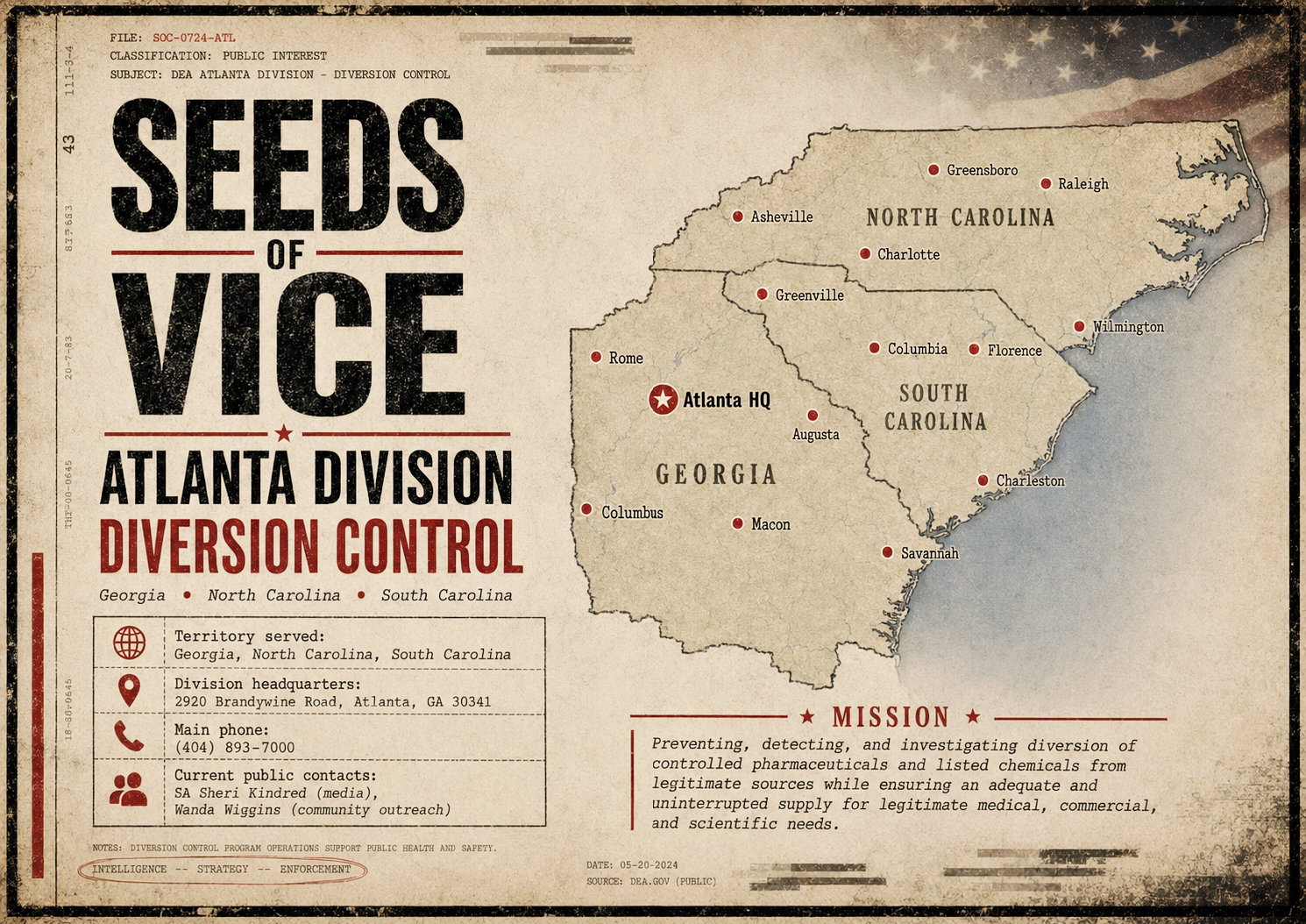
DEA Atlanta Division
Who Serves Georgia, North Carolina, and South Carolina and How Federal Diversion Control Reaches Lawful Medicine
Information and public contacts verified July 21, 2026
Latest complete prescribing data year: 2024
Most people know the Drug Enforcement Administration through its criminal enforcement work: narcotics investigations, seizures, arrests, trafficking organizations, fentanyl, clandestine laboratories, and international drug networks.
That is only part of the agency.
The DEA also administers a national regulatory and investigative system governing substances that begin inside the law. Controlled medicines are produced by registered manufacturers, shipped through registered distributors, stocked by registered pharmacies, prescribed by registered practitioners, administered in hospitals, used in research, and ultimately received by patients. The federal structure responsible for preventing those substances from being diverted out of lawful channels is the Diversion Control Division.
That national division reaches the country through DEA field divisions. For people in Georgia, North Carolina, and South Carolina, the relevant field division is the DEA Atlanta Division.
This page identifies the territory, publicly named personnel, contact locations, official mission, and ordinary functions of Diversion Control within that region. It also places the Atlanta Division within the documented transformation of opioid prescribing and dosage from the medical environment surrounding 1984 through the latest complete national and state data available for 2024. Why? Because the 1984 we remember isn’t the one we are about to live through. The 1984 we remember was the good times.
The purpose is to help people understand the federal institution operating in their region, the authority it exercises over the lawful controlled substance channel, and the prescribing environment in which that authority now operates.
Who the Atlanta Division Serves
The DEA Atlanta Division serves Georgia, North Carolina, and South Carolina. Its present headquarters is at 2920 Brandywine Road in Atlanta, Georgia. DEA publicly identifies Jae W. Chung as the division’s Special Agent in Charge.
For a person living anywhere in those three states, the Atlanta Division is the regional DEA field division responsible for that territory. This does not mean that every DEA matter is directed personally from Atlanta or that every employee listed within the division works on pharmaceutical diversion. A field division contains multiple forms of federal drug enforcement activity, including conventional criminal investigations and the regulatory and investigative work associated with Diversion Control.
The distinction matters.
The Atlanta Division is a geographic field command. The Diversion Control Division is a specialized operational component of the DEA with a national mission. Diversion personnel assigned within the Atlanta field territory carry that national regulatory mission into Georgia, North Carolina, and South Carolina.
DEA currently lists public contact locations in fourteen cities outside the Atlanta headquarters:
| State | Publicly listed DEA contact locations |
|---|---|
| Georgia | Augusta, Columbus, Macon, Rome, Savannah |
| North Carolina | Asheville, Charlotte, Greensboro, Raleigh, Wilmington |
| South Carolina | Charleston, Columbia, Florence, Greenville |
The current Atlanta page displays a map legend containing four possible classifications: division office, district office, resident office, and post of duty. However, its accessible text does not reliably assign each listed city to one of those classifications. For that reason, this page describes them only as publicly listed DEA contact locations. It does not guess their status from city size, an old directory, or a previous organizational arrangement.
The Territory
- Georgia;
- North Carolina;
- South Carolina;
- Atlanta as the verified division headquarters
Current Atlanta Division Leadership and Public Personnel
Jae W. Chung
Special Agent in Charge
Jae W. Chung is the current Special Agent in Charge of the DEA Atlanta Division. DEA states that he was promoted to lead the Atlanta Field Division in January 2026 after approximately twenty six years with the agency.
Chung graduated from Jacksonville State University in 1995 with a Bachelor of Science in forensic science and served as a United States Army military intelligence officer before joining the DEA. He began his DEA career in Los Angeles in 1999 and transferred to the El Paso Intelligence Center’s Global Tracking Unit in 2006. He moved to the Orlando District Office in 2009, became an enforcement group supervisor in 2010, and later formed and led Orlando’s Tactical Diversion Squad.
His later assignments placed him closer to the national and regional command structure. In 2018, Chung became Assistant Special Agent in Charge of the Pharmaceutical, Chemical, and Internet Investigations Section at the DEA’s Special Operations Division. In 2020, he transferred to the Atlanta Field Division as the Assistant Special Agent in Charge of its High Intensity Drug Trafficking Areas program. He became Deputy Chief of Operations for Domestic Operations at DEA headquarters in 2022, returned to Atlanta as Deputy Special Agent in Charge in 2023, and became Special Agent in Charge in January 2026.
This history gives Chung direct prior experience with diversion related operations, including leadership of a Tactical Diversion Squad and oversight of pharmaceutical, chemical, and internet investigations. His current authority, however, is broader than Diversion Control. As Special Agent in Charge, he leads the entire Atlanta Field Division.
SA Sheri Kindred
Media Inquiries
DEA currently identifies Special Agent Sheri Kindred as the Atlanta Division contact for media inquiries. The agency lists her telephone number as 571-362-3458 and provides the division media address DEA.Atlanta.Media@dea.gov. Recent Atlanta Division releases from March, April, and May 2026 also identify Kindred as the media contact.
Wanda Wiggins
Community Outreach
DEA presently identifies Wanda Wiggins as the Atlanta Division’s community outreach contact. Her listed telephone number is 571-776-0364, and her listed email address is Wanda.S.Wiggins@dea.gov.
Recruitment Contact
The Atlanta Division publishes a recruiting telephone number, 571-362-2922, and the email address Atlanta.Division.Recruiting@dea.gov. No individual is named with that contact on the current division page.
Personnel the Public Record Does Not Currently Identify
The public Atlanta Division page does not provide a complete current roster of:
- Deputy Special Agents in Charge;
- Assistant Special Agents in Charge;
- the regional Diversion Program Manager;
- Diversion Group Supervisors;
- Tactical Diversion Squad supervisors;
- Diversion Investigators;
- Registration Program Specialists;
- personnel responsible for each publicly listed city.
Older press releases, conference biographies, professional network profiles, court filings, and third party directories may identify people who held such positions at particular times. They do not independently establish that those people remain in the same assignments today.
Accordingly, the present public roster is limited. Chung is the identified division leader. Kindred and Wiggins are publicly named contacts. Additional Atlanta Diversion personnel should be introduced only when a current official record supports the name, title, and assignment.
The Official Mission
The DEA gives Diversion Control two responsibilities that must be read together.
The division is charged with detecting and investigating the movement of controlled pharmaceuticals and listed chemicals away from legitimate sources. At the same time, it is responsible for preserving what DEA calls an “adequate and uninterrupted supply” for legitimate medical, commercial, and scientific needs. The problem is they judge themselves and accept that casualties exist.
This is not merely an enforcement mission. It is a dual obligation…
prevent diversion without destroying legitimate supply.
That second half matters to patients. It means that DEA’s official responsibility is not fulfilled merely by reducing risk, restricting registrants, lowering production, or bringing enforcement actions. The agency also recognizes an obligation to protect lawful availability for medicine, science, and commerce.
Under federal law, businesses involved in importing, exporting, manufacturing, or distributing controlled substances must register with DEA. Health professionals authorized to prescribe, administer, or dispense controlled substances must register, as must pharmacies authorized to fill controlled substance prescriptions. Registrants are subject to federal requirements involving security, records, inventories, and other regulated activities.
The DEA describes the larger Diversion Control program as including:
- scheduling controlled substances;
- establishing production quotas;
- administering import and export controls;
- registering qualified practitioners and organizations;
- investigating registrants for suspected diversion;
- pursuing violations where diversion is established;
- communicating with regulated industries and professional associations;
- assisting state and local authorities;
- participating in international controlled substance matters.
There is no separate publicly posted Atlanta-specific Diversion mission that replaces this national statement. The Atlanta field program carries the national mission into its three-state territory. The mission comes down from above but not God.
How Diversion Control Works in Practice
The word diversion refers to controlled substances or listed chemicals moving away from legitimate purposes or lawful channels. That can occur through theft, falsified prescriptions, fraudulent records, unlawful prescribing, employee theft, robbery, improper distribution, illicit resale, suspicious ordering, or other conduct involving registered and unregistered people. Our Medicine does not come from doctors and pharmacists. Our medicine comes through them under the control of the DEA. The DEA is responsible for what you are dealing with being under medicated and unmedicated. Not doctors, pharmacists, insurance companies, or politicians. Responsibility for the diversion of medicine away from you falls Soley at the feet of MR. DEA’s Diversion Division.
Registration
Federal registration determines who may lawfully participate in the controlled substance system. Depending on the registrant category, it can govern authority to manufacture, distribute, prescribe, dispense, administer, conduct research, import, export, or otherwise handle controlled substances.
A physician may hold a state medical license but still require DEA registration to prescribe federally controlled medication. A pharmacy may be licensed by its state but require DEA registration to dispense controlled substances. Manufacturers, distributors, researchers, hospitals, treatment programs, and other entities operate within corresponding federal registration categories.
Registration is therefore not simply a record of participation. For many actors in the lawful channel, it is a necessary federal permission. Control.
Compliance Work
Diversion Investigators examine whether registrants are complying with the Controlled Substances Act and its implementing regulations. DEA’s own description of the position includes investigations involving procurement, manufacture, distribution, security, and recordkeeping within the pharmaceutical and listed chemical industries.
Depending on the registrant and reason for review, the work may involve:
- registration status;
- state licensure;
- purchasing and ordering records;
- controlled substance inventories;
- storage and physical security;
- dispensing or distribution records;
- theft and significant loss reports;
- suspicious order systems;
- transfer and disposal records;
- prescription records;
- the correspondence between documented activity and actual inventory.
A compliance review does not automatically mean that a crime has occurred. It can identify satisfactory compliance, correctable deficiencies, possible regulatory violations, or facts supporting a more serious investigation.
Investigation
The DEA says Diversion Investigators gather and analyze information and evidence, conduct interviews, prepare reports, and make recommendations concerning possible regulatory, civil, administrative, or criminal action. They also work with other federal, state, and local agencies and participate in multi jurisdictional programs concerning pharmaceutical and chemical diversion.
The practical work may therefore move through several stages:
- Information, data, a complaint, a referral, or an observed discrepancy draws attention.
- Investigators collect records and determine whether federal requirements apply.
- Records, inventories, transactions, prescribing, dispensing, or distribution patterns are examined.
- Investigators interview relevant people and compare explanations against the evidence.
- Findings are documented.
- DEA determines whether the matter calls for no action, corrective compliance, administrative proceedings, civil remedies, criminal referral, or some combination of responses.
Not every diversion matter is a criminal prosecution. The system can act through registration decisions and administrative authority before or without a criminal conviction. Implied threat of prosecution often suffices.
Production and Supply
Diversion Control also participates upstream by establishing production quotas for certain controlled substances and regulated chemicals. Production quotas concern the quantities manufacturers may produce; they are not the same as prescriptions, patient utilization, or pharmacy inventory. Still, they form part of the lawful supply structure from which all downstream access begins.
The official dual mission is especially important here. The DEA must control production and distribution while also accounting for legitimate medical, scientific, and commercial need. A system designed only to prevent excess would fail if it allowed necessary medicine to become unavailable.
Industry and Intergovernmental Work
Diversion Control is not limited to adversarial investigations. The DEA also describes meetings with regulated industries, responses to inquiries, guidance concerning the Controlled Substances Act, coordination with state and local authorities, and communication with professional or industry associations as parts of the program.
Thus, the ordinary regional system can involve pharmacists, doctors, compliance departments, distributors, manufacturers, law enforcement agencies, licensing authorities, prosecutors, and federal investigators. Some interactions are educational or administrative. Some are investigative. Some ultimately become enforcement actions.
Special Agents and Diversion Investigators Are Not the Same Position
A reader should not assume that every DEA employee is a Diversion Investigator or that every Atlanta press release concerns Diversion Control.
Special Agents are criminal investigators. They commonly investigate drug trafficking organizations, conspiracies, money laundering, illicit manufacturing, and related federal offenses.
Diversion Investigators are regulatory investigators whose core responsibilities concern legally produced controlled substances and listed chemicals. Their work can lead to criminal matters, but it begins within the regulated supply structure and includes compliance and administrative functions.
The two roles can intersect. Tactical Diversion Squads are one example of a structure in which diversion expertise and criminal enforcement capabilities may be brought together. Chung’s biography states that he formed and led such a squad in Orlando earlier in his career.
This distinction explains why an Atlanta Division page must do more than list the Special Agent in Charge. Chung leads the field division, but the regional Diversion system also depends on publicly less visible investigators, supervisors, specialists, attorneys, analysts, and registration personnel whose complete current roster the DEA does not publish on the division page.
How This System Affects Pain Patients and Lawful Medicine
Patients generally are not DEA registrants. The DEA ordinarily exercises its controlled substance authority farther upstream.
It regulates or investigates the people and institutions upon whom patients depend:
- manufacturers that make medicine;
- distributors that ship it;
- pharmacies that stock and dispense it;
- hospitals and clinics that establish controlled-substance procedures;
- practitioners who prescribe or administer it;
- researchers who study it;
- treatment programs that provide it.
The patient occupies the final position in that chain. Constitutionally their control ends before you get home… Making you the weakest link in their supply chain. That is why if there is a problem it must be you…
Now a federal production decision can affect how much medicine enters the market. Distributor compliance decisions can affect how much a pharmacy receives. Pharmacy risk decisions can affect whether a prescription is stocked or filled. A practitioner’s perception of regulatory, licensing, civil, criminal, or institutional risk can affect whether that practitioner is willing to prescribe. So most of us do not end up coming home with the medicine we need in adequate doses.
This does not prove that every denial, forced taper, reduced dose, restrictive clinic policy, or unfilled prescription was ordered by the DEA. State boards, legislatures, insurers, pharmacy chains, hospital systems, corporate compliance departments, professional guidelines, litigation, public health agencies, and individual clinical judgment all influence medical practice… but like I said implied threat of prosecution often suffices.
What Current CDC Guidance Says About Patient Care
The 2022 CDC opioid guideline is not a DEA rule. It is nevertheless relevant because dosage guidance has frequently been incorporated into institutional policy and medical decision making.
The CDC expressly says its recommendations should not be imposed as inflexible standards across patient populations. It describes them as voluntary guidance intended to support individualized, person centered care rather than replace clinical judgment. The CDC also states that the guideline is not a law or regulation and should not be used to produce rapid tapering or abrupt discontinuation.
For patients already receiving opioids, the CDC advises clinicians to weigh the risks and benefits of both continuation and tapering. Unless a life threatening condition such as signs of impending overdose exists, the CDC says clinicians should not abruptly discontinue therapy or rapidly reduce a patient from a higher dosage.
This does not establish the correct treatment for any particular patient. It does establish that the federal public health guideline itself rejects automatic application, abrupt discontinuation, and rigid population wide dose limits…
Current Atlanta Division Contact Information
The following information appears on DEA’s current Atlanta Division page as of July 21, 2026.
Division Headquarters
DEA Atlanta Division
2920 Brandywine Road
Atlanta, Georgia 30341
Main telephone: (404) 893-7000
Public Contacts
| Purpose | Contact |
|---|---|
| Media inquiries | SA Sheri Kindred |
| Media telephone | 571-362-3458 |
| Media email | DEA.Atlanta.Media@dea.gov |
| Recruitment telephone | 571-362-2922 |
| Recruitment email | Atlanta.Division.Recruiting@dea.gov |
| Community outreach | Wanda Wiggins |
| Community-outreach telephone | 571-776-0364 |
| Community-outreach email | Wanda.S.Wiggins@dea.gov |
Georgia Contact Locations
| City | Telephone |
|---|---|
| Augusta | (706) 724-9021 |
| Columbus | (706) 649-7850 |
| Macon | (478) 330-7750 |
| Rome | (706) 232-5104 |
| Savannah | (912) 447-1035 |
North Carolina Contact Locations
| City | Telephone |
|---|---|
| Asheville | (828) 350-3440 |
| Charlotte | (704) 770-2050 |
| Greensboro | (336) 632-4297 |
| Raleigh | (919) 790-3004 |
| Wilmington | (910) 815-4513 |
South Carolina Contact Locations
| City | Telephone |
|---|---|
| Charleston | (843) 308-6660 |
| Columbia | (803) 765-5251 |
| Florence | (843) 661-2171 |
| Greenville | (864) 234-0237 |
These are public DEA contacts, but their presence does not mean that each telephone number connects directly to a Diversion Investigator. A caller seeking registration support, media assistance, recruitment information, community outreach, or another DEA function should identify the purpose of the inquiry clearly.
Opioid Prescribing and Dosage: From the Medical Environment of 1984 to 2024
Why There Is No Single Forty-Year Line
Federal authorities collected controlled substance information long before 2006. Production quotas, distribution records, medical utilization surveys, regulatory records, and commercial prescription data all existed in different forms.
What does not exist is one uniform, patient level, state level dataset measuring the same thing in the same way from 1984 through 2024.
A valid historical comparison therefore requires separate evidentiary periods:
| Period | Defensible evidence |
|---|---|
| 1984-era baseline | Contemporaneous medical utilization surveys, federal production and distribution records, laws, regulations, and medical practice |
| 1999–2005 | National opioid volume or MME estimates where supported, together with distribution and utilization evidence |
| 2006–2018 | Comparable prescription rate and selected dosage measures from the older dispensing data period |
| 2019–2024 | CDC’s current IQVIA Xponent retail dispensing series, including current state comparisons |
Prescription rates, MME per capita, average daily MME, high dose percentages, drug distribution weight, and patient percentages do not measure the same thing. They must not be merged into a single smooth graph or treated as interchangeable evidence. That is the governing statistical rule for this.
The 1984-Era Baseline
A National Center for Health Statistics report published on March 14, 1984 examined analgesic utilization during office based physician visits in 1980 and 1981.
The report defined utilization as an analgesic being ordered or provided by an office based physician during an office visit. It excluded drugs ordered by telephone and did not attempt to determine whether patients ultimately followed the physician’s instructions.
Across the combined two year survey period, the report estimated:
- 116.641 million analgesic drugs;
- 31.380 million opioids;
- 85.261 million nonopioids.
The calculation is:31.380 million÷116.641 million×100=26.903%
Rounded to the whole number precision used by the report, opioids accounted for approximately 27% of analgesic drug mentions in office based practice.
Among the frequently mentioned opioid products were:
| Product as reported in the survey | Estimated mentions |
|---|---|
| Tylenol with codeine | 7.746 million |
| Darvocet-N | 5.199 million |
| Empirin with codeine | 2.519 million |
| Percodan and Percodan-demi | 2.144 million |
| Demerol | 1.703 million |
The appropriate conclusion is therefore limited but meaningful:
Opioid analgesics were an established and measurable part of ordinary office based medical practice when this report was published in 1984.
It would be inaccurate to convert the 27% share into prescriptions per 100 people or compare it arithmetically with the 2024 dispensing rate. The measures answer different questions. I just wanted to remind you of how it was.
The National Bridge: 1999 Through 2015 (9-11 era)
The CDC’s later national analysis provides a bridge from the late twentieth century into the modern prescribing era… what they are calling it since people accepted control in the face of fear the new normal.
The CDC reported that approximately 180 MME per capita were sold nationally in 1999. By 2010, the amount prescribed had reached 782 MME per capita. It then declined to 640 MME per capita in 2015. Thus, the amount fell after 2010 but remained approximately three times the 1999 level in 2015.
The 2010 to 2015 MME per capita decline was:(640−782)÷782×100=−18.16%
Rounded to one decimal place, that is an 18.2% decline.
The CDC also found that the national opioid prescription rate rose from 72.4 prescriptions per 100 people in 2006 to 81.2 in 2010, remained approximately level through 2012, and then fell to 70.6 in 2015.
The dosage measures reveal another part of the transformation:
| National measure | Starting point | Ending point | Published change |
|---|---|---|---|
| High-dose prescriptions, defined as at least 90 MME per day | 11.4 per 100 people in 2010 | 6.7 in 2015 | 41.4% decrease |
| Average daily MME per prescription | 58.0 in 2010 | 48.1 in 2015 | 16.9% decrease |
| MME prescribed per capita | 782 in 2010 | 640 in 2015 | 18.2% decrease from displayed endpoints |
| Average prescription duration | 13.3 days in 2006 | 17.7 days in 2015 | 33.0% increase |
The CDC’s published percentages for high dose prescribing and average daily MME were calculated from its underlying data. They should control over percentages reconstructed only from rounded display values.
Georgia, North Carolina, and South Carolina: The 2006–2018 State Series
The CDC’s archived state tables provide a comparable dispensing rate series beginning in 2006. A rate of 90 prescriptions per 100 people does not mean 90% of the population received opioids. The numerator counts prescriptions, including new prescriptions and refills. One person can receive more than one prescription during a year.
Selected benchmarks show the regional rise and subsequent decline:
| Year | Georgia | North Carolina | South Carolina |
|---|---|---|---|
| 2006 | 79.8 | 85.2 | 90.4 |
| 2010 | 90.2 | 93.1 | 98.6 |
| 2012 | 89.4 | 98.6 | 104.0 |
| 2015 | 79.4 | 88.4 | 95.1 |
| 2018 | 63.2 | 61.5 | 69.2 |
Rates are opioid prescriptions dispensed per 100 residents.
Georgia
Georgia’s rate was 90.2 in 2010 and 63.2 in 2018.(63.2−90.2)÷90.2×100=−29.93%
Rounded to one decimal place, Georgia’s rate declined 29.9% from 2010 to 2018.
North Carolina
North Carolina’s rate was 98.6 in 2012 and 61.5 in 2018.(61.5−98.6)÷98.6×100=−37.63%
Rounded to one decimal place, North Carolina’s rate declined 37.6% from 2012 to 2018.
South Carolina
South Carolina’s rate was 104.0 in 2012 and 69.2 in 2018.(69.2−104.0)÷104.0×100=−33.46%
Rounded to one decimal place, South Carolina’s rate declined 33.5% from 2012 to 2018.
These calculations describe changes within the older state dispensing rate period. They do not measure average patient dose, number of patients treated, adequacy of pain relief, or the clinical appropriateness of any prescription.
CDC Period: 2019–2024
CDC’s current publication covers retail pharmacy dispensed opioid prescriptions from 2019 through 2024 using IQVIA Xponent data.
The database is built from a sample of approximately 54,600 non hospital retail pharmacies, representing nearly 94% of United States retail prescriptions. It excludes mail order prescriptions and methadone dispensed through opioid treatment programs. Geography is assigned according to the prescriber’s location, and the reported counts are projected estimates rather than a literal census of every prescription.
The current national rate fell from 46.8 prescriptions per 100 people in 2019 to 35.4 in 2024. CDC describes that decline as steady across the six-year period.
The three Atlanta Division states also declined:
| Jurisdiction | 2019 rate | 2024 rate | Rate-point change | Percentage change |
|---|---|---|---|---|
| United States | 46.8 | 35.4 | −11.4 | −24.4% |
| Georgia | 57.9 | 45.0 | −12.9 | −22.3% |
| North Carolina | 56.7 | 44.5 | −12.2 | −21.5% |
| South Carolina | 60.4 | 45.2 | −15.2 | −25.2% |
The 2019 state values come from CDC’s official state table, and the 2024 values come from CDC’s current February 2026 publication.
The calculations are:
United States
(35.4−46.8)÷46.8×100=−24.36%
Rounded: 24.4% decline
Georgia
(45.0−57.9)÷57.9×100=−22.28%
Rounded: 22.3% decline
North Carolina
(44.5−56.7)÷56.7×100=−21.52%
Rounded: 21.5% decline
South Carolina
(45.2−60.4)÷60.4×100=−25.17%
Rounded: 25.2% decline
South Carolina experienced the largest percentage decline of the three states during this current data period. North Carolina experienced the smallest, although its rate still fell by more than one fifth.
The National Prescription Count
The estimated national count of retail opioid prescriptions declined from 153,624,095 in 2019 to 120,410,433 in 2024.
The arithmetic is:120,410,433−153,624,095=−33,213,662
The estimated count therefore fell by 33,213,662 prescriptions.−33,213,662÷153,624,095×100=−21.62%
Rounded to one decimal place, the estimated national prescription count fell 21.6%.
That is different from the 24.4% decline in the national dispensing rate because the rate incorporates population change. Counts and population adjusted rates should not be reported as though they were the same statistic. The population increassing as these numbers fall is telling.
How the Three States Compared With the Nation in 2024
The 2024 national rate was 35.4 prescriptions per 100 people. All three Atlanta Division states remained above it.
| State | 2024 rate | Rate points above United States | Percentage above United States |
|---|---|---|---|
| Georgia | 45.0 | 9.6 | 27.1% |
| North Carolina | 44.5 | 9.1 | 25.7% |
| South Carolina | 45.2 | 9.8 | 27.7% |
The percentages are calculated against the national rate:
Georgia
(45.0−35.4)÷35.4×100=27.12%
North Carolina
(44.5−35.4)÷35.4×100=25.71%
South Carolina
(45.2−35.4)÷35.4×100=27.68%
Rounded to one decimal place, all three states were approximately 26% to 28% above the national rate in 2024.
This does not prove that patients in those states were adequately treated. It also does not prove that the prescriptions were inappropriate. A population dispensing rate measures the number of prescriptions relative to population. It does not measure diagnosis, pain severity, treatment outcome, patient satisfaction, dose adequacy, access barriers, or whether a person who needed treatment received it.
What the Historical Record Proves—and What It Does Not
The evidence supports several firm conclusions.
First, opioids were an established component of office based analgesic practice in the medical environment surrounding 1984. The contemporaneous survey estimated that they accounted for approximately 27% of analgesic drug mentions.
Second, national opioid volume rose greatly after 1999 and reached a documented high point in 2010 before declining through 2015.
Third, high dose prescribing and average daily MME per prescription declined substantially during the supported 2010–2015 analytical period.
Fourth, retail opioid dispensing rates declined markedly across Georgia, North Carolina, and South Carolina during both the older and current data periods.
Fifth, all three states remained above the national retail dispensing rate in 2024.
In the medical environment documented at the beginning of 1984, opioid analgesics were a substantial and ordinary part of office based treatment. Opioid prescribing later expanded sharply, reached measurable national and regional high points, and then contracted through reductions in prescription rates, total volume, and documented high dose prescribing. By 2024, the retail dispensing rates in Georgia, North Carolina, and South Carolina were far below their early 2010s levels, although each remained above the national rate.
Seeds of Vice Analysis
What the Official Record Proves
Some places are better than others. As I have been writing this it occurred to me a person in pain can read them all to find a better place to relocate to in the pursuit of medicine and a functioning life. Good luck to you all.
What the Record Suggests
Modern does not always mean good.
What Seeds of Vice Concludes
Knowledge is power. Keep reading.


Bestsellers
-

A gift of Luck
-

Proof of Progress: Mr. DEA’s Diversion Autographed Hardcover & Seed Pack
$39.99 -

Seeds of Vice ™
$24.99 -

Seeds of Vice Book Set
$119.00 -
Seeds of Vice: On Poppy Tea Autographed Hardcover & Seed Pack
Original price was: $39.99.$29.99Current price is: $29.99. -

Seeds of Vice: On The Poppy Plant Autographed Hardcover & Seed Pack
$55.00
