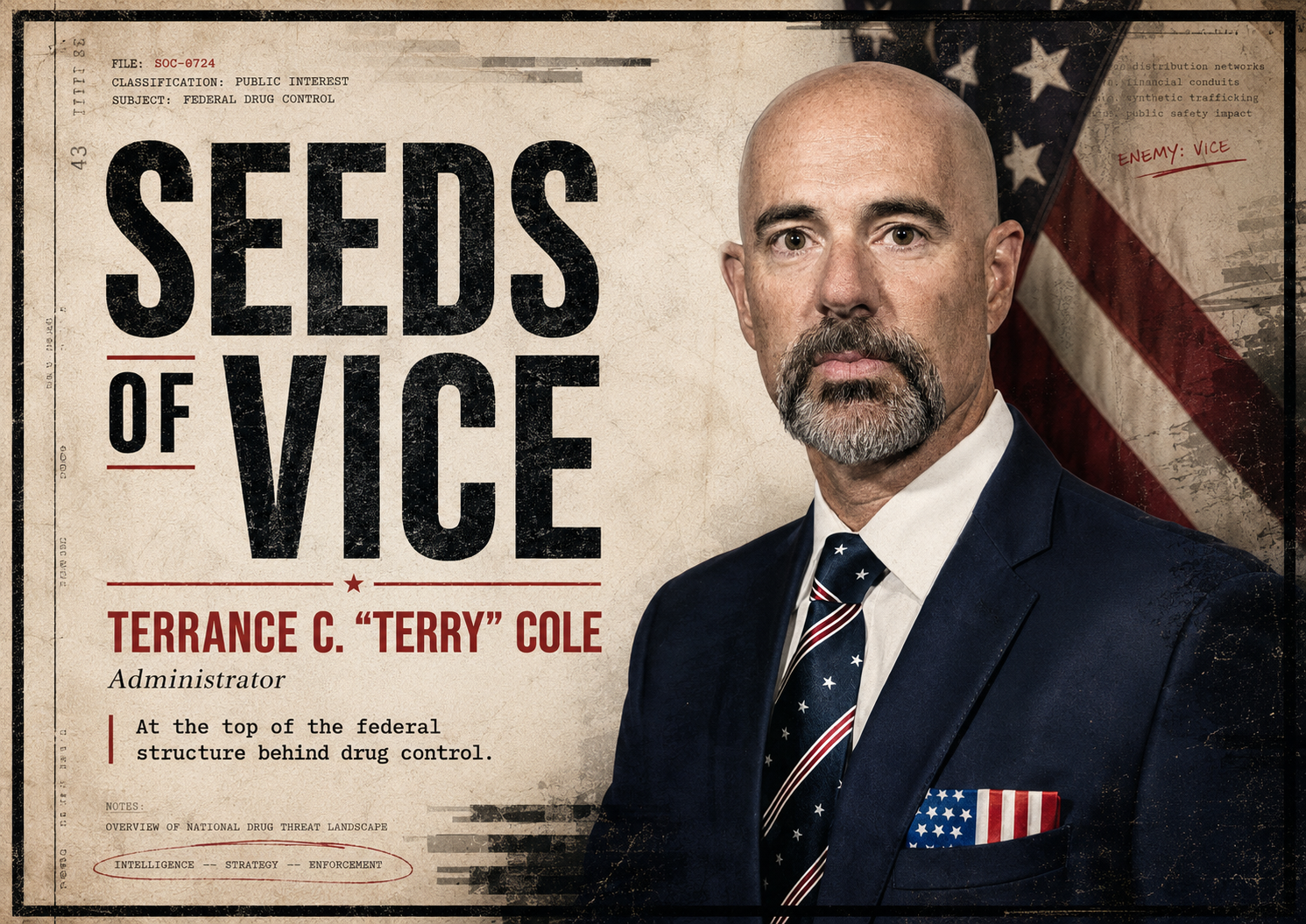
Terrance C. “Terry” Cole: Enforcement at the Top of Lawful Medicine
Official Role
Terrance C. “Terry” Cole is the Administrator of the U.S. Drug Enforcement Administration. That places him at the top of DEA’s national command structure. He does not sit over one limited office. He sits above the agency’s enforcement, intelligence, diversion control, and public outreach missions.
That matters.
The DEA is often understood by the public as a street drug agency. Cartels. Seizures. Fentanyl. Foreign supply chains. Raids. Task forces. Arrests. But the DEA is also the federal agency that reaches into the lawful controlled medicine system. It registers doctors, pharmacies, manufacturers, distributors, researchers, importers, exporters, hospitals, clinics, and treatment programs. It oversees the controlled substances that still exist inside medicine.
So when Terrance Cole becomes DEA Administrator, he becomes more than the public face of cartel enforcement. He becomes the top federal official over an agency that helps decide how controlled medicine is watched, feared, supplied, restricted, investigated, and regulated.
Cole is not just at the top of drug enforcement. He is at the top of lawful medicine enforcement.
What The DEA Says
The DEA presents Terrance C. Cole as a veteran law enforcement leader with more than thirty one years of public service. According to the official biography provided, he was sworn in as DEA Administrator on July 23, 2025, after confirmation by the United States Senate.
DEA describes him as a man with deep operational experience and a lifelong commitment to public safety. He began his DEA career as a Special Agent and rose through the agency over more than two decades. His assignments included Oklahoma, New York, Dallas, Washington, D.C., the Special Operations Division, the National Security Council, Colombia, and Afghanistan.
At the time of his retirement from federal service in 2020, Cole was serving as DEA’s Acting Regional Director for Mexico, Canada, and Central America. Before joining the DEA, he was a certified police officer in New York.
From 2023 to 2025, he served as Virginia’s Secretary of Public Safety and Homeland Security in Governor Glenn Youngkin’s cabinet. In that role, he oversaw eleven state public safety agencies, more than 19,000 employees, and a $5.7 billion annual budget. The DEA’s also credits Virginia with a 59.1 percent reduction in overdose deaths during his leadership, calling it the largest year over year decrease nationwide.
The official biography also points to his education. Cole graduated from Rochester Institute of Technology with a degree in Criminal Justice. He holds leadership certificates from the University of Virginia and the University of Notre Dame Mendoza School of Business. He has also pursued continuing education at MIT Sloan Executive School for Artificial Intelligence and Machine Learning.
The DEA’s closing language is the real signal. It says Cole is leading DEA into “a new era of global enforcement,” defined by “speed, strength, and an unrelenting commitment to saving lives.”
That is the public story.
A veteran agent. A global operator. A homeland security executive. A cartel fighter. A modern enforcement administrator. A man brought in for the synthetic drug age.
Connection to Diversion Control
Cole’s official biography emphasizes cartels, synthetic drugs, chemical supply chains, illicit finance, cryptocurrency, violence, global enforcement, and international partnerships.
That language is intentional. It is how the DEA frames itself to the public.
But the Administrator’s authority does not stop at cartel enforcement. The DEA Administrator also oversees Diversion Control.
That is why he matters to us.
Diversion Control is the side of DEA that governs lawful controlled substances. It is not just about illegal street narcotics. It is about the legal medicine pipeline. It reaches into production quotas, registration, compliance, inspections, recordkeeping, suspicious orders, pharmacy access, distributor conduct, manufacturer limits, prescribing fear, medical investigations, administrative actions, and the pressure felt by doctors and patients long before any criminal case exists.
When the DEA says it is recommitting to enforcement, the question is not only what happens to cartels. The question is what happens to lawful medicine under the same command culture.
A doctor does not have to be convicted of anything to be afraid. A pharmacist does not have to be charged with anything to hesitate. A distributor does not have to be publicly named to reduce supply. A manufacturer does not have to be raided to live under quota pressure. We do not have to be accused of wrongdoing to be denied medication.
That is the power of Diversion Control.
It operates in the space between medicine and enforcement. It turns registration into leverage where pain can be used to force us to sign our rights away in exchange for care. It turns paperwork into exposure, professional judgment into risk, pain care into public-private prohibition.
As Administrator, Cole sits above all of it.
So the connection to Diversion Control is not symbolic. It is structural. His office is the office over the office that governs controlled medicine.
Seeds of Vice Analysis
Terrance C. Cole’s biography reads like a command résumé for the modern drug war. Police officer. DEA Special Agent. Domestic field assignments. International work. Special Operations Division. National Security Council. Colombia. Afghanistan. Regional command involving Mexico, Canada, and Central America. State homeland security. Artificial intelligence and machine learning education.
That is not a random career path. It is the path of enforcement becoming global, technological, and administrative at the same time.
The DEA wants the public to see experience. I see continuity.
The old drug war was sold as a fight against traffickers. The new drug war is sold as a fight against synthetic drugs, chemical networks, digital money, global cartels, terrorism and death itself. That language has power because the overdose crisis is real. People are dying. Families are being destroyed. Communities are being hollowed out. No honest person should pretend otherwise.
But the overdose crisis has also given federal enforcement a renewed moral mandate.
That is where the pain crisis gets buried.
The state counts overdose deaths because overdose deaths are visible, political, and measurable. But the state rarely counts the pain patient abandoned after a pharmacy refusal. It rarely counts the disabled person forced into withdrawal because a doctor retired, closed, or stopped prescribing. It rarely counts the cancer survivor treated like a liability and the veteran who cannot get stable pain care because everyone in the supply chain is afraid of being the next person to lose everything they have ever worked for as well as their family and freedom.
That is the conflict.
The overdose crisis gives the DEA its public mandate. The pain crisis exposes the cost of that mandate when enforcement pressure reaches lawful medicine. It severely affects the standard of care nationwide to varying degrees of severity.
Cole’s biography presents enforcement as lifesaving. Enforcement saves lives… But when enforcement becomes the dominant language around medicine, care itself starts is changed. Doctors begin thinking like defendants who will be questioned. Pharmacists begin thinking like investigators who will be questioned… Distributors begin thinking like risk managers. Patients begin thinking like suspects… At least until they start acting like them because they need medicine and they are being treated like criminals anyway.
That is not medicine. That is a prohibited existence that is extremely bleak.
The artificial intelligence and machine learning detail also matters. It tells us where enforcement is going. The future of drug control will not only be agents and seizures. It will be data systems, pattern detection, transaction monitoring, predictive suspicion, risk scoring, pharmacy behavior analysis, prescribing analytics, and automated flags that may be difficult for ordinary people to understand or challenge. Think Facebook Jail for medicine.
A person in pain may never meet the Administrator, a Diversion official, or see the database, the quota model, the suspicious order threshold, the corporate policy, or the compliance memo, or the doctor’s notes. But they will feel the result at the counter.
That is how modern power works.
It does not always knock on the door. Sometimes it changes the rules above you until the answer below you becomes no.
Why His Role Matters to Us
This role matters to us because the Administrator sits at the top of the federal agency that controls the boundary between prohibited drugs and lawful medicine.
That boundary is not theoretical. It is where people live.
It is the pain patient trying to fill a prescription, the doctor deciding whether compassion is worth personal risks. It is the pharmacist deciding whether filling a lawful prescription creates too much uncertainty, the distributor deciding whether a pharmacy looks suspicious, the manufacturer working under quota limits. It is the researcher asking please, and the citizen trying to understand why a medicine can be legal, prescribed, needed, and still nearly impossible to obtain in quantities that restores function. The Medicine is there… We cannot live without it… It is his job to ensure everything they do does not result in our loss of function due to the lack of medicine.
I am not interested in pretending this is only about one man. This is not about private character. It is about public authority, the office, the command structure, and the reach of federal medicine control.
Terrance Cole matters because he stands at the top of an agency that speaks in the language of rescue while governing systems of restriction. The DEA says it is saving lives. Seeds of Vice asks which lives are seen, which suffering is counted, and which people should be allowed to disappear behind the phrase “public safety.” if any.
The history of government control over medicine is not clean. It is full of moral certainty, emergency language, professional fear, paperwork, licensing power, and citizens told that their own suffering must be managed through distant authority. Again and again, medicine becomes the place where the agency habitually claims protection but delivers control.
That is why I wrote this.
Not to chase followers or feed gossip. Nor to pretend a biography tells the whole truth of a person.
It exists because the office matters.
At the top of DEA sits the power to frame enforcement as care, surveillance as safety, restriction as responsibility, and control as compassion. For us, that is the history worth remembering. Medicine does not become free simply because it is legal. Medicine is only free when the people who need it can reach it without being crushed between fear, policy, and the law.

Bestsellers
-

A gift of Luck
-

Proof of Progress: Mr. DEA’s Diversion Autographed Hardcover & Seed Pack
$39.99 -

Seeds of Vice ™
$24.99 -

Seeds of Vice Book Set
$119.00 -
Seeds of Vice: On Poppy Tea Autographed Hardcover & Seed Pack
Original price was: $39.99.$29.99Current price is: $29.99. -

Seeds of Vice: On The Poppy Plant Autographed Hardcover & Seed Pack
$55.00
