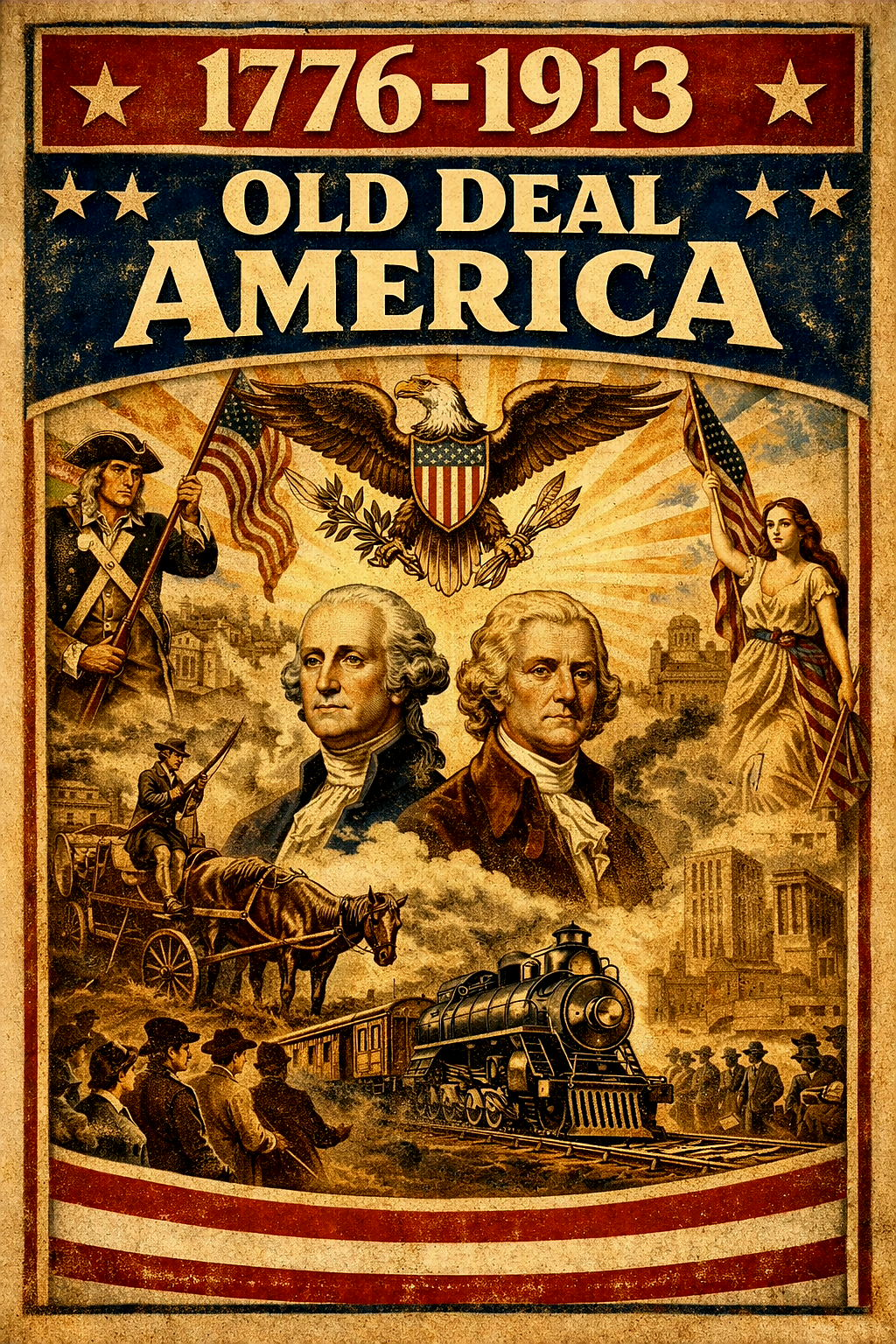
Old Deal America
Old Deal America (1776–1913)
The World Before We Forgot What We Had
For most of its early life, the United States was not governed the way it is now. This is not an opinion, and it is not nostalgia. It is a description of structure, habit, and expectation. From the end of the American Revolution through the opening years of the twentieth century, Americans lived inside a system that assumed something modern life does not: that the individual bore responsibility for his own security, prosperity, and happiness, and that society itself depended on that assumption remaining true.
Old Deal America was not a Utopia. It was often harsh, physically demanding, and unforgiving. But it was intelligible. Cause and effect were visible. Failure was personal. Success was local. And responsibility was not delegated upward to distant institutions and agencies; it was lived daily in families, churches, trades, and communities spread across a vast and growing land.
To understand what is happening now, it is necessary to understand our past and what was quietly set aside to be forgotten.
A Nation Built in Communities, Not Systems
Old Deal America was not organized around programs. It was organized around places. Towns, parishes, counties, and regions formed the real geography of American life. People lived among those who knew their names, their work, their reputations, and their habits. This closeness was not sentimental; it was functional.
Local trades and small businesses formed the backbone of economic life. The blacksmith, the carpenter, the miller, the shopkeeper, the farmer… these were not abstract “sectors” but visible men whose skill and reliability mattered. Work had a face. A man’s livelihood depended not on credentials or distant approval but on whether his work held up, whether his word was trusted, and whether he showed up when expected.
Churches, not government offices, were the primary institutions of social cohesion. They were not merely spiritual centers but civic ones. They organized aid, enforced moral norms, mediated disputes, and anchored families across generations. Membership implied duty, not entitlement. Help was available, but it was relational, not anonymous.
Communities enforced expectations socially long before law intervened. Order did not require constant policing because reputation mattered. To be known as dishonest, lazy, or unreliable carried real consequences. To be known as capable and trustworthy carried real opportunity. This was not cruelty; it was feedback.
The world did not meet anyone halfway. And because it did not, relationships with those nearby were of utmost importance.
Responsibility as the Condition of Freedom
Freedom in Old Deal America did not mean insulation from hardship. It meant ownership of one’s person, one’s time, one’s labor, and what that labor produced. A worker owned himself first. He decided where to go, what to do, whom to work for, and when to leave. There were risks in this freedom, but they were understood risks.
To be free was to be responsible, and to be irresponsible was, quite often, to fail. This was not ideological; it was practical. Prudence paid because imprudence carried immediate costs. In frontier regions and small towns alike, survival itself depended on foresight, restraint, and competence. The ethic was simple and widely shared: no one owed you a living, but no one was meant to be abandoned either… provided you had first shown yourself willing to carry your share. Key word being willing.
Security was personal before it was institutional. Families were expected to care for their own. Communities were expected to step in when misfortune struck. Churches and fraternal organizations filled gaps. These arrangements were imperfect, but they were adaptive and grounded in knowledge of real circumstances. Aid came with accountability because it came from people who knew you.
Law existed, but it did not hover over daily life. Its role was largely to set boundaries, protect property, and resolve disputes after harm occurred. Possession was often said to be nine-tenths of the law… not as a slogan, but as an observation about how order actually functioned. Courts dealt primarily with damages and ownership. Criminal law was present, but sparse by modern standards. Life was governed more by custom and consequence than by regulation.
Government, especially federal government, felt distant. Outside of war, tariffs, and postal service, it was largely invisible to ordinary Americans. Local sheriffs, judges, and clerks were known by name. Authority was personal and limited. The idea that a centralized apparatus would manage daily economic or social behavior would have seemed foreign.
Hard Lives, Clear Rules
It is important not to soften the reality of this world. Life was harder physically. Illness, injury, and death were closer. There were no guarantees against misfortune. Mistakes could be permanent. But these hardships existed within a framework people understood.
Economic mobility existed, but it carried weight. Failure mattered. Success required discipline. Markets were freer, but consequences were real. There was no expectation that losses would be socialized or erased. Risk belonged to those who took it.
This clarity shaped character. People planned carefully because planning mattered. They saved because savings protected them. They avoided unnecessary debt because debt carried danger. Credit existed, but it was personal and limited. A man borrowed from someone who knew him, not from a system that did not…
And for most of this period, Americans expected the future to look familiar. Harder work, perhaps. Greater opportunity, perhaps. A growing nation, certainly. But not a transformation of the basic relationship between the individual and authority. America would grow without changing its character… or so they believed.
The Confidence That Preceded the Fall
By the early twentieth century, something subtle but decisive began to change… not in law at first, but in attitude.
Old Deal America had succeeded. The nation had expanded across a continent. Industry had grown. Wealth had accumulated. Innovation accelerated. For the first time, Americans began to experience not just survival and growth, but confidence bordering on certainty.
By 1910, many Americans no longer feared the future. They assumed continuity. They assumed stability. They assumed the system could absorb risk indefinitely.
This confidence expressed itself economically. People began buying and selling debt not merely as necessity but as opportunity. Credit expanded beyond personal knowledge. Financial instruments grew more abstract. Speculation became fashionable. The stock market was no longer simply a place to invest in production, but a place to gamble on perpetual ascent.
This was not confined to financiers. It was cultural. Ordinary citizens participated. The belief took hold that loss was unlikely, perhaps even obsolete. Progress had become self-justifying.
The Titanic was built and launched in this same period in history. It was a triumph of engineering, wealth, and ambition… and a symbol of something deeper. It was not foolish to build it. What was reckless was the confidence that it could not fail. Safety was subordinated to speed and prestige. Warnings were discounted. Redundancy was trimmed. Prudence was set aside. This attitude was indicative of the time.
When the ship sank, it shocked the world not merely because of the loss of life, but because it shattered an assumption: that modern systems had transcended old limits…
A People Unaware They Were About to Be Helped
Standing in 1913, Americans did not believe they were living at the end of an era. They believed they were living in the fullness of one. They trusted their institutions because those institutions had grown out of their communities, not over them. They trusted the future because the past had rewarded their effort.
They did not anticipate that emergencies… financial panic, war, instability… would soon be used to justify permanent structural change. They did not imagine that responsibility would be transferred upward, that risk would be redistributed, or that authority would be centralized in ways that could not be reversed.
They believed, sincerely, that they were free because they were responsible and that this relationship was permanent.
They were wrong.
Old Deal America did not collapse because it was weak. It gave way because it was confident enough to gamble with what it had inherited. In setting aside prudence, it opened the door to a different arrangement… one that promised stability without personal cost, security without ownership, and progress without restraint.
The people living in that moment could not see what was to follow… But they had built the world that made it possible.
And that is where the next story begins.

Leave a Reply