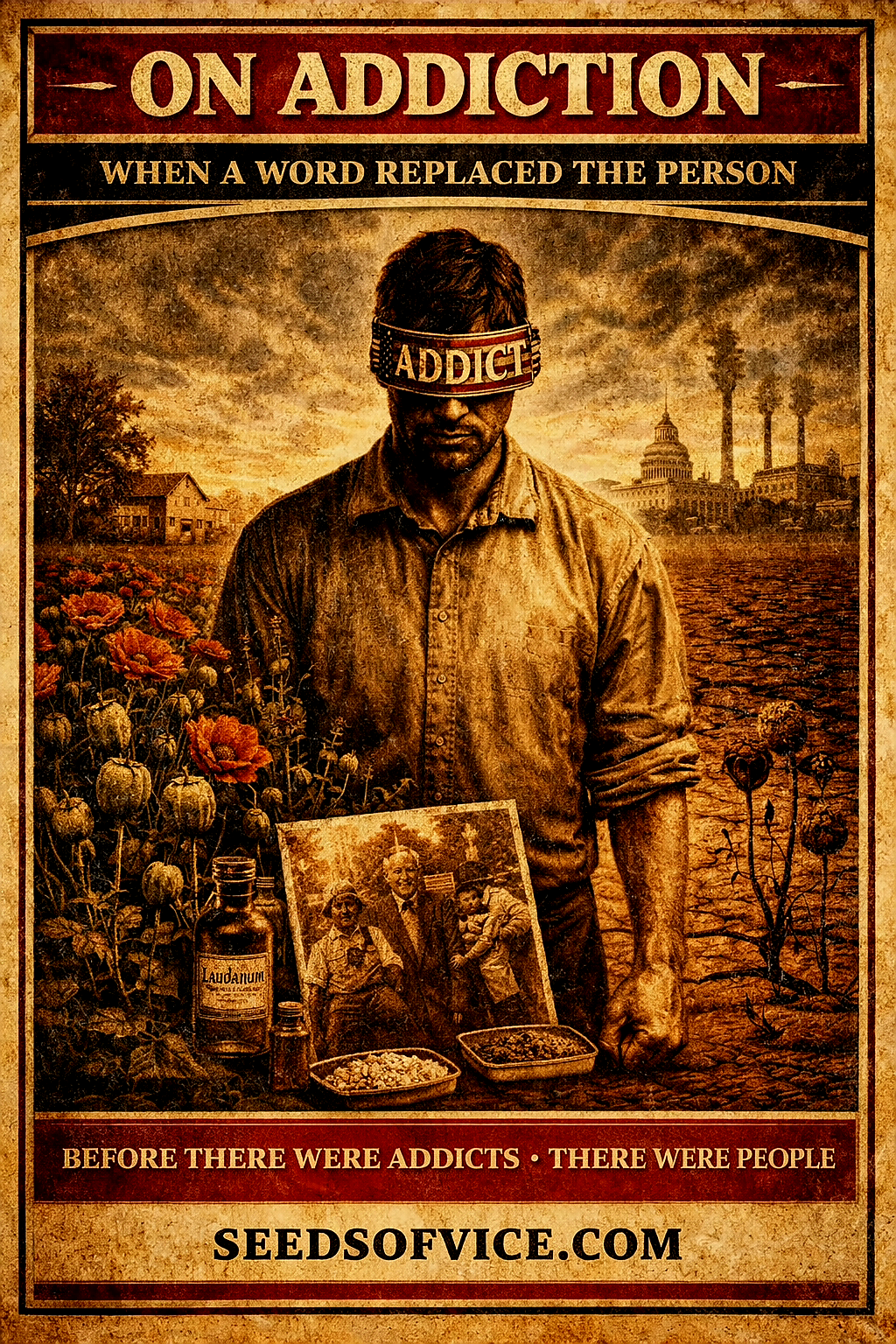
On Addiction
When a Word Replaced the Person
Before there were addicts, there were people.
And before there were people, there were plants.
There was no evil there.
Plants were never the problem.
Plants are a blessing.
They grow everywhere a prayer is whispered.
What man chooses to do with them is where miracles become medicine… or poison.
In the United States, the real poison was never the plants though.
In America the real poison is the story told about the people who use them.
Addiction Is a Modern Word
The word addict is not ancient.
It is not medical in origin.
It is not biblical nor scientific…
It is administrative.
In the late 1800s, nobody was called an addict.
There were:
patients
neighbors
workers
mothers
veterans
sick people trying to survive their own bodies
If someone used opium, morphine, laudanum, or cocaine, the language was simple and human:
a person with a habit…
someone living with chronic pain…
a person whose nerves were shot…
a veteran wounded by war… .
It was not a moral issue.
It was not a criminal issue.
It was medical and because it was medical, the government had no place in it. They had to mind their business. Supreme Court ensured it… under the old deal.
That was a problem.
When Medicine Became Worth Controlling
By the late 1800s and early 1900s, America was full of remedies.
Poppy tinctures.
Cocaine drops.
Morphine tablets.
Heroin cough syrups.
Entire catalog pages read like pharmacies.
People were treating themselves.
Doctors were independent.
Medicine belonged to households, not institutions.
This kind of population is difficult to govern.
A self-reliant people do not ask permission.
A self-medicating people do not surrender sovereignty easily.
So a crisis was manufactured to justify a solution. Morphinism.
The Birth of the “Addict”
Between 1910 and 1920, the label appeared exactly when it was needed.
The federal government required:
a reason to register doctors
a reason to track medicines
a reason to criminalize ordinary sick people
a reason to nationalize the medical supply chain
The Harrison Act of 1914 was presented as a tax.
In reality, it was a registry… a surveillance system.
You cannot control people without controlling medicine.
You cannot control people’s medicine without a label.
So the propagandists of the time jumped too and one was created.
Enter the addict.
From that moment on:
A patient became a problem… dependence became suspicion...
pain became liability…
healing became permission…
Medicine stopped belonging to people
and began belonging to the state. The government had began to pursue individuals health for them without their consent. Seeking collective solutions only finding round holes for square peg.
It was a modern time though. Governments didn’t make mistakes. If there was a mistake it was the citizen.
Dependence & Tolerance are Not Moral Failures Dependence & Tolerance are biology.
When the body adapts to something that works, it adapts.
Withdrawal is natural.
Predictable.
Expected.
It is not sin.
It is not weakness.
It is not shameful.
The crime was not dependence.
The crime was re-framing dependence as degeneracy.
Because if dependent people can be made to look dangerous,
then society will surrender their own rights willingly in the name of safety.
That was the trade.
What the Label Is Really For
The word addict does not describe a person.
It controls a population.
It works as a threat:
“Comply.
Don’t question us.
You’re not an addict… are you?”
Call someone an addict and they lose:
their credibility…
their legal protection…
their moral standing…
Everyone else watches and learns.
This is not punishment.
It is governance.
Addiction and Pain Are Not the Same Thing
Pain existed before addiction policy.
Healing existed before permission.
Most people labeled addicts today are not outwardly harmful.
They are people in pain navigating a system that no longer allows self-direction.
This is why On Pain comes before this page.
Pain is the condition.
Addiction is the accusation.
Self ownership and self medication go against the founding principles of the American revolution of 1937.
Self ownership is what they took from us.
Why This Page Exists
This page exists to remove the label before it lands.
To remind people that:
their pursuing relief ungoverned is not a crime against nature or natures God. If anything… it was how we were designed to be. Ultimately responsible for everything ourselves.
using plants is not evil it’s a divine act that connects us and our health to the creator of all things.
Dependence does not erase individuality nor invalidate ones right of Self ownership. The Universal Right of the Harmless to Not be Harmed.
A government that punishes the sick will eventually punish those who are not.
And the greatest lie told in modern America is that you do not have the right to heal yourself.
You do.
You always have.
Where This Leads
If you understand this page,
the plant pages will make sense.
Cannabis.
Poppy. Coca.
Gardening.
Not as vices
but as tools that existed long before the word addict was invented to take them away.
Why Addiction Is Not a Disease
Calling addiction a disease was never about healing people.
It was about moving authority by shifting perspective and redistributing responsibility to the government.
A disease is something that happens to you.
Something you do not choose.
Something that removes responsibility and transfers control to an institution.
Pain can be a disease.
Injury can be a disease.
Cancer can be a disease.
Choice is not a disease.
Suffering is not a disease.
Dependence is not a disease.
Using a tool repeatedly because it works is not a disease.
To call addiction a disease is to say:
“I am broken therefore I must be managed.”
That belief does not restore dignity.
It revokes sovereignty of not just yourself but others.
Disease Language Changes Jurisdiction
Once something is labeled a disease, three things happen immediately:
1. The individual loses authority over themselves
2. The institution gains authority over the individual
3. Consent becomes conditional
This is why addiction had to be reclassified.
If addiction were merely behavior, the government would have no role.
If addiction were merely dependence, the solution would be information and choice.
If addiction were merely suffering, the answer would be compassion.
But if addiction is a disease, then:
doctors become gatekeepers
bureaucrats become protectors
citizens become patients
And patients do not have rights they have compliance plans and privileges that can be revoked as a means of forcing compliance.
Dependence Is Not Pathology
Human beings depend on many things to function:
insulin
antidepressants
caffeine
pain relief
routine
sleep
Dependence simply means something works.
When a body adapts to a substance, that is biology not illness.
Withdrawal is not proof of disease.
It is proof of adaptation and is natural.
Calling adaptation a disorder is like calling hunger an eating disease.
It confuses people by design.
The Disease Model Serves the State, Not you.
The disease model of addiction does not exist to help the addicted.
It exists to reassure everyone else.
It tells society:
“These people aren’t like you”
“They are mentally ill, not sovereign”
“They must be managed for the public good”
This makes it easier to:
isolate them
monitor them
medicate them
punish them “for their own safety”
A harmless person becomes a permanent suspect.
That violates the most basic moral line:
You do not get to harm a harmless person to make yourself feel safe or for your or their prosperity.
Pain Explains Most “Addiction”
Most people labeled addicts are not chasing pleasure.
They are fleeing suffering. Not hurting is addictive. People can’t get enough of it.
Pain precedes addiction far more often than addiction precedes pain.
To ignore pain and diagnose addiction is to:
treat the symptom as the crime…
blame the coping mechanism…
excuse the system that caused the suffering…
If you remove pain from the conversation,
“addiction” becomes a moral fiction instead of a human story.
Responsibility Requires Freedom & Freedom Requires Responsibility
A core lie of the disease model is that it removes shame.
It does not.
It removes agency.
A person cannot be responsible if they are declared powerless.
A person cannot recover ownership of oneself if they are told they never had a right to self medicate.
Your belief… and mine… is different:
A man may suffer deeply without losing his moral standing.
Choice does not disappear because it is difficult.
Responsibility does not disappear because pain is involved.
We are made in God’s image.
That includes the ability to choose… even badly.. without forfeiting humanity or our Godliness.
What I Actually Believe
I do not believe addiction is a disease.
I believe:
pain is real
suffering distorts behavior
dependence is biological
choice still exists
sovereignty matters
Healing does not come from labels.
It comes from truth, dignity, and agency.
A system that denies those things cannot heal anyone.
Why This Matters
If addiction is a disease, the state owns your body.
If addiction is behavior, the state has a responsibility to police you.
If addiction is suffering, the state must leave you alone unless you harm someone.
That distinction is everything.
Because once society accepts that self-medication is a disease,
it no longer has to justify harming the harmless.
And that is the line I refuse to cross.
This is next